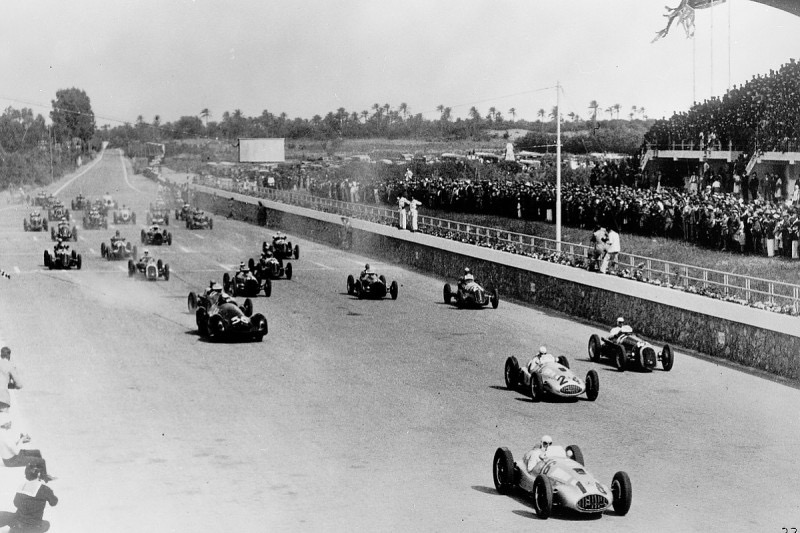
Lang makes a rocketing start and leads Caracciola and Farina whilst Villoresi’s streamliner falters. (Mercedes-Benz Classic)
Story by Robert Young
Photos courtesy Mercedes-Benz Classic
The race
The 30-lap race started in searing temperatures and one wonders how Luigi Villoresi was coping in the cramped confines of the streamliner’s cockpit. The track temperature was reported to be some 50 degrees and it was up to 40 degrees in the shade.
The race was to be started by ‘lights’ and by Marshall Balbo waving a flag, and this caused some confusion as the lights flashed before Balbo dropped the flag, and Lang, watching the lights, streaked away. For the Officine A. Maserati it was a disaster – Trossi’s car broke a piston and failed to complete a lap, the streamliner had a gearbox fault and Cortese retired on lap 4.
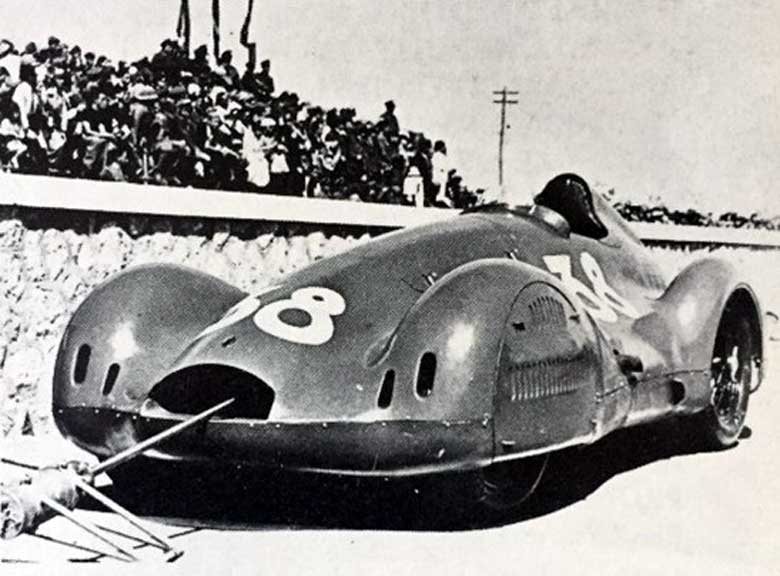
To the delight of the Italian fans the streamline Maserati was the pole sitter. But Luigi Villoresi’s race was shortlived as the streamline Maserati stuck in second gear and left a stream of oil. (Maserati Factory archives)
After the first lap the flying Lang was already way out in front. Farina ran second, followed by Caracciola, Aldrighetti, Biondetti, Emilio Villoresi, Severi, and Pintacuda but Farina had no chance of keeping up with Lang’s pace and was losing three to four seconds per lap while he had to concentrate on keeping Caracciola behind him instead.
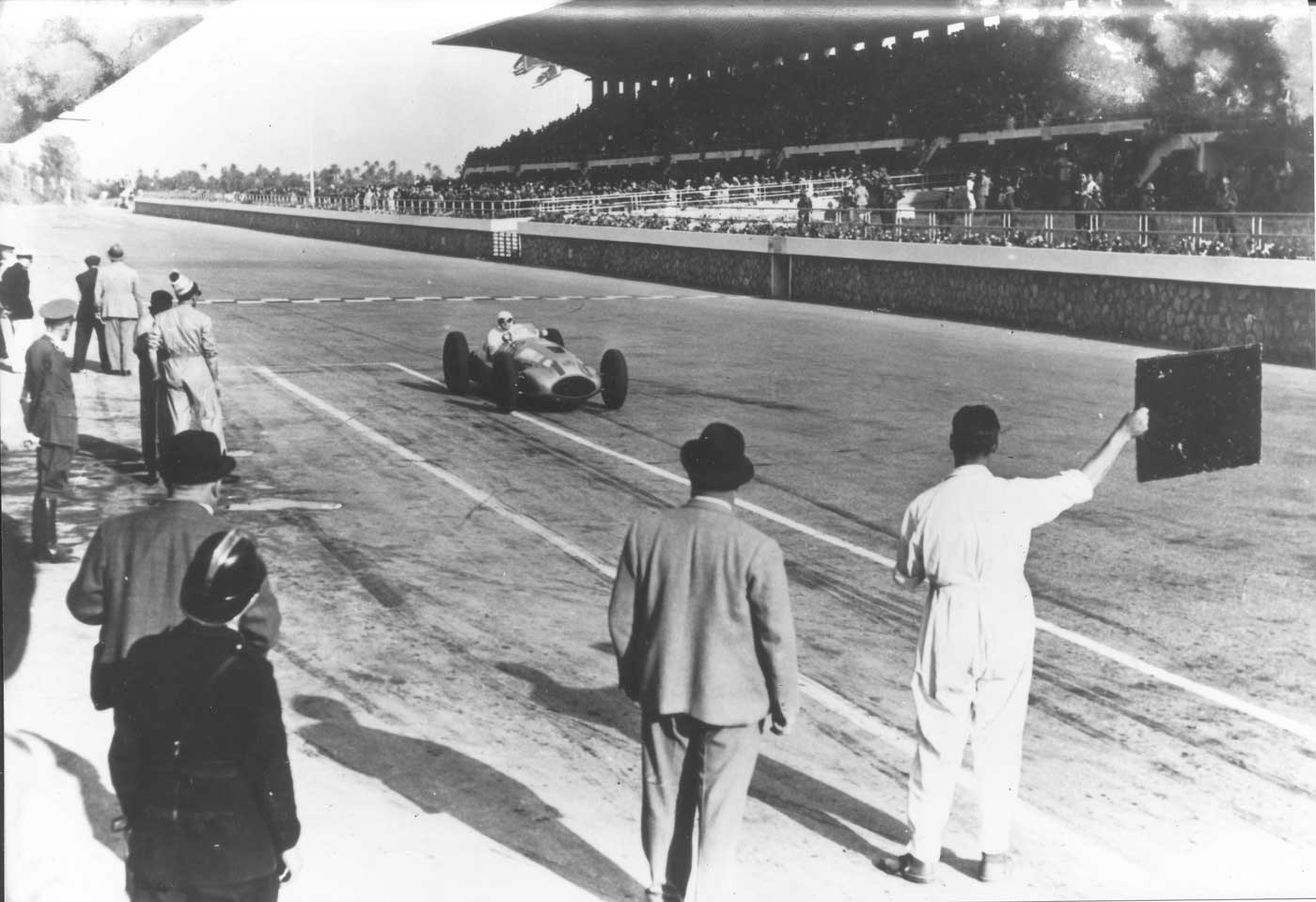
Lang speeds past the packed grandstands. (Mercedes-Benz Classic)
After five laps the field was spread out. Lang, lapping at speeds of 130 mph, was leading Farina by 21 seconds but Caracciola, lying third, had closed to within 5 seconds of the red Alfa and he was in turn nearly 50 seconds ahead of Biondetti’s Alfa Corse 158 that had been lapped by the leader.
By lap 7 the result was a foregone conclusion as Caracciola passed Farina and pulled away at 4 seconds a lap with the Mercedes team running “1-2” as the red cars began to drop out in mass. Lang went on to win at an average of 123 mph and finished almost a lap ahead of his team mate. His fastest lap was 131 mph.
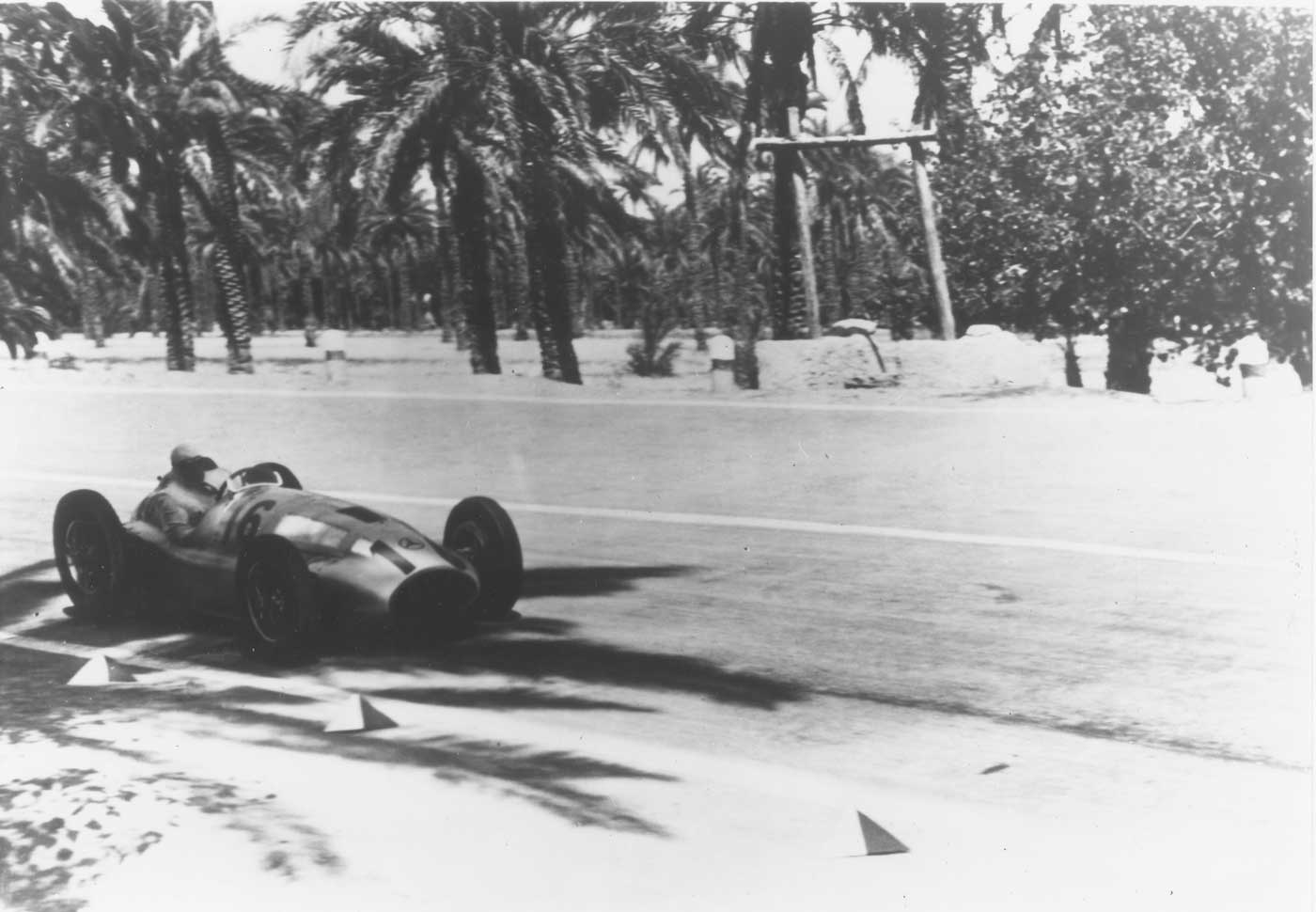
Surrounded by palm trees and concrete posts the high-speed circuit was not for the faint hearted. (Mercedes-Benz Classic)
Serious overheating maladies struck the Alfa Romeos. Vaporisation in the fuel lines was suggested as a likely cause. First to retire was Farina and he was soon to be followed by Aldrighetti. In a planning masterstroke, to cope with the heat in North Africa, the Mercedes designers had led the bevel driven Grätzin fuel pump to the carburettors thru a fin-and-core radiator.
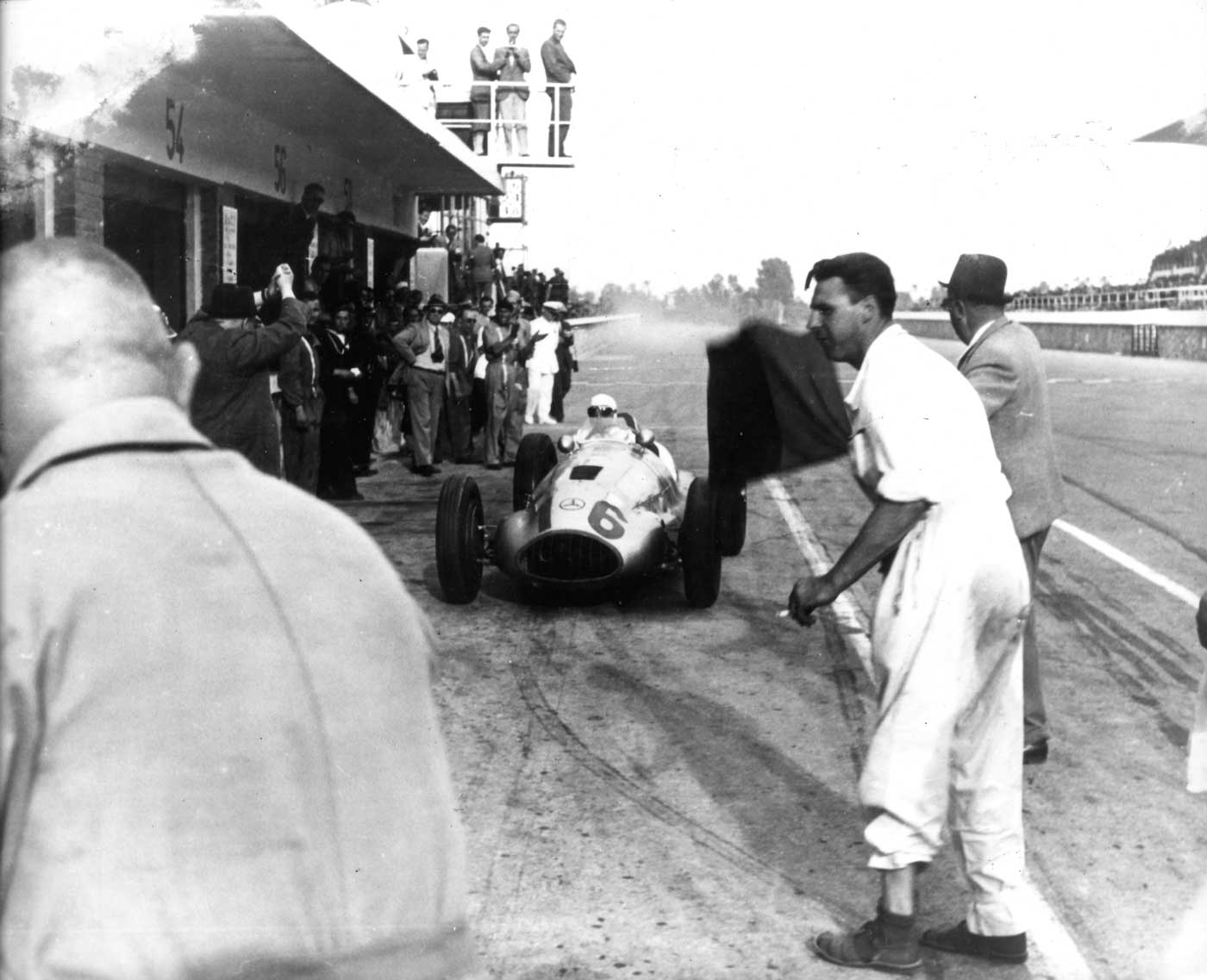
Lang stops for fuel as Neubauer brandishes his famous flag. The mechanic exhales after a puff from his cigarette. (Mercedes-Benz Classic)
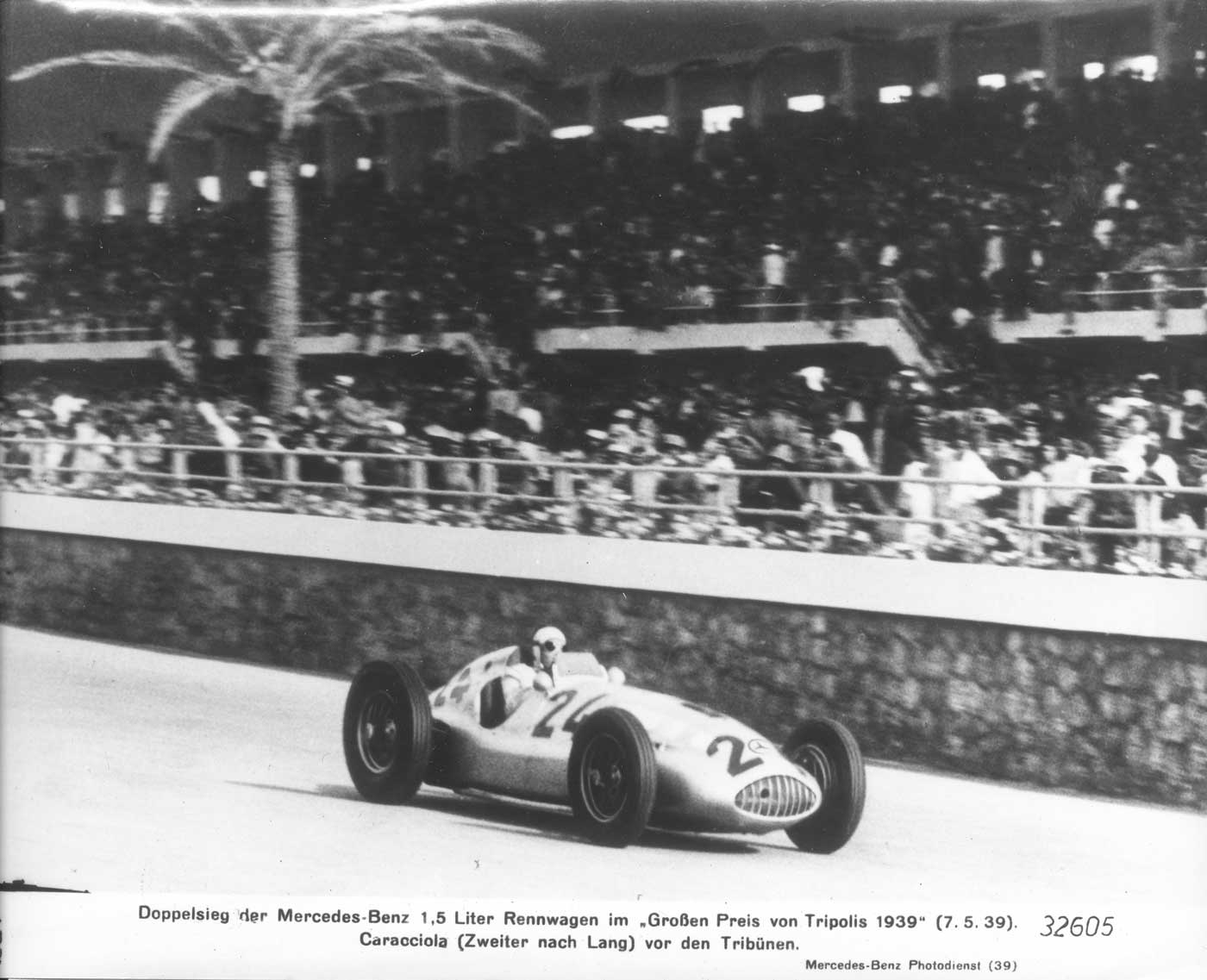
Caracciola speeds past the elegant grandstands. (Mercedes-Benz Classic)
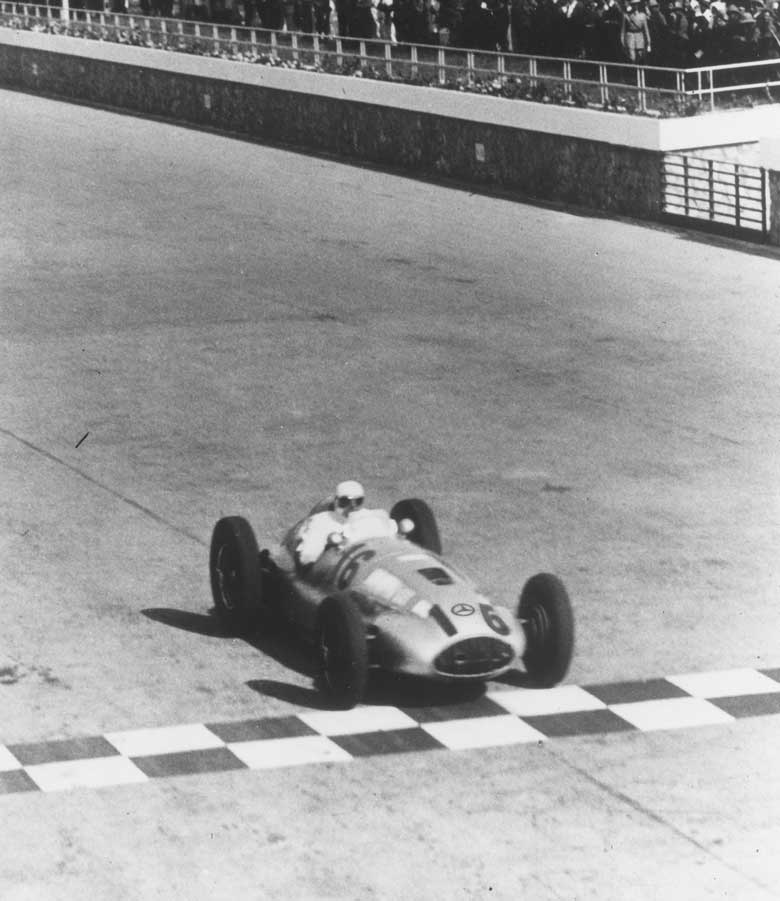
Lang streaks to victory. (Mercedes-Benz Classic)
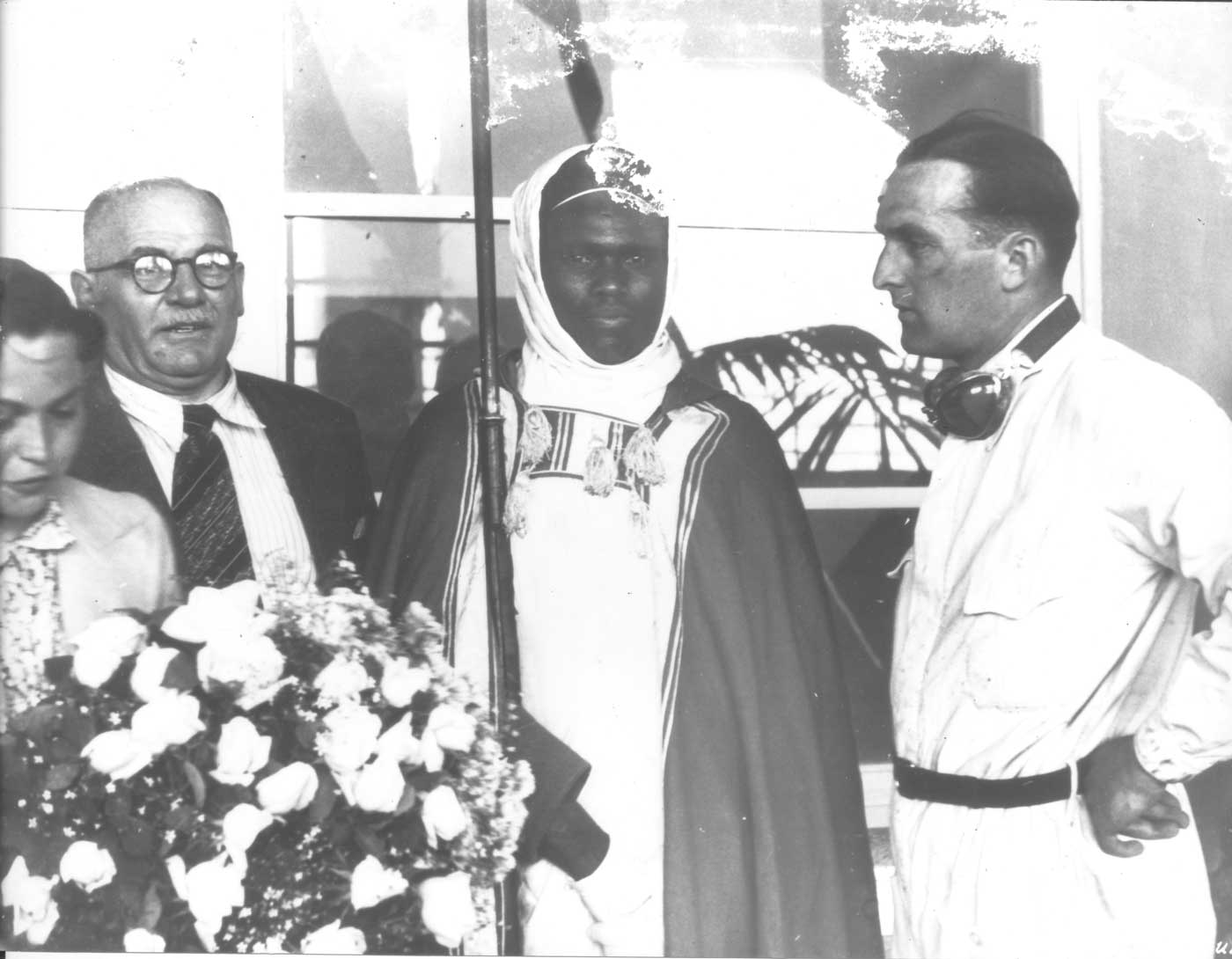
In 1939 Lang completed a hat-trick of wins at Tripoli. An approving Dr Sailer is on the left. (Mercedes-Benz Classic)
Piero Taruffi, in his book Works Driver, summed it up: “In 1939, still driving for Scuderia Ambrosiana, I revisited Tripoli. This time the race was being run as a 1500 event in the hope of breaking German supremacy; but at the last moment Mercedes-Benz entered two brand new cars whose existence had not even been suspected. The race was run in torrid conditions. The Alfa entries, with Farina as number one, retired with vapour locks in the fuel lines owing to the heat ……… I was fourth, driving my own Maserati. The Germans turned up with a formidable organisation. With only two cars to look after they had brought about forty mechanics and technicians plus numerous crates of spares.”
Mercedes planned another assault on Tripoli for 1940 with revised cars and even aerodynamic ideas but war clouds had been gathering, and with Nazi Germany invading Western Europe, there were no silver cars at Tripoli, and Giuseppe Farina led Biondetti and Trossi for a Alfa Romeo 1-2-3 victory.
Such was the progress in race technology that the superb Alfetta 158s averaged over 5 miles per hour faster than the W165s of the previous year and the race time was an incredible 5 minutes faster.
Aftermath
Caracciola, who had moved to Switzerland during hostilities, visited Daimler-Benz in 1941 to persuade Dr Kissel, the managing director, to supply him with the two cars so that he could resume racing as soon as the war was over. In 1945, just before the Nazis were defeated, the cars were shipped to Switzerland only to be confiscated by the customs, leading to a protracted legal case between “Caratch” and the Swiss authorities.
With WWII over Caracciola was invited by Tony Hulman to take part in the 1946 Indy ‘500’ using one of the W165s but it is believed that permission to ‘export’ the car was refused by one of the Allied powers because it was felt that a win by a German car would damage Allied prestige.
It is interesting to speculate the possibility of the W165 triumphing at the brickyard and, if so, what influence that may have had on future Indycar design. A comparison of race winning speeds (while it is accepted that the circuit layouts are different) between Indianapolis and the Tripoli circuit is set out below:

Nevertheless the 45-year-old Caracciola travelled to America for the race and was invited by Joel Thorne to drive his Thorne Engineering Special. Sadly, he crashed the car during a practice run and was badly injured. The cause of the accident has never been confirmed but one of the theories suggested that the driver was hit in the face by a bird.
Ironically, it was the English-born Californian, George Robson, in the other Joel Thorne car, who took the checkers at 114.8 mph. It was Robson’s first ever major win.
So, as it was, the ‘Mini-Mercs’ never raced again.
Leave a Reply