In a 2022 VeloceToday piece, Allen R. Kuhn described his life as a race photographer in Southern California and touched on his work taking PR shots of models for class assignments and later for sports car magazines. But we said, “Forget the girls, tell us how you became a race photographer,” we begged. But now, with all due respect for the models that grace this article, we allow Kuhn to focus on those memorable experiences. We apologize that in most cases the models’ full names are lost to the ages.
Photography and Captions by Allen R. Kuhn
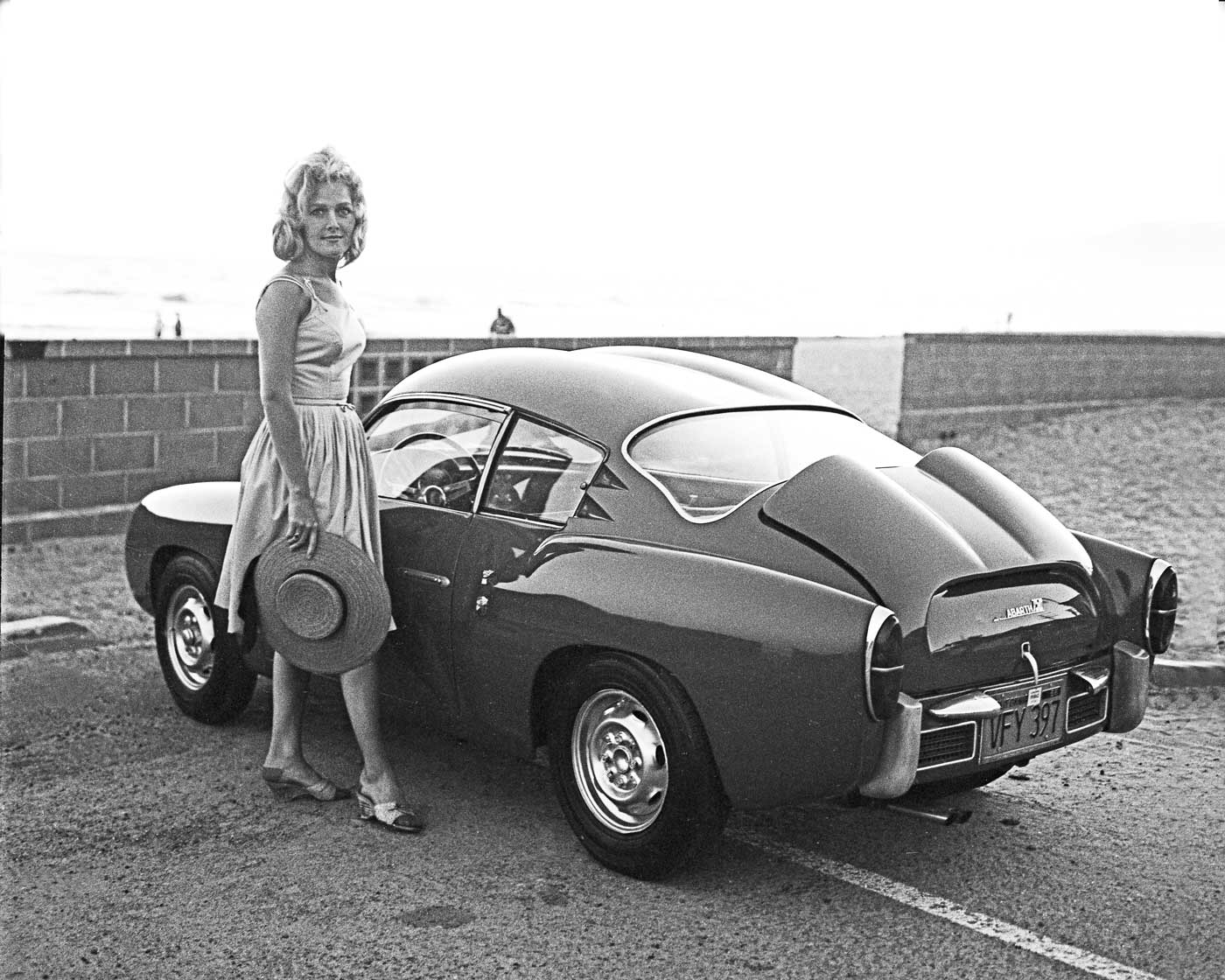
Your Editor thought we should start this controversial article with at least one car being in the picture. I am happy to say that the little beauty belonged to me. I speak of the Abarth, of course. The other beauty is Bridget, whose first words when she saw the Abarth were, “How the heck do you get into it?” The next was, “At least I can wash the top without getting a ladder.”
The late 1950s, Hollywood, California, aka La La Land
Welcome to a dream job in a dreamy capital of sun and stars. A budding race photographer drives about in an exotic Abarth 750 GT Zagato, attends a photography school and takes 8×10 shots of young models to be given to the studios. He’s the envy of all the boys, to paraphrase the Chiffons.
Becoming Bob Collins
In Cars and Dolls, Kuhn previously noted that he was also a fan of the TV sitcom “Love that Bob” or the “Bob Cummings Show, dating from 1956 to 1959. Kuhn lived and worked in L.A. a few miles from the studio at which the series was filmed. Recalls Kuhn, “I watched the show on TV, eager to let Cummings be my role model. This was either an impossible coincidence or serendipity. The Bob Cummings Show was about a good-looking photographer by the name of Bob Collins, living in L.A, who specialized in photographing beautiful women. Hey, I was in L.A., I was a photographer. Well, two out of three ain’t bad. We all wanted to be Bob. A student friend of mine actually thought he was Bob Collins.” Each week millions tuned in to watch as Bob’s attempts to woo his models are constantly foiled by his secretary Schultzy (Ann B. Davis) and his sister, played by Rosemary DeCamp.
Starving Artists and Models
Allen had some of the same experiences as Bob Collins when it came to scoring with his subject. “I did make acquaintances with some of the models we shot and had the courage to ask several for a date and to my surprise they accepted. I doubt the fact that I told them I would be happy to give them 8X10 prints for their portfolios had anything to do with it.”
In an episode of the Bob Cummings show, (see youtube above) Collins dates a model only to find out all she wants is a good meal. Allen found this to be true as well. “Funny how with most of them a date meant going to a scenic area and taking pictures, buying her dinner and not much else!”
A Focused Education
Not surprisingly, L.A. is home to a number of art, drama and photography schools, which support the TV and movie studios. This allowed Allen to obtain an education in photography after graduating from Inglewood High School in 1956. Remembers Allen, “Having been one of the ten finalists in the Kodak High School Nationwide Photo Contest, I just missed out on getting a full scholarship to Brooks Institute of Photography. It was the most prestigious school for photography in the country and the most expensive, too. I settled on the less expensive option, the Los Angeles Trade Technical Junior College.
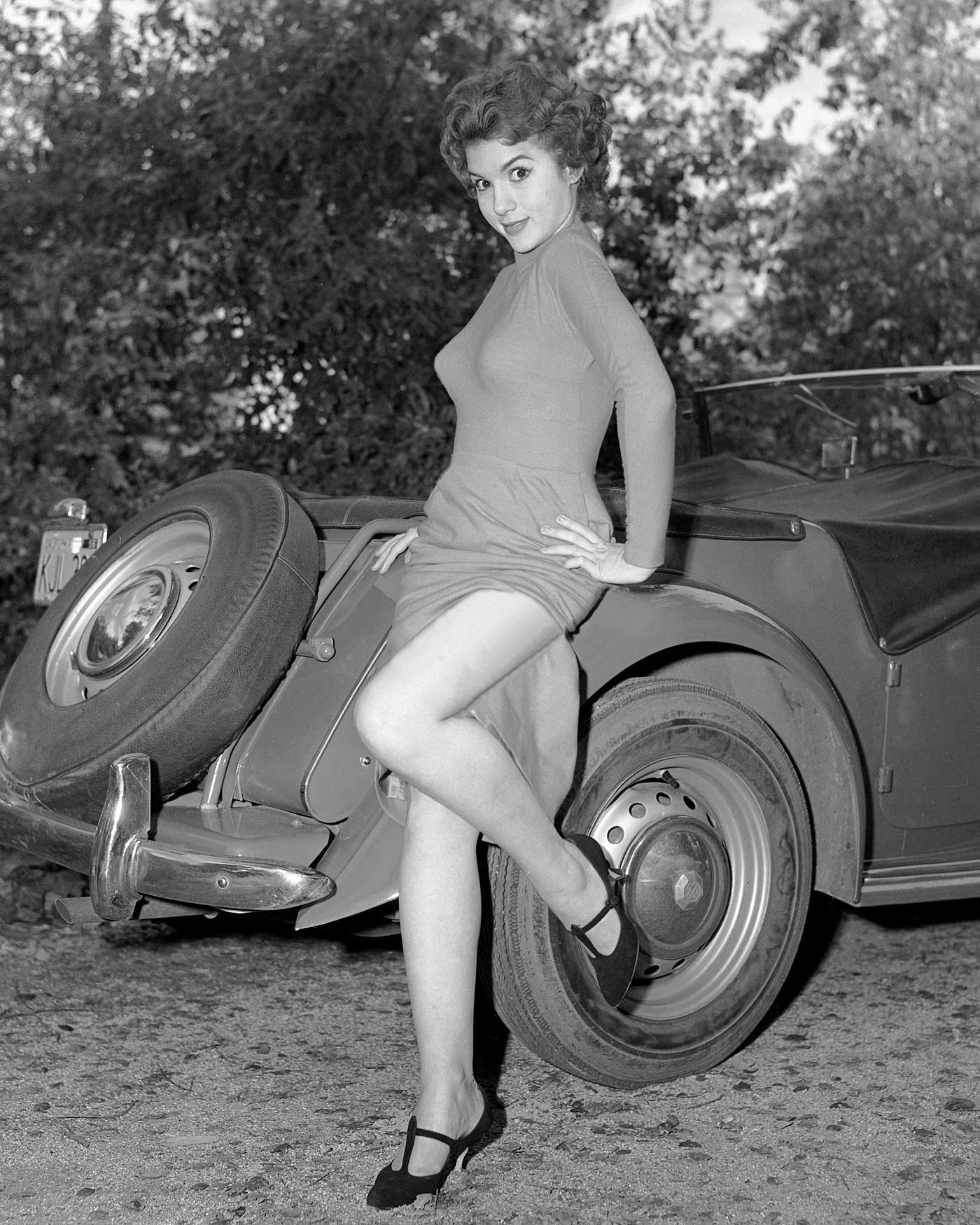
My 1952 MG-TD (which I owned prior to the Abarth) and Eva making the picture worthwhile. This was a field trip on our own to Occidental College here in the parking lot. Eva was one of the models that I also dated for a short time, that is until she had the required 8x10s for her portfolio. We did have plans to do a day trip to Pebble Beach for the 1956 road races. However, when I came to pick her up Miss Eva had come down with the flu. Not wanting to drive that distance by myself I thought well, I’ll just go next year instead. I’m sure most of you know that there was never another next year.
“With my trusty Canon IV S-2 and Rolleicord in hand, I entered the L.A.T.T. Junior college to become the next Bob Collins, Glamour Photographer. I noticed that the teacher had connections with the Hollywood Studio Club. It didn’t take long to realize I had picked the right class. Right from the beginning, we were off on field trips with the models in tow.”
The Hollywood Studio Club was a segregated living quarters strictly for budding actresses and female models. Ex-tenants who stayed there included Kim Novak, Barbara Eden, Dorothy Malone, Rita Moreno, Farrah Fawcett, and, of course, Marilyn Monroe. “But our teacher could not persuade any of them to pose for us.”
Speaking of Farrah Fawcett, there was one photographer from Allen’s class who made it big. A poster of Farrah in a red bathing suit sold over 12 million copies, a record at that time, taken by Bruce McBroom in 1976. “Unfortunately, my connection is with McBroom and not Farrah. We both went to L.A.T.T.J.C. at the same time but in different classes. He was fortunate enough to have the opportunity to take that photo of Farrah. Job well done! But how can you not take a great photograph of her. Sadly, he was on assignment and didn’t see a nickel from the sales!”
It was perhaps the peak of what we remember as the Pin Up craze. Pin-Ups first appeared during WW I, and became very popular during the mid 20th century showing beautiful women in provocative or flirtatious poses with very sexy garments. The photographs were to be pinned up on a wall. They gained popularity during WW II and the U.S. Government printed up five million copies of Betty Grable in a back shot with her looking over her shoulder at the camera. Pin Ups like Grable were also prominent on fighting aircraft and bombers.
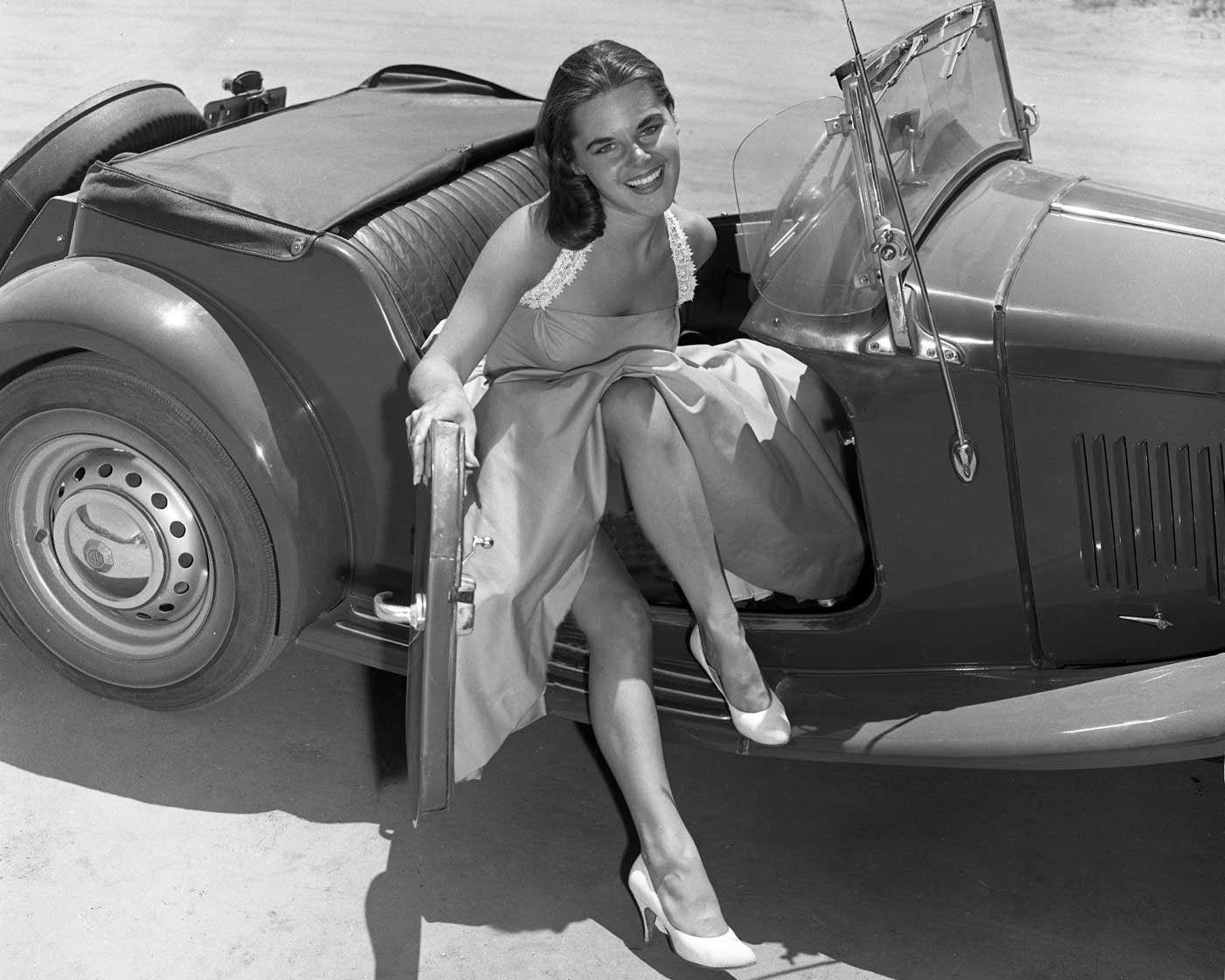
Allison did not know of what she had just done. Please notice her left foot planted firmly on the fender missing the running board area completely. This did not bode well for the finish.
“It seems that I hit the Pin Up era as it was slowly winding down,” recalled Allen. The appearance of Playboy in December of 1953 featuring a very nude Marylin Monroe was not good news for Pin Ups. Who needs pinups if one has Playboy? Ironically, it was a fellow Pin Up photographer by the name of Tom Kelly who took the photos of Monroe that precipitated the downfall of the genre.
Shooting with Harold Lloyd on his estate
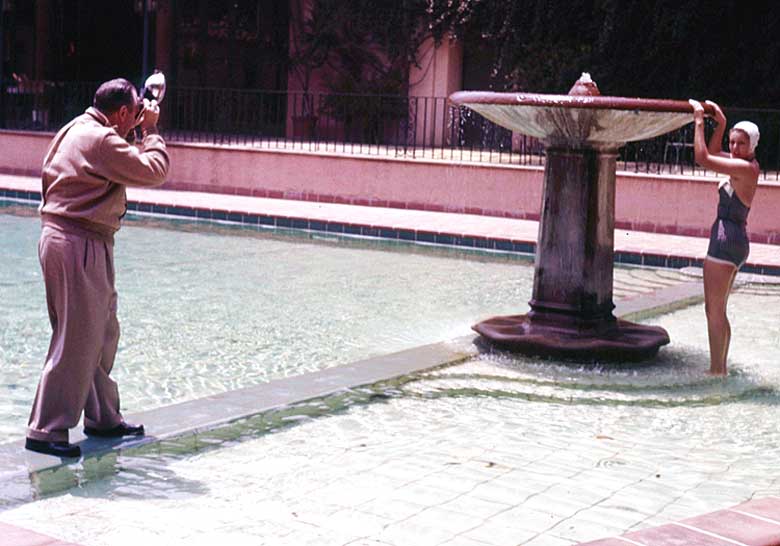
That’s Harold Lloyd, obviously at left, doing his own camera work.
Will those who have heard of Harold Lloyd please raise your mouse! ……(waiting)
Hmmm. Well how about those who remember seeing a silent movie star hanging for dear life on the hands of a huge clock?……..
Ok, we hit paydirt here. Lloyd was a contemporary of Buster Keaton and Charlie Chaplin. According to Wiki, Lloyd was one of the most influential film comedians of the silent era, Lloyd made nearly 200 comedy films, both silent and talkies, from 1914 to 1947. Just watch this youtube to be convinced.
Says Allen, “Being a photographer involved going to various locations around Los Angeles, including the Harold Lloyd Estate and Paradise Cove, with models furnished by the instructor. Lloyd’s mansion was called “Greenacres” located in the Benedict Canyon section of Beverly Hills and was the largest in Los Angeles and beyond. How big was it? Would you believe 45,000 square feet with 44 rooms sitting on a 15-acre hilltop of manicured landscaping. Of course, it had the obligatory tennis courts but also had its own golf course (only one), bridle path, a stone castle for his daughter.”
In October 1972, the Los Angeles Times visited the property and noted that it had “the feel of Sunset Boulevard.” A young writer (played by William Holden) visits Norma Desmond’s (played by Gloria Swanson) mansion off of Sunset Boulevard and notes that “It was the kind of place that crazy movie people built in the crazy 20s.” We shall not forget that a magnificent Isotta Fraschini had a lead role in that movie and actor William Holden was a prominent Ferrari owner (1954 Ferrari 375MM Spider).
The Girls of Paradise Cove
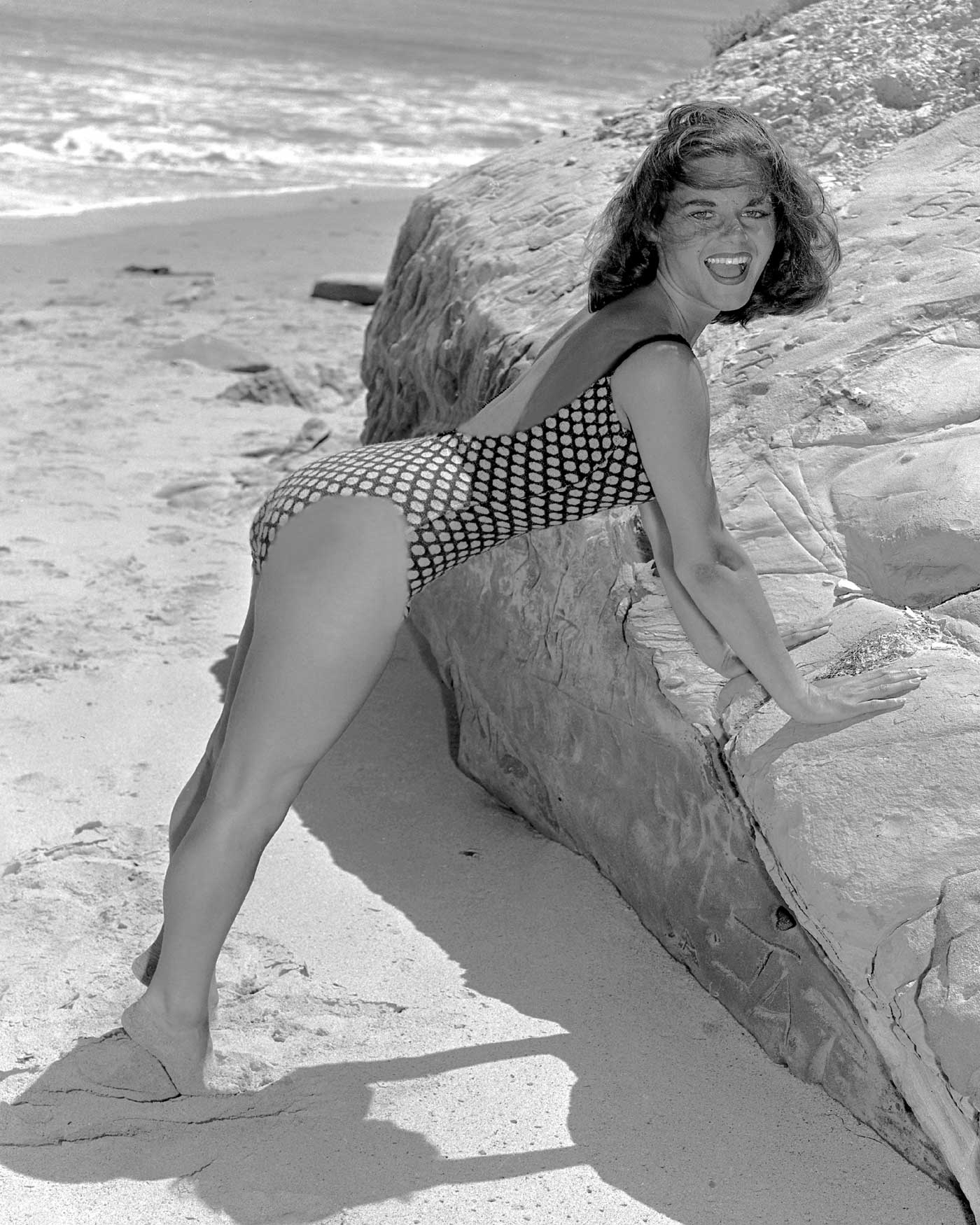
Perky Susan could put a smile on any man’s face. She was just so outgoing and so energetic that it was hard to keep up with her. I spent much time trying to capture that energy. She didn’t require any coaching from me to strike the perfect pose. She struck it here at Paradise Cove.
Paradise Cove was one of the students’ favorite places to shoot while at photo school. One reason is that there were plenty of places to photograph the lovely and willing models they brought along. Another was, that most were out of sight of the instructor. Allen recalls, “But then there was the ‘Incident.’ It seems that some of the photogs persuaded one of the models that it was such a warm day, and she was in shorts and a shirt, that she would be more comfortable without her top. But it seemed that there was a traitor in our midst who went and found the instructor. And after that ‘Incident,’ no more topless shoots at school events. Oh days of blissful innocence.”
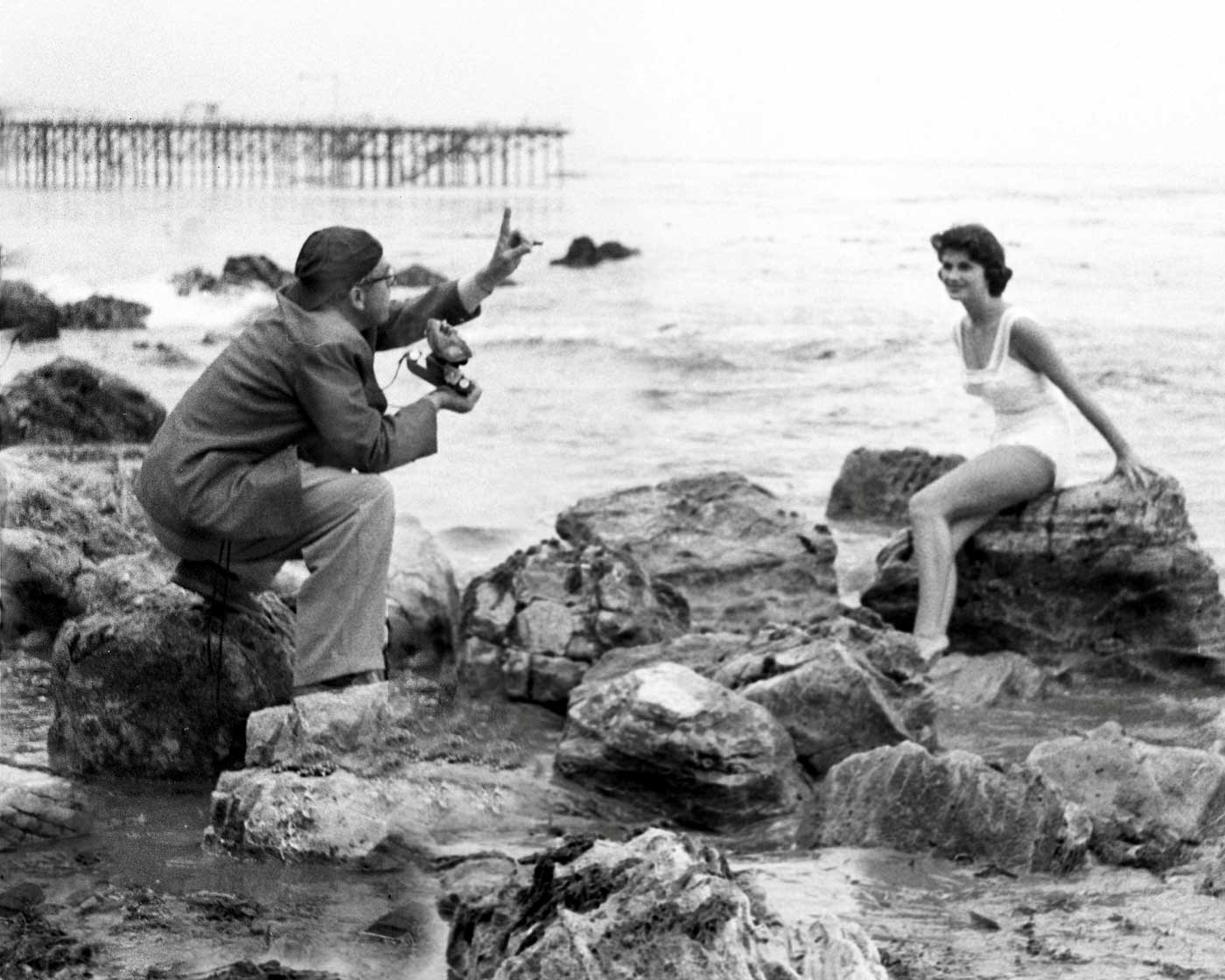
In addition to shooting at his own mansion, Harold Lloyd attended one of our outings at Paradise Cove. He especially liked shooting the alluring models we would bring and I shot some pictures of him shooting one of the models at the edge of the ocean among the rocks. In 2006 the Los Angeles Times newspaper published an article about him. I decided to send a copy of one of the pictures of him plus a short article to the author of the article. To my surprise, the author sent me a nice note and asked if I would let them use the picture plus expanding my words. I did and it was published Oct 15, 2006.
Miss California Sports Car
Kuhn’s talents were quickly noted by car magazines once he began race photography, but roads often lead back to Rome. “I became the staff photographer for the California Sports Car magazine, shooting the sports car races and photographing models and starlets for the ‘Miss California Sports Car’ section.”
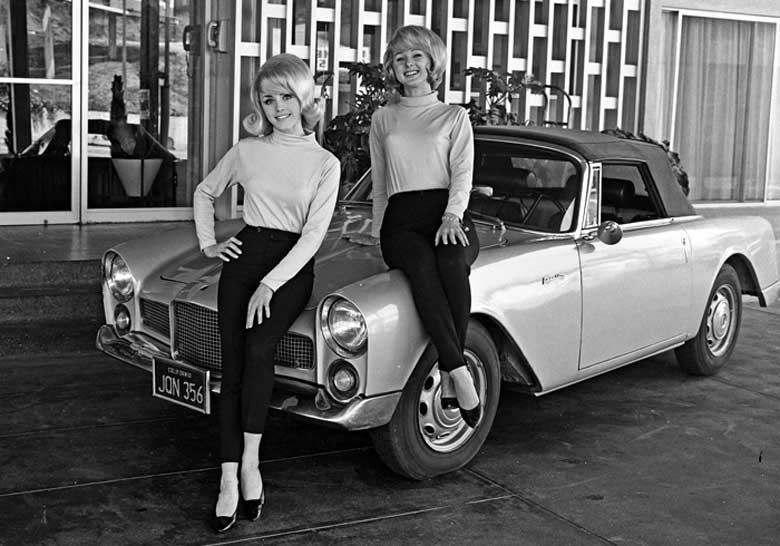
Chrissy and Patty are sitting on the Facel’s fenders while at some swank beauty salon on Sunset Boulevard. They were the first two to share the title of Miss California Sports Car, a page in the magazine where we would choose a model, or two, to pose in car-oriented backgrounds. The Facel Vega was furnished by California Sports Car magazine’s publisher.
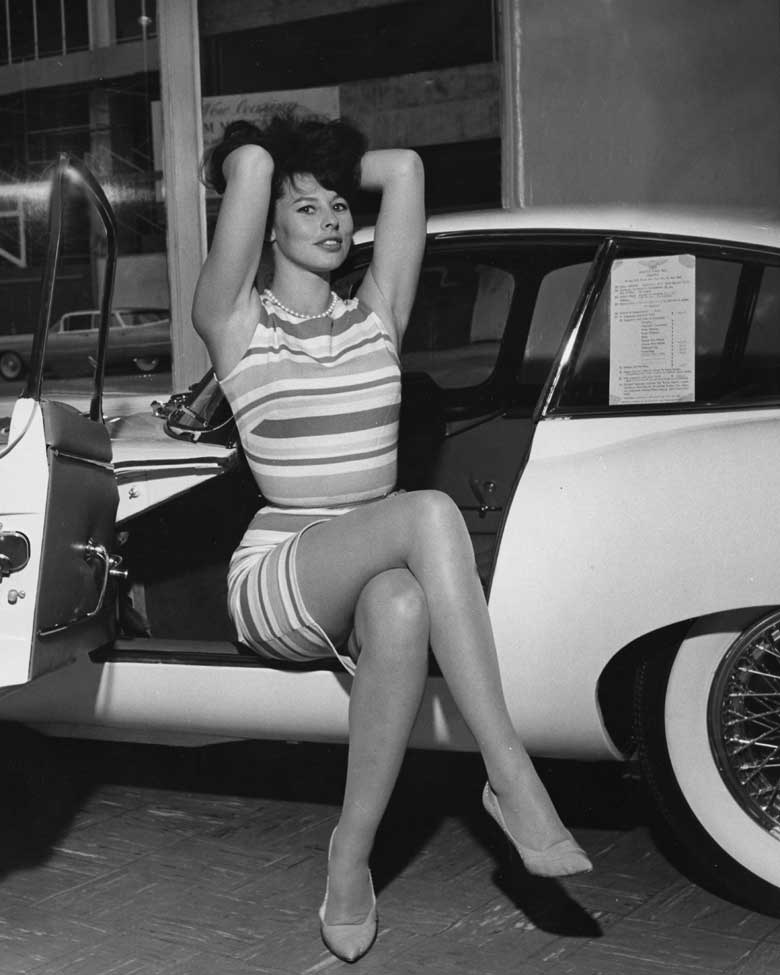
This is at the Charles Hornburg Jaguar showroom on Sunset Boulevard. Since both the XKE and the model, Bambi Hamilton, are equally provocative, this was an ideal place to bring them together. She was our choice for the May 1963 issue. In October 1958, Bambi made the cover of Modern Man magazine, a precursor to Playboy by two years. We never went to the extreme like the men’s magazines of the day.
MG Mitten
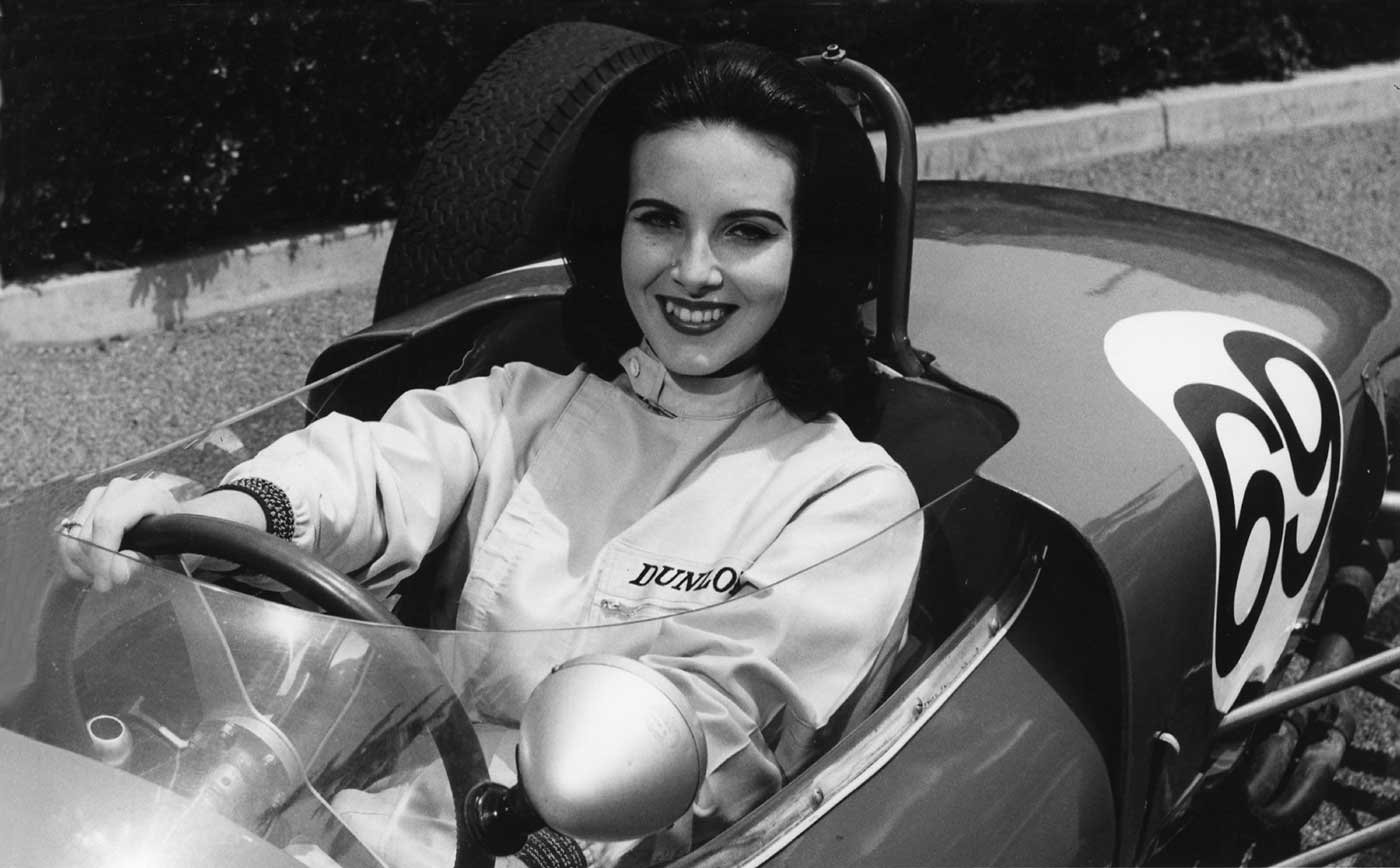
This was one of my first advertising photographs, and I didn’t even know it. I found out about it when I saw it in one of the car magazines for MG Mitten. Perhaps some of you remember Natalie in those ads.
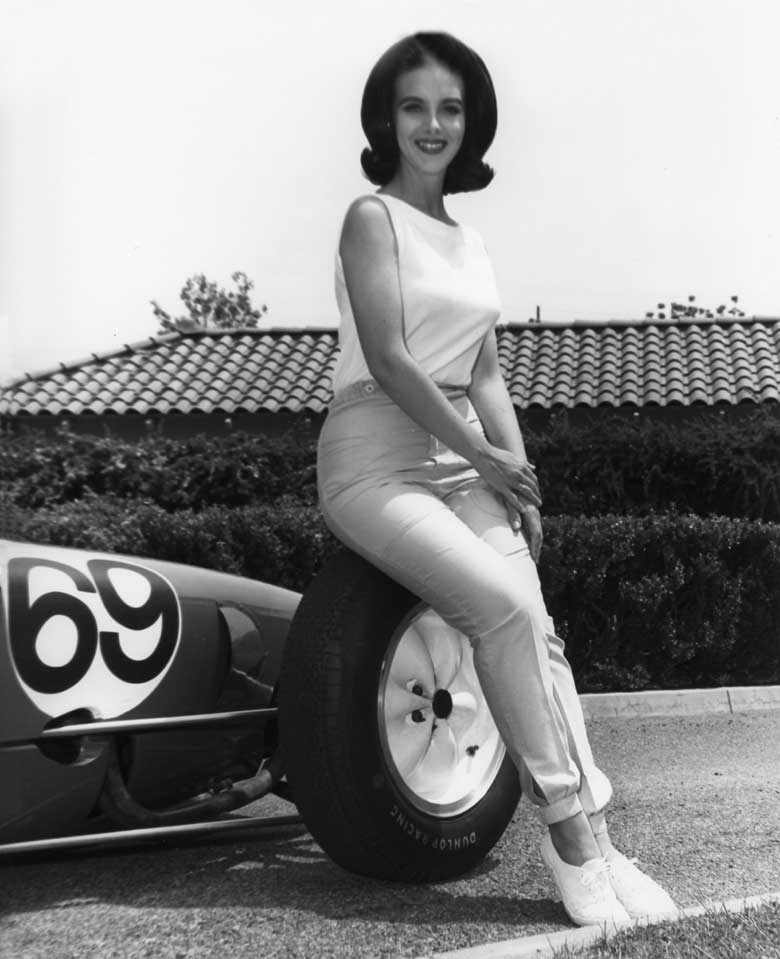
Natalie standing by the Lotus F Jr that Bruce Eglinton let her drive at Riverside. She had great fun and she could drive my Abarth anytime she pleased. Although when we dated a few times, I was always in the driver’s seat.
Where are they now?
And then, quicker than engines went from front to back, it was over. The Bob Cummings Show lasted until 1959, a good run with over 163 episodes and one Emmy. Cummings’ career began a downward trajectory, and he died in 1990 at the age of 80. Pin Ups also went into hiding, replaced by the stunning success of Playboy centerfolds. Harold Lloyd passed away in March of 1971 at the age of 77, while Greenacres was parceled out after his death, but the mansion and surrounding buildings survived and are now on the National Register of Historic Places. Playboy went the way of the pinup and by 2020 it was in digital form only and was no longer in print, finally defeated by internet porn. Abarth had a brief life but was trounced by the new EPA and DOT regulations that began in the mid 1960s and then by Fiat in 1979. Can you imagine a Zagato with five mph bumpers? MG complied with the drastic bumper edicts but not for long. Aside from one or two of the models seen here, sadly, we were unable to find traces of any others.
In 1966, Allen Kuhn put down his racing camera. “I was no longer interested in the newer rear engined race cars,” he said. “The beauty was gone and it became too commercialized.” With his wife Carole as co-pilot/navigator, he started shooting scenic pictures on their many adventures in their 34 foot motor home.
Postscript: Says Allen,” I have not intended to offend anyone with this off beat journey. Please contact me at allen.kuhn@verizon.net if you like or visit my web site at: wwww.vintage-sportscar-photos.com“
…
Here are a few more interesting shots
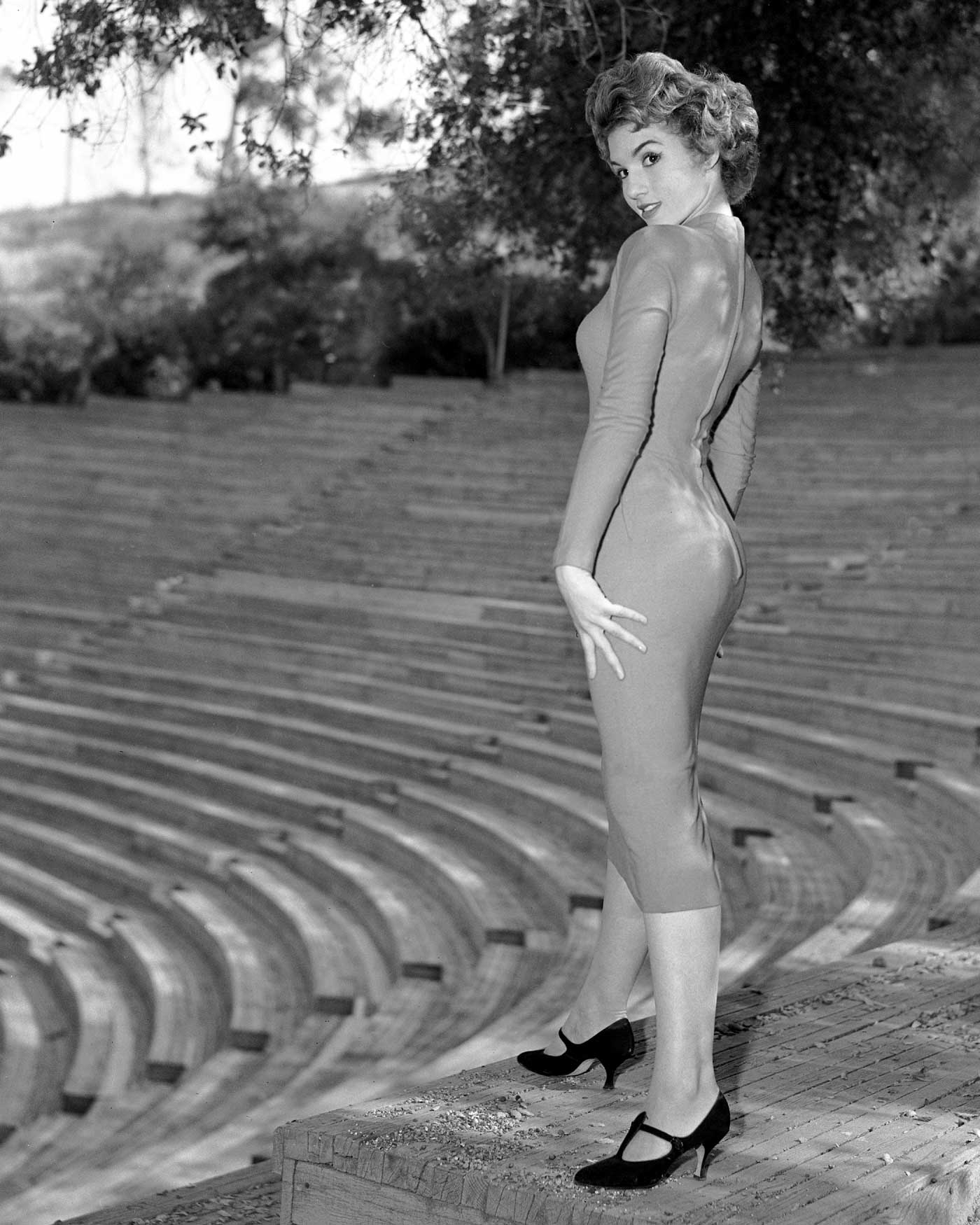
Eva again, at Occidental College this time at the outdoor amphitheater.
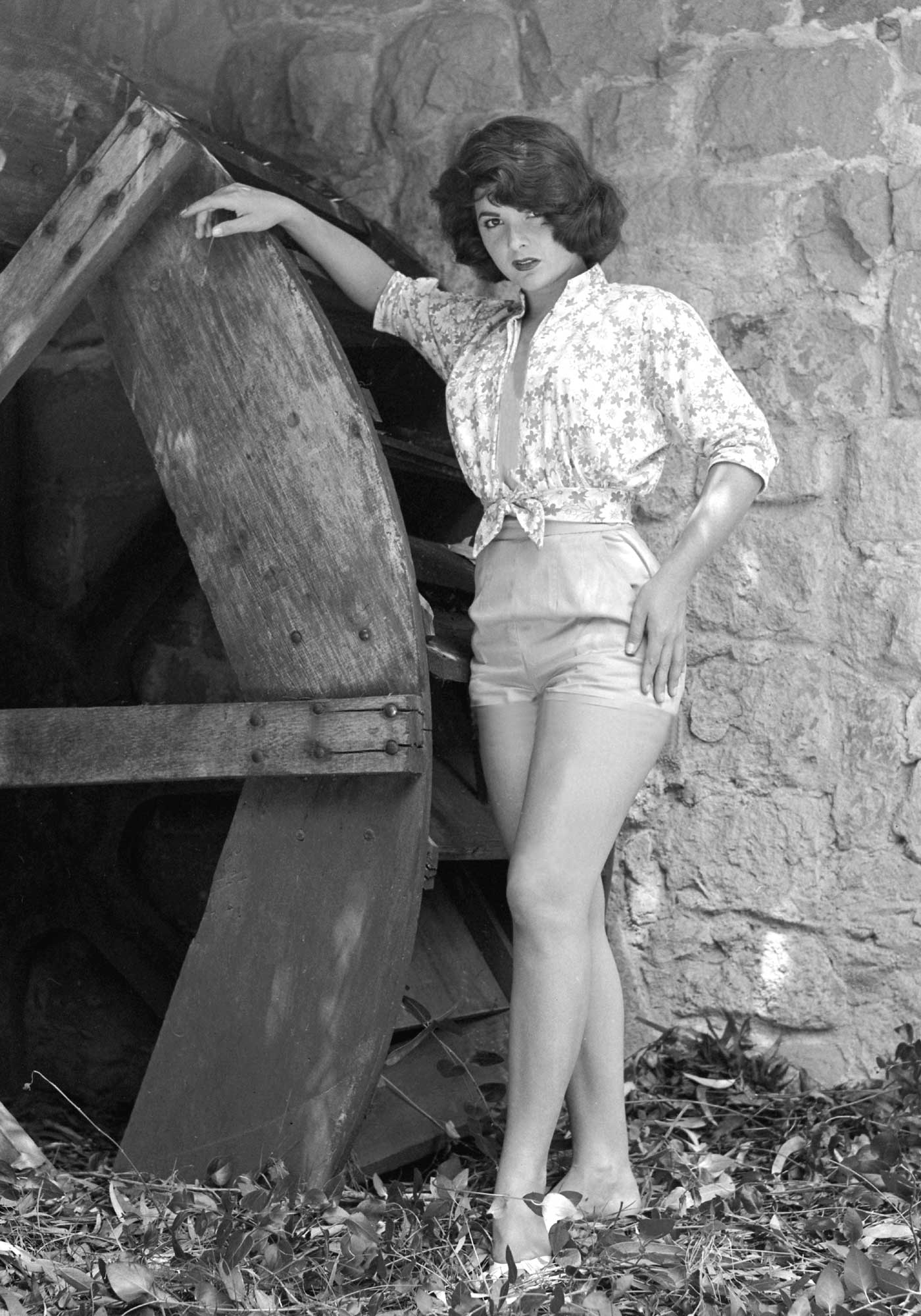
“How would you like to take a little spin, boys?” asked Margie. Here she is next to the water wheel which was part of the castle playhouse at the Harold Lloyd mansion.
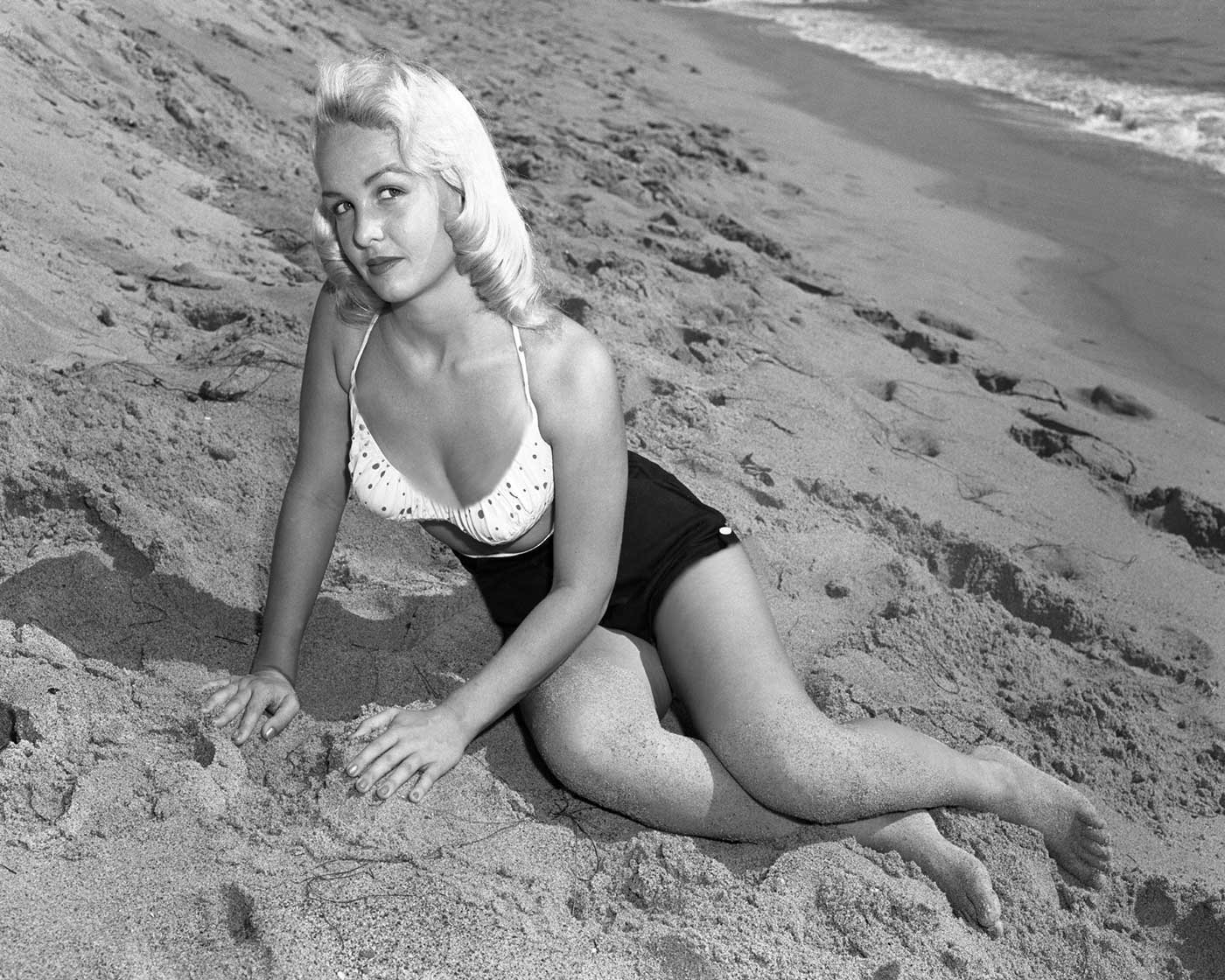
The original “Gidget’ movie was filmed at Leo Carrillo Beach, just down the street from the soft sands of Paradise Cove, where I took this shot of one of our models (but not from ‘Gidget’).
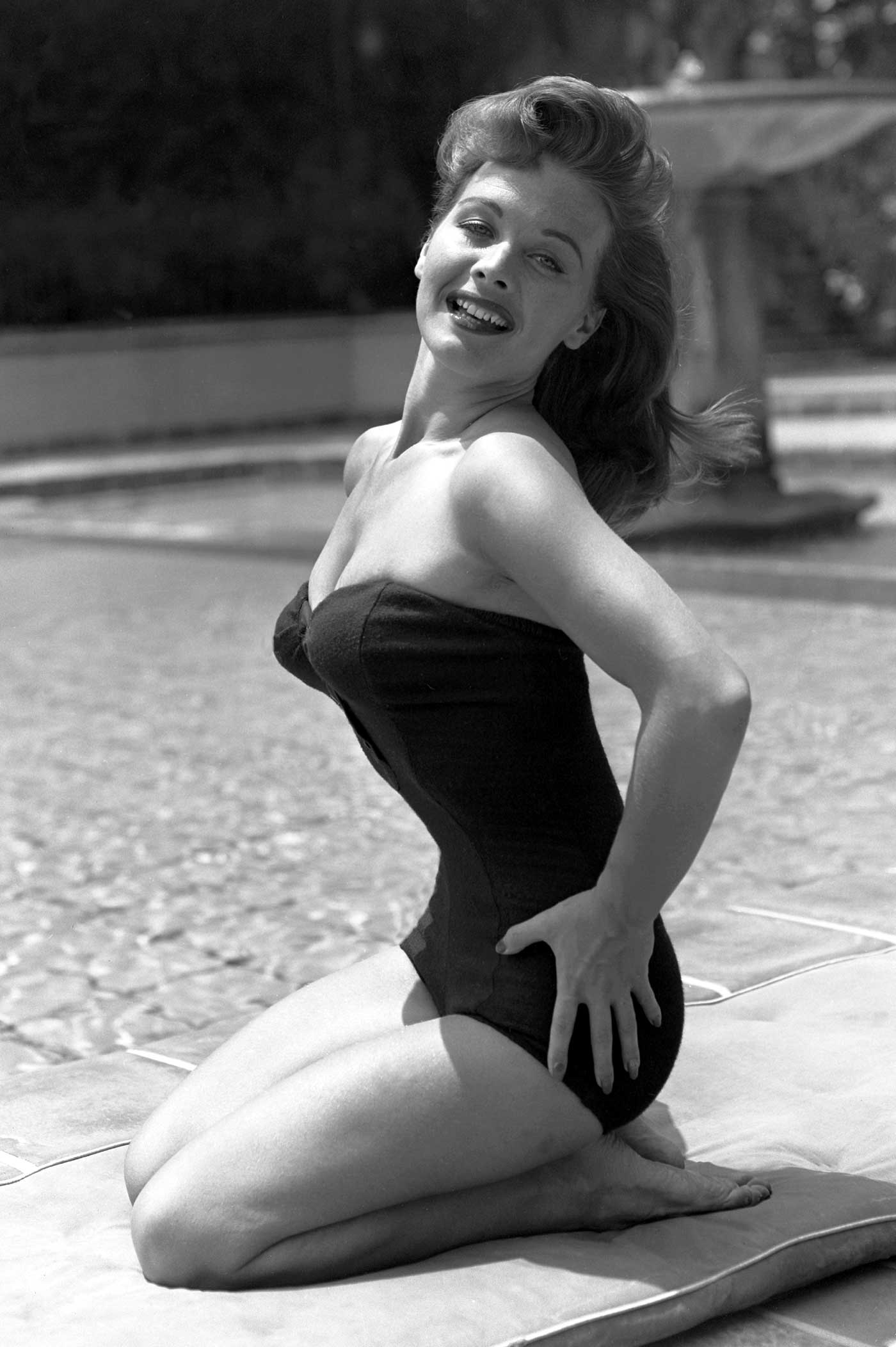
Model Nickie is beside the sumptuous swimming pool, all 50 feet by 150 feet (the largest pool in Southern California). This was owned by silent movie star Harold Lloyd.
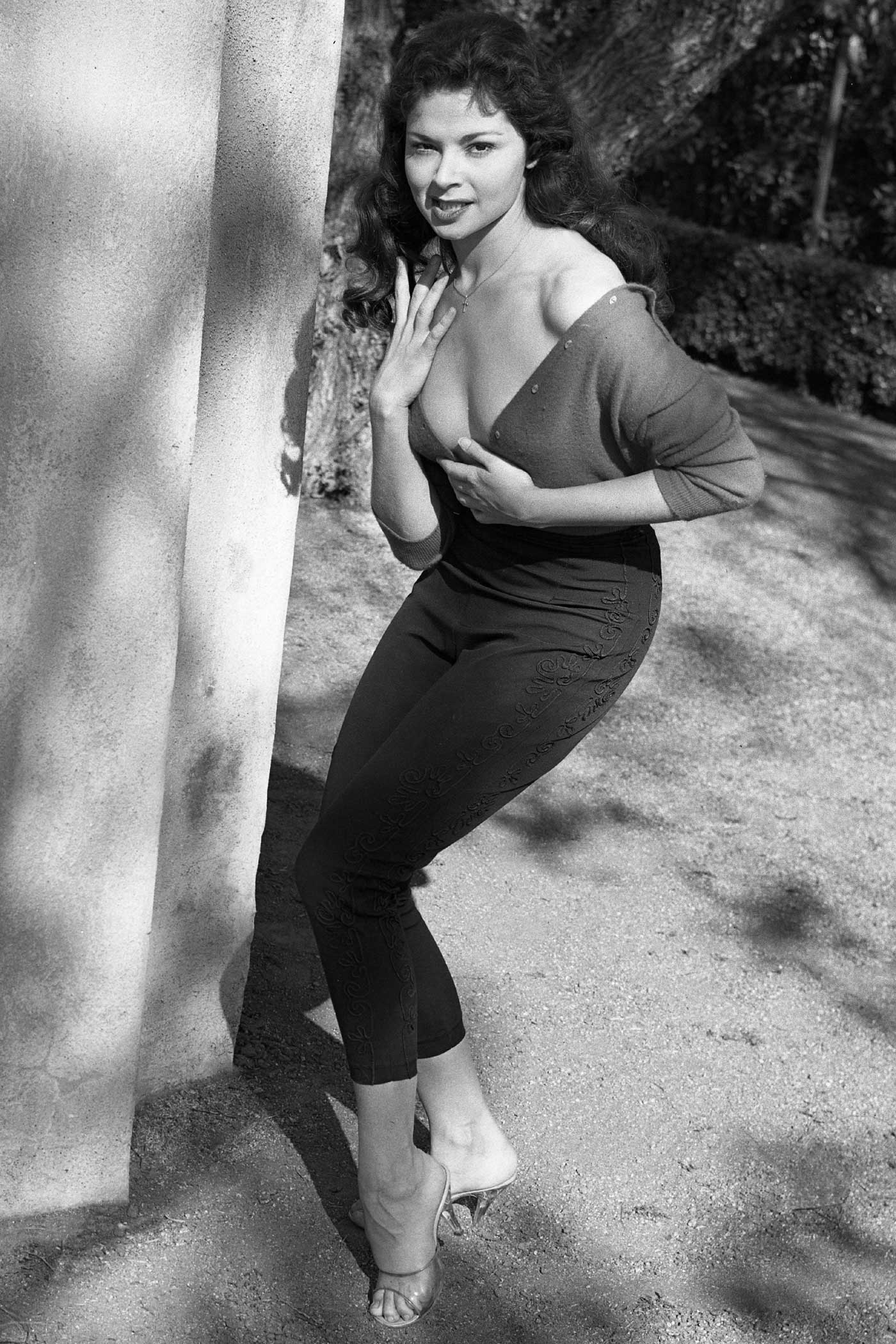
At Harold’s place with the alluring Jackie. I don’t remember exactly which building this was as there were so many. It was easy to get lost there, especially when you had a model like Jackie in your viewfinder. She also had such a nice personality that after a couple of shooting sessions I got up the nerve to ask her out, and she accepted. After going out a few times I started to get the feeling this was going to be a platonic affair. It was, and I was a meal and movie ticket with me being a stand in for her boy friend who was away in the service.
Related stories
We need more articles with pictures like this! It is a big improvement on just car pictures.
Just a minor correction. The car in question is not a FACEL Vega. It is a Facellia, which was an attempt at a down-market, less expensive car that turned out to be the death knell for the firm – sad. The French at the time were big on acronyms, and FACEL means Forges et Ateliers Constructeurs Eure et Loire. The local dealer was Peter Satori in Pasadena.
Nice story and photos.
I have never seen a maroney sticker affixed to an early E Type ever ! Very rare photo. Great work Allen !
Thank you Brandy, I appreciate your thoughts. To set the record straight, I had the car called a Facellia, but was overruled by management.
Thanks, Mike.
Ah yes…putting the cheese in Cheesecake.
I too remember Bob Cummings show, an inspiration.
By the Time Blow Up was in theaters I had my Nikon F, which I shot with until things went digital and you could no longer get E6 film developed.
Published with permission
Hi Allen
Don’t know if you’re still on this mail address but just read your piece from 2022 on Veloce Today which they revisited.
What a cracking write up. It sounds to me like you lived a life that most of us can only dream of; a sort of James Bond figure with a camera rather than a gun surrounded by lovely models of all types!
I take my hat off to you Sir and hope that you are in good health.
Regards,
Rick Treasurer
John, Thanks for the bit of knowledge. I wonder how many people knew there was a name other than Window Sticker for it. Name after Senator Mike Maroney who sponsored the legislation requiring its display. God bless our watchdog senators.
Thanks for writing in Scott. What ever flavor it was cheesecake was good. In 1966 when camera were you using before the Nikon F? I started out with my folks Kodak Pony 135, Top of the live.
Allen, There were many family cameras, but the main influence was that my Dad had an ad agency in Chicago and I watched most every camera being used. My first real camera was an SLR Konica.
As to your whatever flavor…cheesecake was good…in the 60s my first serious teacher was David Chan, head photographer for Playboy. Though the dispenser of much great knowledge during this period when we all shot to emulsion, two stood out. 1) he taught me how to bracket speed / aperture with the comment: “if you get one good picture from a roll of 36 you’ve succeeded.” The other was: when focusing with one eye in the view finder “Shoot with both eyes open or one day you’ll get run over.”
Thanks for asking!
PS: shoot with a Nikon D810 now, fully manual just like the old F. Quick fun fact, I used a hand held Weston light meter for years (decades); when I’d walk around a car at Pebble taking light readings, all the other shoots and folks would step away from the car until I was done…bracketing.
http://www.velocitygroup.net/TheGallery/
Where are they now???
The William Holden Ferrari mentioned in the story is in the Simeone Automotive Museum in Philadelphia. It’s driven every few months on Demo Days along with many of the museum cars on the 3 acre parking lot!
Thanks for all the great info Scott. Sorry for the delay, but my computer decided to not like the internet any more. Took it to the Geek Squad and it worked there by resetting WI FI. Got it home and same problem, no internet connection, but the other computer has has internet. So back to square one. I’ll take a look at your link as soon as I get my computer back.
Thank you lyank1 for your comments. I second the visit to the Simeone Museum by all means. Not a large one but with stunning vintage historical automobiles. And you get to see some running.
Allen, it is good to hear from you and to hear that you’ve written, once again, a prize winning piece for the magazine. I enjoy the photos and the “period” young ladies you so aptly reduced to silver residue on Kodabromide glossy paper. While the photos are great and bring back memories, it is your incredible ability to reduce to writing the history of the shots with both accurate information and just a little humor. I have to give you an A+ on both.
Submitted by the editor for D. Keith Lowther