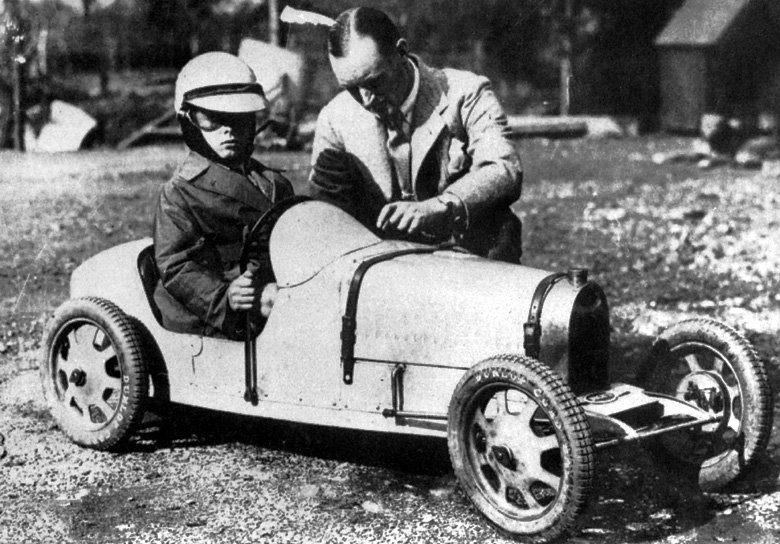
British Speed King Donald Campbell practices his craft in his Baby Bugatti. Campbell would set many speed records both on land and water but died in a speed boat record attempt in 1967. His father Malcolm, also a Land Speed Record holder, assists. Photo courtesy the Bugatti Trust.
From the VeloceToday Archives, March, 2011
By Marshall Buck
I can’t believe that the answer has been in front of me all these years. The answer to what you ask? The answer to the question I often ask myself: How am I ever going to afford a genuine vintage Bugatti? Simple answer…buy a ‘Baby’ Bugatti; a child’s car to be precise. I’m not talking about one of those cheapy Toys R Us plastic jobs. No sir, the one I have in mind is very special….one of the authentic half scale renditions of a Type 35.
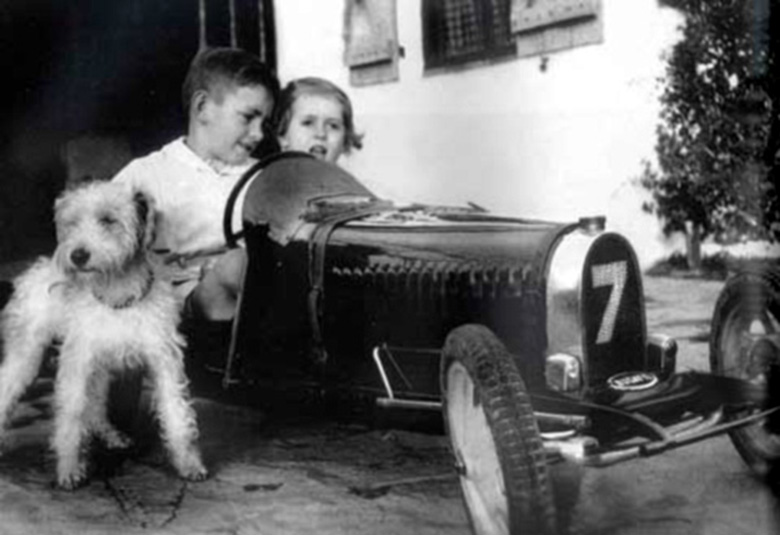
Jackie Forrest Greene, his dog and his sister with the Baby Bugatti number 7. Jackie’s father Eric won the 1928 500 Millas Argentinas with a Type 35, also number 7. Photo courtesy Lao Iacona and from the book ‘Bugatti Argentina’.
So, provided I can scrape together the required $60,000 or more to put me in the driver’s seat, and as long as I exercise and keep away from too much Brie and wine I’ll be able to fit into it. I’ve been told (too often) that I happen to be “perfect race driver size” a.k.a. “vertically challenged.” Granted there might also be a few drawbacks to owning and driving one of these. It ain’t fast, figure somewhere in the range of 10 to 12 mph, I won’t be able to license it for road use, and the biggest hurdle will be that I’ll probably have to wrestle it away from my seven year-old daughter every time I want to take “my Bugatti” out for a spin.
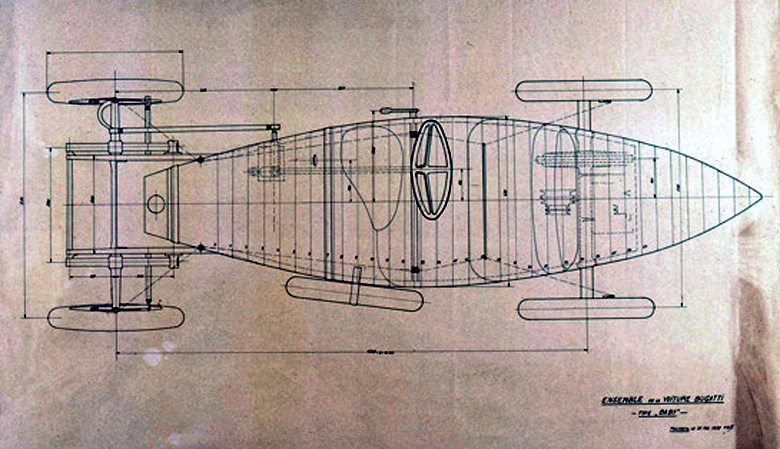
Julius Kruta of Bugatti Automobiles SAS provided this rare factory drawing of the Baby Bugatti. In the lower right corner it reads ‘type, Baby’. Note the rear axle. The battery was placed under the hood near the steering column.
I’ve always been fascinated by any half pint car, especially the Bugatti. My first encounter with one in the flesh (actually it was two of them) was in 1998, at the home of the late Allan Stone. He was a well known art collector and gallery owner of note, as in “Allan Stone Gallery” which still exists on the upper East side of New York City. Mr. Stone was also a serious car enthusiast and had a few Bugattis in his garage as well. I was curating a model exhibition then, titled “The Art of the Automotive Model” for the Stamford Museum in Stamford, Connecticut. It was a little bit of a stretch on the “model” theme to include one of these ‘Baby’s’ in the exhibition since it really is not a model car, however; an important member on the Museum’s board of Directors, Michael Graham, himself a serious collector of cars and models really wanted us to accommodate with inclusion of the ‘Baby’….. so we did.
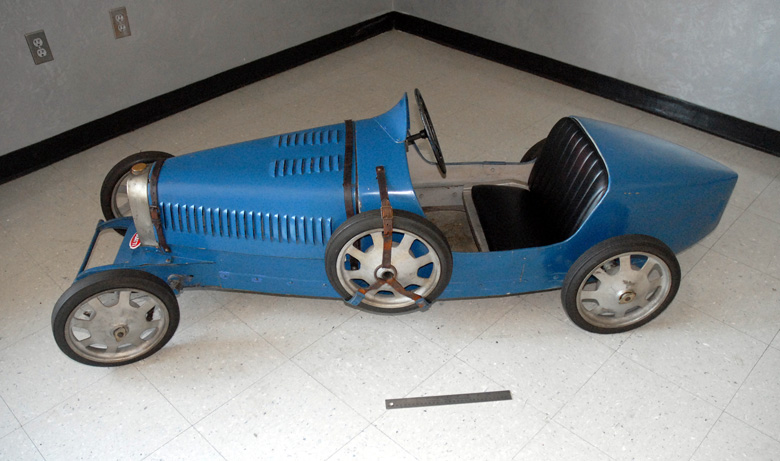
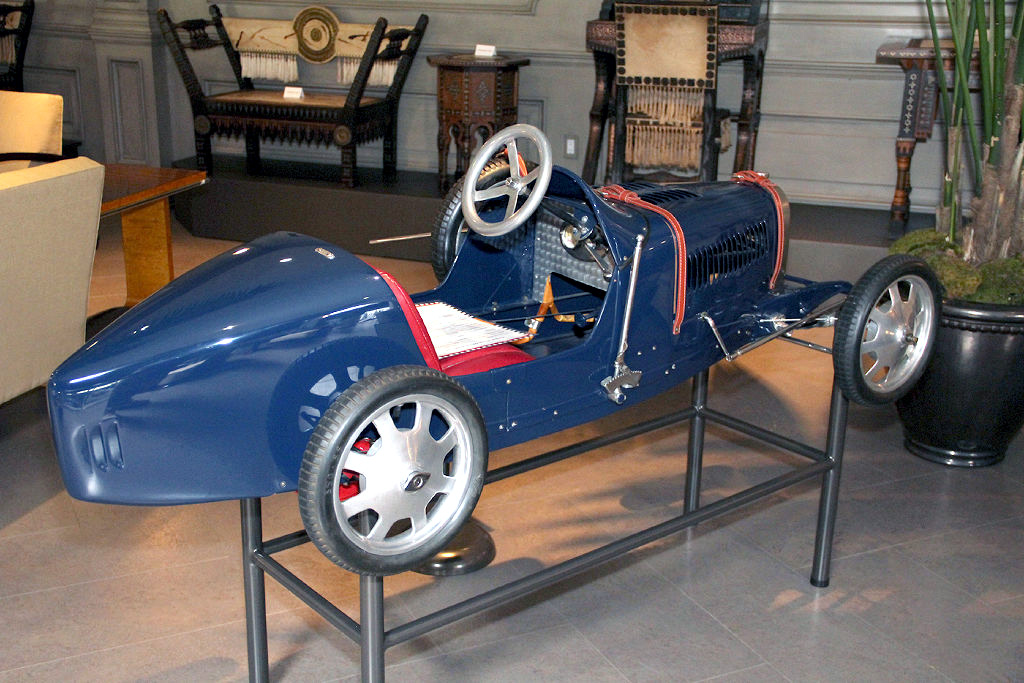
The Simeone Foundation also has a Baby Bugatti on display. It appears to be in very good original condition and there is a set of correct tires waiting to be mounted. This is chassis number 219A. Photo by Harry Hurst.
My visit to Stone’s huge house was truly overwhelming. It was packed to the rafters with art and artifacts of all kinds and sizes (an insurance company’s nightmare). One could get lost in the house and not be found for weeks, maybe even months, and if they found your body, it could very well have been mistaken for some piece of avant garde art! I felt a little like Indiana Jones during my dig inside his house. I vividly remember finally catching a glimpse of the light blue coachwork of one of his ‘Baby’ Bugs, and that in my excitement, as I attempted to climb over various antiques to get to it, I smashed my head on one of several low hanging Alexander Calder mobiles. I saw stars, and…… then a ‘Baby’ Bugatti in fantastic original, unmolested condition.
Since then I’ve seen several of Ettore’s ‘Baby’ Bugs in person; all in various states of condition, ranging from barn find neglect to original with great patina, and even to over restored a-la Pebble Beach.
Homework: Baby Bugatti
When I was asked to write about these ‘Baby’ Bugattis, I knew right from the start that my knowledge on them was limited as was the scant information in my archives. I was going to have to do some digging, which I did, and there may still be more to discover than what I have come up with. I approached this in the same manner as when I research cars for my own CMA model production runs….. I read what I could find, and then made a mad dash to contact the experts. I am grateful for the help and information provided to me by Richard Day, Curator of The Bugatti Trust in England www.bugatti-trust.co.uk; Fred Simeone of The Simeone Foundation Automotive Museum where they have a ‘Baby’ on display www.simeonefoundation.org; Julius Kruta who is the Head of Tradition and marque historian for Bugatti Automobiles S.A.S. www.bugatti.com; Sandy Leith who is the Registrar of the American Bugatti Club www.americanbugatticlub.org; and Donald Koleman, President of Competition Motors Ltd. www.competitionmotorsltd.com. With their help I have attempted to piece together most parts of a small, yet confusing puzzle. One of the biggest chunks of that puzzle was that the the Baby Bugatti, long hailed as the Type 52, was not.
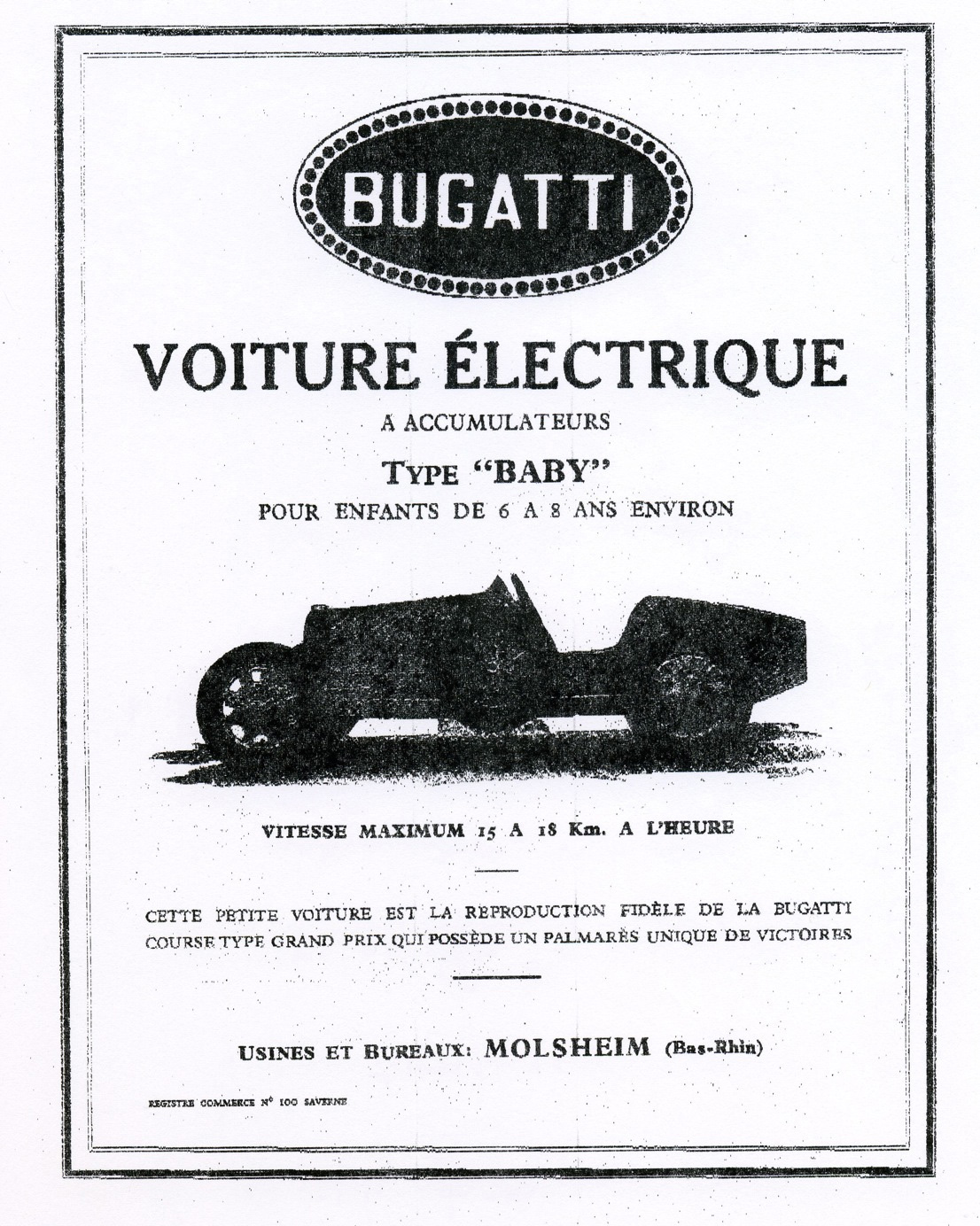
Our thanks to Fred Simeone for sending us a scan of the front cover of the original Factory Brochure. Again, no mention of the Type number.
But, but, you must be mistaken!
Some of you may have noticed that I did not refer to the aforementioned ‘Baby’ Bugatti as anything but that. I made no reference to any Type 52 designation simply because….well…..it is not. I used to think this 1/2 scale car was a Type 52, but I was wrong as is anyone else referring to them as such. Yes, I said that, and yes I know that historically everyone has called this 1/2 scale car a Type 52, however that is incorrect. The official designation per all factory records is Type ‘Baby.’ I am told that this enlightenment regarding the official designation has only come about within the past ten years. Allow me to explain. During the recent past, Bugatti Automobiles has opened up its vast files from Molsheim for research to historians whom are recognized as the foremost authorities in the world. This has allowed many more important pieces of information to surface, and for some corrections to now be made. ALL documentation and literature from the factory actually calls them Type ‘Baby’. On the cover of the only official factory brochure for this model it is clearly and proudly labeled: TYPE ”BABY” On all factory drawings and records including sales records this model is only referred to as ‘Baby.’ Note that on the factory drawing shown, it is clearly labeled Type ‘Baby.’ Nowhere is there any reference at all as to these children’s cars being designated a Type 52. Thank you Fred Simeone for supplying the copy of the brochure and another thank you to Julius Kruta for supplying the copy of the drawing.
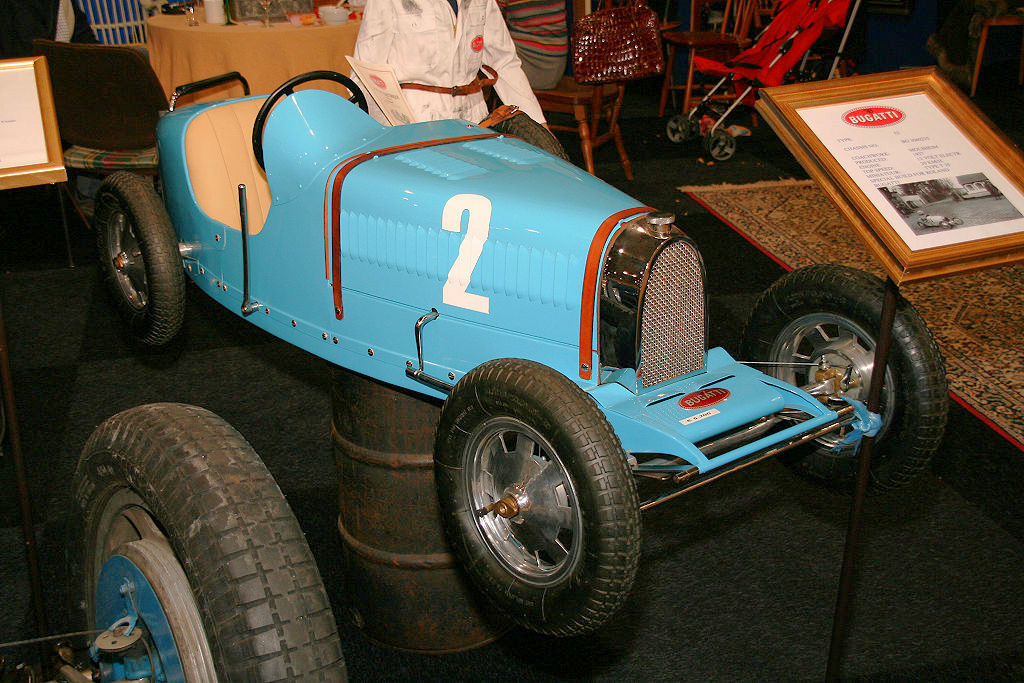
Hugues Vanhoolandt found this Baby at the Maastricht International show. Wheels and tires do not appear to be original but it does look spiffy. Probably a full restoration.
The unfortunate perpetuation of the name myth can be blamed on so very many articles and books written over the years proclaiming the Type 52 designation, which all of them have done with absolutely no documentation to substantiate it. Everyone seems to have taken the given T-52 designation on face value alone, including most auction companies, numerous writers who put little to no effort into any research, and various museums. The Mullin Museum have yet to correct and update their records and displays. Don’t rely on Wikipedia for everything, they also still have it wrong. With that said, I have noticed since we first published this article, that quite a number of writers, and a number of companies have read it, and finally taken note of this new and correct information.
The first clue that something was amiss at Molsheim was that at Bugatti, a Type number was always given when a project was conceived. If one checks the original documentation and dates of other Types conceived you will see that the Type 52 designation would be clearly out of sequence for the date of its conception as well as for those of the Type 51 which is from 1930-31 and the Type 53 from 1932. That would mean that if the ‘Baby’ were truly a Type 52 (which it is NOT) then its conception date would have to be around 1931, not 1927 as it was. And again, all records list these as ‘Baby.’
I’m cracking open the cognac now, would anyone care to join me? Go to your bookshelves and consult “The Bugatti Story”, by L’Ebe Bugatti, First U.S. edition, Chilton, Philadelphia, 1967. Look in Appendix 1, the 74 types of cars built at Molsheim. There it is, Type 52, right after the Type 51 of 1930 and the Type 53 of 1931. Fine. Except the T52 was clearly first constructed in 1927.
Did the mistake then begin with the daughter of Ettore Bugatti?
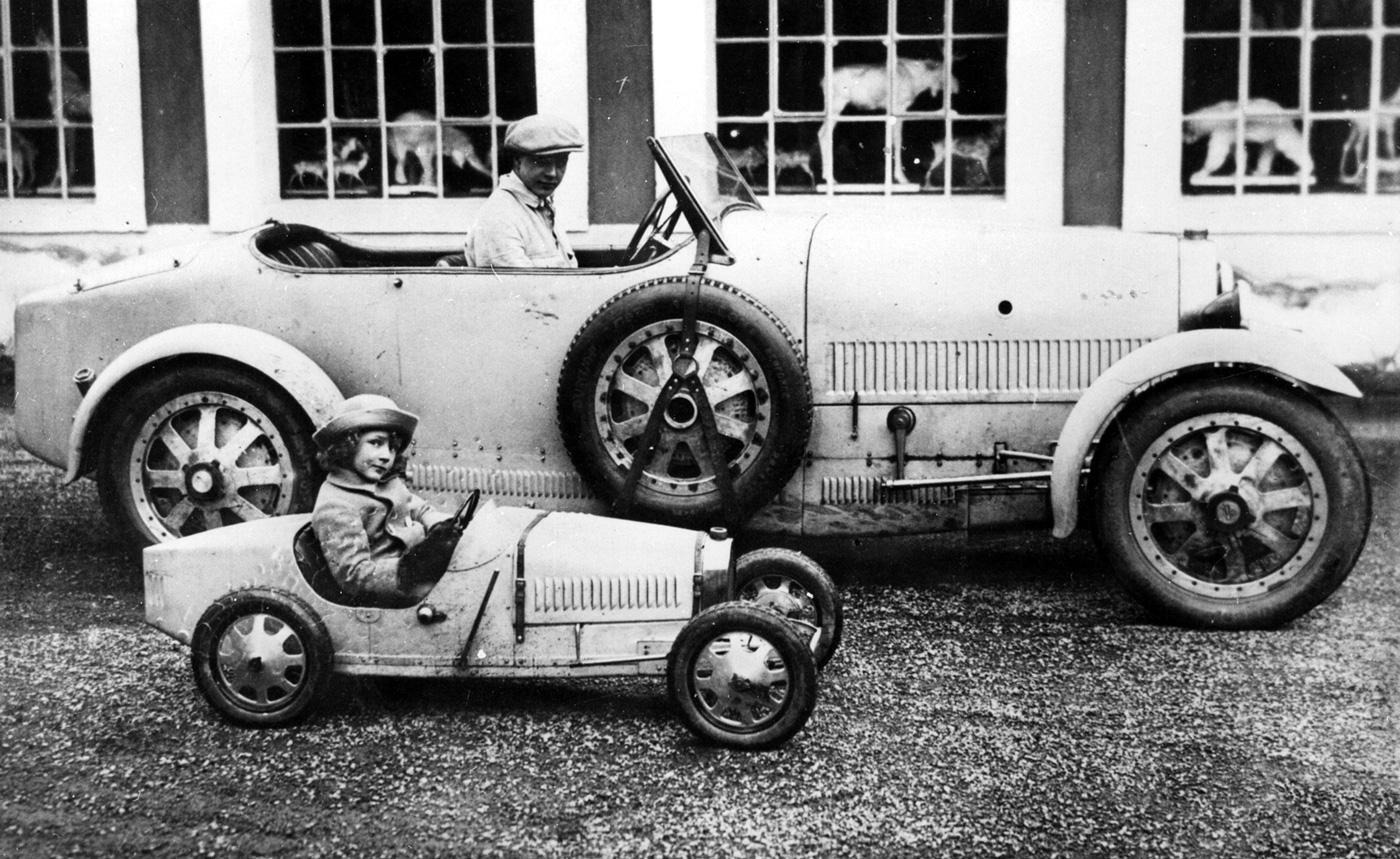
The car that started it all. Roland Bugatti in the first Baby Bugatti next to bigger brother Jean in a Type 43. The photo appeared in many newspapers and created a demand for the Baby Bugatti. Courtesy Bugatti Trust
The very first Baby Bugatti was built for Roland Bugatti, Ettore’s five year old son. Proof again that it’s good to be born with a “silver spoon” or in Roland’s case, more like a silver steering wheel. The Baby made its public debut at the 1927 Milan Automobile show, and was priced at 3,900 FF, which seems to be the price most were sold for, though some were delivered at higher prices.
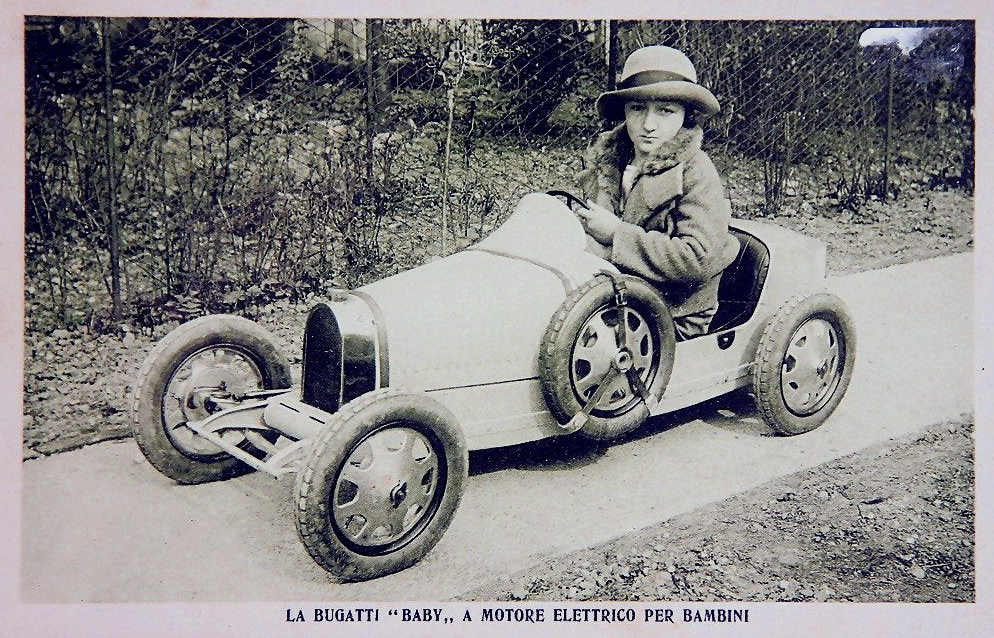
An original postcard from the factory.
The highest delivered price I am aware of was what may have been the last sale which was as late as July 1938 with a price of 5890 FF. Typically, important Bugatti clients not only bought a full size Bugatti, but usually a little one as well. Amongst the usual list of affluent enthusiast buyers were royal families and celebrities. But as we alluded to in the first part of our story, the Babys were always Babys, and never called T52s (even by royalty).
The mystery deepens
No one is sure when, where or how the mythical T-52 designation came to be. Perhaps the myth started with the late Hugh Conway’s first book on Bugatti, published in 1962 that had the incorrect designation within, referring to the Baby as the Type 52. It is even possible that he may have published a mention or reference to the wrong designation as early as 1959 in the BOC “Bugantics” publication, but I don’t have confirmation on that. Regardless of an exact start date for Conway’s T-52 reference, it was most likely his writing and publication of that designation which may have been what started the ball rolling. After that, and throughout the years, other authors and journalists simply used that as reference, and perpetuated the incorrect T-52 designation without ever bothering to properly research it. (I did the same until I started digging.) That wouldn’t be the first time misinformation has been written and quoted by the populace, and I’m sure it won’t be the last. Why or how did Conway let this designation slip by? Who knows; but having corresponded with Richard Day on this, I am in full agreement with him that since Conway had such a close association with Molsheim it is more likely that the mis-designation originally came from senior staff at the factory who were less than concerned with accuracy.
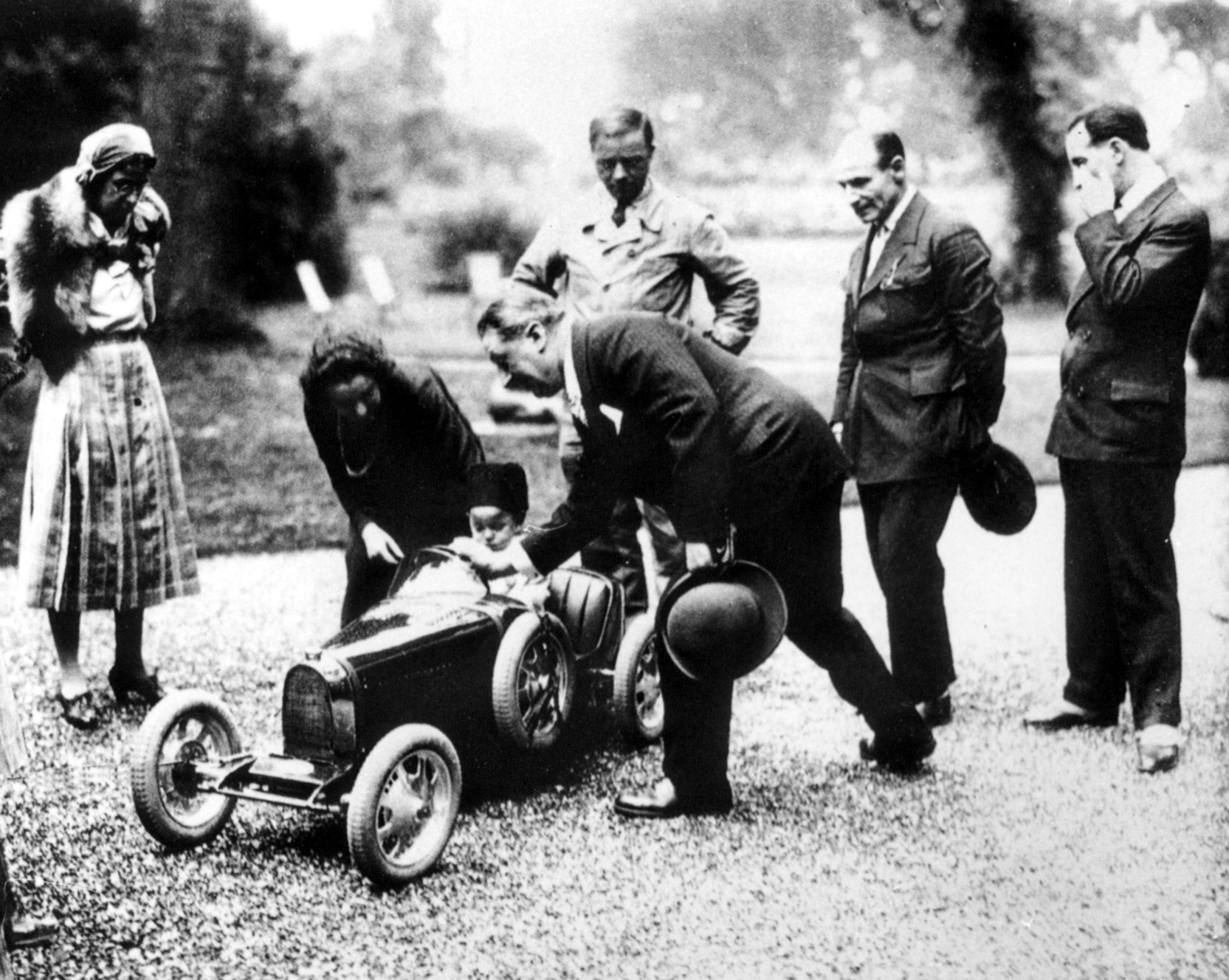
Royalty was fascinated by the Baby. The Prince of Morocco enjoys driving his much to the delight of the entourage. Ettore Bugatti is giving a helping hand. Fiat\’s Giovanni Agnelli also got his start with a Baby. Photo courtesy of the Bugatti Trust.
Now before you start sending me hate mail, put those poison pens down for a minute. Please note that I am a very big fan of the late Hugh Conway, and I hold him in extremely high regard. I believe the incorrect designation (as mentioned above) was unintended, and never again checked. Given where it was originally supplied to him from that is very understandable, especially when considering the vast amount of information on the marque he dealt with. These things do happen. Even NASA and VeloceToday have been known to have made some mistakes.
And, how about this. In 1981, Griffith Borgeson published Bugatti by Borgeson: The dynamics of mythology, which was widely criticized by other Bugatti historians. In it Borgeson perpetuates the T52 myth, writing in a caption “Roland, in the original T52, with Lydia and L’ebe.” Criticized or not, Borgeson wrote the book after a long series of interviews with his friend, the aforementioned Roland Bugatti, for whom the car was built in the first place. Aha! Why did this very obvious error get by Roland?
No one knows.
Regardless of what some may think; let me make this perfectly clear, the only production child’s car manufactured by Bugatti was officially designated Type Baby – nothing else.
Peter Mullin found this Baby in Argentina. It reportedly was one of the 23 LWB models ordered for the Buenos Aires Zoo. The steering wheel does not appear to be original. Photo by Hugues Vanhoolandt.
Now that we know what to call it, how many are there?
The Baby is a half scale rendition of the iconic Type 35, and it’s rare, but not uber rare. It is estimated that around 500 of these were produced at the Molsheim factory from 1927 to 1930. That figure combines both the SWB and LWB versions. What? Didn’t know there were two different wheelbases built you say? Neither did I, but there are; more about that in a moment.
It is unclear as to how many still exist, but the general consensus is that very many if not most, have not survived. There is no definitive record anywhere as to the exact number produced; and what is there is more than a little confusing. Within the factory sales records are many Babys with delivery dates showing them to be out of sequence according to their individual numbers. The highest chassis number on record is 499A which was sold by the factory in July of 1936. Certainly 499A was one of the very last as what appears to be the remaining five Babys were sold between November 1934 and July of 1936. However, we have one more out of sequence delivery for number 456 which has an even later sale date of July 1938. My head hurts now, how is yours?
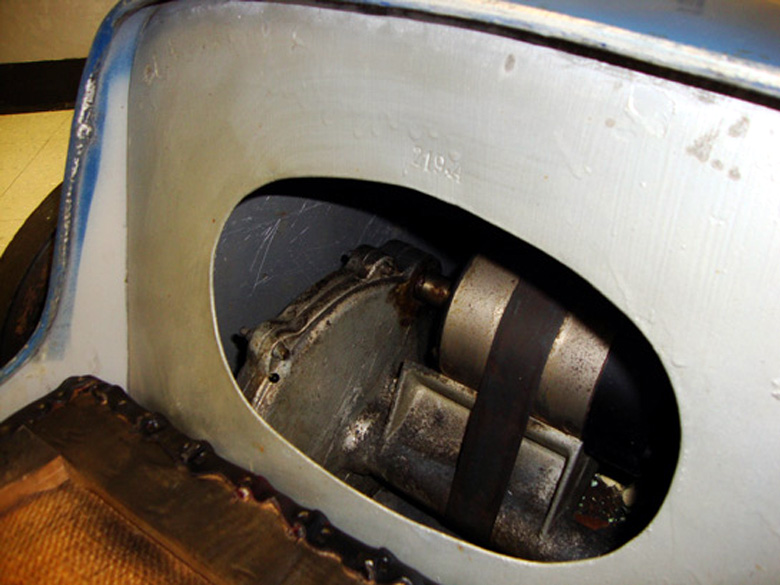
Fred Simeone’s Baby: Behind the seat is an opening for servicing the electric motor and drive gears. The motor is strapped to the rear axle housing and drives the large spur gear to one wheel. The serial number is stamped into the sheet metal just over the center of the opening and reads’219A’, indicating a LWB.
Wheelbase, LWB and SWB
Now about the wheelbase, and back to the factory brochure for a moment. On its cover it reads “for children ages 6 to 8.” That is my pigeon translation of the French text, but close enough. The first Babys built were short wheel base and what I’ll call short body; perfect for an average size five-year-old such as Roland. These can be easily spotted in two ways. First, they just look proportionally correct, like a shrunken Type 35 that they are supposed to be. If you’re not sure, then count the hood louvers, 16 per side. The long wheel base cars have longer hoods/bonnets. It is thought that this later change was made to accommodate older and larger children. Aside from not quite looking like a mini T-35 you can again use the hood louvers as your guide; 21 per side.
Once again, there is no definitive record of exactly how many of each SWB and LWB were built, though according to sales records it does appear that there were fewer SWB’s sold/delivered. The records are confusing as dates and individual numbers dart back and forth leading everyone to believe that you could order either the better looking SWB or the more practical LWB variant. The “A” following the last digit distinguished the LWB model.
Ettore’s Baby does demonstrate the overall thinking of Bugatti, and here are its basic specifications:
Aluminum body with two leather straps.
One side mounted spare wheel & tire.
Seat upholstered in leatherette type material or possibly leather.
Detachable Cast aluminum wheels.
Cast front axle.
Four drum brakes with expanding wooden shoes.
Powered by a 12 volt, 60 amp electric motor geared to the rear axle.
As per the cover of the brochure, max speed is a claimed “15 a 18 KM a L’Heure” About 10 to 12 mph.
Variable speed via a throttle type of lever.
Reverse gear via a switch reversing polarity of the motor.
Dunlop tires which were exactly half size of originals. Most likely that Dunlop made these tires especially for Bugatti.
Weight 150 lbs. Probably the SWB, with the LWB being just a bit more, but no stats to define this.
Wheelbase: SWB 1.2 meters (which is half scale of the Type 35). LWB 1.32 meters.
Color(s). No reference in the records and again, no one seems certain about colors offered, but looking at numerous period photos, it appears that there were two or three original colors. Most in blue, then yellow, and maybe red.
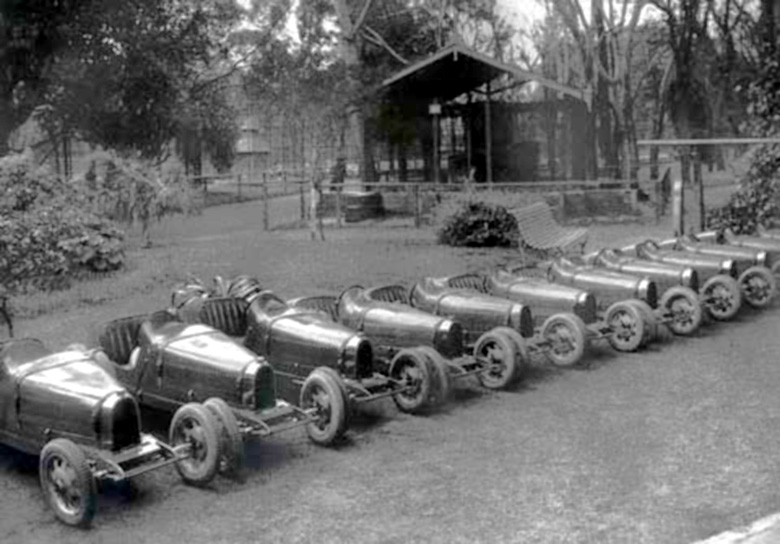
A line up of the 23 Baby Bugattis at the Buenos Aires Zoo. All were LWB models, cost at least 3,900 FF at time when the real Type 35 (A) sold for 65,000 FF. The Zoo may have gotten a discount for buying in bulk! Courtesy Lao Iacona, Bugatti Argentina.
See them at the Zoo
Many of these 1/2 scale cars were sold to various fair grounds around the world, some located at fashionable summer resorts. At some of these resorts, children’s Baby Bugatti races were held. It is known that many of these small Bugattis ended up in locals as far away as Brazil and Argentina. Amongst factory sales records, one such sale was for twenty of these; sold to a buyer in Sao Paulo, and he paid 3,900 FF each! Another large order was from the Buenos Aires Zoo in Argentina for twenty-three of these for rental. Being that E.B. was always interested in any promotion of Bugatti: there were some races held just for these half pints at certain Bugatti specific events, some known to have taken place in Spain and France as pre-races to the official real car races.
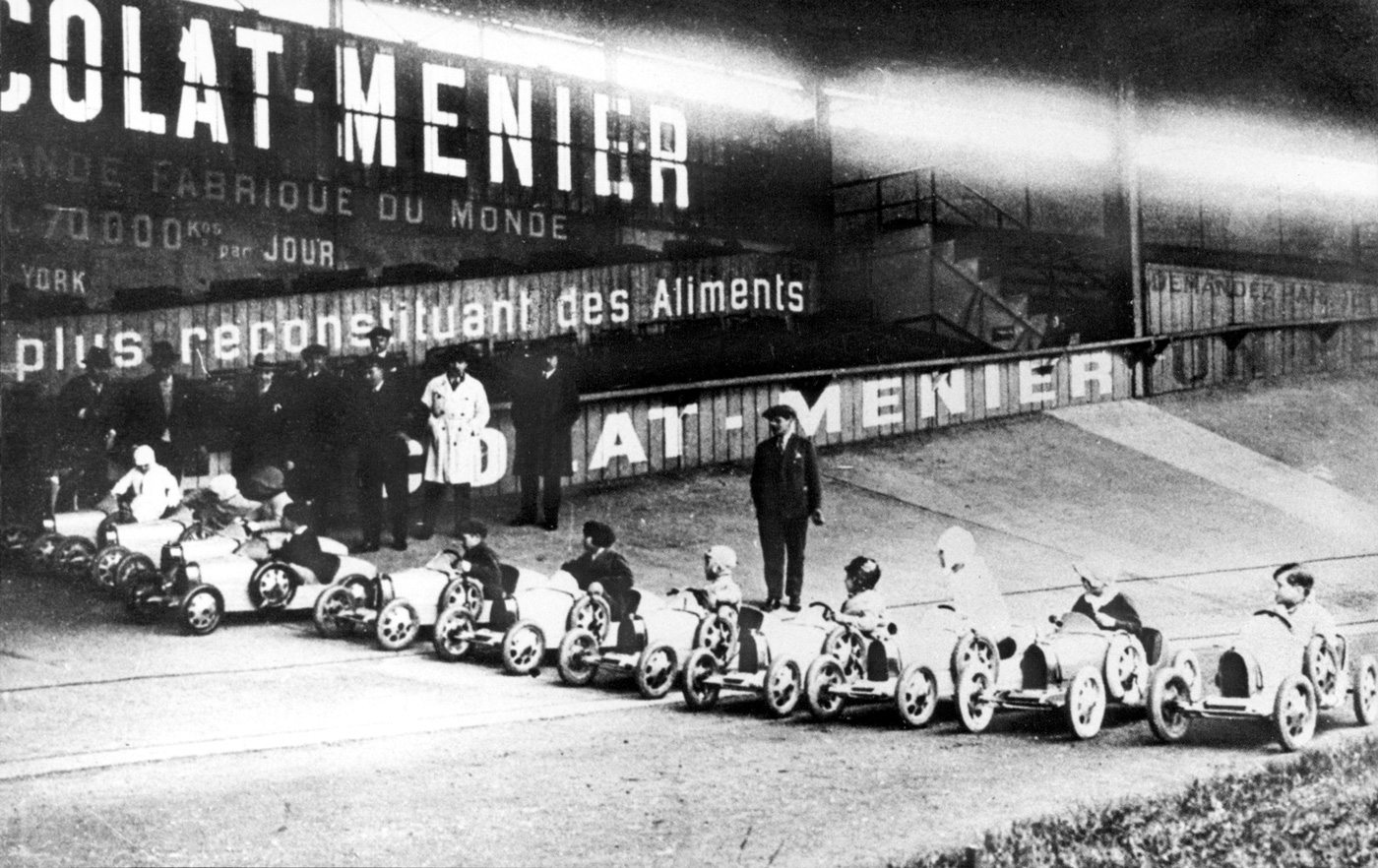
Back in Europe, there were many single make events for the Baby Bugattis, a precedent to the \’Little Big LeMans\’ event held every year in France today. Courtesy Bugatti Trust.
How to buy
Want one, do you? First, make sure it’s a real one, not a reproduction. Expect to pay in the plus minus range of $60k and up to around $85K in Europe. These don’t come up for sale very often, and when they do it’s usually at an auction. If you do not want to wait for that, then contact a Bugatti specialist; there are many. From my research I know that Competition Motors Ltd. has sold several of these over the years (www.competitionmotorsltd.com). If this acquisition is for your collection, I say go for it. However, if you want one just for your little prince or princess to bomb around in then you might want to consider one of the many reproductions available for a substantially lower entry fee. Like anything in this world that has some cachet or other perceived value to it, and often where someone sees an opportunity to cash in…..they have done so. Though not always a bad thing; I have mixed feelings on this, and have been privy to some rather heated discussions on said subject, which can be argued on from now until the cows come home.
There are many reproductions which have been made by numerous companies and individuals worldwide. They vary in authenticity and pricing…most appear to be of very good quality. Among them is the Argentinean company PurSang, who is the most well-known maker of these Baby reproductions. Just the LWB version is offered. They have been making these for about 10 years now, and each is made to order. Figure on setting aside somewhere in the neighborhood of $10,000 or so to join the club.
The Type Baby is an interesting side note in Bugatti history and a testament to the allure of the mark. Suffice it to say, that with all that is known and the quantity produced, this model was without a doubt a commercial success of the time for Bugatti. These were toys when first produced, albeit they were for the wealthy, but nonetheless they were toys for their children. That said, the Type Baby has always been considered a real Bugatti amongst collectors and marque enthusiasts. And now of course they are sought after bona-fide collector’s pieces.
A note about The Bugatti Trust. Simply put, I could not have written this to the extent that I have without their help and access to information and photos contained within their archives. They are an amazing and highly recommended resource for both enthusiasts and researchers. Housed within their facility is a phenomenal collection of information. If you happen to be a nut for historic photos as I am, then set aside a couple of days for viewing all of them. Even better, you can purchase copies at www.bugatti-trust.co.uk
About Marshall Buck
Marshall Buck founded Creative Miniature Associates in 1982, now known as CMA Models, Inc. Since then he has been involved with high-end automotive miniatures as a collector, model maker, manufacturer, and broker; catering to serious collectors and offering a combination of services not found anywhere else. A great deal of investigative research, some of it exhaustive, goes into producing and building historically accurate models to the level he is well known for.
Marshall has authored a number of articles on models for various publications and wrote a featured model column for Vintage Motorsport magazine from 1988 to 1999. In 2007 he started hitting the keyboard again for Sports Car Market (which he left earlier this year), and has joined VeloceToday, and Mesh New England.
Growing up in the USA and Europe, he was immersed in art and culture from childhood. His parents were collectors of fine art and antiques, which gave him his appreciation for quality and craftsmanship. From the age of eight onwards he was always building model kits.
After his education, he held various positions in professional photography, then television production on various TV shows, and onto the post production management side. During all this time he was honing his model making skills while custom building model cars for himself and for a few select customers, one of whom was an extremely well known car collector and part owner of Aston Martin Lagonda Ltd. In 1982, that client convinced and funded Marshall to go into model making full time. He took time off from the model business in 1986, doing a three year stint with Miller Motorcars, and in 1989 he went back to model making full time. Since then, he and his models have garnered much publicity and praise world wide – some of which even brought him a personal visit from David Letterman. Marshall’s client list is a virtual who’s who of some of the most well known car enthusiasts around. Since he wrote this piece, Marshall has become the editor of “AutoMobilia Resource” magazine.
Leave a Reply