
Book review by Pete Vack
Norfolk, Virginia, 1976. I know it was 1976 because I had recently received my hot-off-the-press copy of Michael Frostick’s photo history of Lancia. Sitting in our living room were Sue Dixon and Keith Goring, down from Connecticut to deliver an old Appia sedan and pick up an Alfa Sprint Veloce. Sue was eager to take a look at the Frostick book; we were all starved for information about Lancia, and this was the first history of the marque in English. Sue perused through the pages and then stopped.
“Frostick’s got this wrong,” she said, pointing to page 126.
”Look, this is not an Appia Zagato, it’s a Flaminia! How dumb!!” Sue was never one to pull punches but I was amazed at her attention to detail and in-depth knowledge of the subject. She was right of course. I wondered how many other people in the entire world could have spotted that in those early years of learning Lancias.
A daunting work, well done
Almost a half century later, we are reviewing one of the most recent Lancia books, Fuoriserie Lancias, written by Wim Oude Weernink, who, in 1976, was working on his first Lancia book, La Lancia, which would not be published until 1979. Nigel Trow would follow shortly with The Shield and the Flag and there would be a steady flow of books on Lancia, (but never equal to that of those published about Alfa Romeo). Unfortunately, Sue is no longer around to help review Wim’s latest; I know she’d do a much better job than I.
Strangely enough, when I recounted the story about Frostick’s error, Wim came back with another story. “In 1975, while visiting Lancia’s press department, Michael Frostick and his wife sat down in front of Mrs. Marie-Pierre Baggio, secretary of Sandro Fiorio, head of press department and father of racing manager Cesare. Frostick gave Mrs. Baggio a few paper sheets with names of various Lancia models and asked her to find the relevant pictures. She did and this went on for a day and a half, and Frostick left the Lancia office with a thick envelope full of Lancia archive pictures that he had to sort out. That was the result of his research into Lancia and explains Sue Dixon’s observation….”
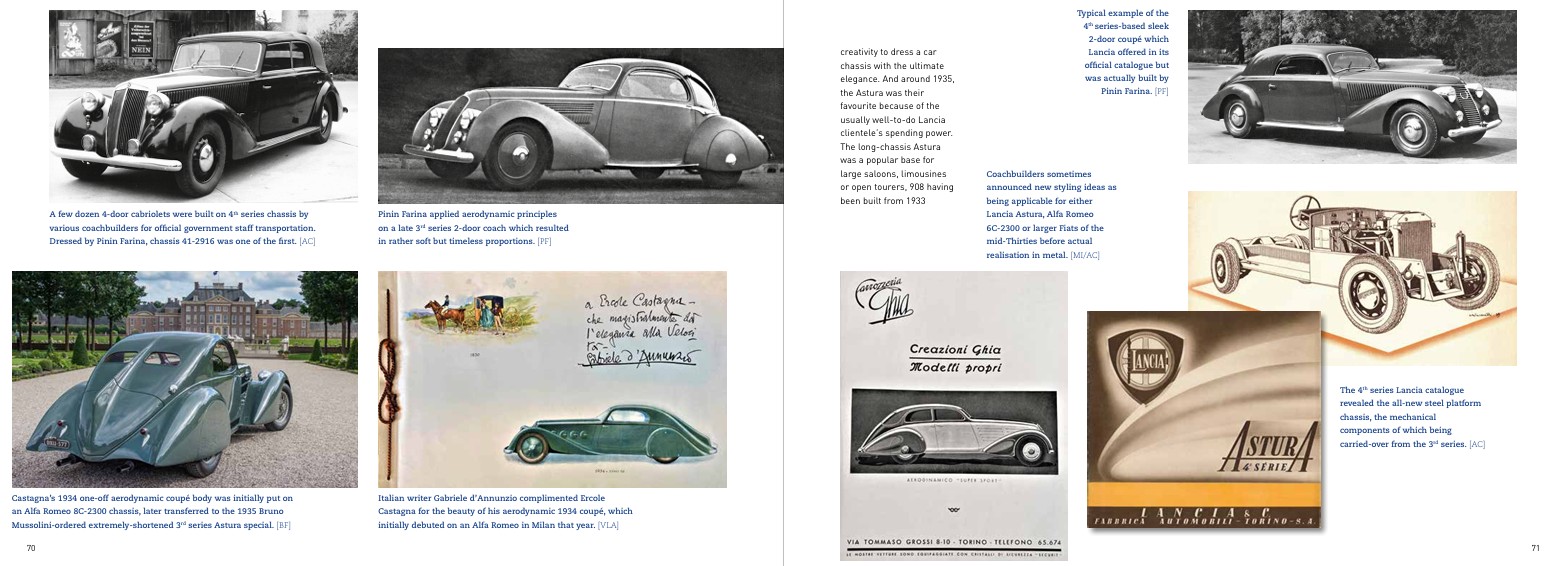
Are you ready for Asturas? They are here, in abundance and beauty.
So we really shouldn’t blame Michael too much, and were all glad he was able to publish so many photos of Lancias. Which in turn, brings us to Wim Oude Werenink’s Fuoriserie Lancia, An Illustrated History of a Culture, 1925-1985, the utterly amazing gathering of rare Lancia photos, which can also be difficult to identify properly. There are Lambdas and Dilambdas, Asturas and Agustas, Artenas, Aprilias and Ardeas. Many had no coachbuilder’s badges, and if so can’t be seen in the old photos. The grilles were usually not standard and individual. For Wim to find and identify some 650 images is a huge feat, no doubt augmented by his restoration of a 1932 Lancia Astura, a project which required a lot of research. Oude Weernink also has the advantage of many more years of research, and a lot of other shoulders to stand upon.
Fuoriserie Lancia is as good as it gets when it comes to Italian coachbuilders and Lancia. The ads, brochures, and photos included show us something about the car, the coachbuilder, and/or the individual designer, or customer (such as a dealer). It should definitely be considered a must have for any Lancia library, as well as anyone interested in the story of Italian coachbuilders.
The Culture of Carrozzeria

The modification of the Lambda chassis in 1925 resulted in a sudden demand for custom bodies.
In Italy, there were only four automobile manufacturers; Fiat, Lancia, Alfa Romeo and Isotta Fraschini, and that the coachbuilding craze really began with the Lambda, after Lancia modified the unitary chassis at the request of Battista ‘pinin’ Farina. Oude Weernink explains:
“That was the start of production of a range of no less than 26.000 bodyless chassis for the next 30 years, to be clothed by individual coachbuilders with exclusive one-off bodywork or produced in very limited numbers. And because Lancia’s clientele usually were well-to-do individuals, demand for exclusivity of coachwork was above average. Building on that, Lancia’s highly appreciated qualities created new business opportunities which suited the booming and very creative Italian coachbuilding industry. Located for a large part in and around Turin, where Fiat focused on mass-production, exclusive coachbuilding for Lancia evolved as a unique culture of high levels of creativity and craftmanship, so much appreciated then by individual customers as well as today’s connoisseurs and collectors. A culture also much enhanced by the glamour of popular local concours d’élégance.”
In addition to the many coachbuilders who widely promoted their fuoriserie Lancias to advertise their business, Lancia dealers played a large role in the culture, often ordering special cars and selling them via their dealerships.
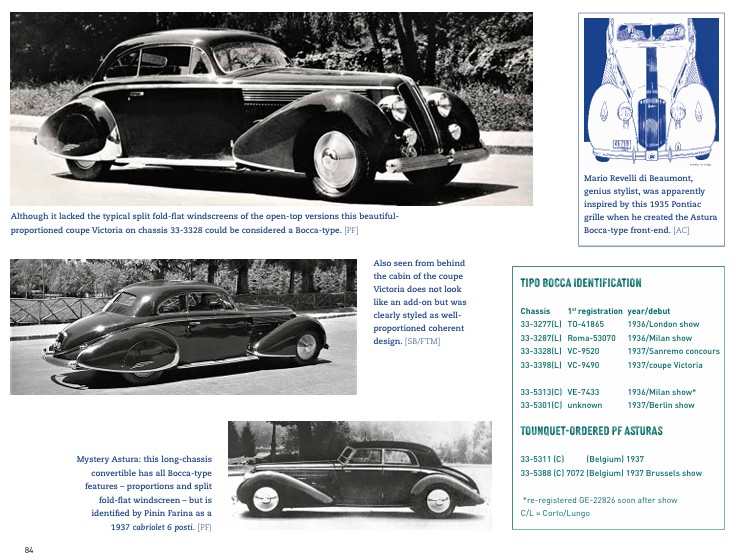
Vittorio Bocca was a Lancia dealer in Biella who commissioned a few Asturas to be built by Pinin Farina and designed by Mario Revelli de Beaumont which featured cascading designs on the grilles and hoods, and high waistlines.
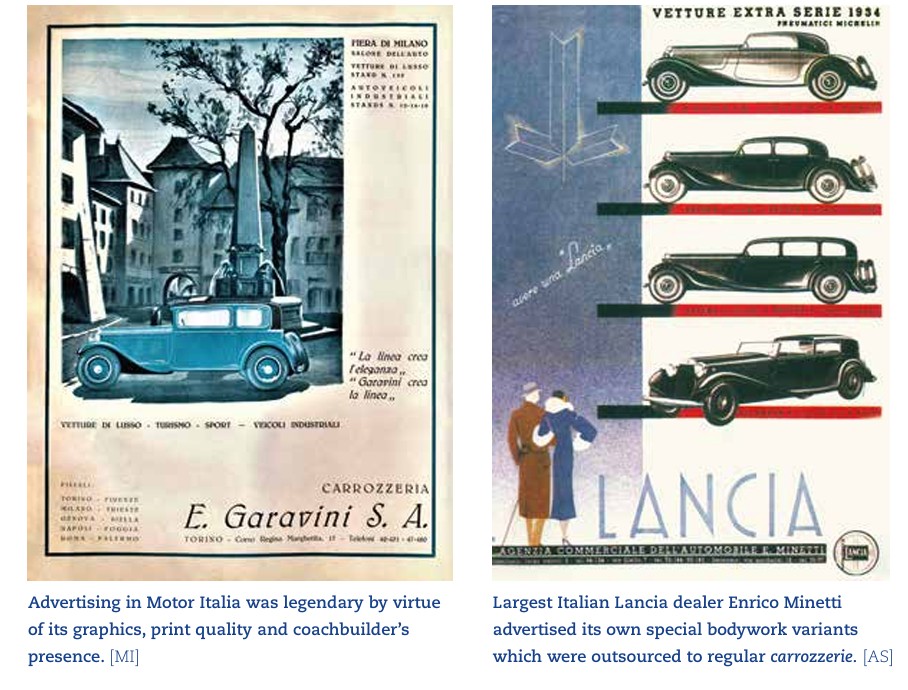
The list of Italian coachbuilders is impressive, Garavini being only one. Lancia dealers like Minetti also offered up their own versions of the latest Lancias.
With Fiat intent on mass production, Alfa into a few upscale sports models, and Isotta leaving the scene in 1932, it would appear that Lancia was the main beneficiary of the growing coachbuilding culture. While many of us, like this reviewer, all too often focus only on the post war Italian coachbuilders, Wim reminds us that the heyday of the Italian carrozzeria was between the wars. There was a vibrant, active, competitive environment in which dozens of coachbuilding firms, dealers, concours de elegance thrived. And in fact, from the early Fifties onward the industry gradually declined and this automotive ‘culture’ would disappear forever.
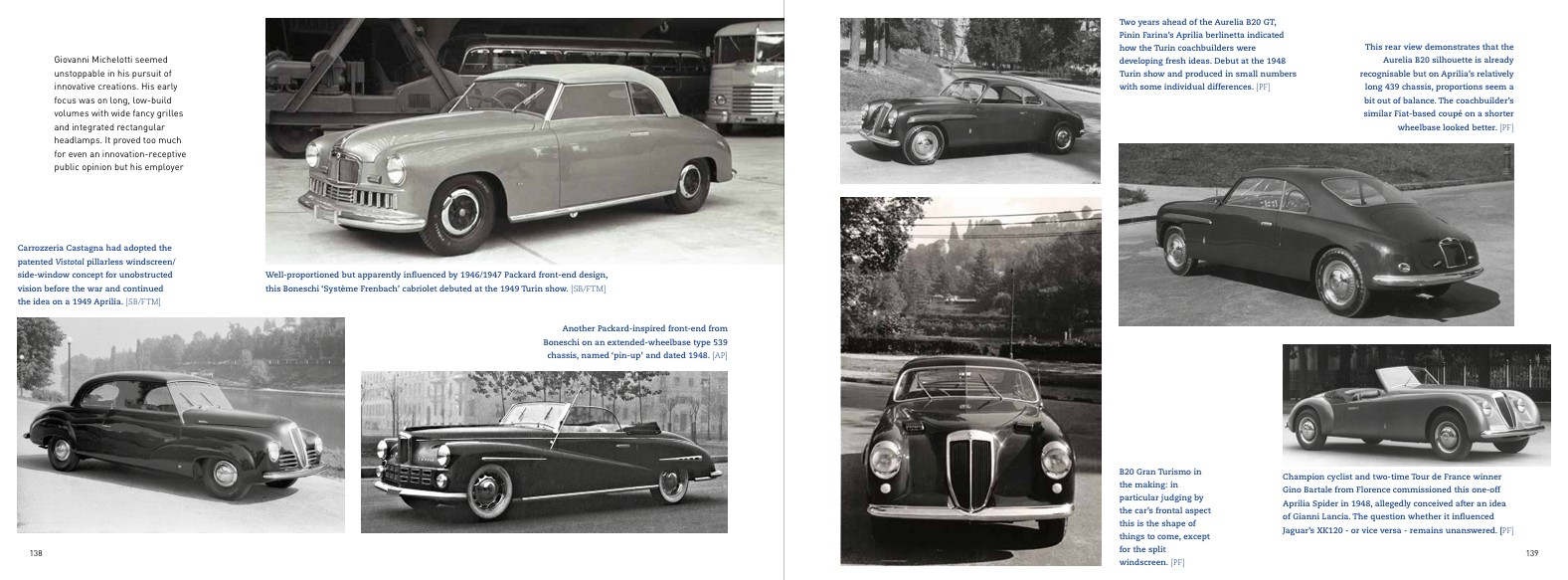
A surprising number of delectable post war Aprilias. Where are they all now?
Oude Weernink sorts this challenging terrain by breaking it up into chapters by Lancia model, with a few digressions. It works well, and of the 225 pages, roughly half are devoted to the prewar era, and we learn much. However, he does not neglect the Appias, Aurelias, Flavias, Fulvias and Flaminias of the post war era. Not a model goes by without displaying some coachwork hitherto unseen by these eyes.
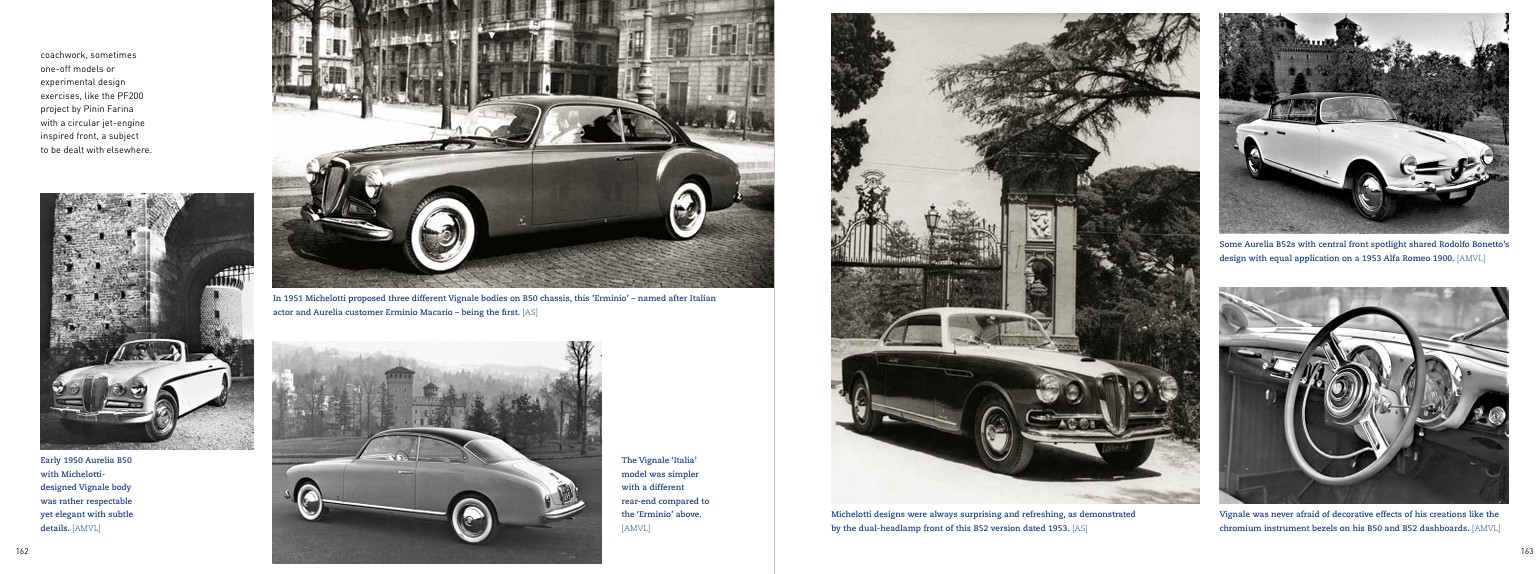
Squint. With each page, a new selection of special bodied Aurelias.
The end of the custom-built Lancias
As can be discerned by the title, the end of the era which began with the Lambda is called at about 1985, at a point where all the coachbuilders bar one or two have disappeared and Lancia as a significant marque virtually disappeared. Writes Oude Weernink, “The legacy of all coachbuilders who worked with Lancia seems obvious. Unfortunately, almost all the companies have by now ceased trading and the individual personalities who made it possible have passed away. The lost cultural heritage has left an enormous void, particularly in and around Turin. Even the traditional catwalk for individual coachbuilding, the Salone dell’automobile Torino, was discontinued in 2000.”
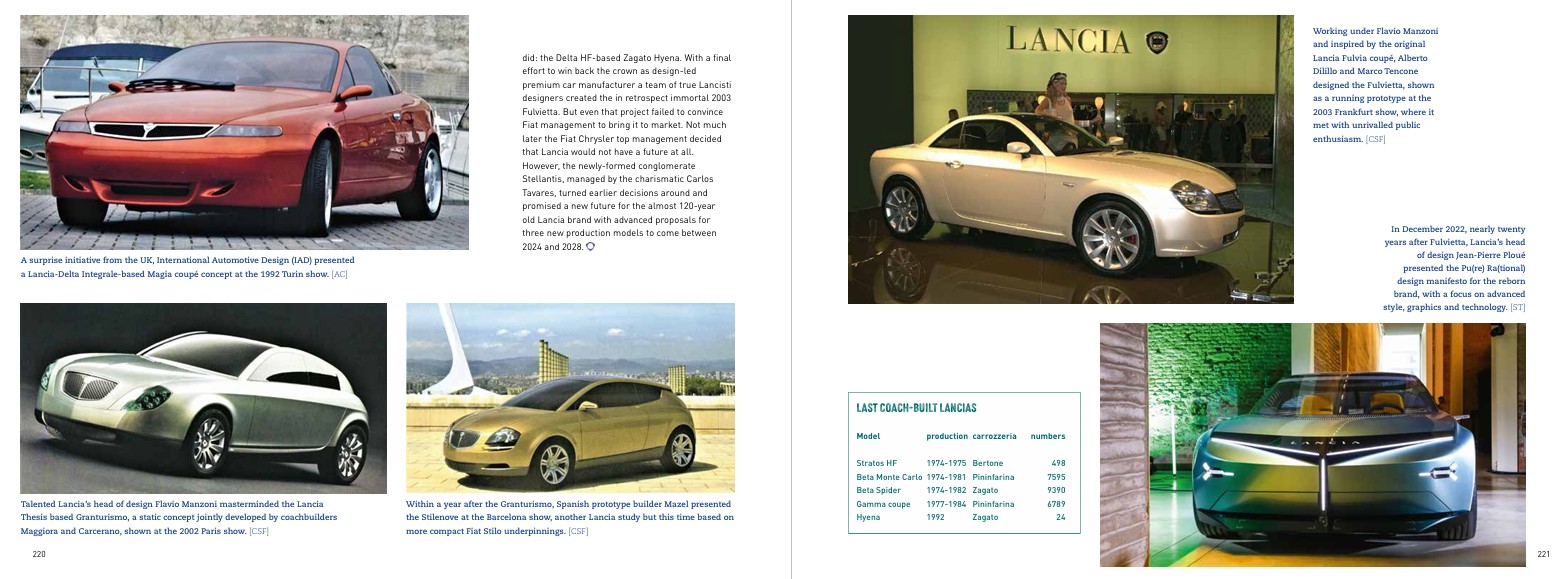
The last of the custom built Lancias
Retail price 80 euros plus shipping. It can be ordered at
https://www.historicar.be/en/product-category/lancia-en/
