
Gijsbert-Paul Berk in 2007.
By Pete Vack
Gijsbert-Paul Berk, Dutch author, artist, editor, administrator, journalist and VeloceToday contributor, has passed away at his home on October 29, 2025, at age of 95.

Behind the wheel of a Horch, 1933, age 3. Wrote Gijsbert, “In his endearing biography, Peter Ustinov reveals that as a young boy he honestly believed that he was a car. There are probably a number of subscribers to VeloceToday who recognize such a mental aberration from their own childhood; I, for one, found Ustinov’s admission very reassuring, because I remember going to school, always running and making brumm, brumm sounds, like changing into a lower gear for each street corner. Most adults along the route looked at me with bewilderment, certain that this small boy was quite mad.”
Gijsbert-Paul Berk was born in 1930 in Kampen, the Netherlands. As a teenager, Gijsbert-Paul witnessed the German occupation and the regular air raids by the allied air forces that made living in the larger Dutch cities, such as The Hague, rather unpleasant and dangerous. He recalled that “For this and other reasons my mother decided that I should go to a boarding school near the midsized provincial town of Zeist, in the center of our country. I very much enjoyed living there among boys of my own age, some of whom have become friends for life. But my interests changed drastically.” He never believed that the German army could cross the Channel and never lost faith in the final victory of the Allies. He became fascinated by electricity and the functioning of radios. The German occupiers had officially requisitioned all the radios of the Dutch civilian population and listening to the emissions of the BBC, or the Dutch language program Radio Oranje, equally broadcast by the BBC, could land one in prison.
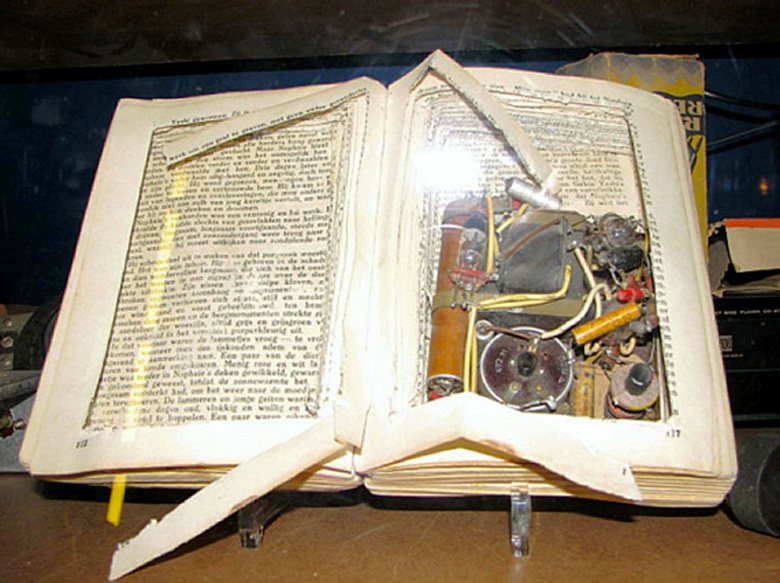
Wrote Gijsbert. “During the German occupation many boys of my age built Crystal radio receivers. Some were fitted in books or even bibles, because in these years was strictly forbidden for Dutch civilians to possess a radio set.”
“What better incentive for young adolescent boys than to build their own radio receiver! By reading old books and magazines I discovered how radio valves or tubes and heterodyne sets worked,” wrote Gijsbert. “But I began my new adventure by building a simple crystal radio or so called ‘cat’s whisker receiver’ and used the top part of an old telephone horn as a headphone. Its advantage was that you needed no electricity and could listen to it in your bed, hidden under the blankets.”
After the war, he studied at the Institute for Automobile Management IVA, Driebergen. Post graduate education included courses on industrial time-and production management at the HEC business school in Paris. He went to work as an apprentice for Maurice Gatsonides, (then involved in building Gatso cars), then to Paris to try his luck as a designer / draftsman for various coachbuilders, among them Saoutchik. But the French coachbuilding industry was on its last legs.
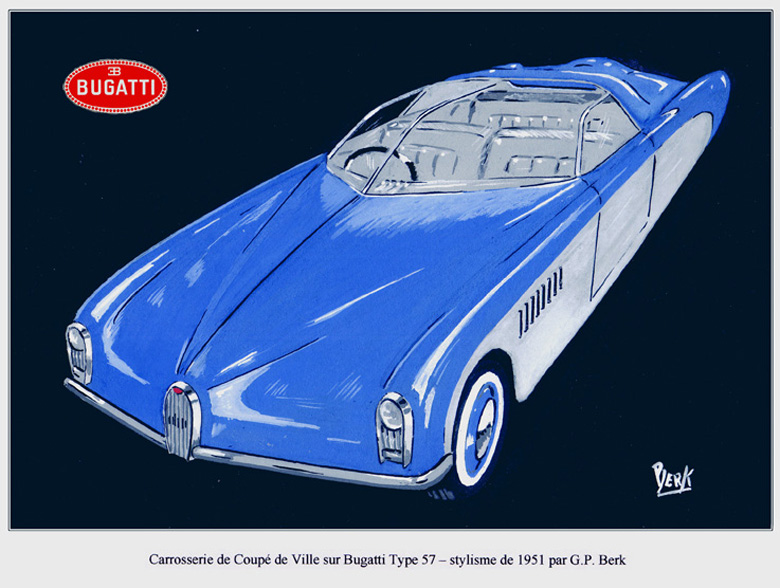
Wrote Gijsbert-Paul, “I was great a fan of Bugattis. This was one of the reasons why I designed this Coupé de Ville body for a Type 57 chassis. Of course I was inspired by the prewar designs of Jean Bugatti but tried to give the car a more modern appearance. I used the horse- shoe symbol not only as a fake radiator for the cooling intake but also as headlight covers. I did send a photocopy of these drawings to Monsieur Pierre Marco, then the Managing Director of Bugatti. However I never got a reply.”
Returning to the Netherlands, he found work as the assistant in the sports department of the Netherlands Automobile Club KNAC. He became involved in organizing rallies and the annual Grand Prix race on the Zandvoort circuit (Read Decision at Zandvoort). At that time he also started writing articles for De Auto, the magazine of the KNAC. In 1955 he joined Fred van der Vlugt, who had founded the magazine Autovisie, as technical editor and was the first Dutch journalist to road test the Citroën DS.
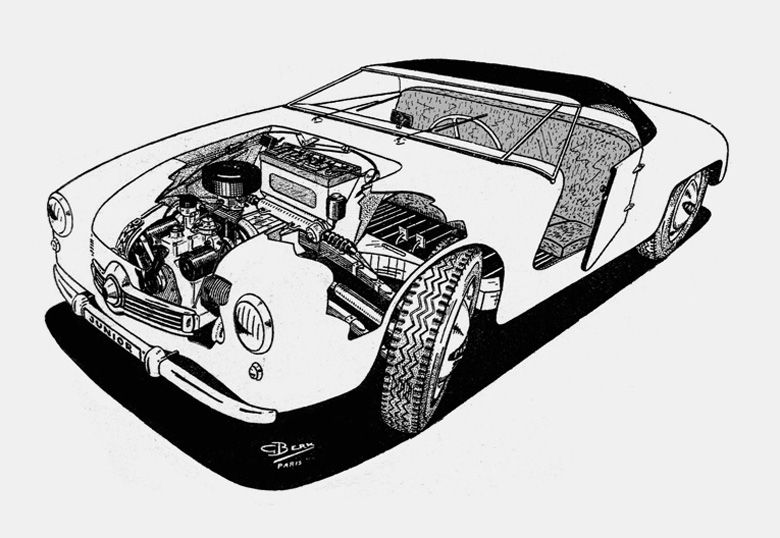
Gijsbert-Paul wrote, “My first article for the Dutch magazine ‘De Auto’ was a description and road impression of the recently introduced Panhard Junior. To illustrate the story I made this cutaway drawing, using a factory photo of the engine mounted in the chassis. The commercial manager at Panhard (they did not have a Press service) was quite impressed. The Editor in Chief at the Royal Dutch Automobile Club liked it as well and published it.”
From 1959 onward he worked as a freelance journalist, contributing amongst others to Car and Driver, Popular Mechanics and Auto en Motor Techniek also writing and translating books about cars and car maintenance. In 1966 he became Director Publicity and Marketing communications for Renault in the Netherlands. In 1973 he was appointed Deputy Director at the Amsterdam Exhibition and Congress Centre RAI, responsible for the communications of their exhibitions and trade fairs. In 1993 he was chosen as Secretary General of the FBTN, the Federation of Trade Fair Organizers in the Netherlands. He contributed to a TV documentary on the 50th anniversary of the Citroën DS and was for several years a member of the jury for the International Concours d’Elégance at Het Loo. After his retirement he moved with his wife Barbara to the Oise department in France. There he started writing again and produced the biography of André Lefebvre.
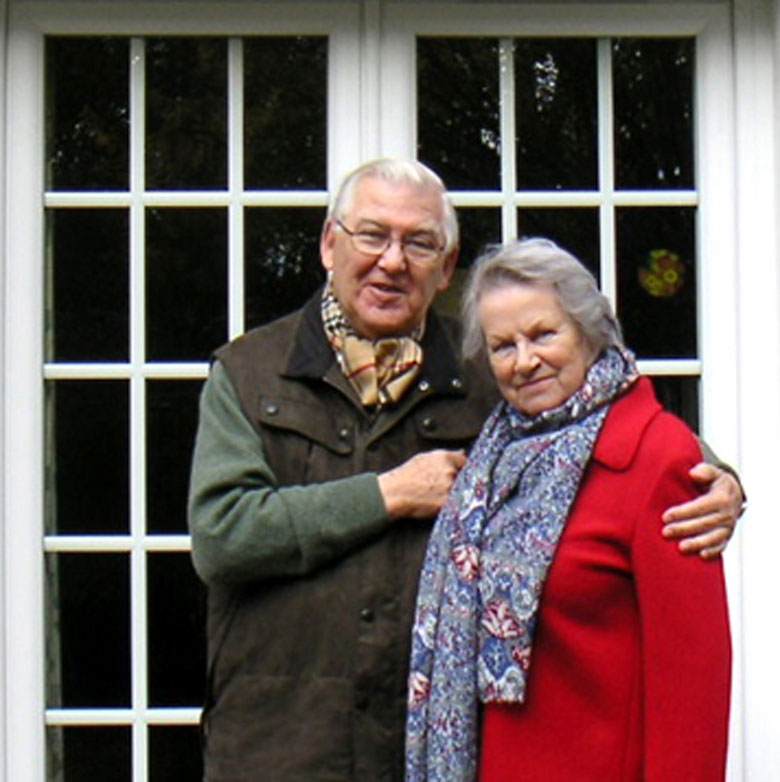
In 2011 with his wife Barbara.
Gijsbert-Paul Berk was a kind and generous mentor, contributor and supporter of VeloceToday since his book, “André Lefebvre and the cars he created for Voisin and Citroën” was reviewed by us in 2010. His first article for VeloceToday was The 1923 French Grand Prix in 2012, a massive 9 part series dealing with this epic race in depth. His last, in 2022, at the age of 92, Gijs wrote about his efforts to maintain his mobility. VeloceToday was blessed, for his list of accomplishments in the motoring world are legion.
Gijsbert-Paul wrote two excellent articles about his youth growing up during WWII in the Nazi-occupied Netherlands, and another about his hopes of being hired by French coachbuilders after the war. They are free and pdfs can be had upon request:
Gijsbert-Paul, like all really great journalists, was interested in the present and pondered the future, even while researching the past in depth. From 3D additive manufacturing to self-drive cars, he refused to let his passion for history get in the way of absorbing the latest, constantly reminding us that we must stay abreast of industrial and automotive news while immersing ourselves in the distant past.
‘Gijs’ wrote widely for VeloceToday. Here are but a few of his articles:
I cherish my copy of Gijs’ fascinating biography of André Lefebvre, purchased after reading about it on Veloce Today. I’m grateful that he was able to enjoy such a long, full, and generous life.