Introducing a new series of articles in VeloceToday.
By Staff
From now on, whenever you see the artfully constructed banner above in VeloceToday (thanks to Jodi Ellis), you know that you will be in for a treat. Think of the banner as a sub-website, a book or huge folder, or simply a cornucopia of great articles that fall under the heading of The Sports Car Craze that Changed America.
Under this banner we’ll publish special articles that address, in a variety of ways, the formative years of the sports and import car movement in the United States that was the basis for much of what exists today in terms of classic cars, clubs, vintage racing, events, auctions, media and a myriad of activities. We will stray, from time to time, away from Italian and French cars to present a wider perspective. We’ll use text only, text with images, photo galleries, slide shows, and even video to tell the story. There will be no beginning and no end, for the story is huge and multifaceted. You will forgive us if there is no organization, no table of contents, no timeline, but in keeping with the serendipitous nature that makes VeloceToday unexpectedly interesting.
Featuring The Photography of Robert Pauley
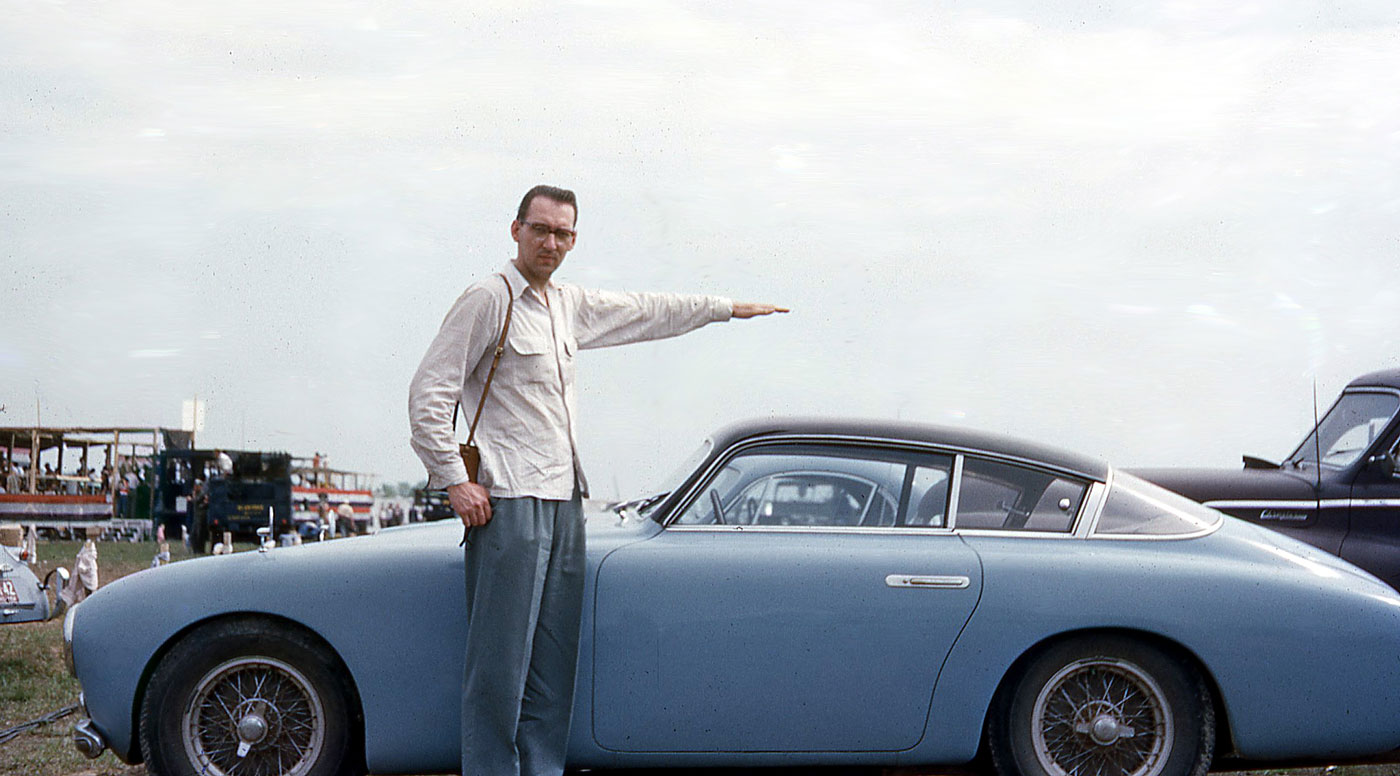
May 2, 1954. Six foot one, thirty-year-old Robert Pauley stands next to the 166 S Vignale bodied Ferrari, S/N 0065 Inter, indicating the low profile of the car. The event was the SCCA race at Andrews AFB, Maryland. The Ferrari was initially purchased by Inico Bernabei of Rome in January of 1951 and exported to Florida in 1952. Photo courtesy of Robert Pauley
In addition, we will use this format to present the photography of Robert Pauley, Glen Glendenning, and Frank Shaffer, who were all there to witness and photograph the early years of the sports car craze. All three photographers were telling us the same story from their own unique perspectives, and though they didn’t realize it at the time, what they handed down to us was the story of the sports car movement in America.
Featuring The Photography of Glen Glendenning
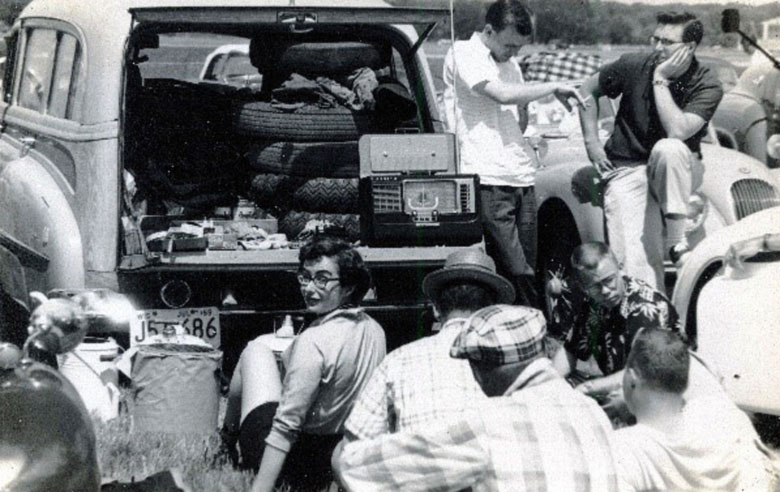
Glen Glendenning attended many sports car events from 1950 to 1958 and left an incredible photo album to Dave Rex. This is the scene at a SCCA race at Iowa City, May 30th, 1955. His pit crew is listening to the Indy 500 on the radio and they would soon hear about the death of leader Bill Vukovich who was killed in a crash while holding a 17-second lead on the 57th lap. Glen Glendenning photo courtesy Dave Rex.
We gave a lot of thought to the title, (originally to be a book) which evolved from the phrase ‘sports car revolution’. Was the fabled sports car movement in the U.S. a revolution, evolution, a trend? Just exactly what was it? To call it a revolution implies radical changes in the social or industrial fabric, and while it seems that it was important to many of us, whatever effect sports cars had on society or the economy, as Casablanca’s Rick might have said, didn’t really amount to a hill of beans. Yet the word ‘movement’ infers a clocklike change, stealthy and consistent; it wasn’t that either. Perhaps then, the word ‘craze’ might fit the bill, more exciting and bigger than the word fad, and one which fits the times (1946-1976) and the tempos we would be addressing. Hence, The Sport Car Craze that Changed America. Did it change America? Well, it was the harbinger of many small changes, almost all of them for the good. And if it didn’t change America, it certainly changed us and anyone reading these words.
Featuring The Photography of Frank Shaffer
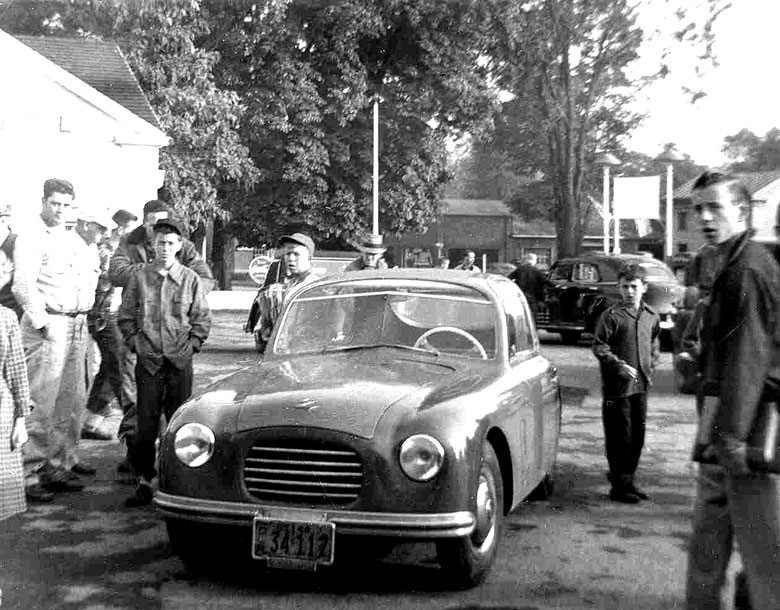
Watkins Glen, 1951, Zagato Panoramica. Frank Shaffer catches the bewildered look of the young men who don’t know what to make of the 1100 Fiat. It was only from Italy but might as well have been from Mars. Right after the war, Ugo Zagato made use of the new plexiglass material to create a series of ‘Panoramica’ cars which had a much greater window area. Both the Fiat 1100 and 500 Panoramica saw limited production at Zagato. Photo by Frank Shaffer
Only in America
VeloceToday has a worldwide audience, so why are we focusing on America? Because the United States was the main beneficiary of the post war boom, as well as the recipient of (and to some degree the cause of) the flowering of new and exciting automotive thinking and designs from Great Britain and Europe. The years from 1946 to 1976 saw the pinnacle of individualism and freedom in automotive design and technology, offering race oriented products that were both optimal in performance, styling and economy. These cars – mainly from overseas -, attitudes and lifestyles transformed the way Americans thought about cars, transportation, and racing.
So, in the weeks and months ahead, hang on as we take a lap around the United State to bring you The Sports Car Craze that Changed America!
Nice start. You’ve whetted my appetite for more.
Fantastic! Looking forward to this series.