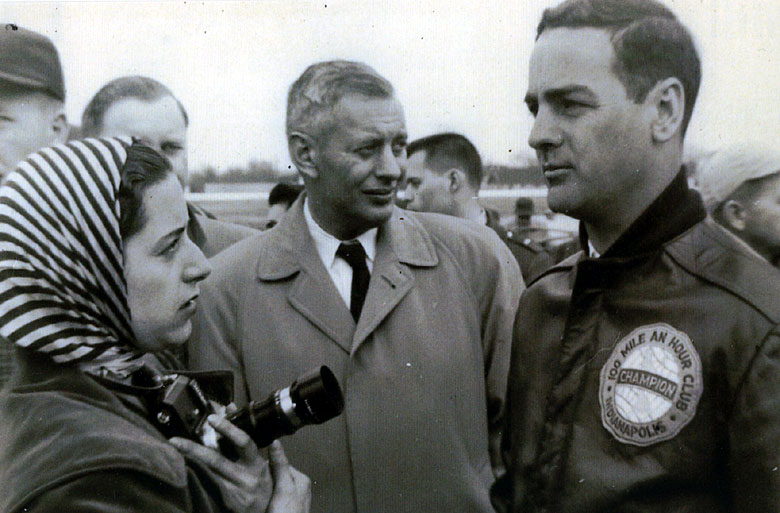
Bartley talks with Pat O’Connor at Trenton, N.J. She was reportedly the first woman journalist to obtain a media pass at Indy. Photographer unknown.
This week we learn about D.M. Bartley from Denise McCluggage, Karl Ludvigsen, and the Editor.
Denise McCluggage:
Diana Bartley wanted to be accepted for what she was, a hard-working, professional journalist when there simply few women doing that. People today cannot believe how rare women were even on large newspapers. Women might do interviews involving food or fashion or kittens-up-a-tree rescue stories but never hard news.
It’s unlikely Diana would have ever had written about cars for Esquire or edited the magazines she did if she hadn’t used her initials, ‘D.M.’ to blur her gender.
That’s the stupid way it was and I was experiencing the limitations, too. Women not allowed in the press box, or in the garage area at Indy for instance. But I never thought of the initials ploy! (Jim Sitz recalls an anecdote about Denise at a USAC race in Trenton, N.J. When she tried to get into the pits, she was told “No Ladies allowed!” She snapped back, “What makes you think I’m a Lady?”)
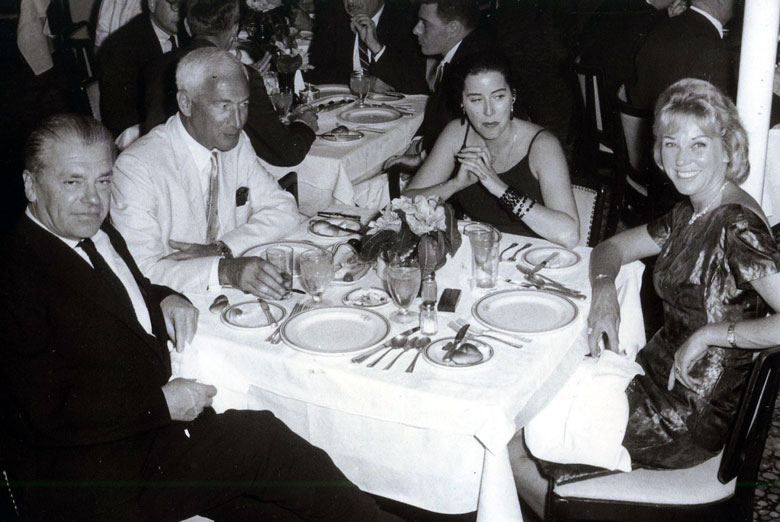
Nassau, 1961. From left, Uhlenhaut, Zora Arkus-Duntov, Diana, and Elfi Duntov.
I was in awe of Diana’s determination and, well, pluck. There was after all the matter of her disability. She required a crutch to get around but how she got around! Lugging cameras to boot. And, get this, her crutch became a fashion accessory — maybe polka dots to match a polka dot dress. Yes, dress. She did not use “initials” in person. She was a feminine presence, a beauty I thought, but she was always a serious pro. More so than I. Hey, I was having fun driving the races. I got to do that because I was writing about them.
Diana and I were friendly but not friends. I respected the reserve she showed me. I after all had come booming into her field. But my admiration for her was deep. She was really good at what she did and the car world was a better place because of that.
Pete Vack:
One of the more delightful stories about Diana Bartley was written by herself, recounting her adventures driving a two cylinder Rovin from Nice to Paris via Switzerland. Written in 1954, we are not sure of the date of the trip, nor in which magazine it was published. It was, however, found online many years ago, and fotunately the Editor kept a copy of the text and photos as found. She begins:
“This is not a story about a love affair with a car. Even now, three years later, I feel somewhat ambiguous about the 11-hp, two-passenger French Rovin I bought in Europe to drive from Nice through Switzerland to Paris. Instead, this is a story about a slowly acquired affection for my little bright-yellow automobile, which was the size of a child’s toy and so mechanically simple that no boy-child would have the least difficulty with it. I am not, unfortunately, either a boy or a child.”
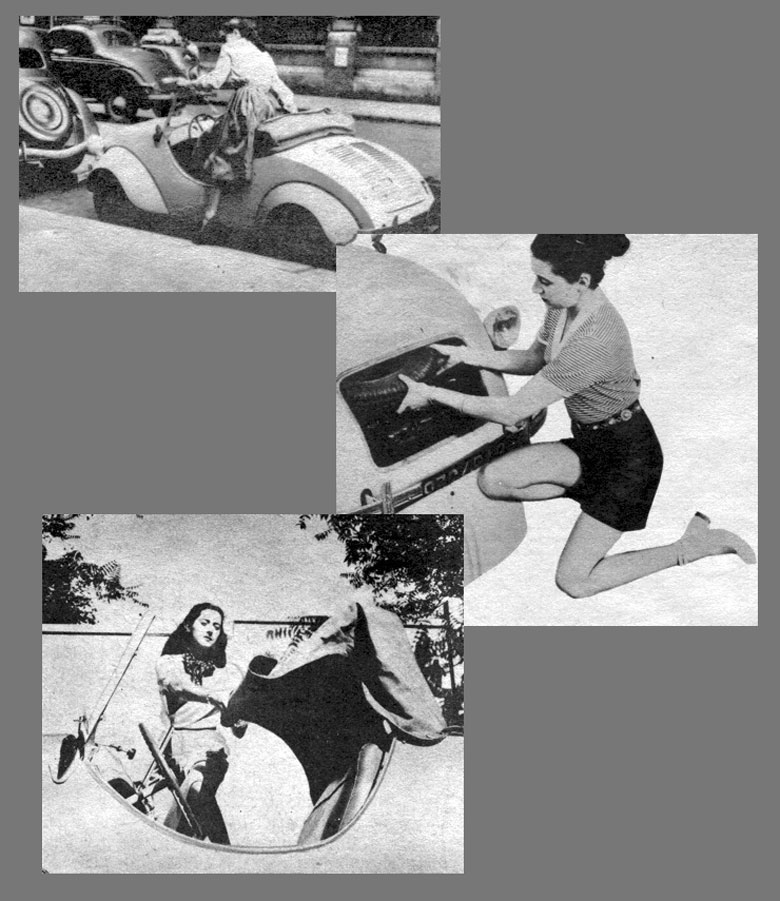
Photos that accompanied the article, showing Diana and her Rovin.
It was all downhill from there, and downhill is what the Rovin did best. Taking it into the Alps was asking a bit too much of the poor thing, and the story just gets funnier as she constantly breaks down and learns how to change a tire she can hold in one hand while cleaning distributor wire leads.
“They warned me earnestly not to try any of the surrounding mountains with the car. I asked how they suggested that I get out of Geneva, which is ringed by mountains, and how they thought I got there in the first place. In answer to the first question, they said perhaps I’d just better stay. In answer to the second, they shrugged a “grace of God” reply.”
She eventually arrived in Paris with the car, where it was more at home with the cut and thrust of traffic.
“But for all the greasy hands, gravel-scarred knees, rain-ruined clothes, and endless annoyances I suffered with my Rovin, in retrospect she looks pretty good to me. Quite honestly, she provided me with more fun than trouble, was a great convenience in the large and sprawling city of Paris, gave me a pleasanter and closer view of the French countryside that would have been possible any other way, and taught me more French than any high-powered American car or guided tour could have. Not only did I get to know her, but I acquired a sort of irritable affection for her – and I still miss her.”
We have provided a link to the complete article:
Rovin, An American Tourist in France
Karl Ludvigsen:
In front of me I have the typescript of the first article that I wrote for commercial publication. Titled “Bugatti and the Future”, it speculated about the design of the new Grand Prix car that Bugatti was building for the 1955 season. This is pretty abstruse stuff. What put this exotic bee in my bonnet?
It was the autumn of 1954 and I’d just arrived in Brooklyn to start my studies in industrial design at Pratt Institute. All the wonders of New York City lay before me, just a subway ride away. This included tiny mid-town bookshop R. Gordon, specialists in automotive books and magazines. Needless to say I soon became a good customer.
Among my early purchases at Gordon’s was a copy of Bugantics, yellow-jacketed organ of the Bugatti Owners Club. Its editor reported on a journalistic coup, a visit to the Bugatti factory at Molsheim during which he was allowed to photograph components of the new GP racer’s engine. He also published specifications of the coming Type 251, though they were noncommittal about the car’s layout.
Intrigued by design features of the engine parts he depicted, I set about the first of my many photo-interpretation efforts. It was clear from the design of its crankcase that power would be taken from the center of the crankshaft of the Bugatti’s straight-eight engine instead of from the end as usual. I commented on this in my article, noting a similarity with the straight-eight engine of the Mercedes-Benz W196. In the French car’s case I speculated that the engine would be rear-mounted, probably longitudinally.
I indulged in further speculation about the potential of Bugatti’s design. “It would now be possible to derive real benefit from a transverse rather than a longitudinal orientation of the crankshaft,” I pontificated. I stopped short of suggesting that this was the actual design of the Type 251, but readied some sketches of what I thought such a transverse-engined Grand Prix car could look like. I laid its engine flat, its cylinder heads facing forward.
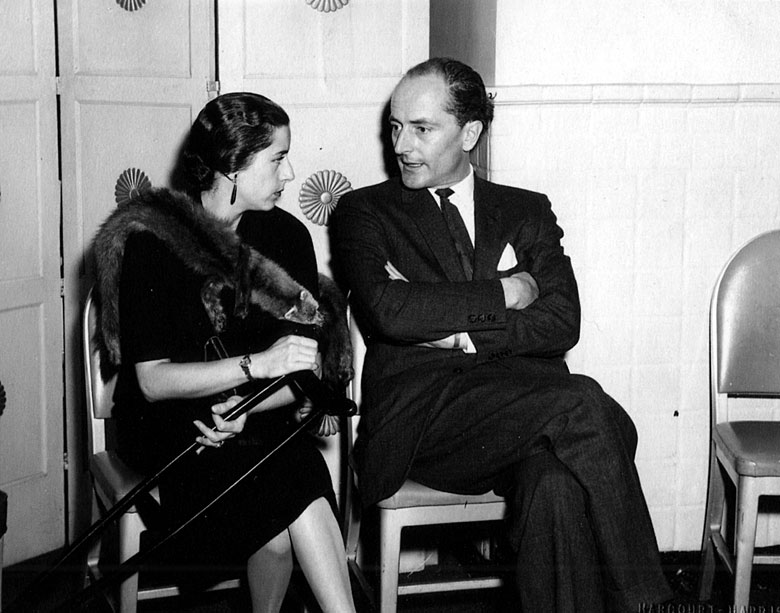
This is a telling photo. With Diana is Mercedes Benz executive Marcus Clary. Notably in other photos of Diana, one does not see her crutches. Look carefully and you will see that she is holding a crutch in this shot. Photo by Harcourt-Harris.
Here was a pretty esoteric eight-page article, written in my garret room at 220A Willoughby Avenue. What was I going to do with it? It would make sense, I thought, to contact a car magazine based in New York. At the time there was only one of consequence, Auto Age. I sent off the story and my proposed illustrations and awaited developments.
Some days later I was called to the phone by my landlord. On the line was Harvey Janes, one of the editors of Auto Age. The Bugatti story wasn’t up their street, he said, but they might be interested in other articles by someone who seemed to have a grasp of car technology. Could we meet? Could we! I arranged to see him at his Manhattan office.
At the controls of Auto Age I found two editors. One was the bespectacled Janes, an affable character with a nice line in irony. The other was a glamorous brunette, Diana Bartley, entirely at home in the world of cars. Between them they assembled the eclectic content of this wide-ranging monthly. Grand Prix Bugattis weren’t in their line, they explained, but they were looking for someone to write technical stories for them. They were willing to take a chance on this 20-year-old industrial-design student.
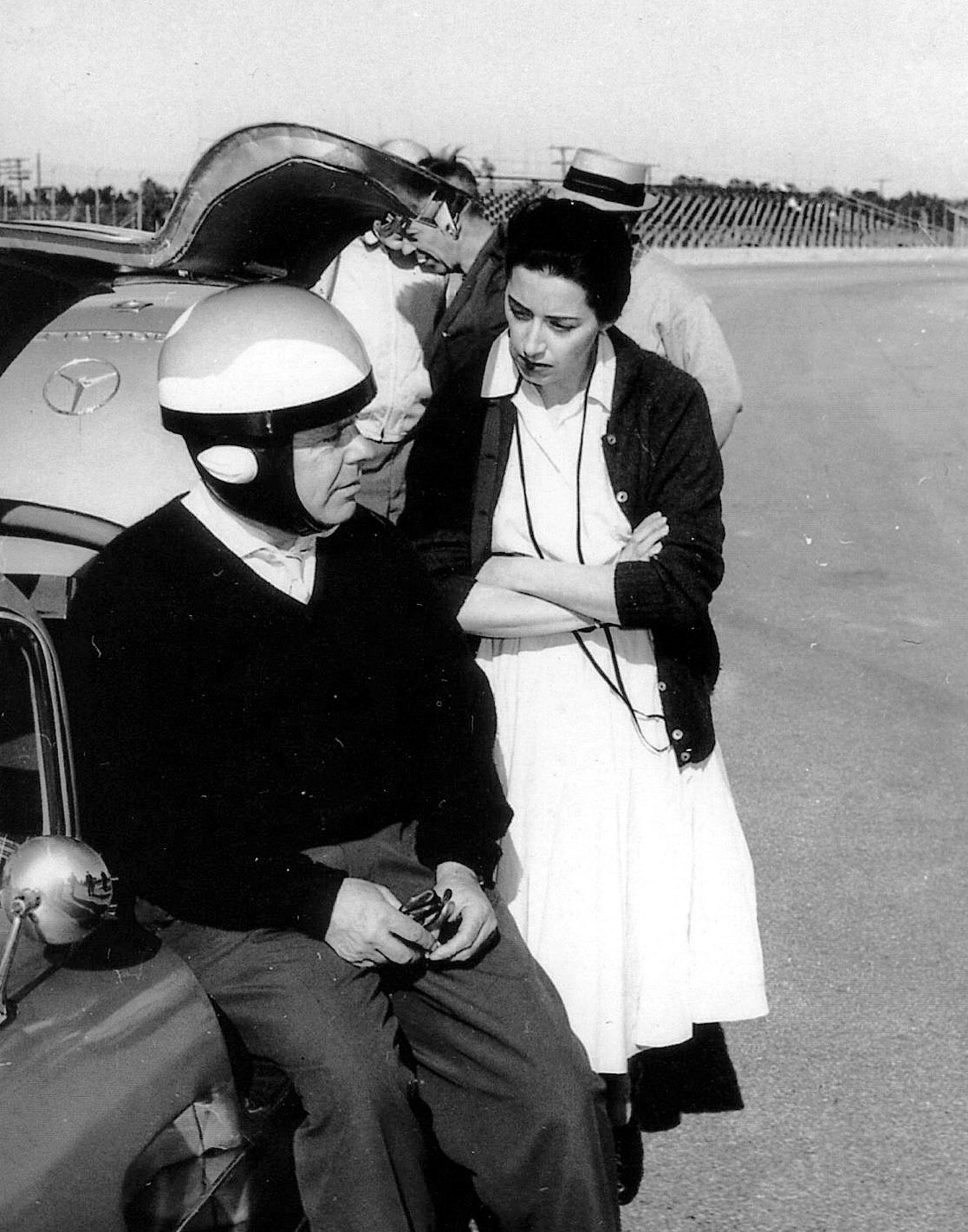
With Rudolph Uhlenhaut at Daytona.
We talked about topics and settled on — of all things — an article about rear axles for my debut. I was interested in another theme, I told them. That summer I’d visited Ford as a guest of a Blue Oval executive, Fred Goodell, a friend of my father. He gave me a tour of the proving grounds in Dearborn, the compact site that once was Ford’s airport. Driving around, we saw a prototype that was unmistakably the coming Lincoln Continental. The subject of great speculation, this ultra-luxury model wasn’t expected on the market until 1956.
From my recollection of the car I thought I could produce some reasonable drawings of the Continental-to-come. The Janes-Bartley team thought this would be a great idea. They cautioned, however, that I might not want my name linked with the story as it would be obvious that Mr. Goodell was responsible for the leak. I know now that such an indiscretion would have had little impact, but back then such scoops were rare and thought to have heavy consequences in Detroit’s executive suites.
Enter Eric Nielssen, a suitable pen name. He had a byline on the axle story while the Continental sneak peek appeared anonymously. Before I knew it, I, or Eric, was on the masthead of Auto Age as technical editor and busy writing articles for the magazine as the alter ego of a student at Pratt hip-deep in his design projects.
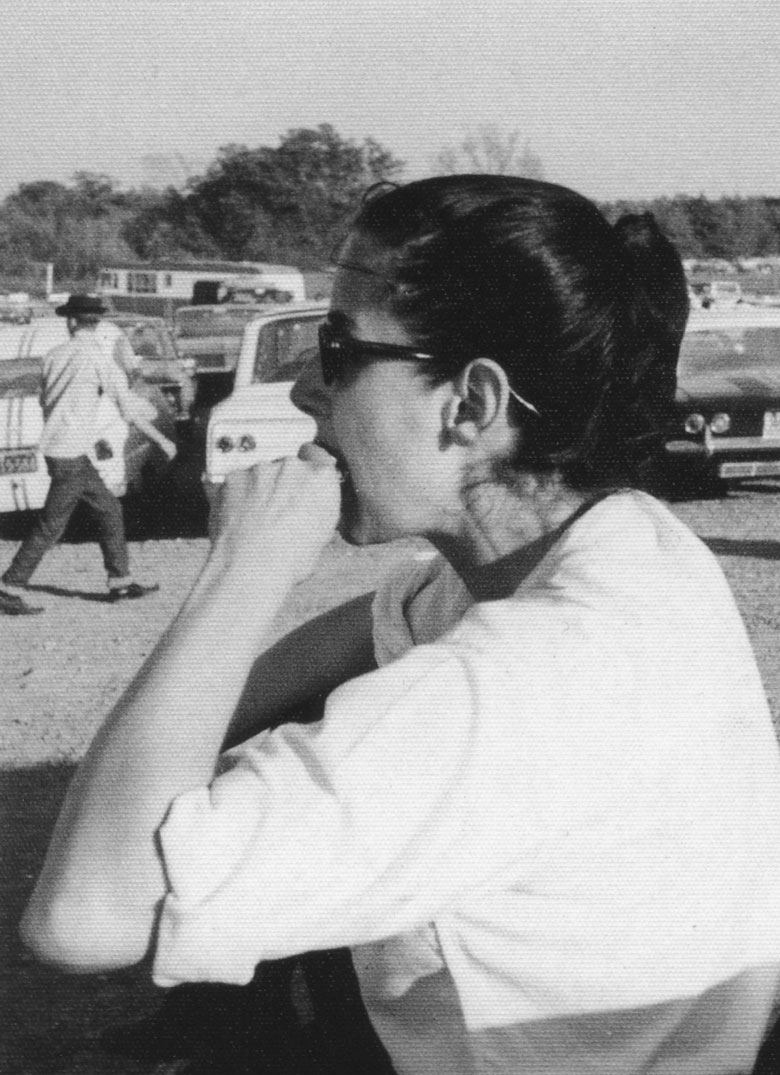
Note on the back of this photo: This photo was taken by Ken Purdy after the U.S. Grand Prix at Watkins Glen, October 6th, 1963.
Thank you Pete and your assembled writers for bringing this piece of motor racing history to us. I remember reading Diana’s reviews of the European racing scene in Competition Press before the days of saturated coverage by the Internet and TV.
Any idea what Rudi was doing with the SL at Daytona ? Great article thanks for the insight on a remarkable woman
Thank you for this assemblage of wonderful story-telling and close look at Diana Bartley’s life and place in motorsport editorial. This is truly 5-star material.
Hi Guys – Thank you or these wonderful stories. I inherited a load of magazines a while back, including some copies of Auto Age. I wondered what they would be good for being more acquainted with the usual, Road & Track, Car & Driver, Sports Cars Illustrated and Sports Car Graphic issues. Well, I just looked at the table of contents in an issue from June, 1956, and voila – an article by Eric Nielssen about independent rear suspension – Great! This is why I never throw away old magazines!
What a nice article about a good automotive journalist. I can help but notice that Karl Ludvigsen wrote 8 paragraphs about himself and 4 about Diana. I wish he’d written more about Diana.
I certainly have enjoyed this sequence about a journalist I had never known. My loss! One thing off-topic really took me back to my youth though: Karl Ludvigsen’s mention of R. Gordon and Co. When they began advertising the Merit model Grand Prix car kits, they became the Mecca of auto racing items for me. I quickly had their name and address memorized and said it almost as one word: “R. Gordon and Company, 32 East 59th Street, New York 22, New York.” As you see, I have never forgotten it. Dad ordered my first kits, and then more. When my parents announced to me that we would be going east for the first time on Dad’s vacation, I was overjoyed, insisting that we go to “R. Gordon and Co, 32 East….22, New York.” They kept their word, and of course it WAS the high point of our vacation for me, among so many glorious attractions we saw. I could not believe the treasures that were packed into that tiny store and can still see it in my “mind’s eye” well over sixty years later. I left with several die cast Italian models, a couple more Merit kits, and several issues of “Motor Sport,” and other magazines. Unfortunately, I never returned, but I treasure that visit to this day.
Mike – listen to Karl’s interview on Cars Yeah, it will confirm your observation, have several of his books, all excellent.