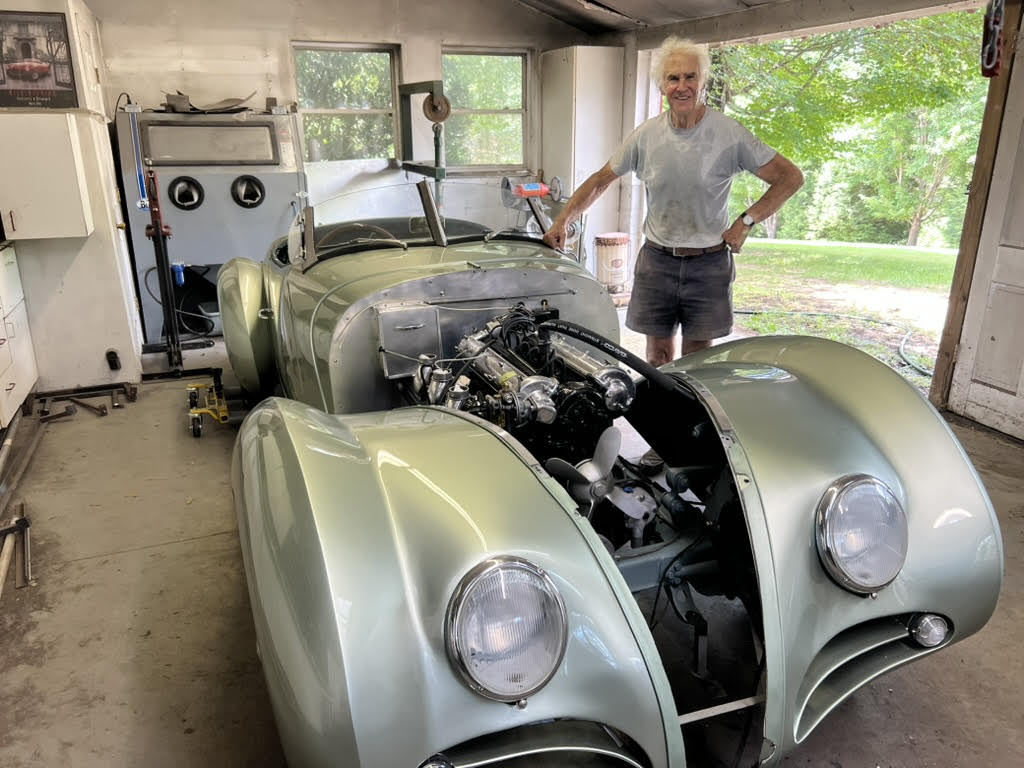
After a long hot summer.
This is part 9 in a series of articles by Paul Wilson. Click here for Part 8 and links to Parts 1-7.
Story and photos by Paul Wilson
As a self-taught amateur, when I can’t fix a mechanical problem I imagine a Real Expert saying, “Oh, that’s easy,” and solving it effortlessly. I’ve learned that such Experts are rare, but I’m still embarrassed that I have such trouble with apparently trivial puzzles. So I squirm a bit as I tell this part of my car’s story. It’s a confession of ignorance.
A year ago I promised to bring my Alfa 6C2500 roadster to Lime Rock’s Sunday in the Park, on Labor Day weekend. I had a whole year, just for the final assembly and installation of the engine. How hard could that be?
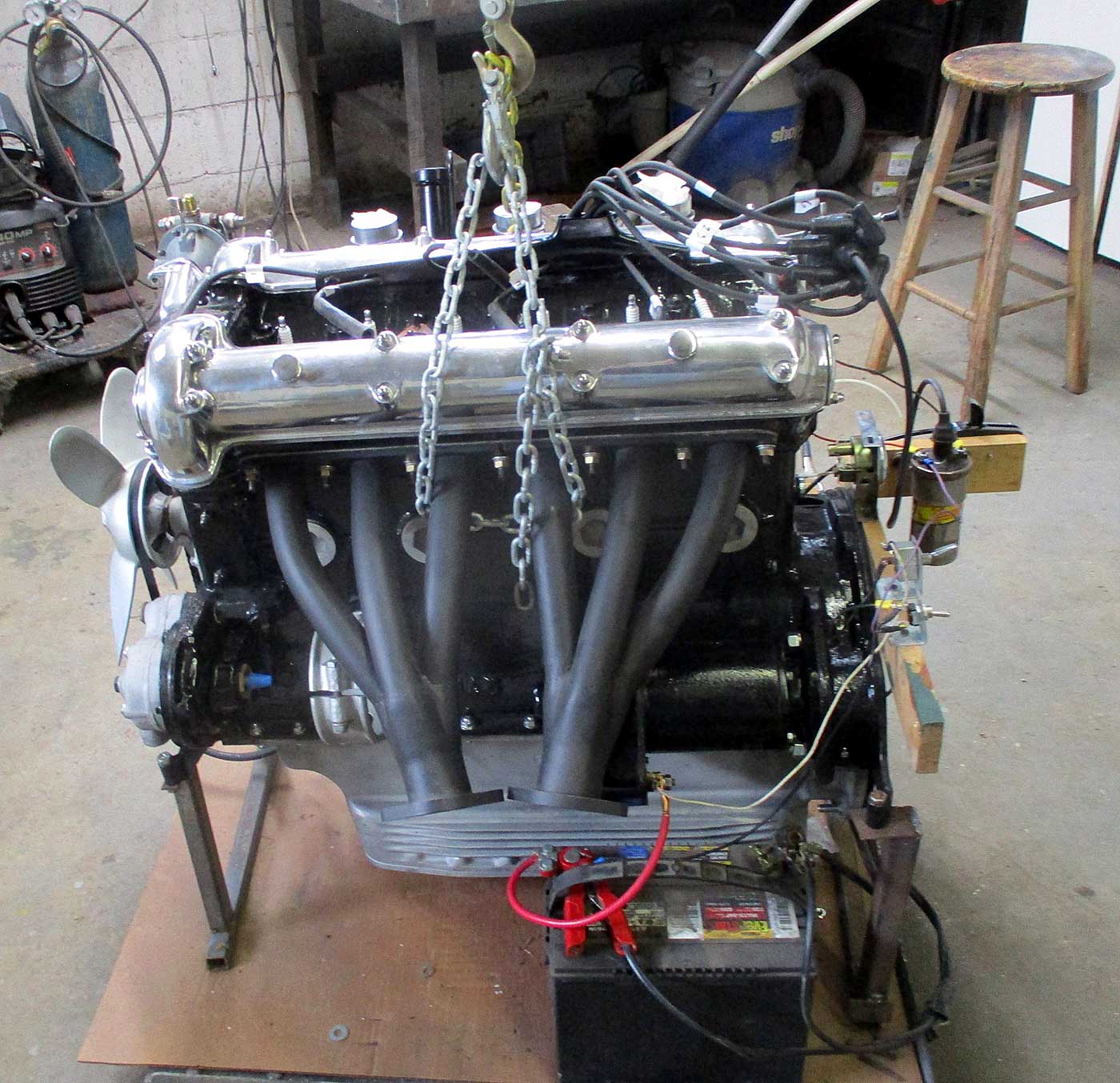
The engine, promised no later than Thanksgiving, was finally ready in May. Twice it had been nearly finished, only to have unexpected issues (no oil pressure, for one) that required disassembly. When I picked it up, I told the shop owner I had to get it all done by Labor Day. He responded with a hollow laugh.
I wanted to run it first on a test stand, where everything was accessible and leaks could be easily spotted and fixed. I made a stand and left the lifting chain in place to prevent it from tipping over.
Next I found six or eight threaded holes in the block and crankcase. What were these for? I had no idea. Like other fasteners on this car, some of them were unusual sizes or threads. The bellhousing bolts are M9 x 1.0, for example. These aren’t available from the usual suppliers. I got some from China, via special order. Most of the mystery holes opened into the unpressurized cooling system and I found enough plugs to fill them. But I knew from my other engine that one large hole contained an oil filter. I didn’t have the cast cover, and full oil pressure from inside made a good seal essential. As a temporary fix, until I could find this rare part, I put in an expanding plug.
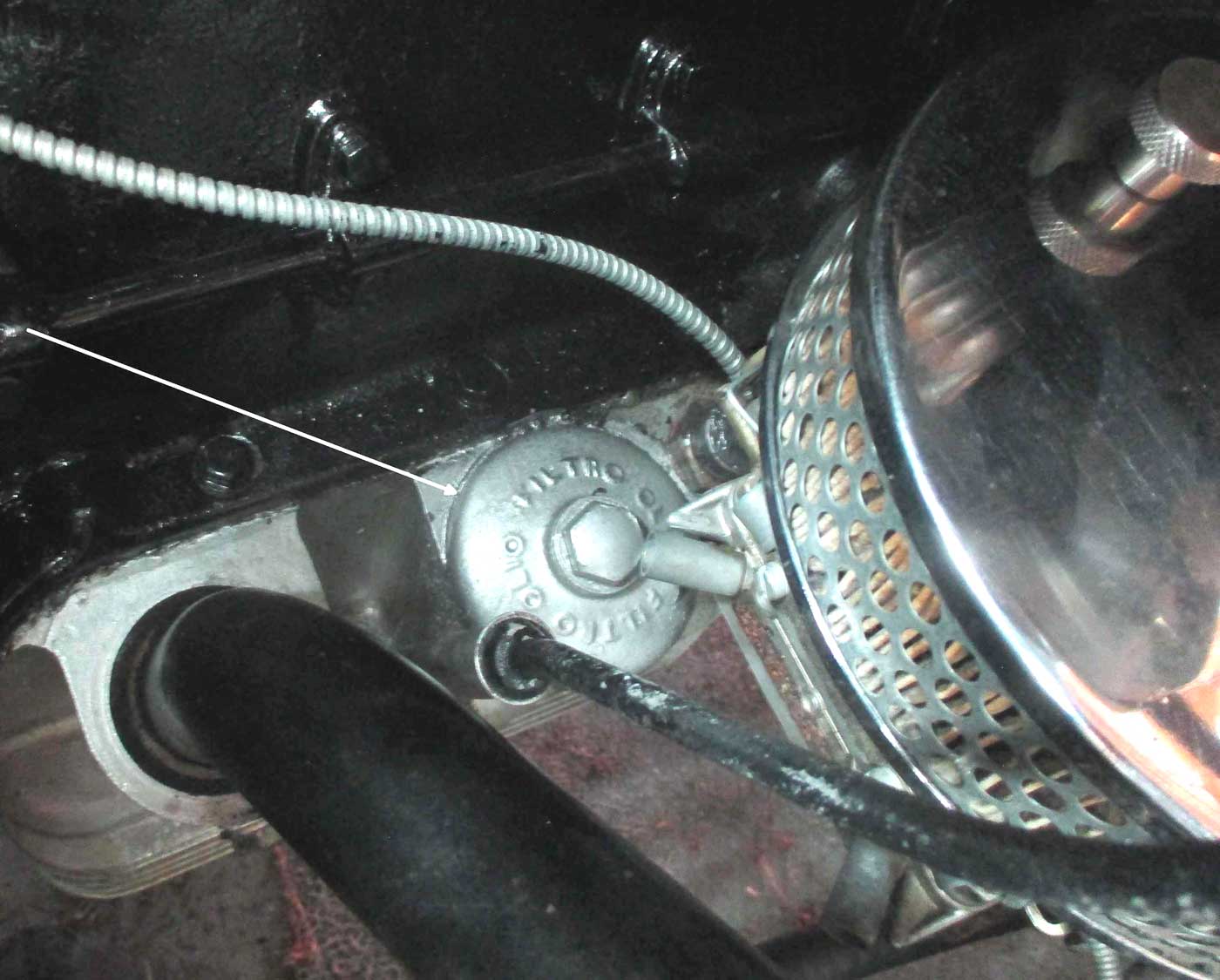
The oil breather and filter on my other 6C 2500 engine. This has a dipstick between the breather and filter.
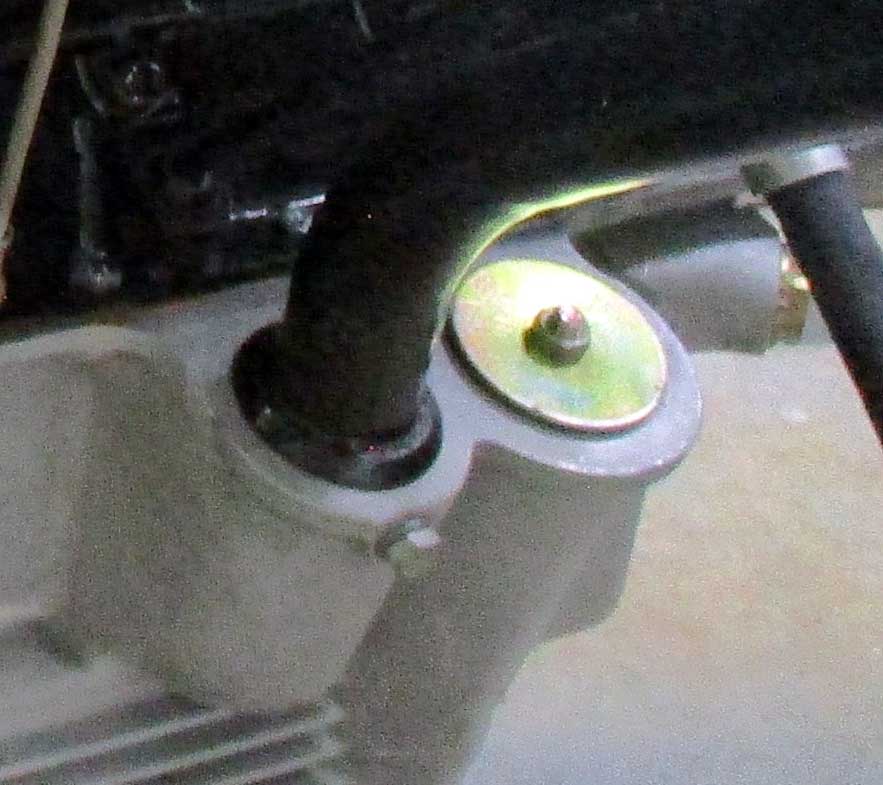
On the Roadster’s 6C 2500 sump, there is no dipstick and note the temporary plug to cover the hole for the missing oil filter.
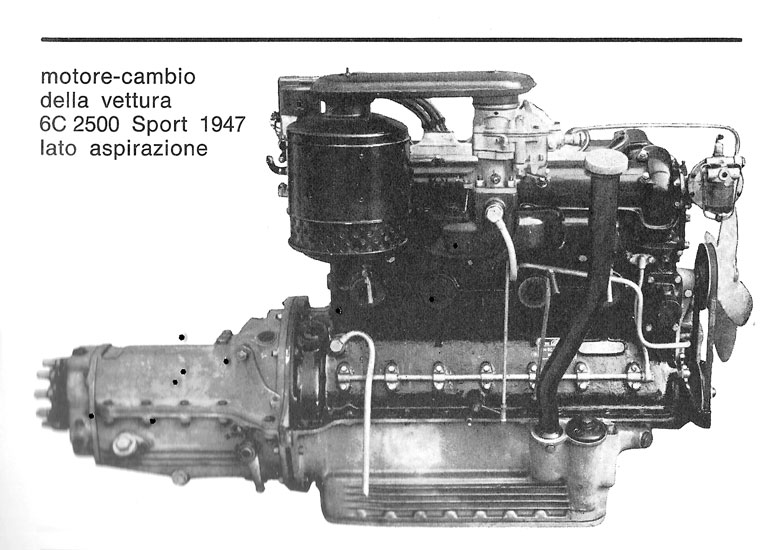
Intake side of a 6C 2500 with a single carb manifold. Note the position of the breather tube and oil filter. (Fusi)
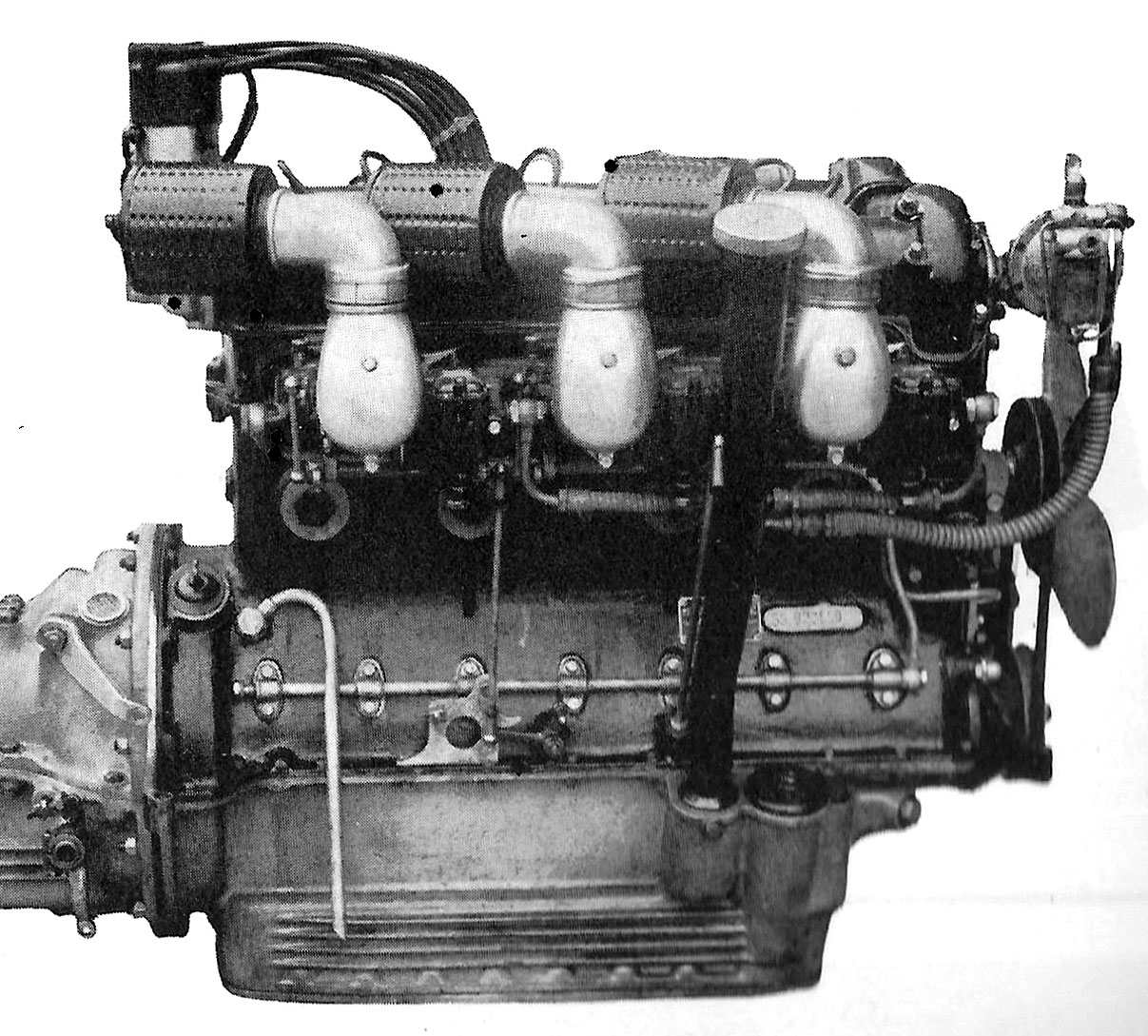
intake side of a 6C 2500 with the three carb setup. (Fusi)
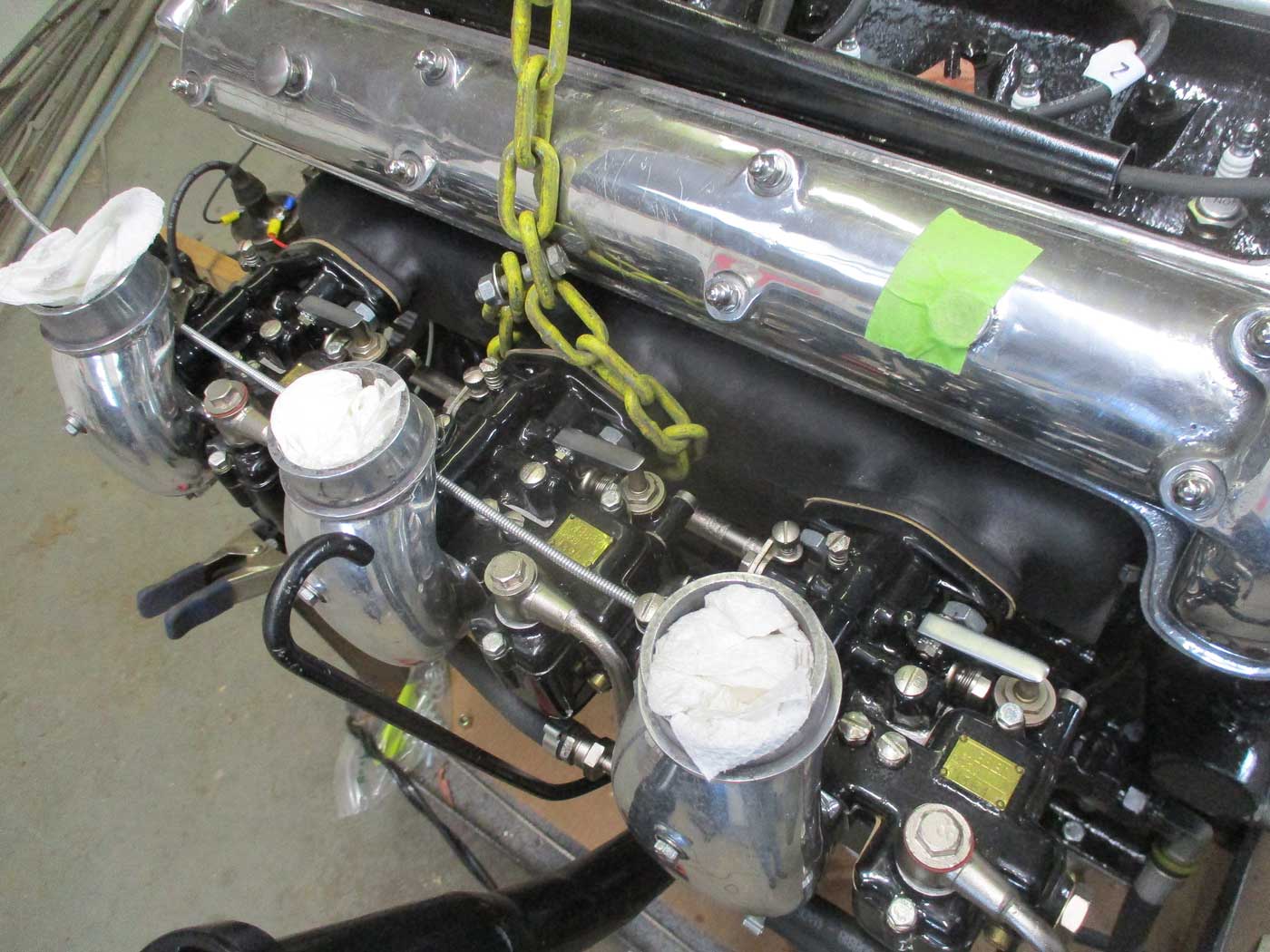
There is a set of 36 DO2 Webers on the internet for sale at $20,000. Yes, four zeroes. Proceed with great care. Soft metal strips easily.

Next came the assembly of the intake manifold and carburetors. I expected to slip the manifold over the studs, then tighten some nuts. But no. I had a triple carb setup, this head was made for a single carb, and the studs were in different places.
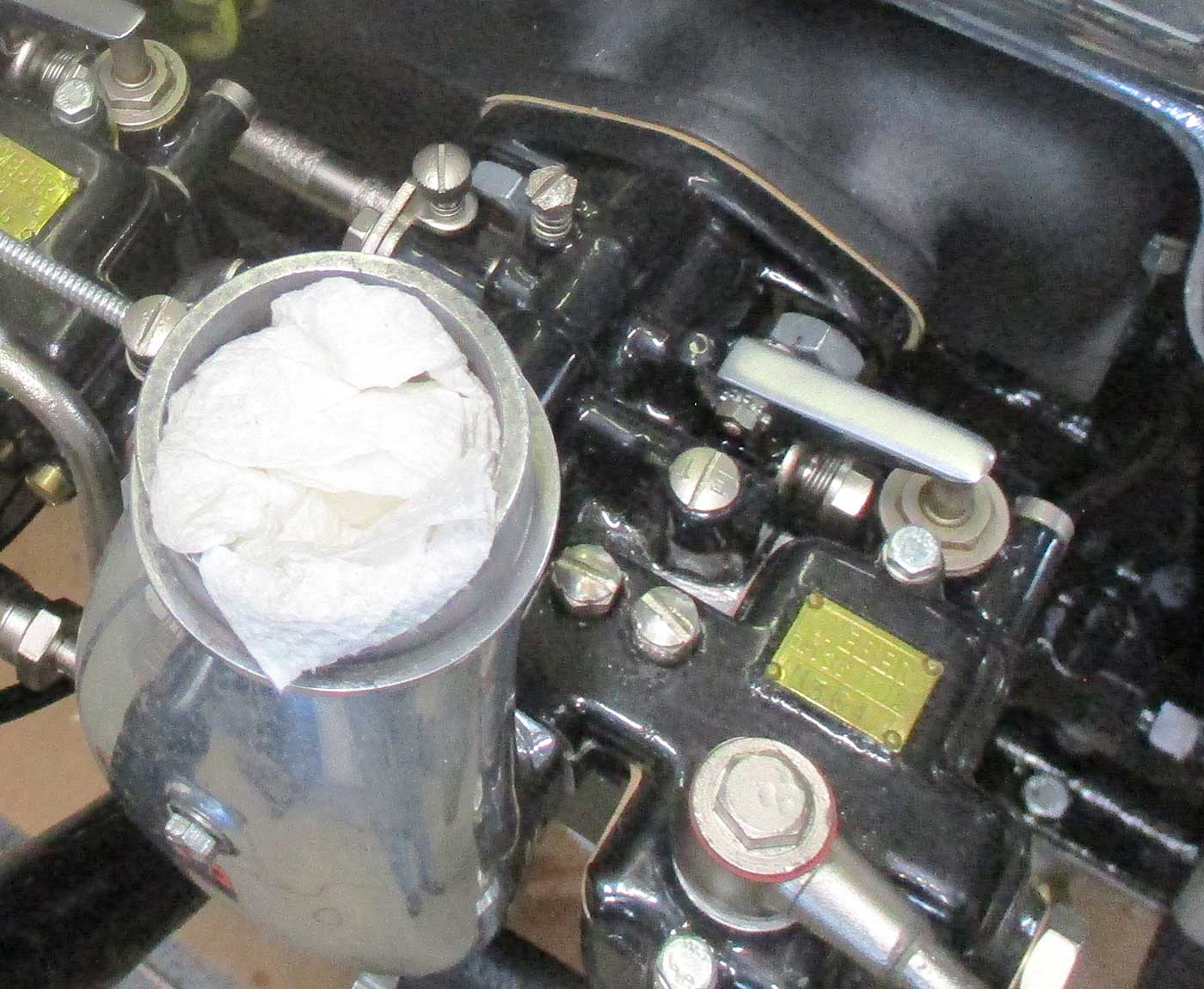
A close up of the Weber and manifold. The head needed new holes drilled to accommodate the studs for the three carb manifold.
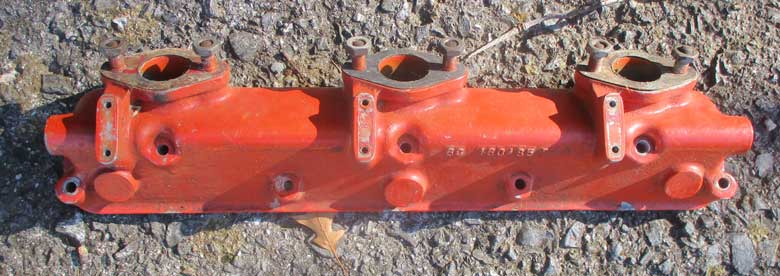
The 6C2500 three carb manifold. The studs were OK for the four lower holes, but not for the top three. We’re not out of the woods, yet.
So I had to drill and tap the head for the studs I needed. Next I put on the carbs. The linkages (original, unlike later ones) have ball joints with spring clips; most of the clips were missing. Mike Pierce sent me a couple, which is all he had. Mike not only knows more about Webers than anyone else alive, but is also one of the nicest–a priceless combination, for anyone needing help with rare Webers. I modified spring clips from ballpoint pens to make the last clips I needed.
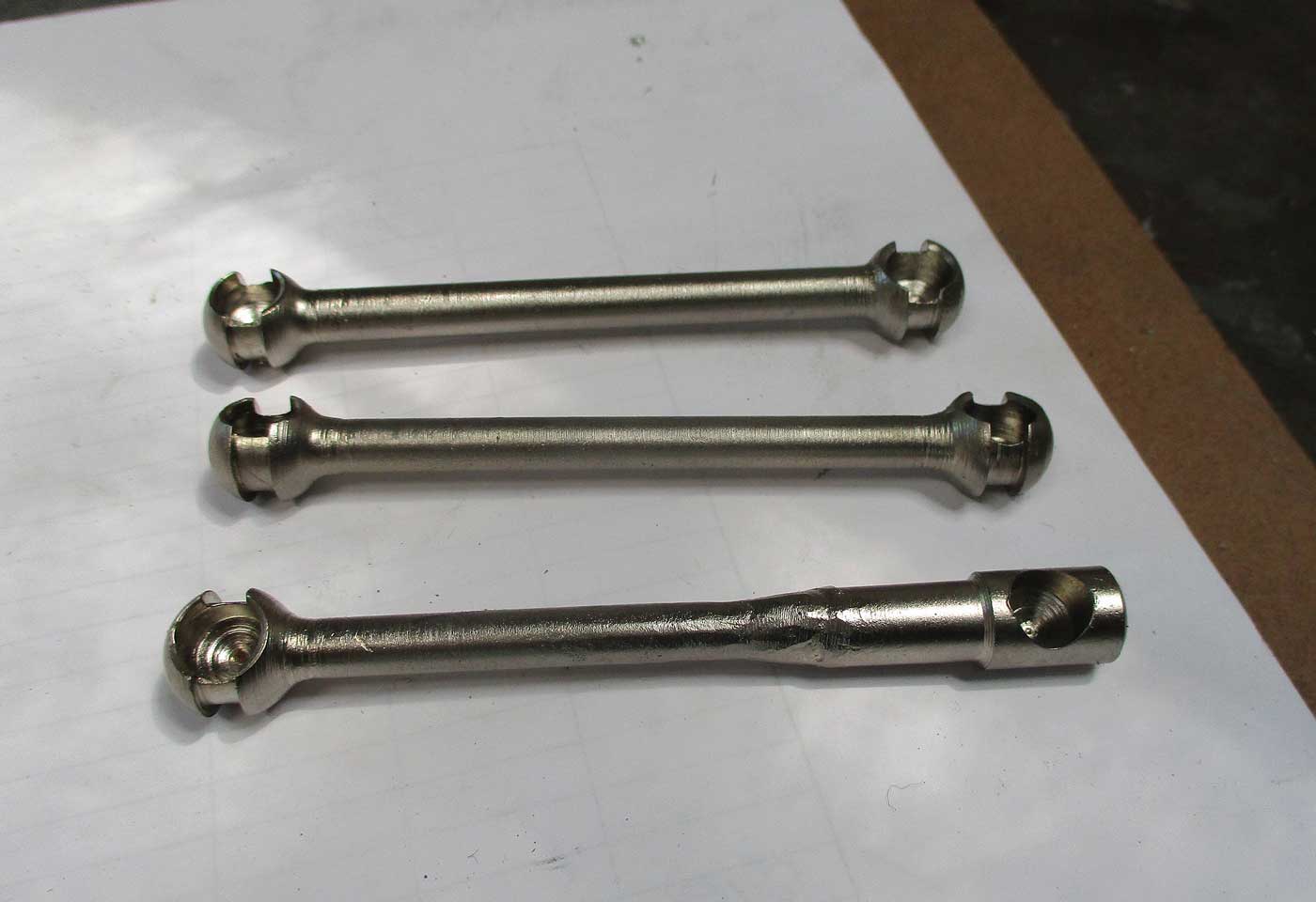
Three very sturdy carb linkages needed springs that hold the linkage to the adjacent ball joints. Of course they too are extremely rare.
More stressful drama lay ahead. Sets of Weber DO2 carburetors have sold for tens of thousands of dollars. Mike had beautifully rebuilt mine, but I was scared to touch them. Not only are they irreplaceable, but they’re made of soft metal. At the top, metal fuel lines lead to banjo fittings, tightened onto each carb top by special bolts.
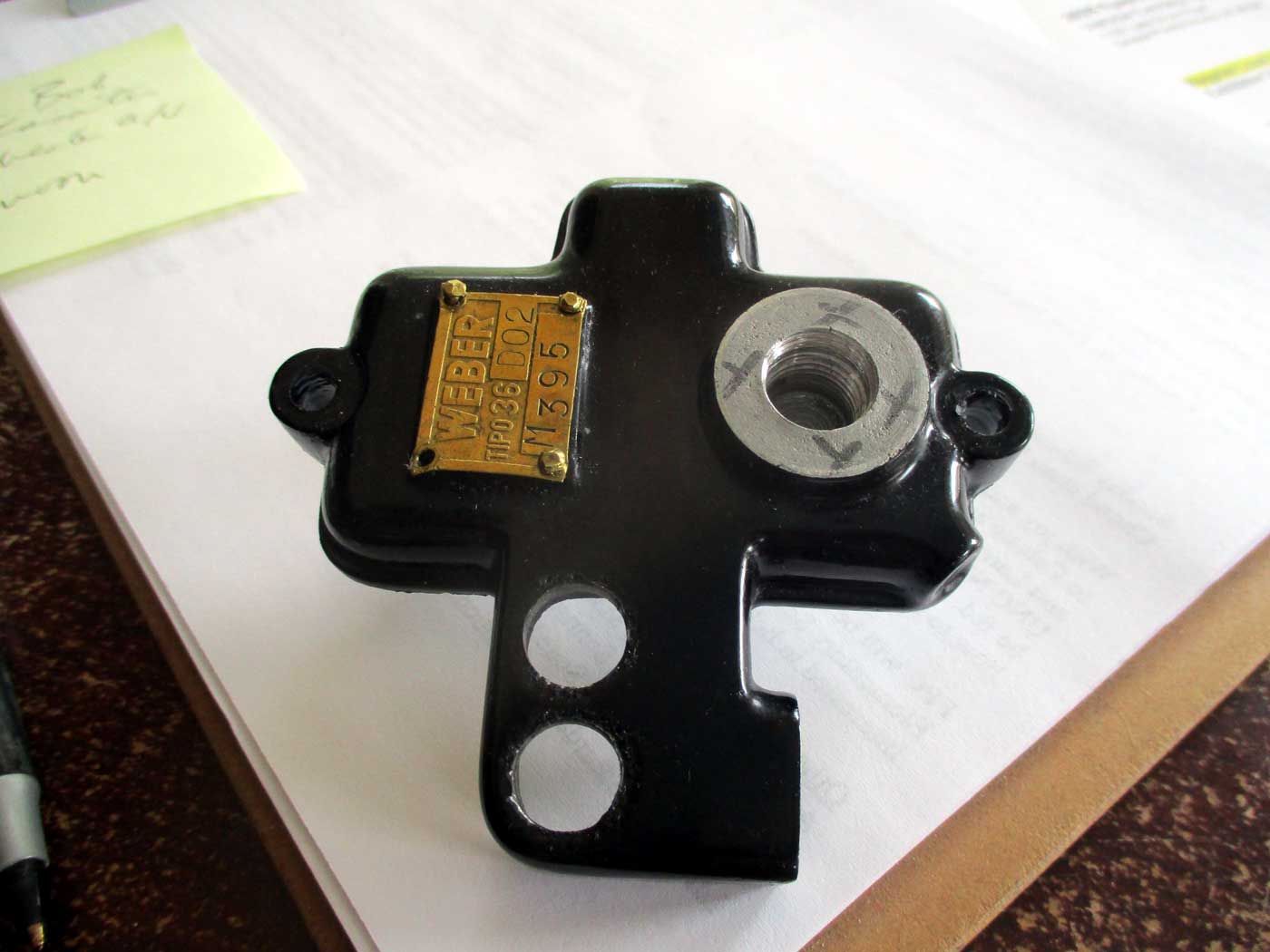
Weber carb top, the Xs indicating the inlet hole and the stripped threads. Try as we might, we could find very little information about this rare single throat side draft Weber. You try.
Copper washers seal the gaps. Or they are supposed to. When I put the inlets on, they leaked. I tightened the bolts, they leaked less. Finally, only one leaked. I cautiously tightened the bolt a bit more, and suddenly the wrench moved easily. I’d stripped the threads! Panicked, I sent Mike a message of distress. DON’T TOUCH IT! He replied. SEND IT TO ME. This wasn’t the first time some fool had done what I did. Mike repaired it with strong new threads. This time, no leaks.
Even to run relatively briefly, the engine needed a fully-equipped test stand: throttle, choke, switches for ignition and starter, coil, oil pressure gauge and hookup, some rudimentary provision for cooling and exhaust. I wasn’t going to run it long enough to need a radiator but wanted the cooling system filled, so I connected hoses so the water could circulate.
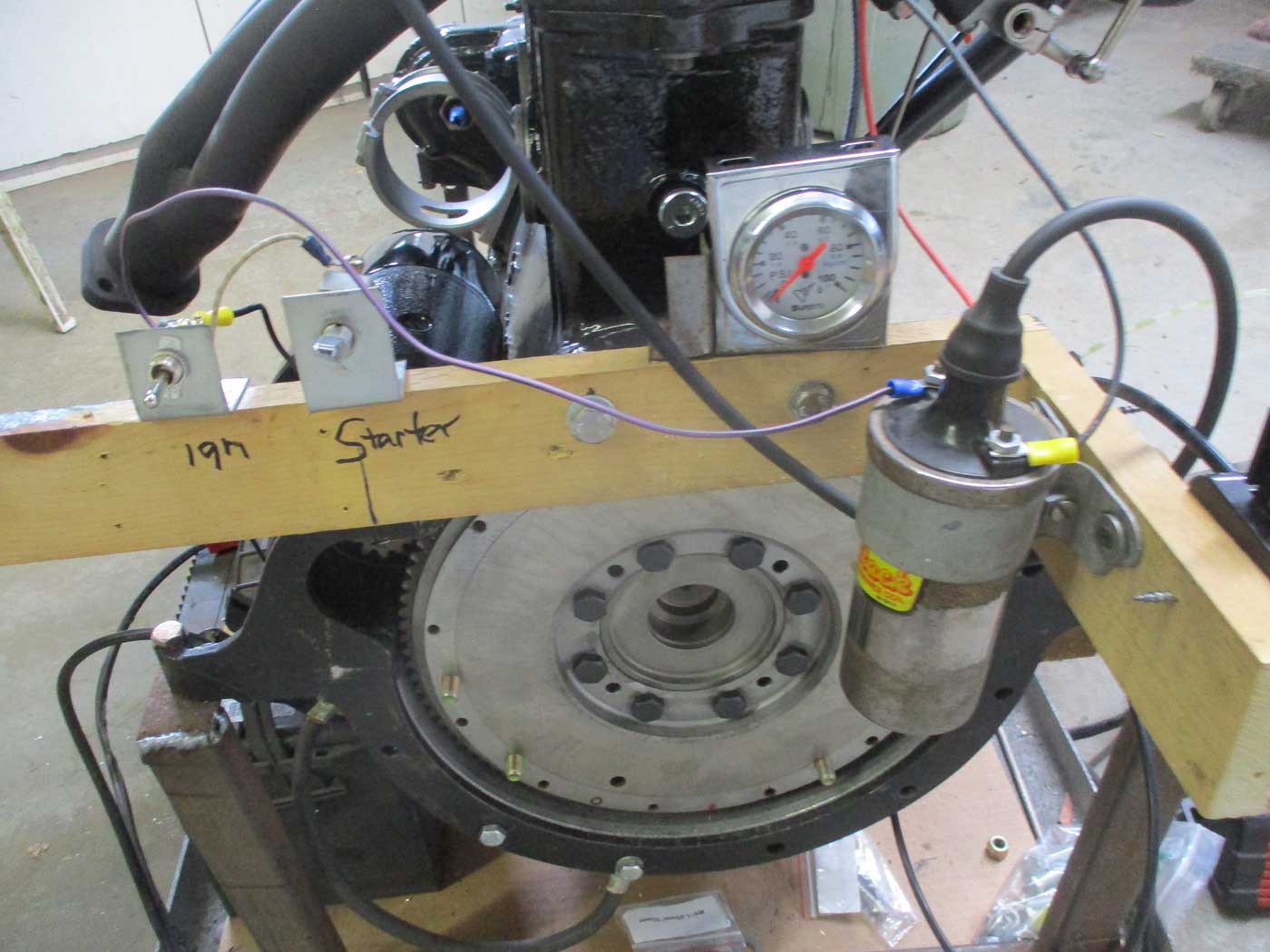
Engine stand with starting switch and oil pressure gauge.
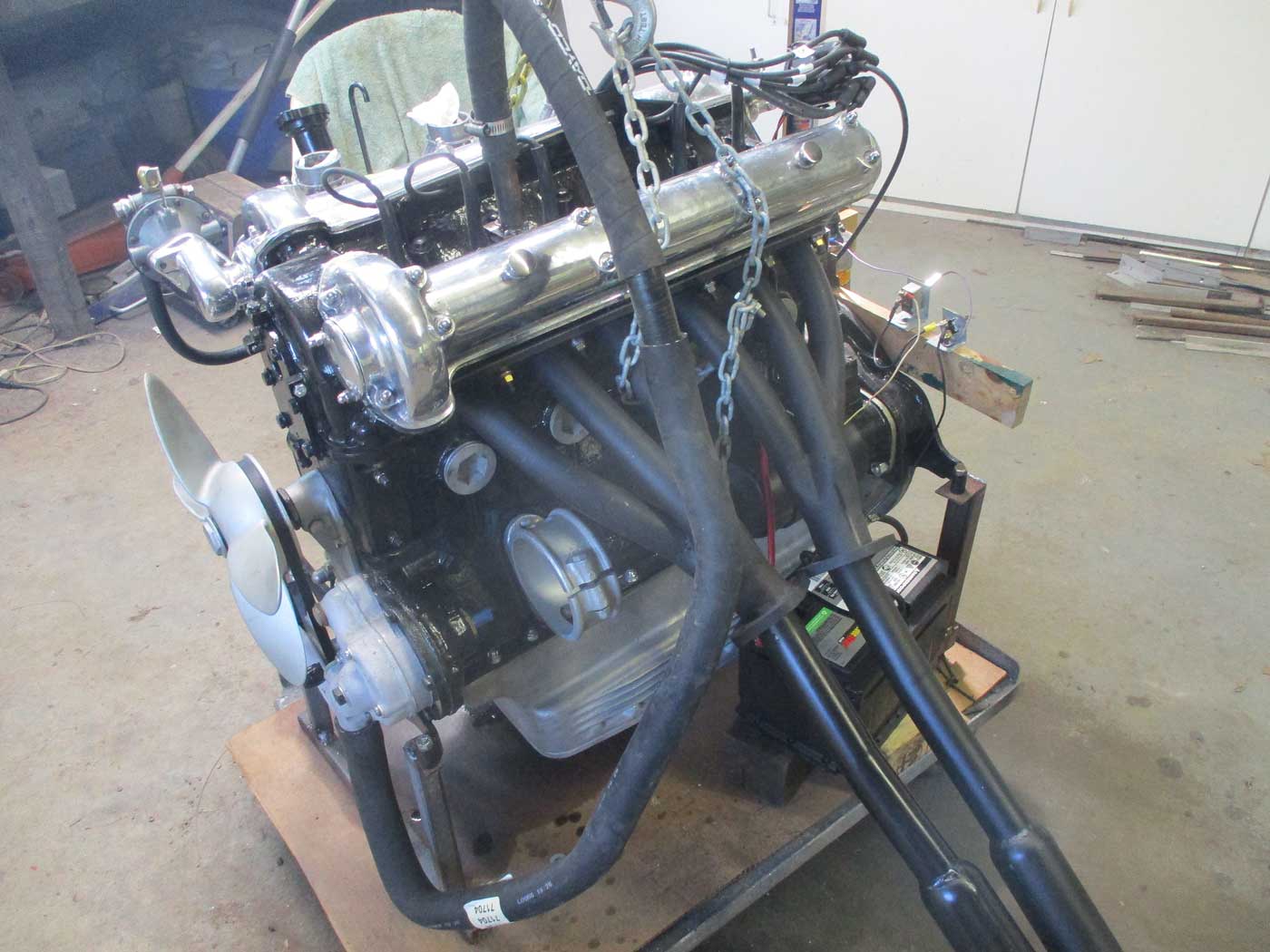
Stand with water recirculation and exhaust and would only be needed for a short time to test for leaks.
I hit the starter, and it started! Not only that, but it sounded smooth and quiet, and had good oil pressure. I was congratulating myself when I noticed that the starter was smoking. Before the engine ran, it had spun the engine with no problems, but now there was clearly a fault somewhere. It worked once or twice again, then quit. If I hit the starter switch, it smoked, silently.
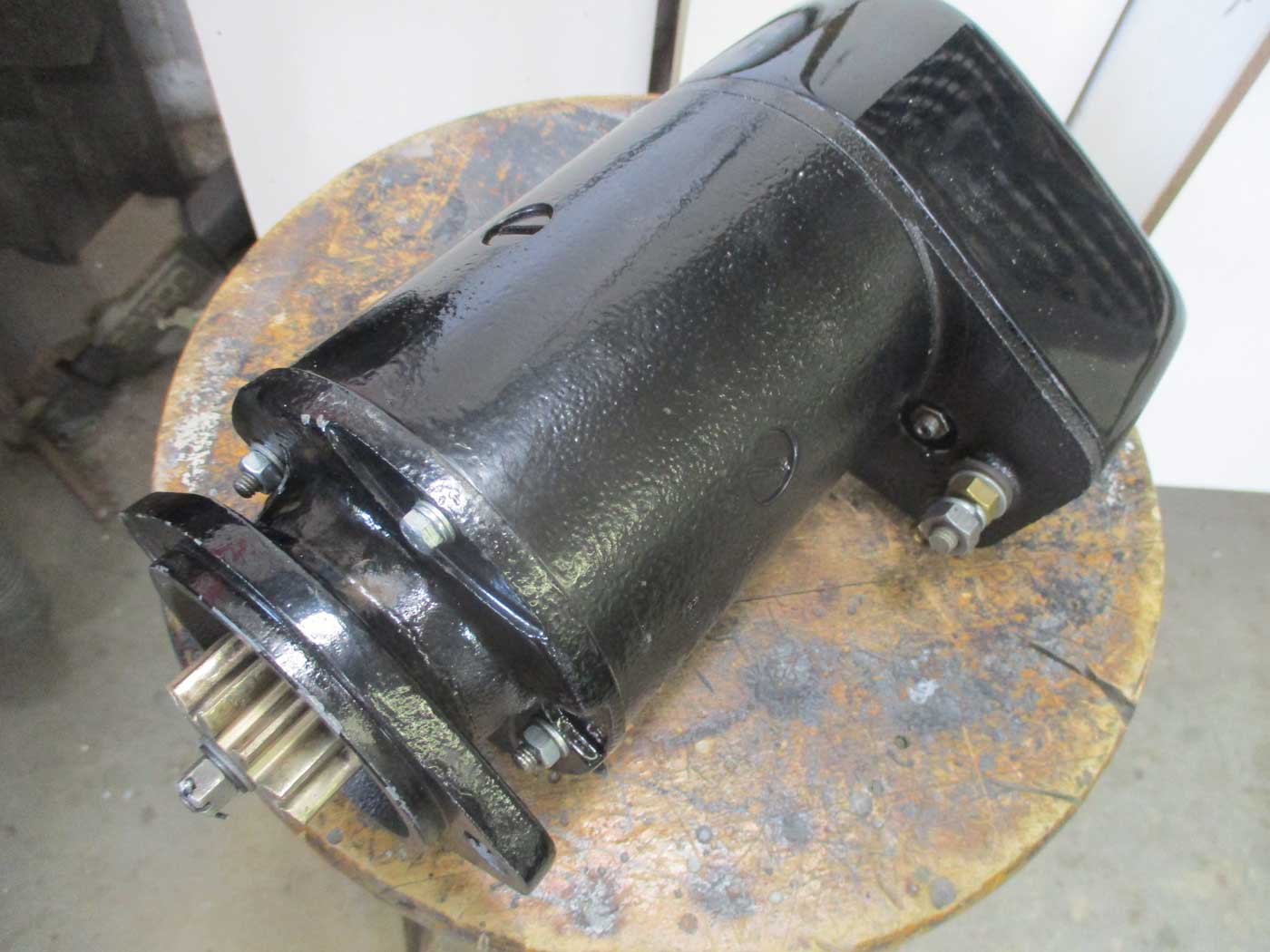
Unnecessarily complex original starter went back to Italy for a fix but still failed.
The starter, unlike any other I’ve seen, moves the whole armature back and forth to engage the gear, not just the gear. Because of its quirks, I was advised to have it rebuilt by a specialist in Italy. It was intercepted at Italian customs, who assessed import duty of $1000. It was just there for repairs, I said, and then would be returned. No difference, they said. The duty was non-refundable. Pity anyone in Italy offering services. No wonder their economy is doing poorly.
And now, after another large sum for the rebuild, it had a short. I took off the end cover, found a burned-out wire, and reconnected it. But it still didn’t work, and still smoked. I didn’t dare take more apart, not really knowing what to look for. But what’s a starter, anyway? Just a big electric motor. Surely I could slap on something else that would work. I asked a kind and deeply knowledgeable friend in Germany for advice. You’ve got a problem, he said. First, starters like yours have been unavailable for years. The only substitute we’ve found is a truck starter, but it has to be expensively modified. That’s about $2K, but I don’t have one here. It takes a few months to have one made.
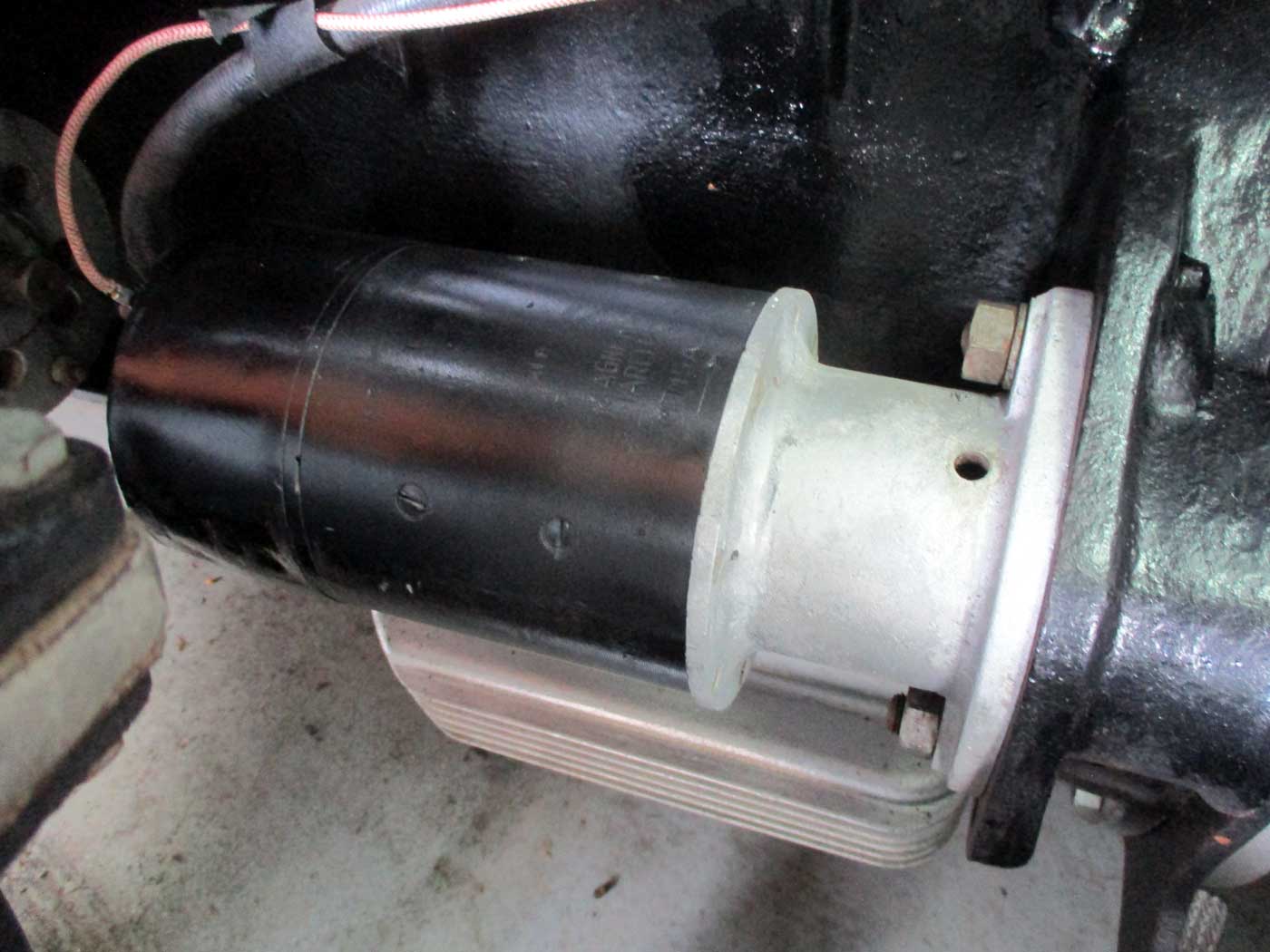
Even though it looked different, this starter, found with some old spare parts, was a Marelli and not only did it fit and had the correct teeth, but it worked.
At times like this I’ve felt as if I’m under a special curse, directed at amateurs like me who presume to work on rare and exotic machinery. But there may also be benign forces with influence. From the large heap of 6C2500 parts I gathered at the outset of these adventures, a few stray items remain, untouched and not consciously recognized in the half-century since they arrived. On the shelf was a starter. Unlike my other starter, this one had a conventional pinion gear, not a moving armature. I also have Jag parts up there, but maybe if I was really, really lucky, it was for a 6C2500, and still worked. I cleaned off the dirt and revealed the name: Marelli. I cleaned it, painted it, and put it on. Never has the growl of a starter been such music to my ears.
So, the engine ran. All the systems functioned. True, it still sat on a test stand, and I’d used up all but a month of the time I had left before taking it to the show.
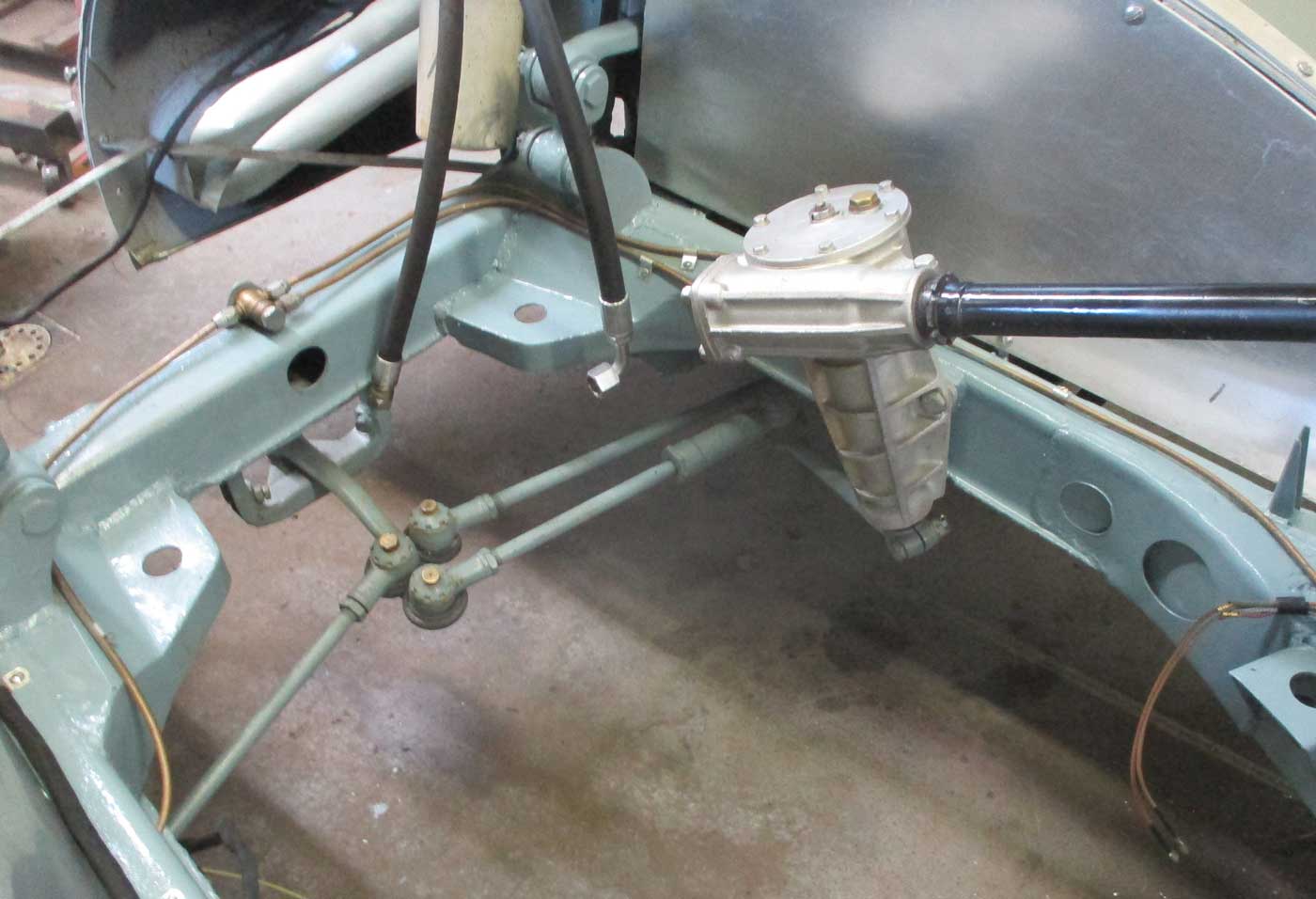
The engine bay awaits.
But all I had to do was put it into the car, make a few linkages, and hook up the exhaust system. The rest of the car was pretty much ready. How hard could it be, just to finish it up?
How fulfilling it must be to possess such skill ! Congratulations Mr Wilson !
Famous last words: ‘How hard could it be, just to finish it up?’ LOL
Been there, done that!