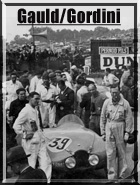
Let the Blue Begin: While waiting for our copy of Roy Smith’s new book on Gordini, we begin our series of articles on the marque, aided and abetted by Graham Gauld, who kicks off the series today with a look at Gordini before the war; Hugues Vanhoolandt, who has been photographing Gordinis all over the world helps the editor illustrate the early Simca Gordinis; and in a week or so, Ed McDonough, who drives a famous Gordini.
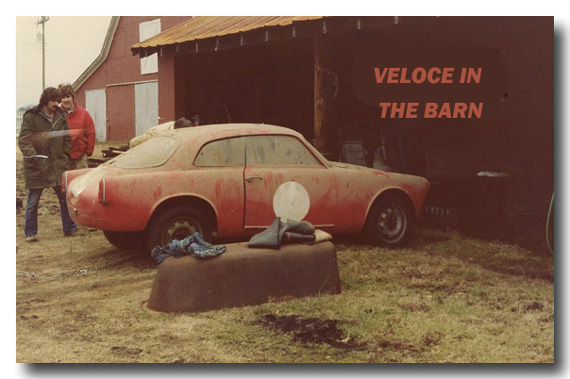
Alfa Find Part 1
By Pete Vack
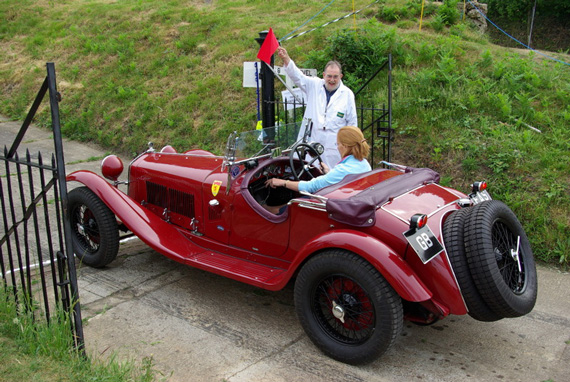
It’s funny how we manage to remember dates. By the looks of the tags on the Chevy station wagon, it appears to have been 1977. Or maybe 1976, it’s hard to tell. But I also know that Michael Frostick’s “Lancia” book had just been published by Dalton Watson and that was in 1976. I had just received my copy when Keith and Sue arrived and was eager to show it to them, so it must have been 1977.
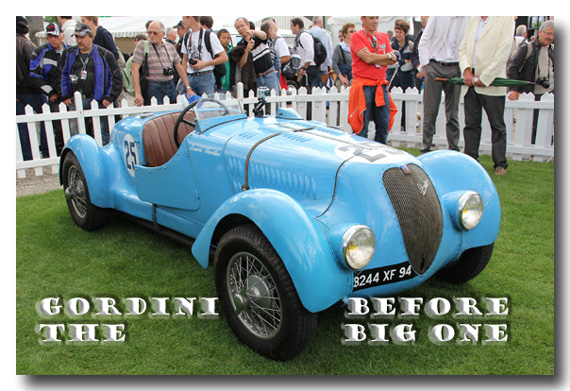
Graham Gauld on Gordini
By Graham Gauld
Does anyone remember the Fodor guides to hotels, restaurants and the like? Back in 1957, Fodor sent me a review copy of their then-new guide to Italy. It arrived just as I was planning my first trip to Modena, so I looked up the area. I came upon a small hotel, the Albergo della Rocca, in the tiny village of Bazzano to the north of Modena. It was a great choice because it was run by the Rochi family as a typical Italian family hotel. Occasionally Enzo Ferrari came there to dine, but many years later I discovered that Bazzano had another role to play in the history of motor racing. It was the birthplace of Amedeo Gordini.
Amedeo’s father was a horse dealer but died in 1902 when Amedeo was only three years of age. However, it was not long before cars entered his life as Modena was a hot bed of motor sport and was one of the towns used on the Giro d’Emilia car event. (I say car because in 1909 the first Giro d’Emilia cycle race took place and also visited Modena.) Gordini was enthralled and that was it; he was going to become a mechanic, and at the very young age of 10 he took up an apprenticeship in an engineering shop in Bologna.
A man named Weber was an early influence on Gordini. Photo by Mary Decker Vack
Pre-War Gordinis and Simca Huits
By Pete Vack
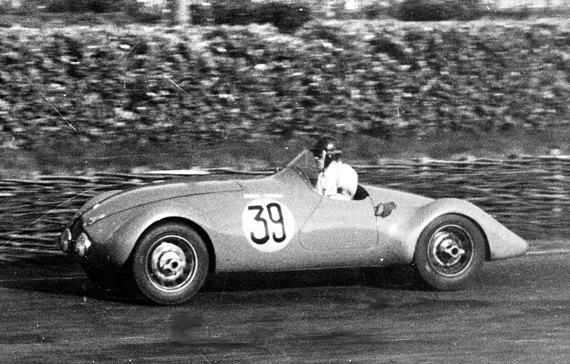
As Graham Gauld has written, Gordini’s racing prior to the 1950s was both significant and interesting. Here we’ll take a look at a few of the prewar Simcas modified by Gordini.
While he had not yet given his name to his cars, Gordini’s modifications to the Balilla Sport, the Simca Cinq (Fiat Topolino) and the Simca Huit were very successful – in fact one might argue Gordini was almost as successful before the war as he was after!
Although having established his Suresnes Fiat garage in about 1927, Gordini didn’t gain much traction until 1935, when the Balilla began to come into France in numbers. Before that, Gordini had struggle to derived speed from the Fiat 514, introduced in 1929. It was a solid if not stellar replacement of the 509; with 1438cc, the four cylinder flathead would allow the production car about 55 mph. More or less representing Fiat, Gordini prepared a 514 Torpedo much like the one in the photograph, to enter the Course de cóte de Suresnes, a trial up the Mont Valérien. The prize was given to the slowest car! Not only that, he won the event in both 1933 and 1934, gaining him the title “The King of Slow Drivers”. But even then, Gordini realized that any publicity was usually good publicity.
The 1438cc Fiat 514 of 1929 was a slow car, but not perhaps as slow as it was made out to be by Gordini. Fiat photo.
Racing a Vintage Maserati 300S
From the VeloceToday Archives
By Pete Vack
Color photos by Richard Prince Photography
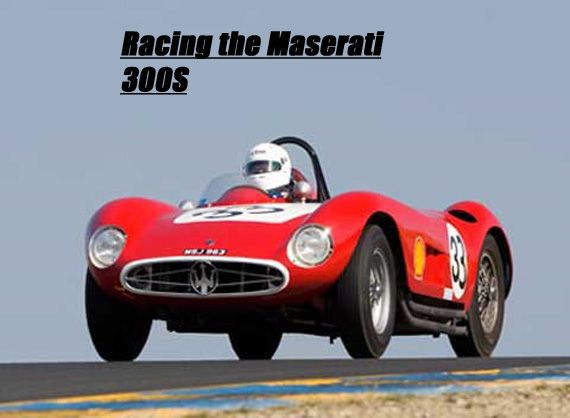
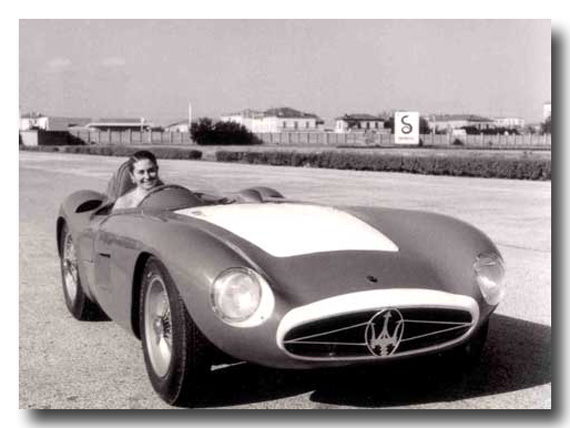
In his epic book, Maserati 300S, Walter Baumer tells us a fascinating story about a little-known race driver by the name of Benoit Musy. He was the son of a President of Switzerland and “a brave man, who saved the lives of many German Jews in the last months of WWII.” Musy purchased a Maserati 300S, chassis 3057 new from the factory in June of 1955. He bought a truck to haul the car, his beautiful wife Consuela and young son Edouard. In 1955 and 1956, he entered seventeen events throughout Europe, winning six outright. But at Montlhéry in late 1956, Musy entered a Maserati 200S Maserati as the 300S was being overhauled. Tragically, Musy was killed driving the 200S, and his grief stricken wife sold the 300S immediately.

Consuela Musy sits behind the wheel of her husband’s new Maserati 300S. Together with their son Edouard, they traveled from race to race. Courtesy Walter Baumer.
After a long, hard life in Africa 3057 was discovered in 1987 by Swede Stein Johnson, who was tipped off about an “Italian beach buggy”. After its restoration, the car was sold to Michael Hinderer. In the meantime Musy’s son Edouard heard of the car’s existence, and was invited to ride in the car at the Nurburgring in 2001. For Musy it brought back many memories. “I still smell the oil and remember the sound,” he said. “Everything is there–again!”
Our Features This Week, March 28, 2013
Giulio Borsari has just passed away, at age 87.
During the 2007 Ferrari 60th anniversary event I was walking down Via Emilia in Modena and I passed a little garage. Looking inside, I could see photos of the Scuderia Ferrari building that used to be around the corner. There was an old gentleman alone in the garage reading a newspaper. I entered the shop and indicated I was interested in a closer look at the photos. The old man folded his paper and began speaking Italian. My Italian was worse than his English and we ended up talking about the photos in broken English and Italian and lamenting that the Scuderia Ferrari building had been torn down. The old gentleman was Borsari. What a thrill it was for me. Borsari was one of Phil Hill’s favorite Ferrari mechanics. When I mentioned Hill, Borsari’s face lighted up and he started telling stories. I wish I had had more time and much better Italian. The funeral will be this Friday.–David Seielstad
All of our Features Articles for the 1st Quarter 2013
Italians, French at Brooklands
Everyone is familiar with the Le Mans 24 hour race, first run in 1923. Less well-known is the British equivalent, the Brooklands Double Twelve race. Vintage Alfa Romeo fans may recall the event, however, as the first running of the Double Twelve was in 1929, the winner being Giulio Ramponi driving a 1500cc Alfa Romeo at an average speed of 76 mph.

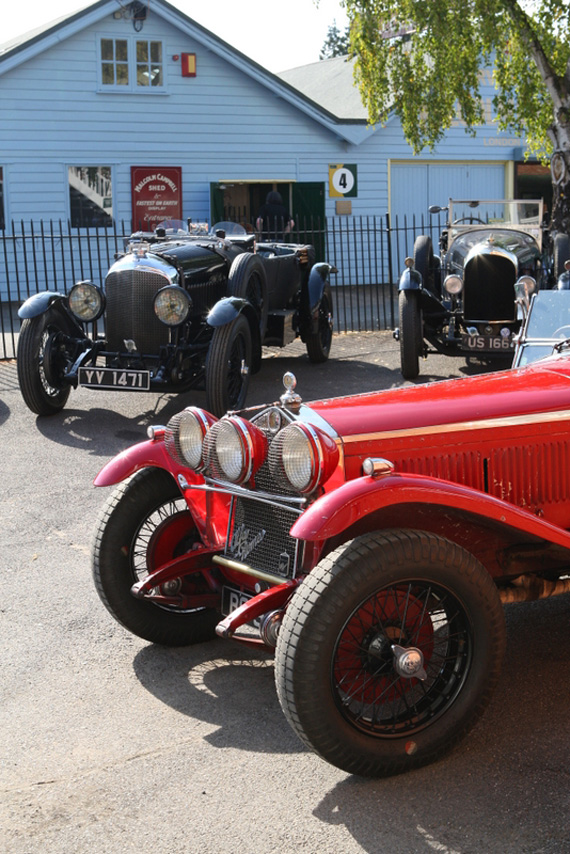
What the Double Twelve is all about: This is a 1930 Alfa 1750 6C Zagato parked near two of W.O. Bentley’s most famous cars. Similar cars competed in the famous 24 hour race in the early 1930s at Brooklands. Please note that most of the images in this story were taken at previous events at Brooklands.
So why was it called the Double Twelve, rather than the Brooklands 24 hour race? In an effort to appease the local residents of nearby Weybridge, nighttime racing was banned at Brooklands, so the race was run in two 12 hour heats on consecutive days.
The race had a short history of only three years. The winners of the Double Twelve in 1930 were Woolf Barnato and Frank Clement driving a 6.5 litre Bentley with Sammy Davis (the late OSCA pilot Colin Davis’s father) and Jack Dunfee finishing second, also driving a 6.5 litre Bentley. The winners of the final race in 1931 were The Earl of March and Mr. CS Staniland driving an MG Midget, their winning average being 65.62 MPH.
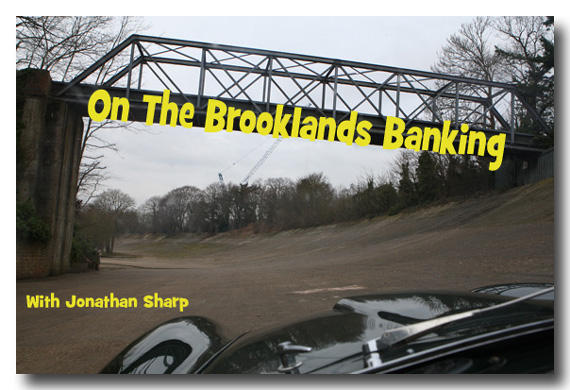
The story of the Double Twelve then jumps to 2007, Brooklands’ centenary year. The Brooklands museum organized a large event in celebration; in fact it was the largest motoring event to take place at the circuit since its demise in 1939. The weekend of events that year were run along the lines of the various forms of competition that took place in period including a concours and some very fiendish driving tests using what remains of the banked track and the test hill. Motor racing had at last returned to Brooklands, the birthplace of British motor sport.
Chris Williams storms the test hill in the Napier Lion-powered Bentley. The wording on the tail reads 'If driven responsibly report as stolen'.
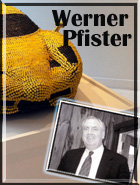
Werner Pfister
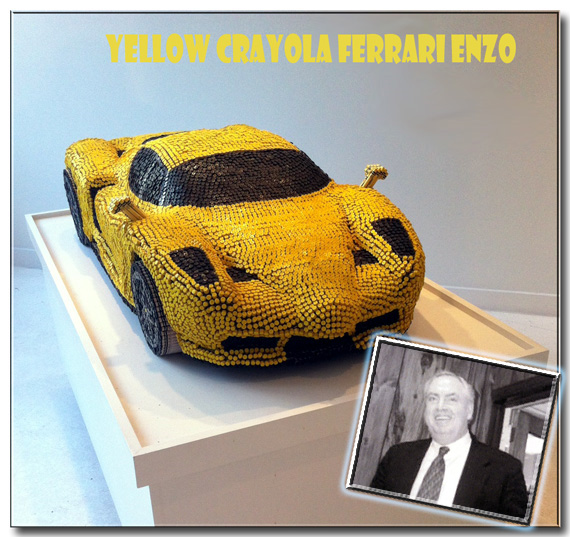
“The Yellow Crayola Ferrari Enzo” was the last and one of the best articles submitted to VeloceToday by Werner Pfister, who died earlier this week after a lengthy battle with cancer. His story about a Crayon Ferrari crafted by a renowned artist for a Children’s hospital reminded us of Werner’s keen eye for an interesting story as well as his generosity and kindness.
[Read more…] about Werner Pfister
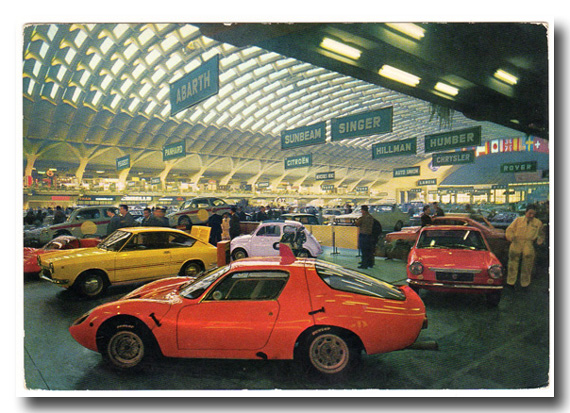
WE HAVE A WINNER! The correct answer was, Abarth OT1300/124 at the 1967 Turin Auto Show. Congratulations to Graham Earl.
Name the year, the show, and the yellow car. Win one of three prizes, your choice: MCarpedi postcard book, Abarth Buyer’s Guide, or a Watkins Glen CD. Send your guess to vack@cox.net. First come, first served so enter now.
Our Features This Week, March 21 2013
Phillip Island Classic, Australia
Story and Photos by Vince Johnson
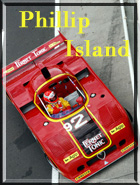
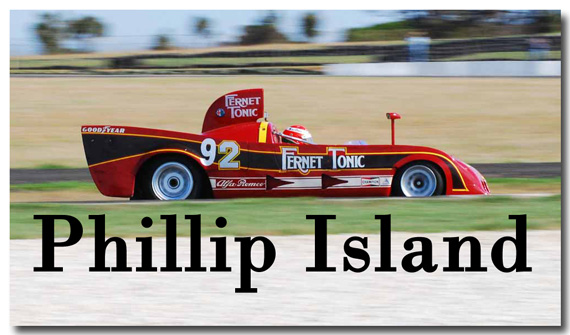
Usually the scream of a high-revving V12 engine shouts “Italian”, but the best sounds from the track at this year’s Phillip Island Classic Festival of Motorsport (March 8-10) were from a pair of Matra Simcas. Brought to the Classic by father and son team of Hall & Hall (UK), chassis #1 and #5 each had Le Mans credentials, third places at the 1973 and 1974 24-hour enduro, to go with the sound. They were up against some stiff opponents in the featured ‘International Sportscar Challenge’ races, giving away hundreds of cubic inches to the Can-Am opposition.
[Read more…] about Phillip Island Classic, Australia