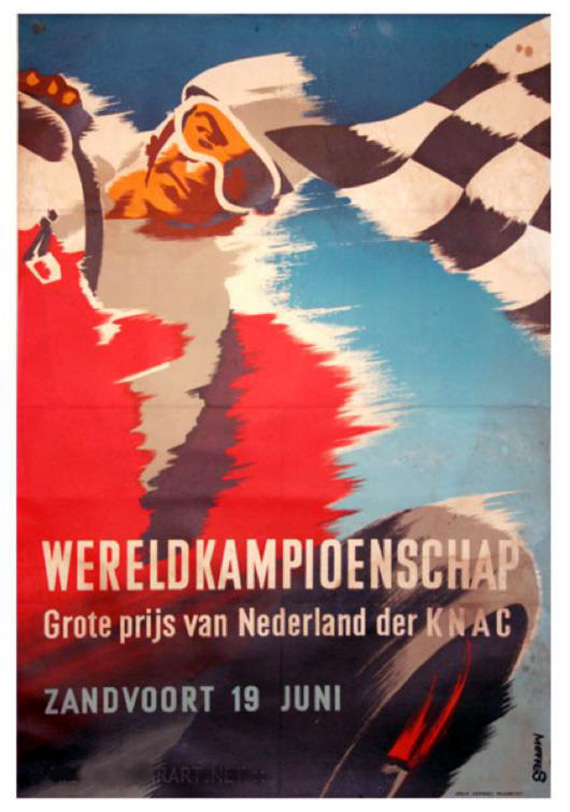
The poster for the 1955 Grand Prix at Zandvoort. It was designed by the well-known Dutch graphic artist Frans Mettes.
The Dutch Grand Prix was scheduled for one week after the disastrous 1955 Le Mans event. Should it have been cancelled? What would you have done? In this exclusive story, VeloceToday correspondent Gijsbert-Paul Berk, who was an assistant to the Royal Netherlands Automobile Club at the time, describes the ensuing crisis and decision.
Story by Gijsbert-Paul Berk
This year’s 24 hour race at Le Mans is now over, but no one who has closely followed motor racing in the fifties can ever forget the horrible accident exactly 60 years ago, on June 11, 1955 during the Le Mans 24 hours race. This black page in the history of motor sports caused the immediate death of the French driver Pierre Bouillin (who drove under the pseudonym of Pierre Levegh), at least 88 spectators, and hundreds of wounded. It was and remains the greatest loss of life due to a motor racing event.
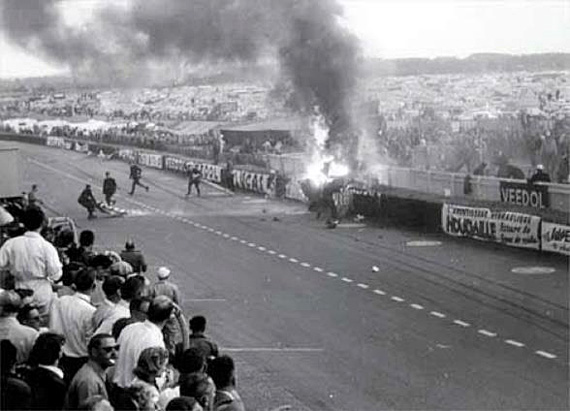
11 June 1955, 18:25. Tragedy struck at the 24 Hours Race on the Le Mans circuit. Photo © DR
This sudden tragedy posed a great dilemma for the board of the Royal Netherlands Automobile Club (KNAC). Should the Dutch Grand Prix scheduled for the following weekend be canceled or take place as planned?
At the time I worked as an assistant at the Sports Department of the KNAC. I had wanted to go to Le Mans to write a report for the magazine The Auto, as I had done the previous years. However my boss, the Sports commissioner Jan van Haaren, who was also member of the International Sporting Commission of the FIA, had to be present at Le Mans himself, and with our Grand Prix at Zandvoort to be held the next weekend, he decided that I should stay back and ‘hold the fort’.
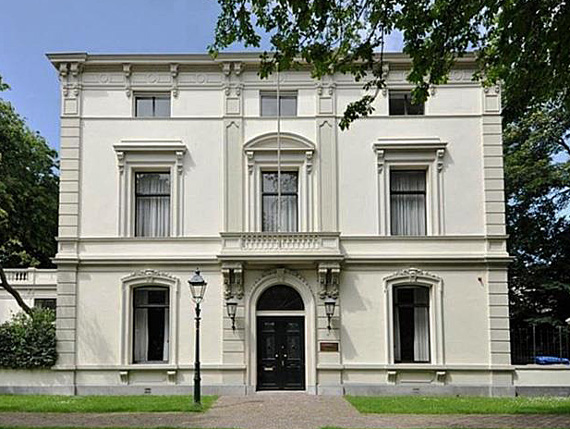
The headquarters of the Royal Dutch Automobile Club at The Hague. The Sports Department was located behind the large window on the ground floor, left of the main entrance.
That fateful Saturday evening of June 11, I heard on the Dutch radio about the Le Mans disaster. Details were scarce, but later that night the BBC broadcasted that the Mercedes-Benz team had withdrawn from the race in respect for the victims of the crash.
Will the Dutch Grand Prix take place as planned and is Mercedes coming?
The morning after the shocking news I went to our office. Officially the secretariat of the Automobile Club was closed on Sundays but I wanted to be there in case there was further news. Besides, there were still a few things to be finalized for the next weekend.
That Sunday was a madhouse; the telephone did not stop ringing. Journalists from all over the world all asked the same questions: will the Dutch Grand Prix take place as planned and is Mercedes coming? The only honest answer I could give them was that I had no information that Mercedes would not participate. Calling van Haaren in Le Mans proved impossible. According to the Dutch telephone exchange, the French authorities had reserved all telephone lines for emergency calls. I could not get through to the Mercedes Renn Abteilung either, as the factory was closed on Sunday. In the end I called the Managing Director of the Dutch Mercedes-Benz distributor AGAM at his home and asked him to inquire with his colleagues in Stuttgart if their team still intended to come to Zandvoort.
Monday was even more hectic than Sunday. Fortunately, that day a very efficient girl from our typing pool assisted me. She took care of all the incoming telegrams from newspapers, magazines and news agencies that suddenly needed extra hotel rooms and press passes, while I was busy taking the numerous telephone calls. We never had so many press inquiries before. Early that morning I received a telegram from van Haaren informing me that as the FIA together with the French the authorities were holding an inquiry, he would not be back before late Tuesday. Not much later the Managing Director of the AGAM called to say that he had just received a telegram from Alfred Neubauer, the Mercedes racing manager. In it Neubauer wrote that he intended to arrive at Zandvoort that Tuesday. He had also instructed AGAM to hire on his behalf the circuit for the Wednesday, so the Mercedes team could experiment with the set-up of their cars before the official training sessions.
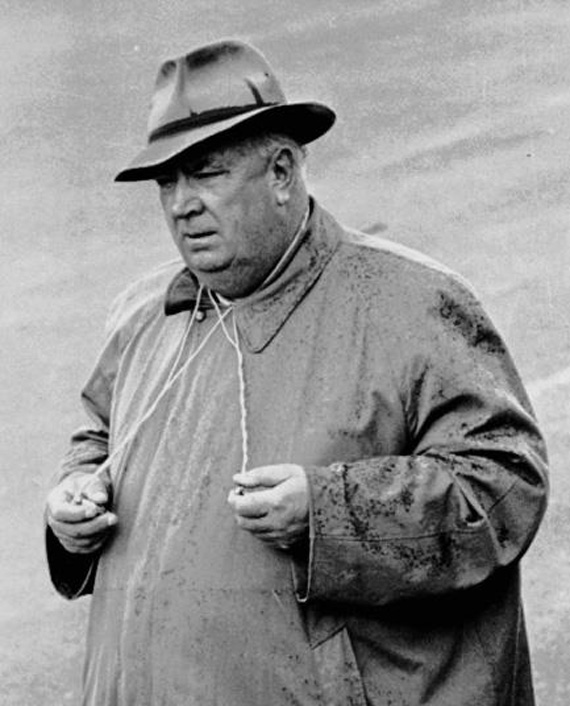
Mercedes-Benz Rennleiter Alfred Neubauer would be instrumental in saving the Dutch GP. Courtesy Mercedes-Benz Press Department
The Baron immediately said to me “We have to cancel the race next Sunday.”
But at the end of the afternoon I was summoned to the office of our Managing Director, whose formal title was General Secretary. The Baron Van Harinxma thoe Slooten was an aristocrat of the old school, more a mediator than a hard-boiled manager. His qualities, as a lawyer and diplomat, were a very valuable asset in dealing with the Members of Parliament and the various Ministries on behalf of the Dutch motorists.
When I entered the room he was sitting behind his desk and was obviously ill at ease. Also present was Mrs. Bruggemans, his Personal Assistant. She was a very intelligent, characterful woman and ‘de facto’ the office manager.
The Baron immediately said to me “We have to cancel the race next Sunday.”
I was surprised, because none of my press contacts had hinted that the Dutch government was envisaging such a step.
“Is this official…” I asked; “…has our government prohibited the race?”
“No”, the Baron replied, “I had a telephone call from our Chairman and he is afraid that it is bad for the public image of the KNAC, if we go on with the race, considering the many that have perished at Le Mans. And I agree”. He must have seen the consternation on my face and continued: “I tried to phone van Haaren to consult him, but could not reach him. As we can’t wait till Tuesday we must call off the race now”
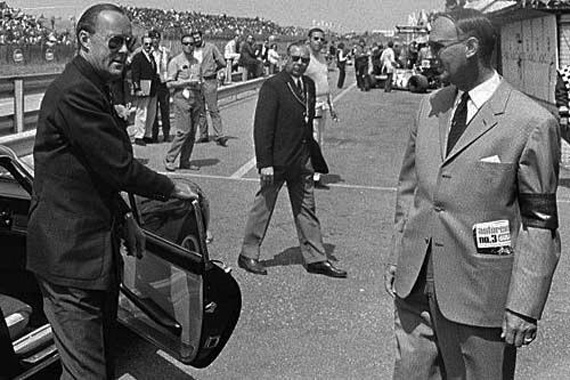
His Royal Highness Prince Bernhard of the Netherlands was a keen car enthusiast and never missed a Grand Prix at Zanvoort. Here we see him stepping out from his black Ferrari. Hans Hugenholz, then director of the Zandvoort Circuit, welcomes him. In the middle – with dark blazer – is Jaap Zwart, Clerk of the Course and treasurer of the Dutch Auto racing Association NAV.
However tragic the circumstances, I also knew that if the KNAC canceled the Grand Prix because of the Le Mans tragedy, this would send a very unfortunate signal to politicians and the general public about the risks involved in auto racing. This would also seriously damage the international reputation of the KNAC as a loyal member of the FIA.
But since my youthful adventures in Paris I had learned to think before I opened my mouth. So it took me a few seconds to answer. “Yes, it was a terrible accident and I fully understand the anxiety of the Chairman and yourself. But do you have considered the legal and financial implications?”
I reminded the Baron that if the Dutch government does not cancel the event, the Royal Netherlands Auto Club will be held liable for legal consequences.
The Baron looked at me and asked: “What do you mean?”
I replied: “If it is not decision of the Dutch government then the KNAC will be held liable for all the financial consequences of canceling the race. As you will certainly know (I suspected that he had not been fully aware of this) van Haaren has signed contracts with all the racing teams engaging the KNAC to pay them starting money and there are many other financial obligations. With suppliers such as the caterers who are engaged to provide the lunch boxes for the flag marshals and other officials, the printer that has produced the race program booklets, the company that installs the public address system, the firm that delivers the straw bales and last not least the municipality of Zandvoort for the use of the circuit and the collaboration of their police force and ambulance team. Therefore I believe that Mr. Kniphorst, the Vice Chairman of the Sporting committee, must be contacted, before taking steps to cancel the event. If such a decision is taken without the consent of the sponsors it is likely that they will refuse to pay out, especially as this morning Herr Neubauer has personally confirmed the participation of the Mercedes team”.
Mr. Kniphorst was not only Vice Chairman of the Sporting committee of the KNAC, but as a Director of Gulf Oil also one of the financial backers of the Grand Prix. In those days the organization of an International race implied taking considerable financial risks. The outlay involved (start- and prize money, renting the track and other charges) could be exactly calculated but the returns were always uncertain. Before TV and publicity rights became an important source of income, the revenues came mainly from the sales of the admission tickets. The number of spectators – and thus the proceeds – depended on various factors that the organizers could not influence. The weather played a very important role; also which other events took place on the same day. In order to limit this financial risk, the Automobile Club had approached the five major oil companies operating in the Netherlands, BP, Caltex, Esso, Gulf and Shell. They had pledged to cover eventual losses of the Grand Prix by creating a ‘Garantiefonds’ (Warranty Fund). Clearly Kniphorst must be informed.
It was a tense moment. Even today I remember my feeling of relief when Miss Bruggemans said. “I think Berk has a point”. “All right” replied the Baron, who as a lawyer was quick to grasp the problem, “I’ll phone Kniphorst and ask his counsel.”
I did not doubt for one minute what Kniphorst would say, because when I phoned him after the confirmation that the Mercedes team would come to Zandvoort, his relieved reaction was: “That means that our Grand Prix can go on.”
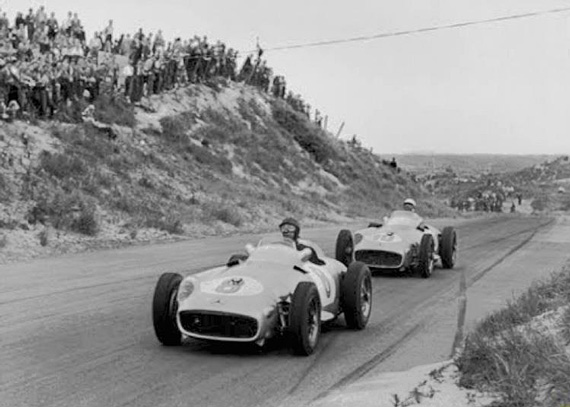
Even the sand dunes of Zandvoort were packed with fans. Here they are watching Moss closely following Fangio. The 1955 Dutch Grand Prix attracted a record number of 70 000 spectators. Courtesy Mercedes-Benz Press Department
Early in the morning of the next Wednesday, Jan van Haaren walked into the office we shared. He greeted me with the words: “I have just heard that you have been very convincing”. Then he went off to Zandvoort where Herr Alfred Neubauer had arrived with the Mercedes team. At the circuit Neubauer insisted that a wide white line had to be painted to mark the separation between the track and the pit lane and that the competitors should be forbidden to cross this line during the race, to prevent an occurrence as in Le Mans.
The 1955 Dutch Grand Prix took place as scheduled, on Sunday June 19. The over 70.000 spectators (a record never repeated) enjoyed the many exciting duels and really got value for their money. Juan Manuel Fangio (Mercedes) won, Stirling Moss (Mercedes) came in second and Luigi Musso (Maserati) claimed the third place. For all the results consult Wikipedia. If you want to see a sort video of the race go to http://www.youtube.com/watch?v=XO94C6VNwHU.
In the aftermath of the terrible Le Mans accident, the 1955 Grand Prix of France (Reims), Germany (Nurburgring), Switzerland (Bremgarten) and Spain (Pedralbes) were canceled by order of their National governments. The street racetrack in the Barcelona suburb of Pedralbes was never used again. The Swiss banned motor racing altogether and the ban is today still in force. However, the Formula One races in Great Britain (Aintree 16 July 1955) and Italy (Monza 11 September 1955) were held as planned. Few, if anyone, criticized the decision to hold the race as scheduled.
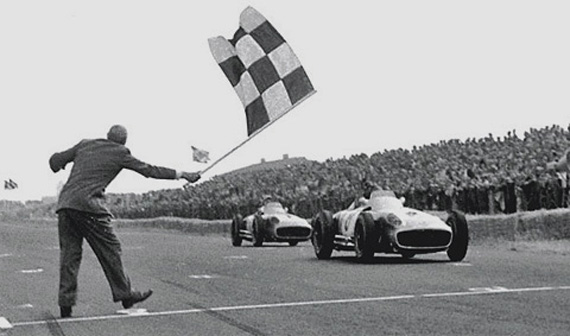
Jan van Haaren, Sport Commissioner and Race Director (and my boss at the time) waves the finish flag for Fangio on his Mercedes. Moss crossed the finish line in second position. Courtesy Mercedes-Benz Press Department
In the U.S. there was similar sentiment. In the prelude to the 1955 Dutch Grand Prix report, Road & Track observed that:
“In spite of the recent setbacks, auto racing seems to be drawing bigger crowds than ever, both in the U.S. and abroad. As the following reports indicate, enthusiasm ranges from the activities of the small localized club to the battle of the Grand Prix giants. Mistakes are made – and mishaps – sometimes serious – occur, but cars are a part of life now, and racing them will always be a great sport, so great, in fact that nobody who live it is about to give it up-politicians notwithstanding.”
The experience of the previous weekend taught me a lesson I have never forgotten. Before you make an important decision, first take into account and consider the repercussions and risks for all parties involved.
* If you don’t remember the details of the tragic 1955 Le Mans race, read the excellent report, Dennis Jenkinson wrote for the British magazine Motorsport.
Pete
Terrific tale of important event in a very dark and difficult time.
I was not yet in Europe, having just graduated from school on
June 17th, 1955, but was following everything that was happening
then , with help of staff of Road & Track and time with Phil Hill. who
had arrived home 3 weeks later since all racing cancelled, with not much
chance of his running private Ferrari Monza over there.
Horray for the Dutch for carrying on, despite
the obvious difficulties. So many other countries
just caved in..(The British and Italians also went on)
My compliments to author for a job well done.!
Jim Sitz
G.P. Oregon
Wonderful first-person account. It’s very interesting how the political workings of a Grand Prix get considered and taken care of.
Yes!,
I have read this great story. I have read about the Le Mans accident, but never found any article about what it was for the Dutch Grand Prix. I was born in the Haque, and was 8 years old when the accident happened, but know the KNAC building very well. I really like to have a printable version of the story.
Kindest regards,
Paul Hooft.
My pals and I went to a Brands Hatch meeting the weekend after the Le Mans tragedy. There was a good crowd of spectators at Brands that day, though perhaps, a little sparse at some of the corners!. We were happy to be there and know that the sport was continuing.