Story by Roberto Motta
Photos Centro Documentazione Storica Ferrari e Archivio Automobile Club Milano
From the VeloceToday Archives, January 2019
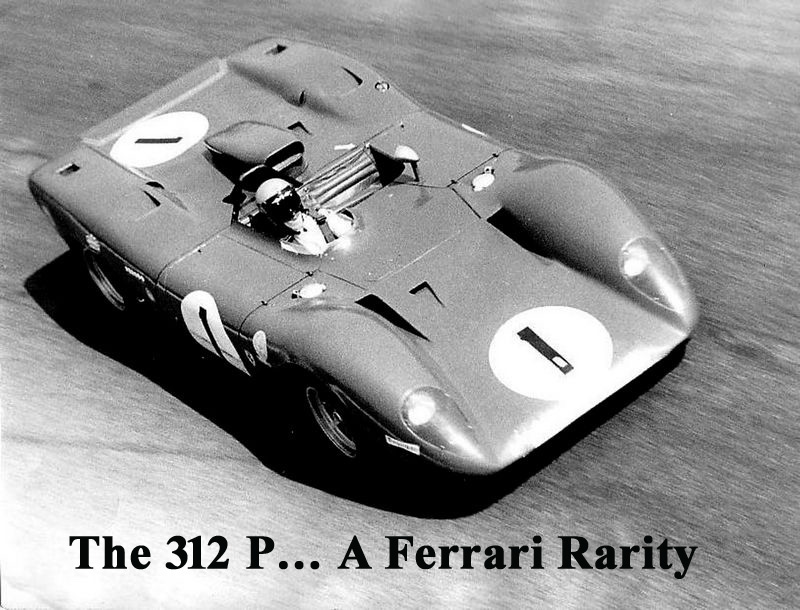
The 312 P powered by the V12 engine is a beautiful but unfortunate car, and never won a victory during its brief racing career. However, it is one of the most aesthetically satisfying cars ever made in the Ferrari workshops, and is the last prototype made before the agreement the agreement between the ‘prancing horse’ brand and FIAT.
The story begins when, after boycotting sports car racing in 1968 season to protest a rule change that banned their 4-litre 330 P4, Ferrari built a 3000cc prototype for the 1969 season, based on the existing F1 Ferrari 312 with a 60 degree V12. It was presented to the press on December 14th 1968 at the Fini Hotel in Modena. During the meeting, Enzo Ferrari announced his intention to participate in the 1969 Manufacturers World Championship with the car, called the 312 P for prototype.
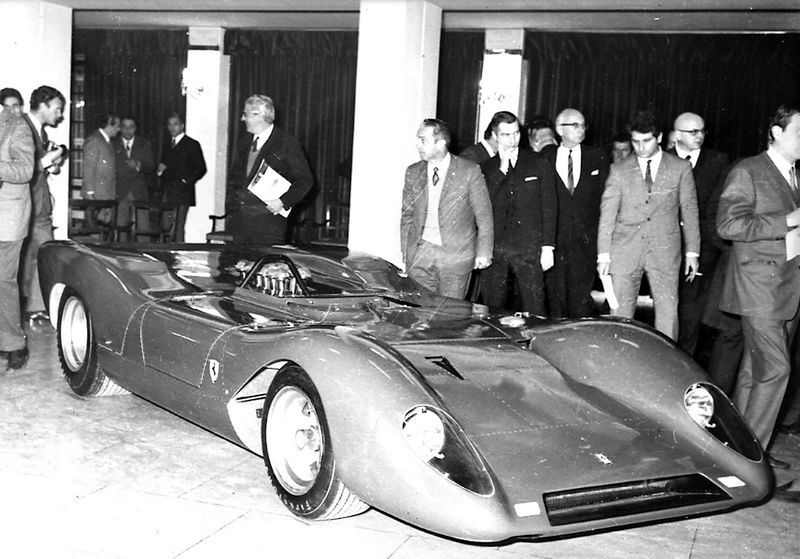
The 312P was presented to the press on December 14th, 1968 at the Fini Hotel in Modena.
Completed in the night before the presentation, the new 312 P had a bodywork that conceptually reflected that of the 612 Can Am, while the engine was the same used for the Formula 1 car but slightly detuned to improve its reliability in endurance races.
The 312P, appeared with a compact, gritty, I-am-a-prototype look. It was a smooth wedge-shaped design, with an elongated and streamlined contour on the front while the rear was cut obliquely. When the car was presented to the press, it had a body clad in aluminum, but for the European season the body was made of fiberglass parts.
The wheelbase was 2370 cm (93.3 in), the length 4230 mm (166.5 in), width 1980 mm (78 in), and height at the roll-bar was 890 mm (35 in). The chassis was made from a multi-tubular structure of welded steel, that was stiffened by a riveted aluminum skin; the front suspension used a double wishbone with coil springs and an anti-roll bar. This suspension was different from the F1 car, as the springs were mounted on board. The rear suspension was the same that was used on the F1 car, with single top links, reversed lower wishbones, twin longitudinal radius arm on each side, coil springs with coaxial shock absorbers and an anti-roll bar. Campagnolo cast alloy wheels with 5 spokes were employed, and provided with a single central locking nut, to permit the use of compressed air gun. Brakes were 4 self-ventilating disks with a 2-piston caliper; at the front, the brake discs were mounted outboard, while on the rear they were positioned inboard near the gearbox.

This image shows us the heart of the car, a V12 engine that able to produce 420-430 hp
The heart of the car was a rear mounted longitudinal 60° V12, with a total displacement of 2989.95 cc, obtained by combining a 77 mm bore and a 53.5 mm stroke, with four valves per cylinder driven by four overhead camshafts, chain driven from the nose of the crankshaft.
The steel crankshaft, with 7 main bearings, featured six crank pins on each of which worked two connecting rods side by side. The connecting rods were steel and attached to aluminum pistons equipped with 3 piston rings, 2 of which seal and 1 was the oilscraper. Fuel delivery was Lucas indirect mechanical injection system. With a compression ratio of 11: 1 it was able to produce 420-430 hp at 9800 rpm while the same engine, used on the F1 car was good for 435-440 hp at 10000 rpm. Finally, the engine was combined with a Ferrari 5-speed + RM gearbox, assisted by a 3-disc clutch, and a self-locking differential.

In the 1000 Km di Monza’s qualifying, Ferrari 312P (chassis 0870) won pole position with Andretti.
Test time
Chassis 0868 was first seen on the Modena airport track on January 16, 1969, as Tino Brambilla began its development program. A few days later the 312P was sent to Vallelunga where it was subjected to tests aimed to check spoilers and air intakes. During these tests, with Peter Schetty at the wheel, the 312P had a horrific accident. Schetty was ok, but the car was seriously damaged and was unable start in the first race of the championship, the Daytona 24 Hours in February.
Sebring 1969
On 23 March, fully repaired, the 312P (0868) was entered in the Sebring 12 Hours for Chris Amon and Mario Andretti. During qualifying, Andretti broke the track record. Starting from the pole position, the 312P momentarily refused to fire and it was Siffert’s Porsche that led the field away. After the first pit stop, the Ferrari and leading Porsche took turns with the lead, dictated by their alternate pit-stop necessities. However, Amon brought in the Ferrari with nose damage caused by running over parts of a Chevron, which had wrecked its rear end. Clearing out the broken pieces and repairing damage did not take long, but it soon boiled over once more due to air trapped in the cooling system and the car suffered from overheating problems throughout the race, eventually finishing second to the Ford GT40 of Ickx and Oliver and first in the prototype class.
Brands Hatch
On April 13th, a new 312P (chassis (0870) was entered for Chris Amon and Pedro Rodriguez, and started from 2nd place on the starting grid, behind the Porsche 908 of Siffert and Redman. The beautiful body of the car was ruined by wings and spoilers but managed to place 4th behind three Porsche 908s despite tire and throttle cable problems.
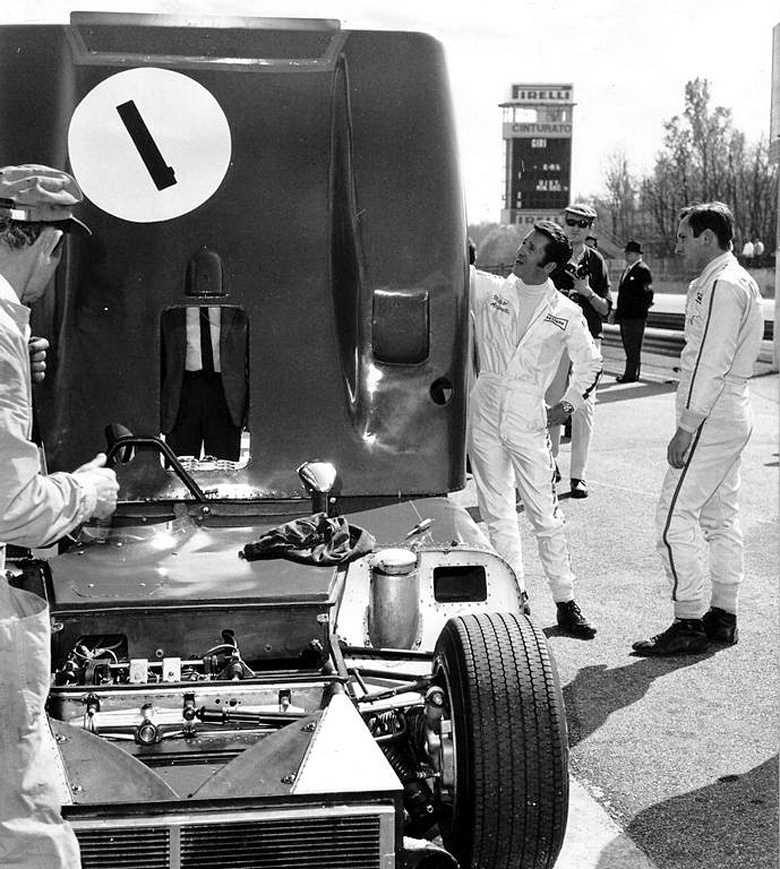
At the ‘1000 Km di Monza’ Mario Andretti, near the car, and Peter Schetty were the drivers of 312P number 1.
Monza
Ferrari brought two cars to the 1000 Km Monza track: chassis 0868 for Rodriguez-Schetty and chassis 0870 for Amon-Andretti. Both cars were without spoilers and had the rear brakes moved to an out-board position in order to facilitate maintenance during pit stops. During qualifying, the 312s were afflicted by tire problems due to the high-speed circuit, but nonetheless, Amon’s car gained the pole position ahead of Porsche, Matra and Alfa Romeo. At the start, Andretti took control of the race but was soon forced to stop for an unplanned replacement of the tires. After the next driver change, on the 39th lap there was a big bang and the 12-cylinder engine broke in a spectacular fashion forcing Amon to walk back to the pits.

Pedro Rodriguez’s 312P s/n 0868 leads the Andrè de Cortanze Alpine A220, s/n 1734 at Monza.
The second car, entrusted to Rodriguez, inherited the first position but soon was forced to com into the pits with a flat tire. Subsequently, the 312 was the victim of a second detachment of the tread from the tire that caused the car to return to the pits with a broken wheel. Then, 0868 suffered a disastrous off due to a suspension breakage; the 312 hit the guard-rail and ended its run right in front of the stands, so severely damaged it failed to take part in several more races.
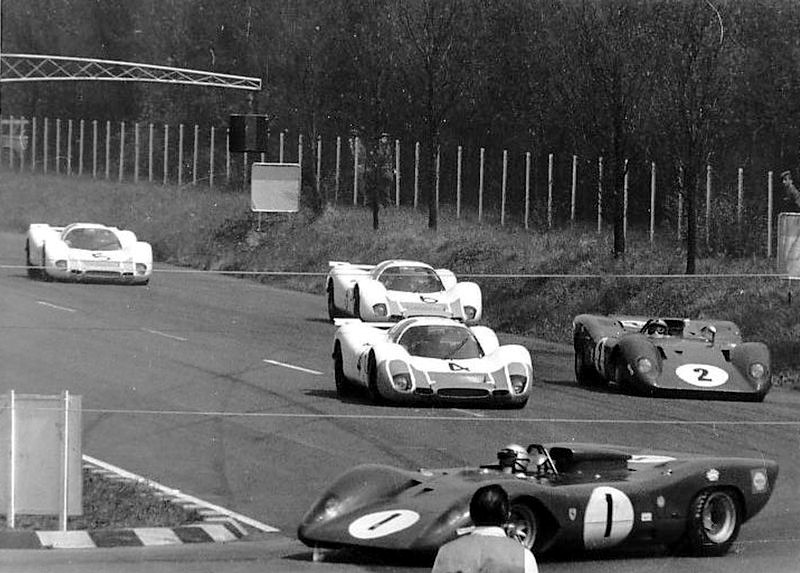
Mario Andretti leads the Rodriguez’s 312P and three Porsche 908s (the 908 number 4 driven by Siffert/Redman will be the winner of the race). The photo however, reveals that the Porsches would dominate the rest of the events that year, save Le Mans where a Ford GT40 won.
Spa Francorchamps
On 11 May, on the Spa-Francorchamps track, 312P 0870 was entrusted to Rodriguez and David Piper. At the beginning of the race, Rodriguez engaged the Porsche of Siffert in a bitter duel then hit a slower competitor who did not realize that Rodriguez was in the process of overtaking. Falling behind due to a pit stop to check damage, the car was not able to express its full potential and ended its race behind the Porsche of Siffert.
Nürburgring
On June first, at the Nürburgring track, 0870 was entrusted to Amon and Rodriguez. On this occasion, the car was equipped with wide tabs on the front and a pronounced vertical spoiler on the rear which apparently helped Rodriguez get second fastest time in practice. But the 312 was plagued by an endless series of problems; first a bad start, followed by an early stop in the pits for the replacement of a wheel, and a second stop to adjust the tire pressure. Finally, driven by Amon and engaged in a furious comeback, it beat the track record with a time of 8 ‘ 03″. But his dream of victory vanished with an ignition failure that forced him to retire. Porsches then dominated the event and with the result of the German race, the Porsche was ‘über alles’ and won the International Championship of Makes, even before the Le Mans race.
Le Mans
Porsche had mathematically conquered the world championship, but Ferrari decided to take part in the Le Mans race anyway. To better cope with the classic French marathon, the 312 received a new aerodynamic look and was transformed into a coupé version thanks to the adoption of a top that perfectly blended with the sleek lines of the body. On the front bonnet, at the base of the windshield, two NACA air intakes were inserted, which conveyed cooling air to inside of the passenger compartment; on the side, two air intakes sending fresh air into the engine compartment were added, while the heat produced by the engine was allowed to escape by opaque black vents. The car that appears to us as one of the most beautiful and harmonious of all the prototype sports produced by Ferrari.

The 312P coupè, here in the Marnello Factory’s courtyard, appears to us as one of the most beautiful and harmonious of all the prototype sports produced by Ferrari.
On 14 and 15 June, during the Le Mans race, two cars were present: the 312P (0868) for Amon-Schetty while the 0870 was driven by Rodriguez-Piper. Porsche came loaded, with four 917s, three 908 coupes and a 908 in spyder configuration.
Thanks to the new aerodynamics, the 312 was able to reach a speed of over 300 km/h, but fell short of the Porsche long tail, which reached the speed of 320 km/hour. The two 312 Ps qualified in fifth with Rodriguez-Piper and sixth with Amon-Schetty. For Ferrari, the Le Mans race was unlucky right from the start. Amon’s car did not even drive a lap and ended his race when at Maison Blanche, he passed the wreckage of the Porsche 917 driven by Woolfe, who died in the accident. Amon lost control and ended his own race in flames, against the guardrail. The second 312 was afflicted by gearbox problems from the start and abandoned the competition after fifteen hours while it was in eighth position, due to the failure of a gearbox bearing. The race went to the GT40 of Ickx and Oliver.
Later, after the championship was decided, Ferrari did not consider useful to participate in the remaining races that took place at Watkins Glen and Zeltweg, races in which Porsche won.
The official career of the 312 P ended with the race at Le Mans and with it also ended the era of the 3000 cc V12 engine that was abandoned by Ferrari in favor of the new 180° boxer engine adopted by the sports cars from the F1 machines.
But the competitive life of the 312P was not yet finished and continued under the sign of the North American Racing Team (NART), as the two cars that took an active part in the World Championship, and various spare parts, were purchased by NART.
But that is another story.