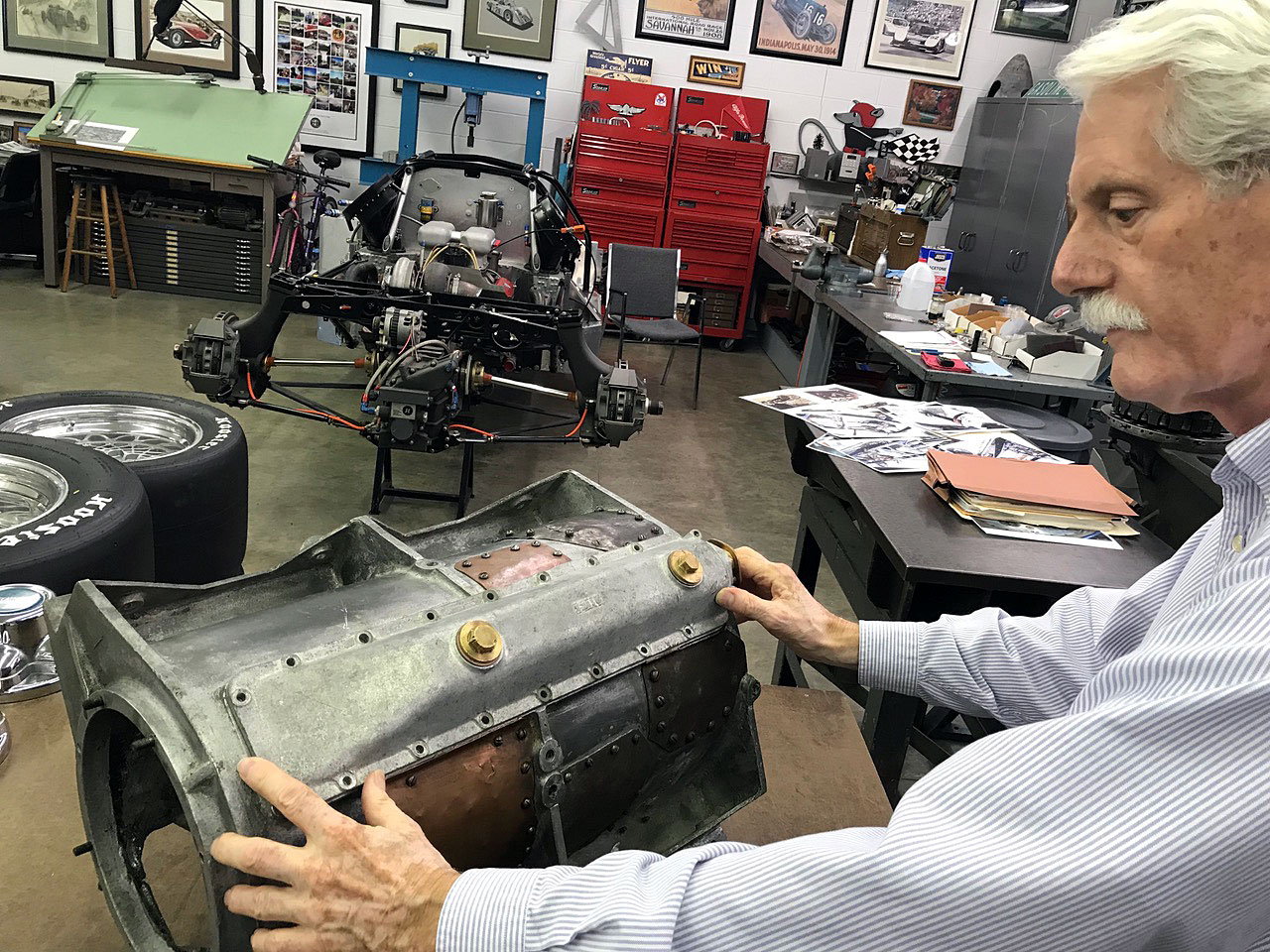
The late Gordon Barrett with the 1914 Grand Prix Sunbeam engine. It was a copy of the 1913 DOHC Peugeot Grand Prix engine that revolutionized the racing engine.
Story and photos by Geoffrey Goldberg
A good friend and a great car guy passed away in September 2020. There was little notice, but he was well known to a number of people as a very special person. The following is a memorial story about Gordon Barrett, one that was written back in 2021 but got sidetracked, and is now being published. May Gordon, and other good folks like him, not be forgotten.
Gordon and I first met in 1990. I had driven a Jaguar E type to the races at Elkhart Lake, Wisconsin, and was busy retorquing the head on its fresh motor.
Wrenching in the paddock seemed reasonable but was unusual even then, and it wasn’t long before a couple of guys wandered by. First was Gordon Barrett, who offered to help; we were joined by Harlan Schwartz, a character in his own right. Thus started two new friendships with these remarkable men, with their affection for special cars, each having their own 8C Alfa Romeo.
Over the next three decades, Gordon and I only saw each other here and there. In 2007, at Pebble Beach, one of the judges was overheard in discussion with a friend, querying: “There is this one car in a class that is just head and tails above all the rest, but we don’t know the car….if it’s real, it’s a winner, but what if it’s a fake?” The class was for the pre-war Alfas, and the car in question was Gordon’s. And there was nothing fake about it. Gordon could tell stories about sourcing the parts, even working through a southern Italian junkyard looking for a brake cable pulley.
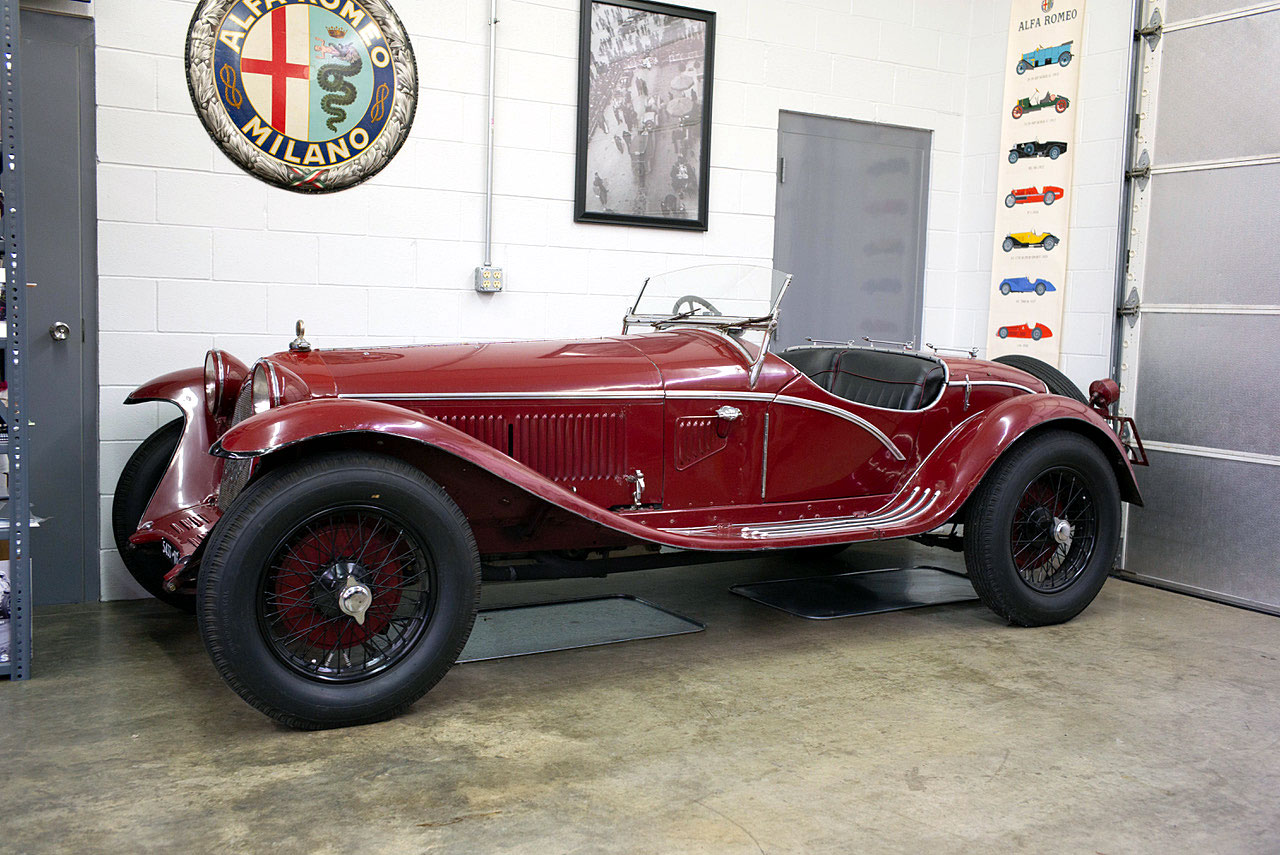
Gordon’s Alfa 6C 1750 was in his shop in Gasoline Alley.
Over the years we shared notes on murky Italian information, along with our mutual admiration for all things designed by Vittorio Jano. Gordon knew of the obscure story about Jano arriving at Alfa Romeo in the late 1920s; when Jano went into the test room, he watched current staff testing an engine for durability. Reportedly, Jano stepped in as the new head of engineering, and he hung his bag on the throttle to keep it fully on and said “Now we go to lunch.” The story was known, but Gordon knew the source. He was steady that way.
The Indy Museum
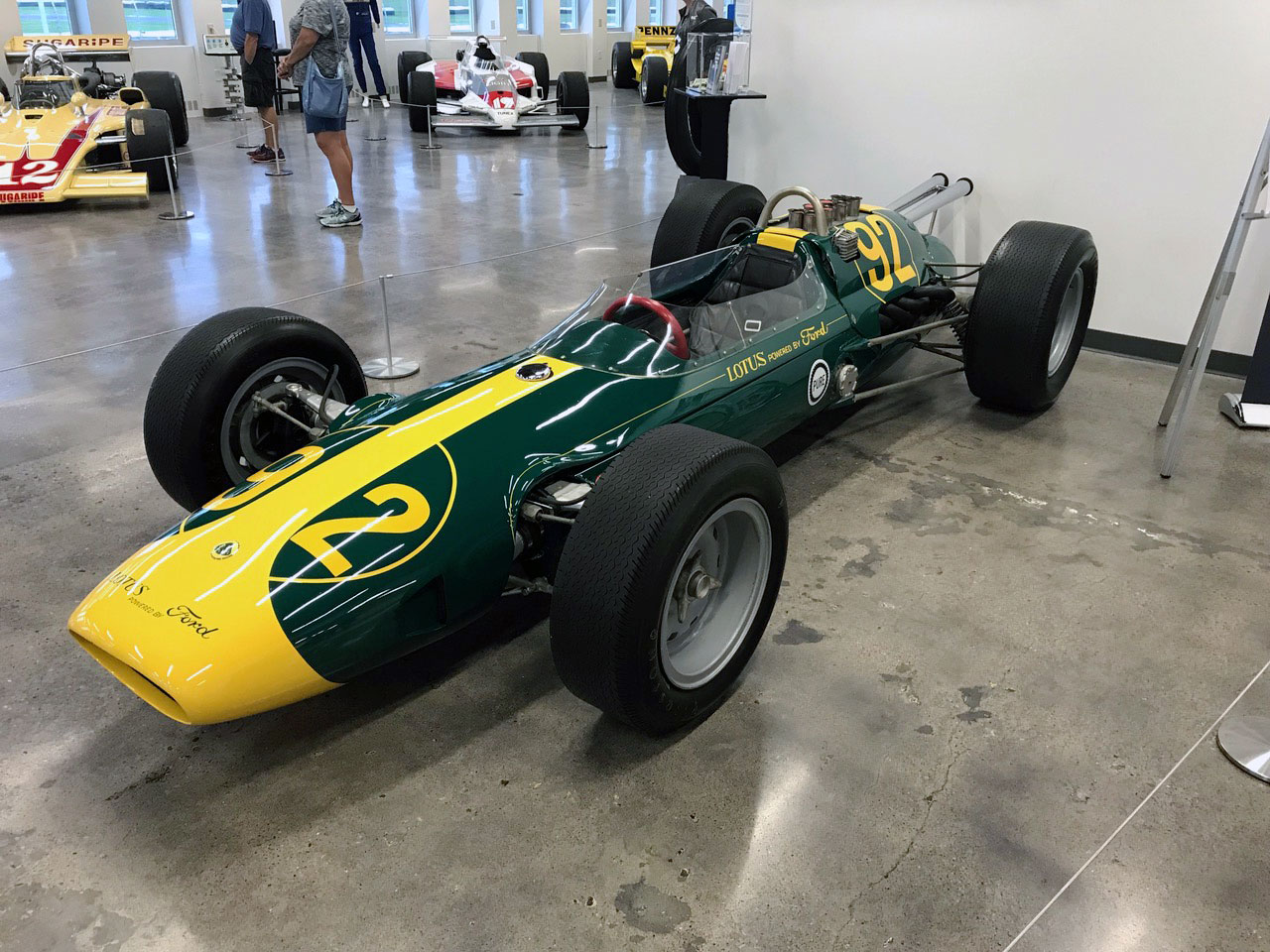
Another car that revolutionized racing was Dan Gurney’s 1963 Lotus Ford 29. Gurney finished seventh while Clark almost won the race. “Despite the short racing history and the lack of a win at Indy, however, the Lotus 29 made history, both for proving that mid-engine cars could successfully compete and for being the last two cars to run carburetors in the Indy 500,” says the Indy Museum.
In 2018 over the July holidays, I decided to go to Indianapolis and finally see the town and race track. Gordon said he would be around and was enthusiastic about getting together. We agreed to meet at the Indy Museum, and there we spent a couple of hours, looking at Offy engines, Lotus cars, and Indy cars from the 1960s-80s. Gordon explained how some were able to be “altered” even while running to go better – which some might have called cheating – but he explained that this was all part of the sport and that craft was measured by how skillfully the efforts were done. He remembered designing interior fittings into the wings so that the wing profile could be modified after inspection without visible hardware. This was child’s play; the really good folks had much better tricks up their sleeves, and that Foyt was famous for his tricks.
Overwhelmed, I can’t remember most of what he told me, but what was clear was his combination of fabrication skills and love of the art in these cars. His background was deep, first trained in engineering, and he went to work for a couple of teams in fabricating the cars. In his words, knowing metal strength gave him an advantage over other people who were just making what worked.
He had started working for Grant King, and then got involved with AJ Watson, and while a true afficionado of American racing would have appreciated all these wonderful stories, try as I might, they fell on deaf ears. But we shared a love of Miller, Offy, tales of Leo Goosen and his engineering.
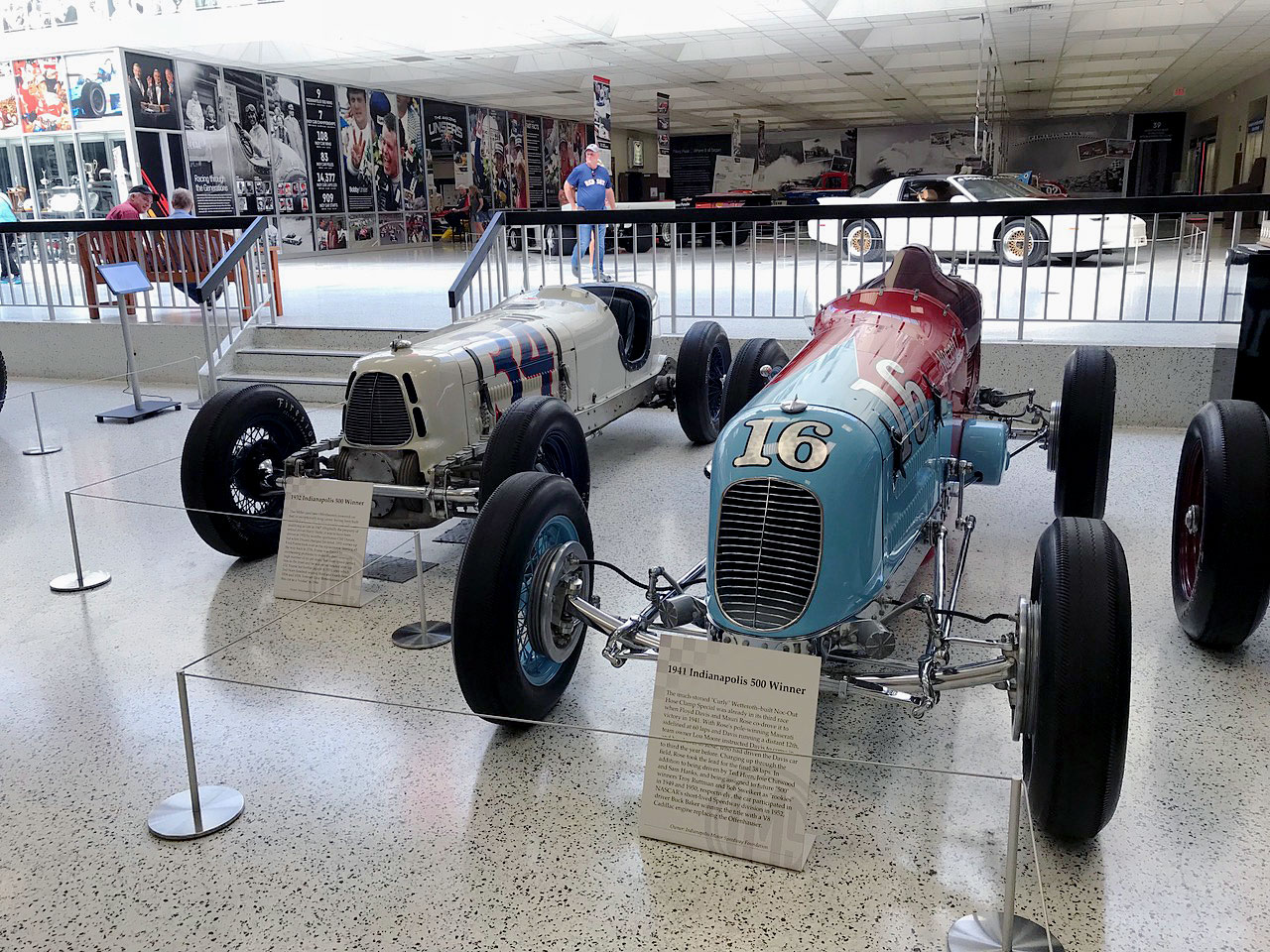
Talk of Millers and Offys. We pondered this display at the Indy Museum. At left, the Harry Hartz-owned Miller driven by Fred Frame which won the 1932 Indianapolis 500 at a record average speed of 104.144 miles per hour. And on the right, the Offy-powered Wetteroth driven by Floyd Davis and Mauri Rose which won the 1941 Indy 500.
We went to his shop on Gasoline Alley. He explained that there were had been several Gasoline Alleys, relocated over time, but regardless of when or where, one hoped treasures were to be found. His shop was somewhere between a fabricator’s dream house and a man-cave par excellence. A few of his cars there – a Lola T70, a 6C Alfa 1750, and a lovely American hotrod creation from California, likely late 1950s. Each had stories – the Lola was somehow an intermediate version, with a special solution used mid-point in the chassis for a structural issue, of such interest that Eric Broadley came to visit and see the fix. The 6C Alfa had been Gordon’s car for decades. Its paint was glorious, at least 40 years old, possibly original (can’t recall), but the patina was as special as the car itself. You could live in that paint and be happy forever.
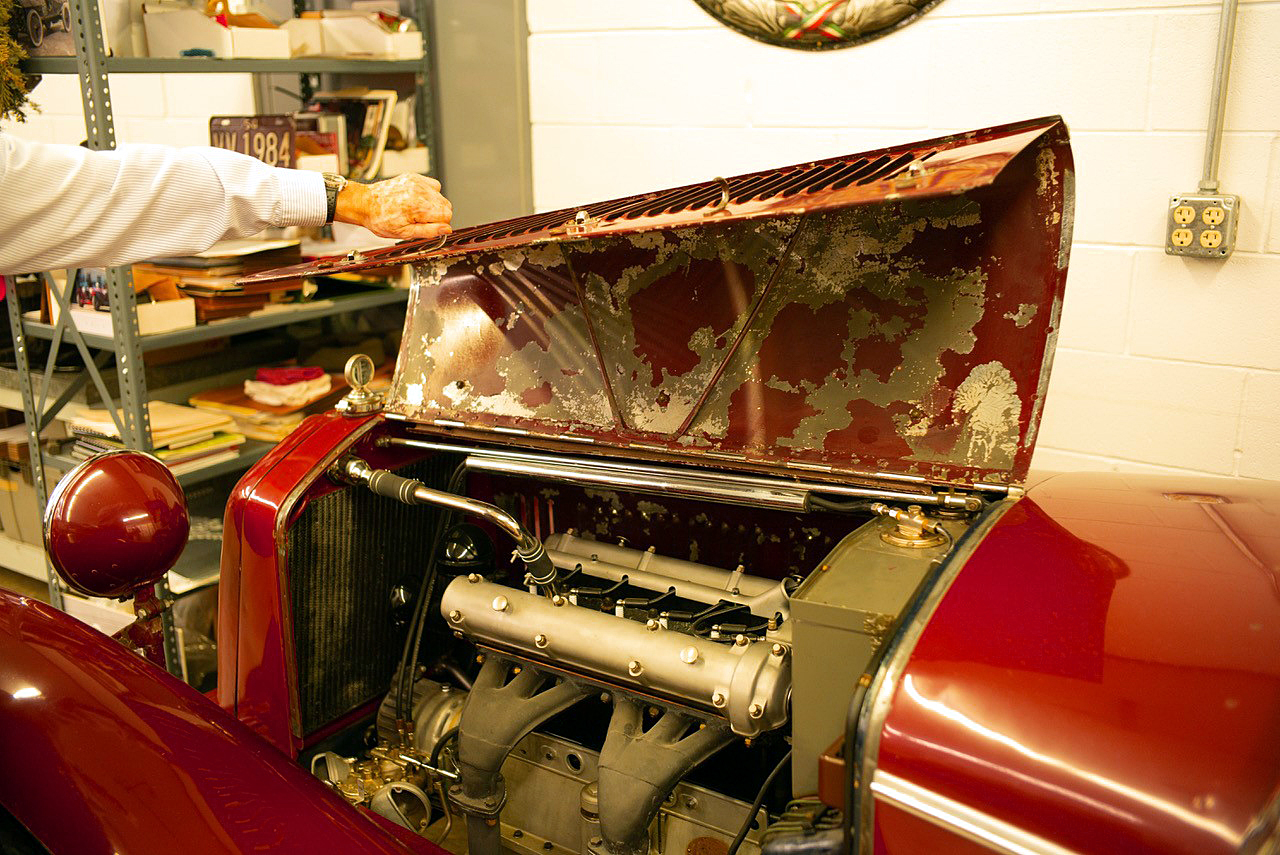
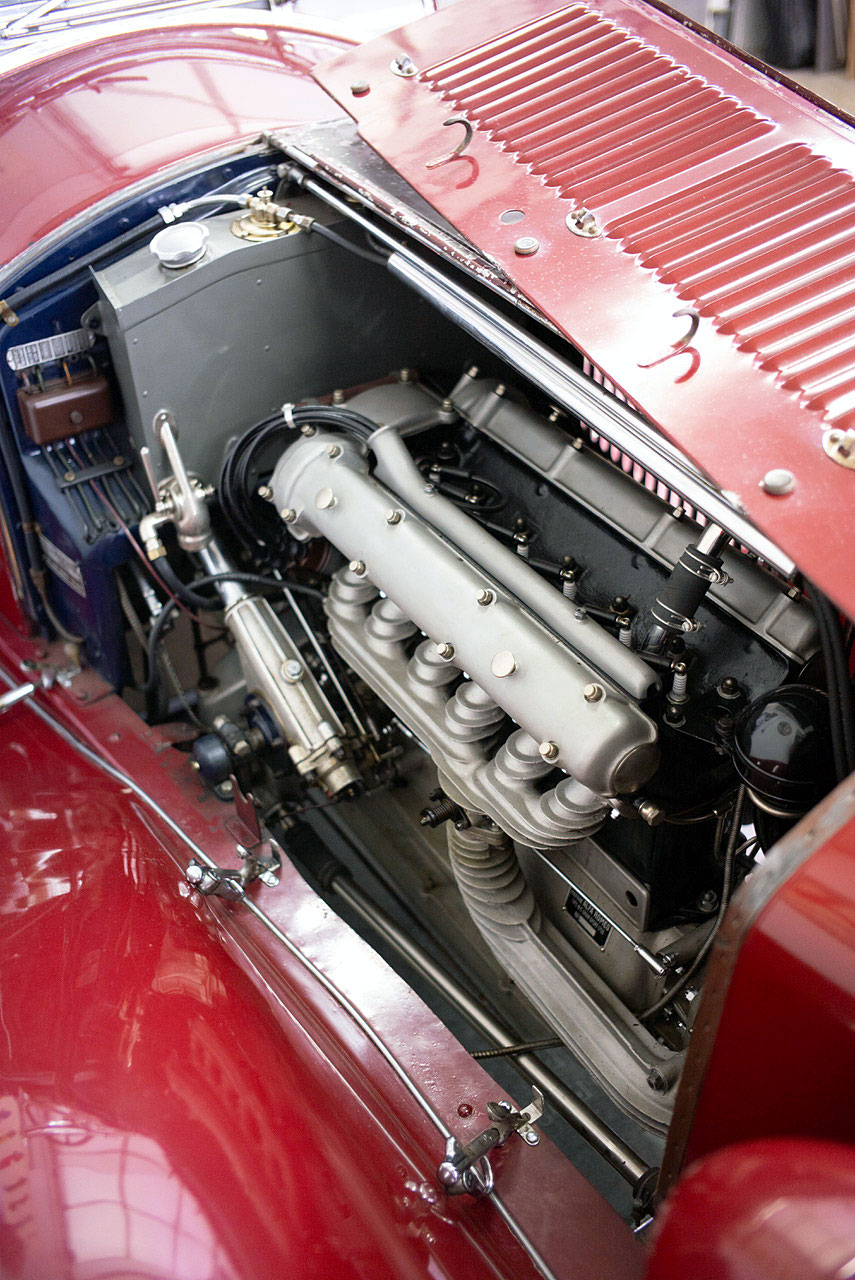
Alfa 1750 engine and paint…Gordon had the car for decades and resisted the temptation to restore.
And the hotrod? Curious, it seemed odd but was a welcome part of the ensemble, with an elegance and simplicity, well done in California. It was the country cousin at the family gathering, the one with an odd sense of humor but a good twist afoot. Fit right in.
We spent the afternoon going through the shop. And regardless of how hard I looked, there was not a single speck of dirt to be found. Anywhere. I checked the benches, the shelves, even old car parts. None, nowhere.
We went through the working shelves, each telling a story, each with a set of issues, organized somewhere between surgeon’s tools and a library par excellence. Clarity of thought and purpose was ever present.
Gordon’s 1914 Sunbeam Grand Prix Engine
Of great interest was the Sunbeam engine from 1914. It was derived from the 1913 3-liter Peugeot Grand Prix engine by Henri, copied by Coatalen for Sunbeam in England. This race engine was significant, an early DOHC four cylinder with four valves per cylinder. Gordon told the story of how Sunbeam “borrowed” one of the racing Peugeots following an event in England, which was then torn apart and copied meticulously.
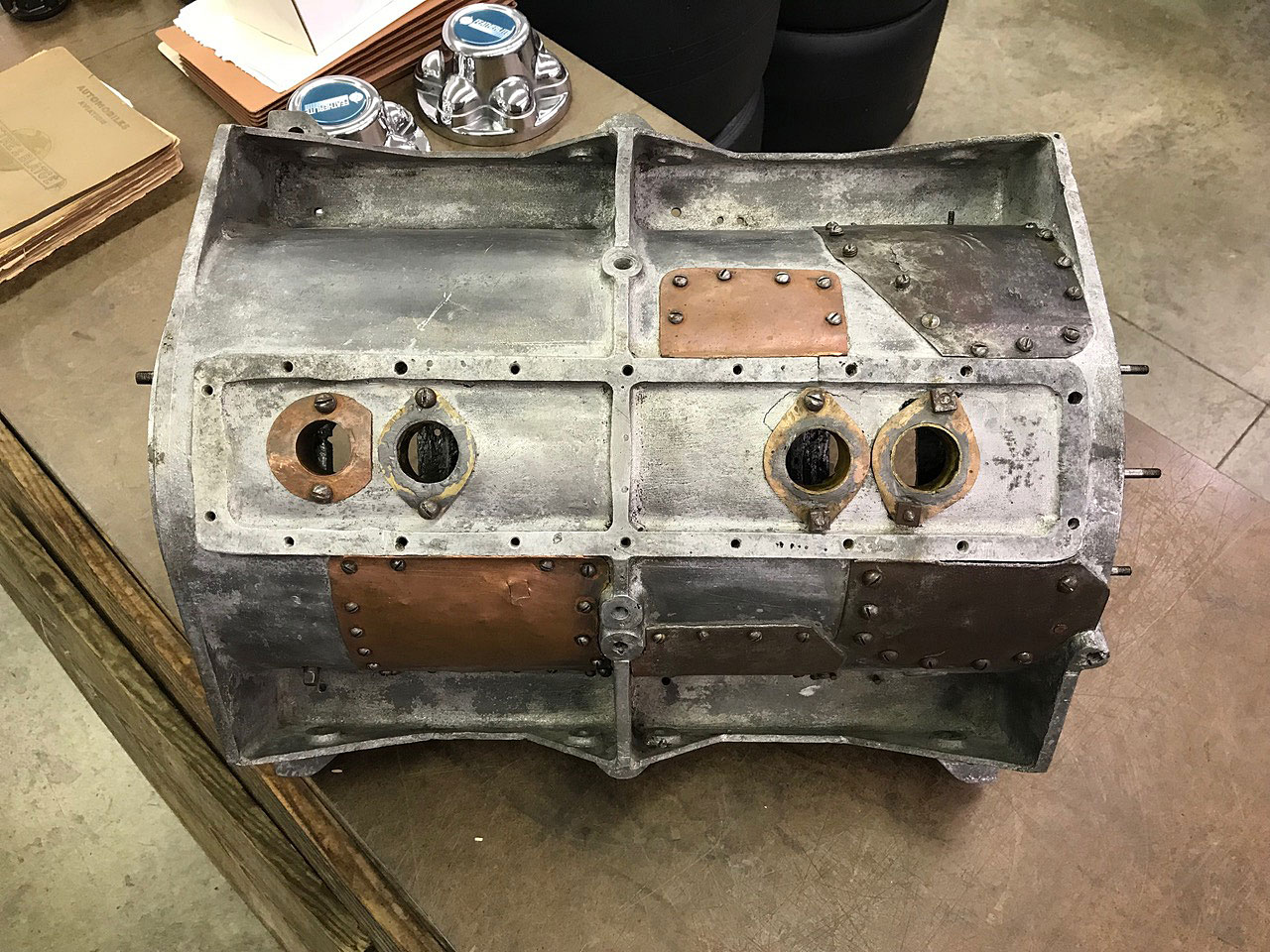
Multiple patches on the barrel crankcase of the 1914 Grand Prix Sunbeam engine. It was a copy of the 1913 DOHC Peugeot Grand Prix engine that revolutionized the racing engine.
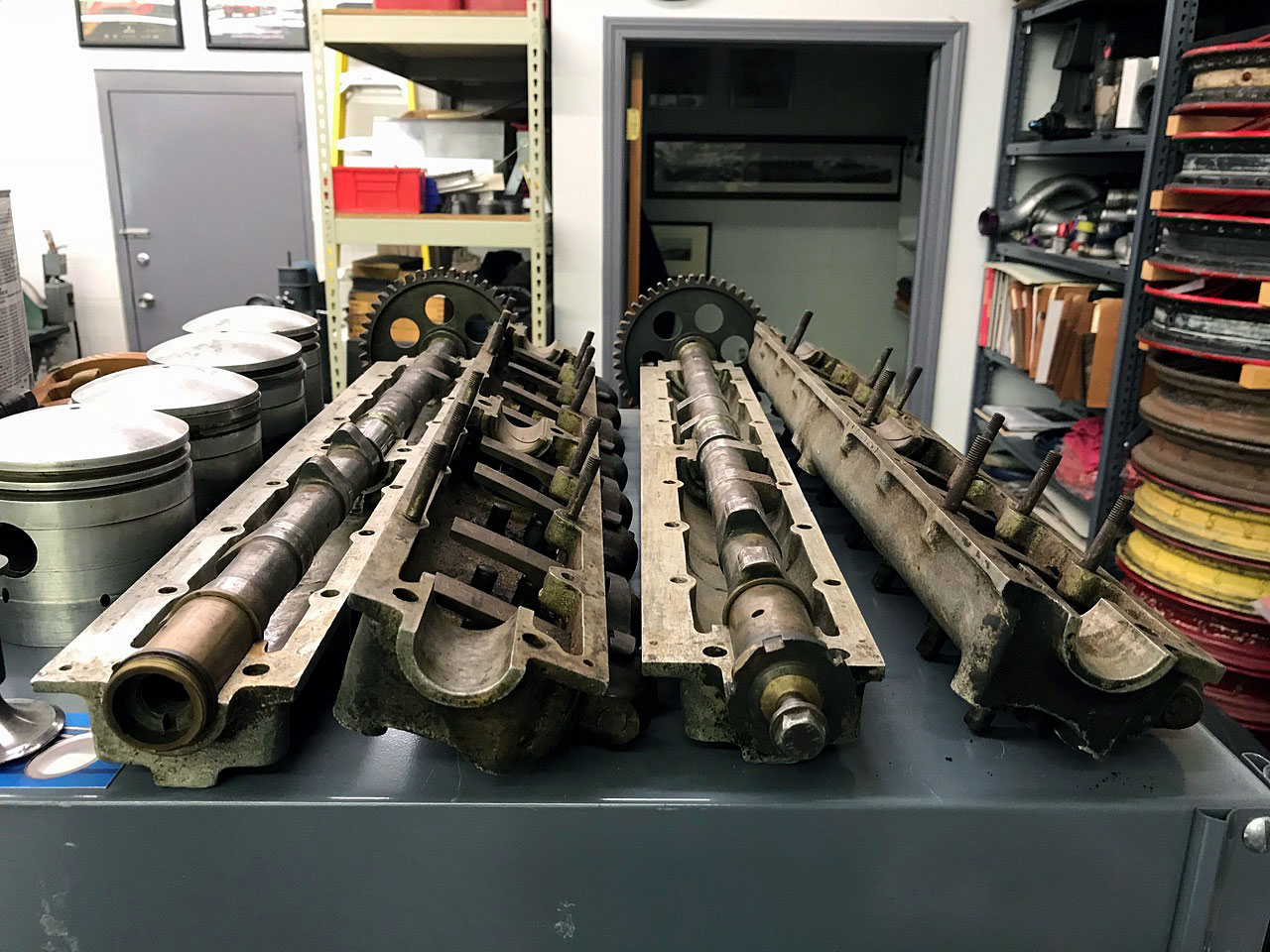
Camboxes of the Sunbeam engine similar to the four cylinder Grand Prix Peugeot.
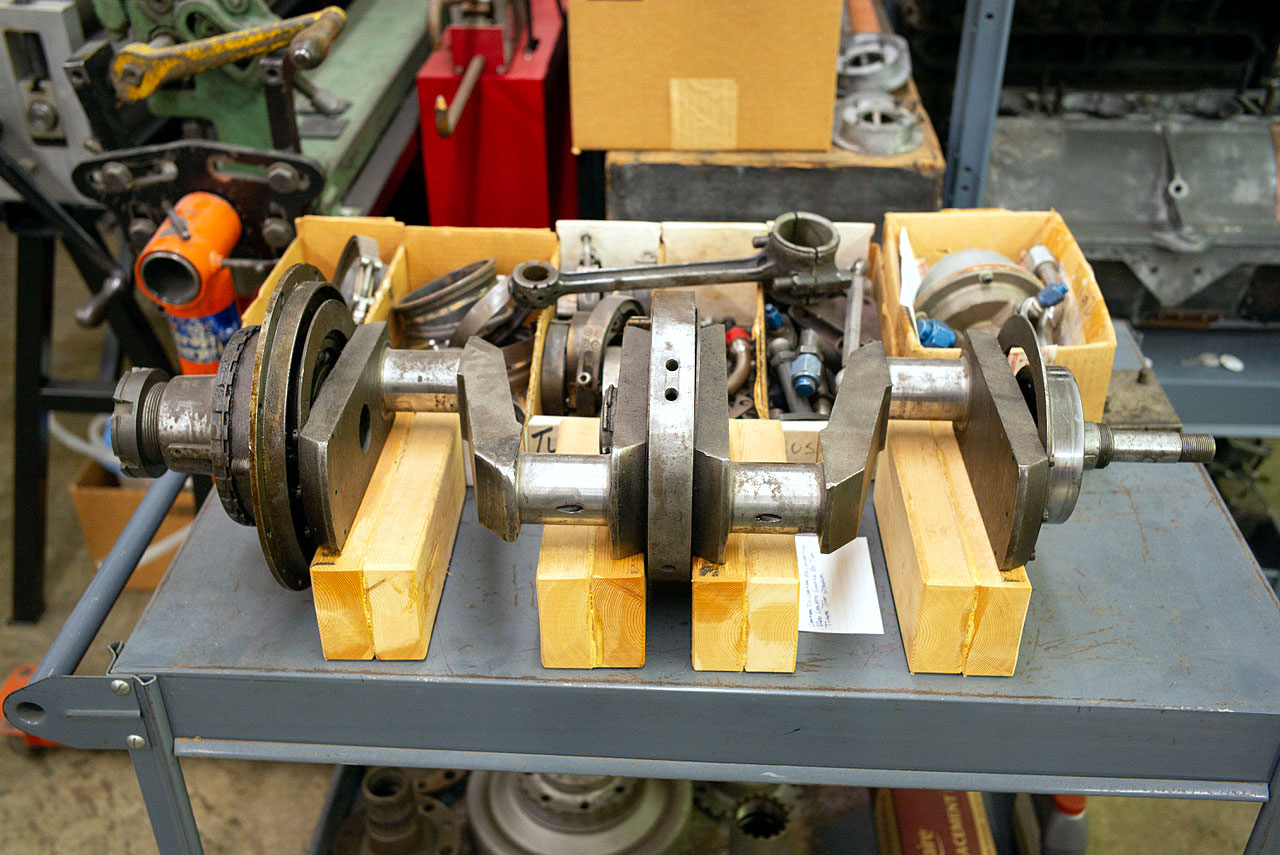
Three main bearings of the Sunbeam GP engine.
Pomeroy suggested how the Peugeot was obtained: “…whilst the Sunbeam cars which won the race were an interchangeable replica thereof, as the Sunbeam designer, L. Coatalen, bought one of the Peugeot cars through an intermediary and imported it to England as a model”. He also noted the engine was “an interchangeable replica (except of an enlargement of bore by 3mm. and stroke by 4mm) of the 1913 Coupe de l’Auto Peugeot, all the parts being copied from one of these cars purchased in France some months before the race.”
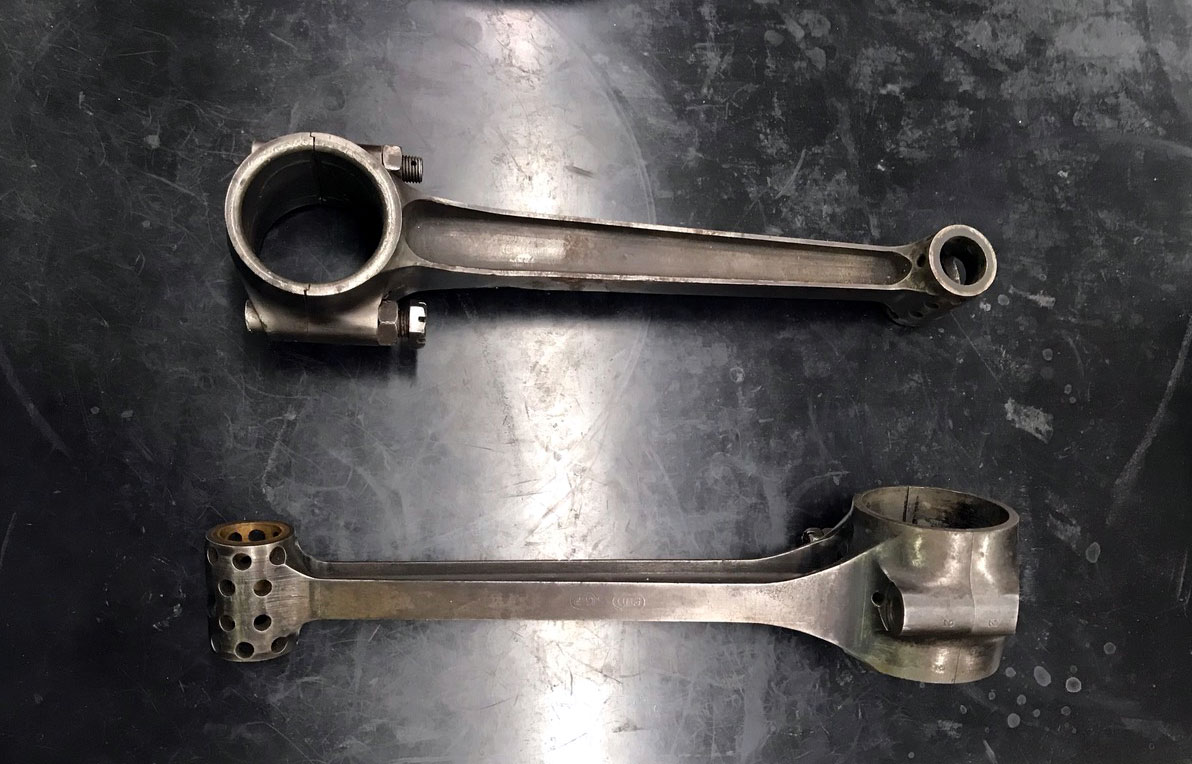
Long stroke of the Sunbeam conrods.
This particular engine had history in several different car frames, and was even in a Mercedes long ago. Gordon said it may have done the French Grand Prix, was likely at Indy in 1915, and run on American oval and dirt tracks. There had been much competition in getting this engine (there was a chassis too, no body), and he was proud to be in charge of putting this very special piece back together. We pondered its massive crankshaft, the overhead cams, the long connecting rods, and in particular, the engine crankcase. It had been much used, an incredible piece of history. Even the patches had patches.
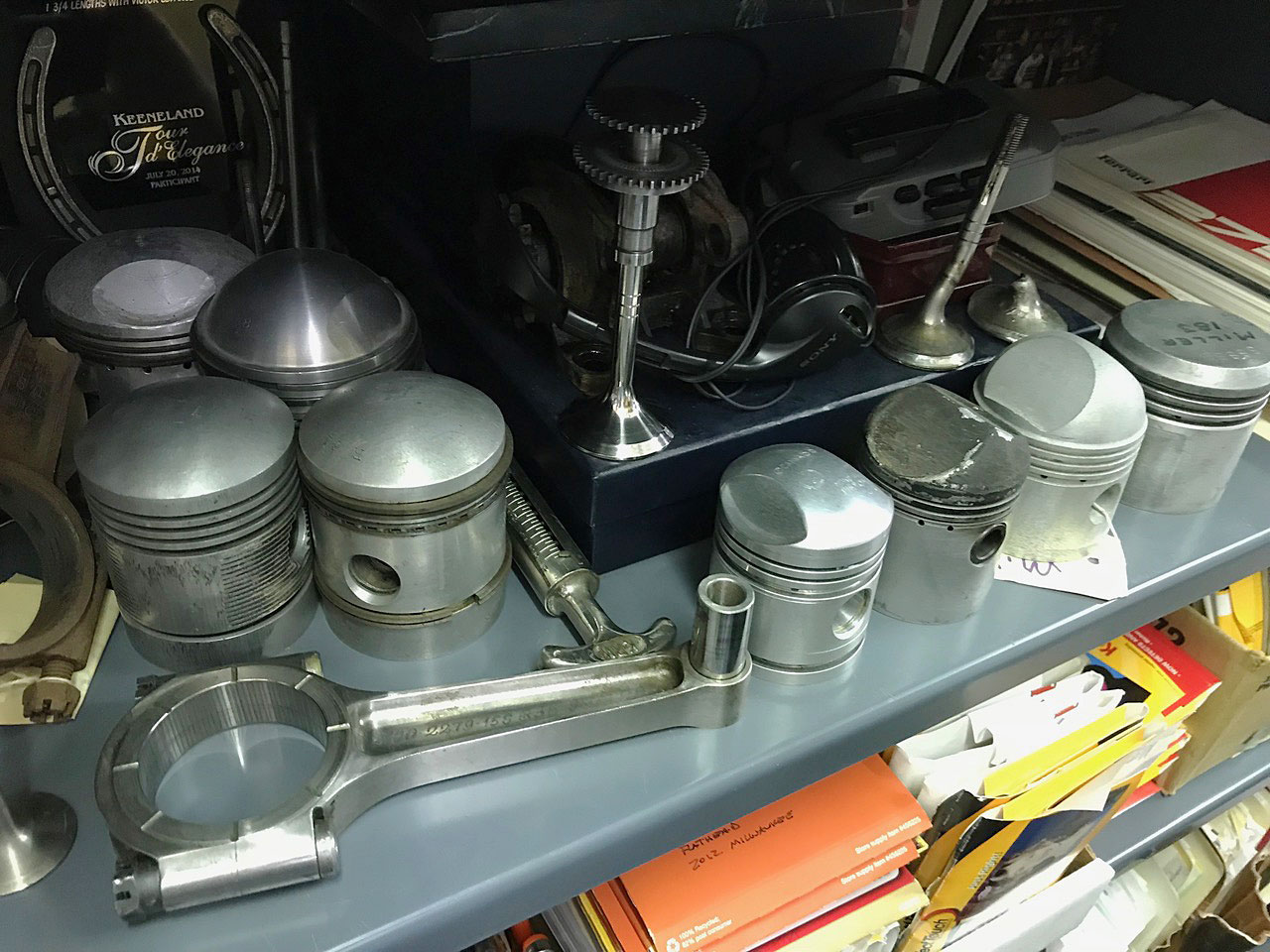
Alfa pistons with the adjustable valves in the background.
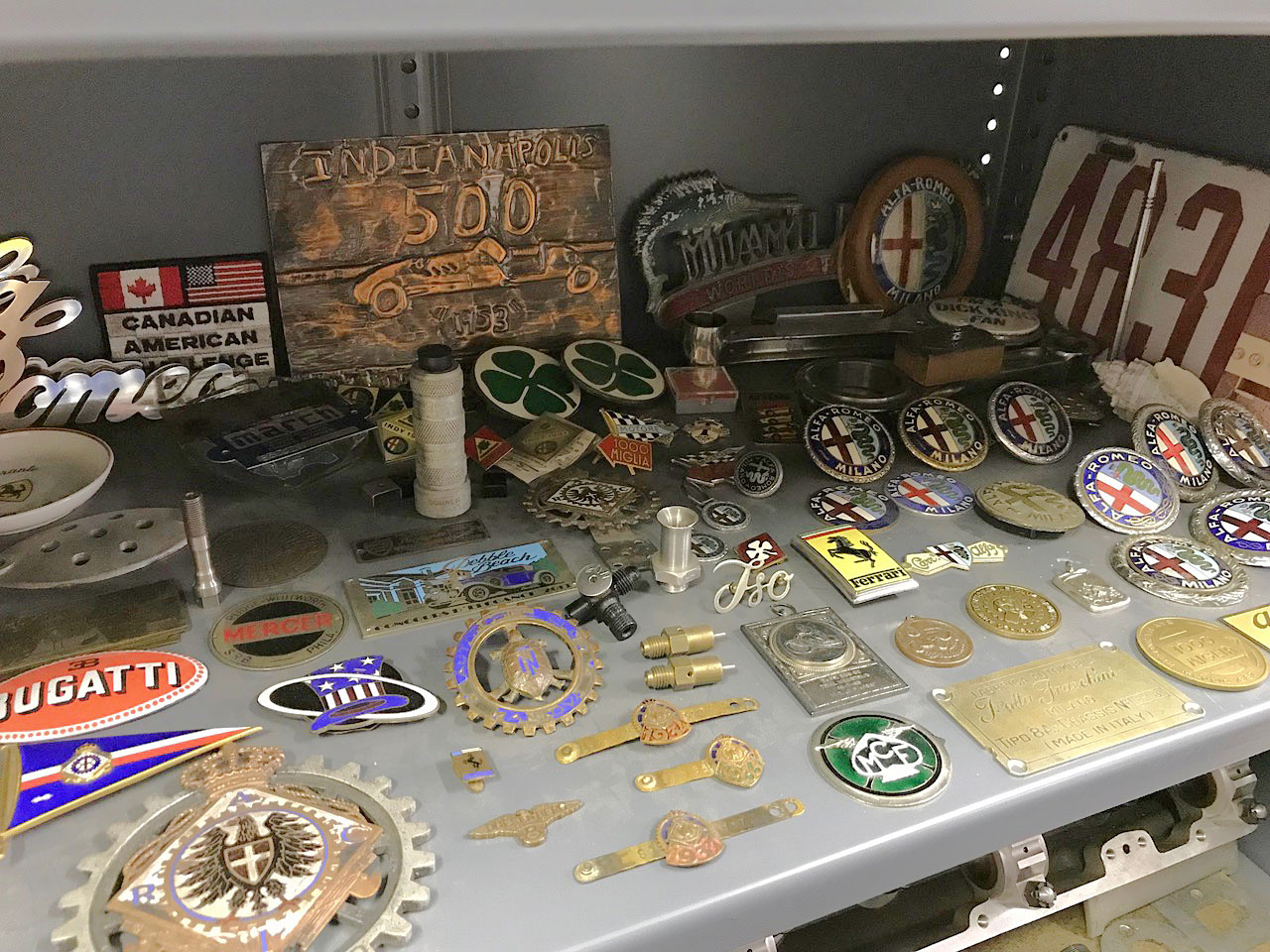
We wandered through the parts shelves, and spent most of our time on the two Alfa shelves: one with memorabilia, Alfa bits and emblems, Milan in Indy. But the second shelf had the true goodies: the famous valve system with adjustment designed by Jano. The valve stem was intricately threaded with an upper and lower flat cap spun on; a special key tool separated them, which clicked through the adjustments to be done quickly and precisely. It only made sense when you could see it in person – and there it was.
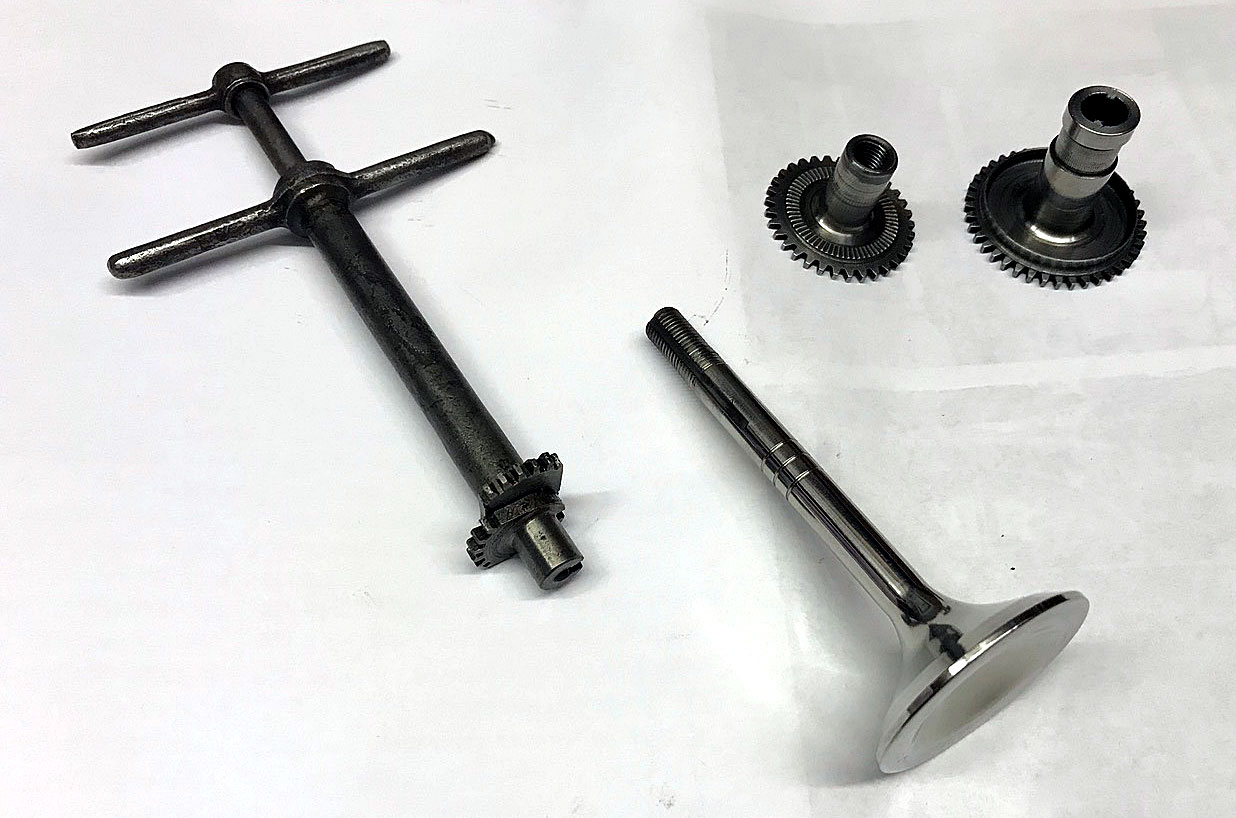
Detail of the Jano-designed adjustable valves, with the tool on the left.
Bookshelves were appropriately crowded, not just with Indy yearbooks, but even a full collection of Floyd Clymer manuals. Few have understood this very curious, passionate, under-appreciated man of post-war America, who was reprinting racing Maserati and Miller brochures in the 1950s! Gordon enjoyed my Lancia book, which we discussed at length. He called it a grand-slam, not easily repeated or followed. He had always admired Lancias, but somehow hadn’t managed to get an Aurelia to join his Alfas. He wrote later about coming to visit and spend some time on Lancias, but sadly, it wasn’t to happen.
On the side shelves were a few vintage car models. In this more intimate space, we relished in this, a library of thoughtful things, of the character and charm of special older machinery. For a moment, it was the atmosphere most special, and the history surrounding us. Of course, it was all because of the person who cared for, assembled, and recognized all these things, but for the time, we simply absorbed all the surroundings.
Both of us were tired but unwilling to give up on the lovely day, and so we finally opted for dinner. Talking late into the night, discussion finally rolled around to his 8C Alfa, which was not in the shop. I told him the story from Pebble with the concourse judge, which he understood immediately. He explained the Alfa was in fact largely unknown: it had been in the hands of a dentist he knew in a barn garage for about 30 years, near where he had lived in Pennsylvania as a youth. It was not on anyone’s radar, and with an additional decade or two of Gordon’s restoration, it was simply new to the Alfa community. We talked of the pulley for the brake cables. Did anyone mention details?
Gordon explained he had done about eight Alfa rallies with the car, and he felt the car would only go downhill if he kept using it. He had just made the unusual and courageous decision to part with it. This was a strange decision for it was truly one of, if not the, best in the world. In true Gordon fashion, he made the move with finesse and total discretion: he traded it for a user 8C, one with perhaps a bit less charm, a bit less perfection, but broken-in and well-appreciated. He took the difference and put it into a retirement fund. He was to receive the replacement 8C within a few days, and was eager to see how he would enjoy it. It was an odd move, to be sure, but upon reflection, made a great deal of sense.
The visit and long day filled one full of joy. It was a delight to strengthen a friendship and spend the day with someone so knowledgeable, accessible and open. There are only a few special experiences one has in life that truly stand out as memorable, that make life worth living. This was one of them.
We touched base a few times after that, but it was hard to repeat the day without being there. I showed a close friend images of the shop – he was so moved that he wanted to approach Gordon about apprenticing for a week in his shop. These are things one should do. And it was only a matter of time before Gordon and I would reconvene, and we discussed his coming to visit. But it was not to be. Amid the sadness is a deeper regret, of not saying goodbye to this special person. May we all live our lives so fully and generously.
PS
The photo taken by Simon Moore to go with his comment below.
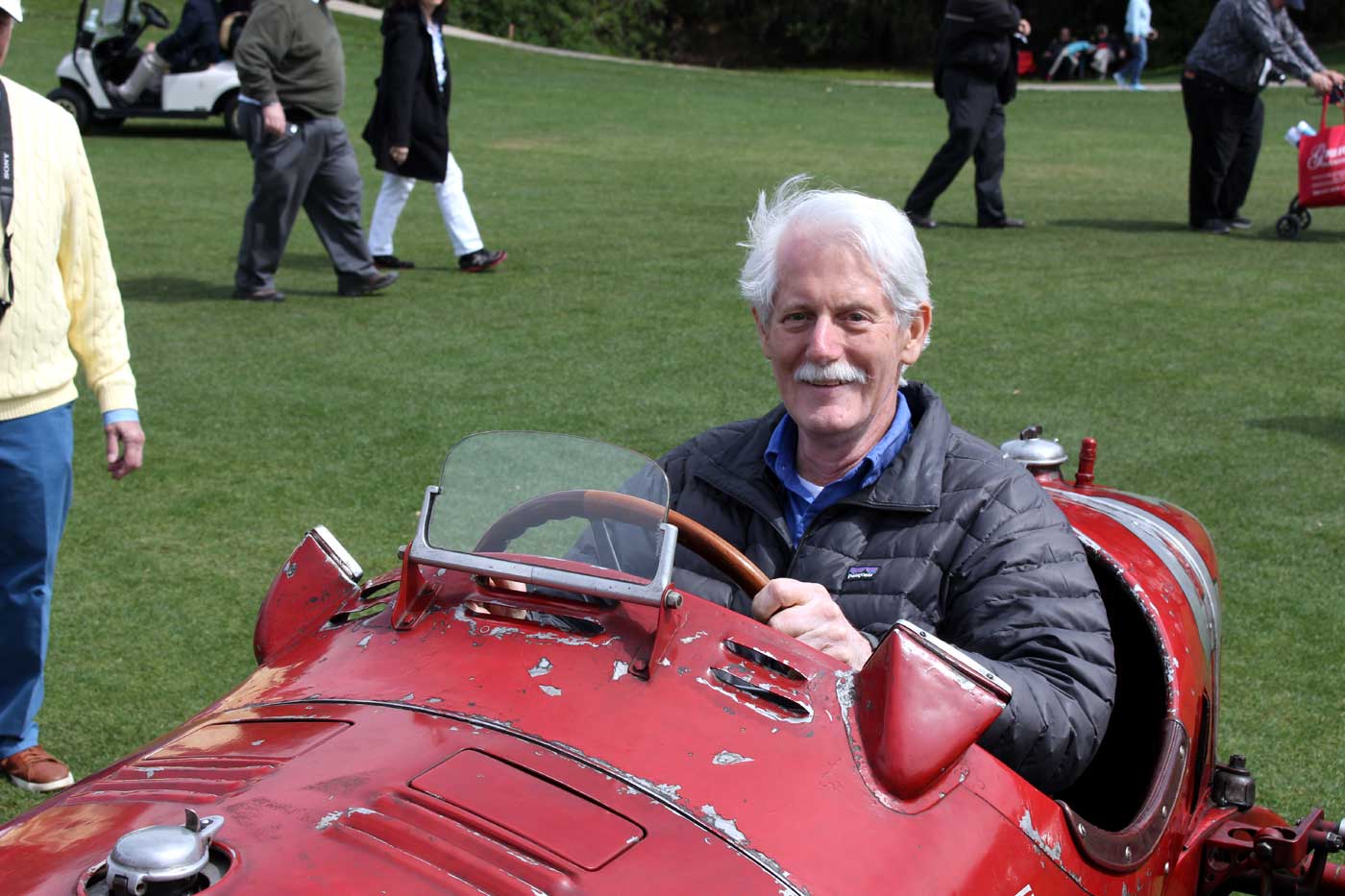
Gordon at Amelia Island sitting in the ex Frank Griswold, ex Tommy Lee Tipo B Alfa – he passed away soon after. A very dear friend.–Simon Moore
I also was a friend of Gordon. Not always easy, for those that knew him we understand. I definitely had a tremendous respect for him and are extremely grateful I got to spend time with him at his shop on Gasoline Alley. Our hobby lost a very special and significant part with his passing.
Thank you for this. Very well done.
could i have met this gentleman at nassau speed weeks in ’62? or was it john gordon bennett–any relation? anyway he rode a scott flying squirrel, which moved me to get one in ’71.
this is a very nice tribute to Gordon Barrett !!
I made aquaintance with him at Pebble Beach ,where he showed his Alfa 1750 . And where I judge .
His car was ( and still is ..) bodied by Brianza , of which we believe 4 were made .
My 1750, bodied by Zagato but equiped with wings by Brianza …
At some stage Zagato was owned by Brianza .
Godon and I went back and forth about both cars in depth .
I still have his letters in his very particular but beautiful handwriting .
Handwriting, yes ! He took all the time in the world to communicate ,very friendly and absolutely knowledgeable about the subject . I have fond memories and am very happy to see his name is and will no be forgotten . By the way, the 8C he sold the 1750 for is not too bad a car either ….!!
Raoul E. San Giorgi, Belgium
Thank you Geoffrey, a really nice tribute and another glimpse into your wide-ranging interests.
Very accurate and thorough tribute to a truly talented , generous and gifted person at the pinnacle of our automotive hobby. I was fortunate to have been to his wonderful shop a few times in gasoline alley over the years . He could speak to every aspect of restoration and fabrication from experience and some very deep knowledge . His shop held so many fascinating tools and parts that were the starting point of once in a lifetime discourse. I remember he helped me obtain some very esoteric antique coating that had been alluding me for quite a while on a car I was restoring. Of course he knew all about it and he was happy I asked and happy to share his knowledge .
If there ever was a car guy’s car guy , Gordon was it!!
Les Burd
Alameda ,Calif
Pete. Pleased to see that you eventually ran the piece about Gordon. My first correspondence with Gordon (in Upper Case letters as always) was in February 1972. Back then he had his GTO. One day a dealer said he would fly in to look at a motorcycle that Gordon had for sale. Gordon said he would be outside the terminal in his car but the dealer said how will I recognise you. He was in the GTO! In the 1980s we had a couple of memorable trips to see Alfa folks including Jim Ibold and his 2.3 and 2.9, Brian Brunkhorst, Doc Lederer, John Clemetsen and many others. Then Gordon passengered me on the 1987 Mille Miglia in my 2.9. In the 1990s I spent the first weekend of qualifying at the brickyard one year – sleeping on his couch! Subsequently, whilst I was living in Singapore he met me in Seattle with publisher Mal Harris to help finalise “The Legendary 2.3”. Of course, I could write more but could you please include the photo here of Gordon at Amelia Island sitting in the ex Frank Griswold, ex Tommy Lee Tipo B Alfa – he passed away soon after. A very dear friend.
I,m an Aussie guy, & met Gordon through Greg Littleton, I spent many many days with Gordon, as I really loved his in-depth talk & values on all old fashioned engines, had many cups of tea with him, I came over to Indy some 23 times from the Land Downunder, as we don,t have any racing like Indy down here, @ all, a very, very interesting person, he will sure be missed. Cheers – Doug Pepper, Brisban, QLD. Australia.