The story of the early years of Road and Track, thanks to Jim Sitz.
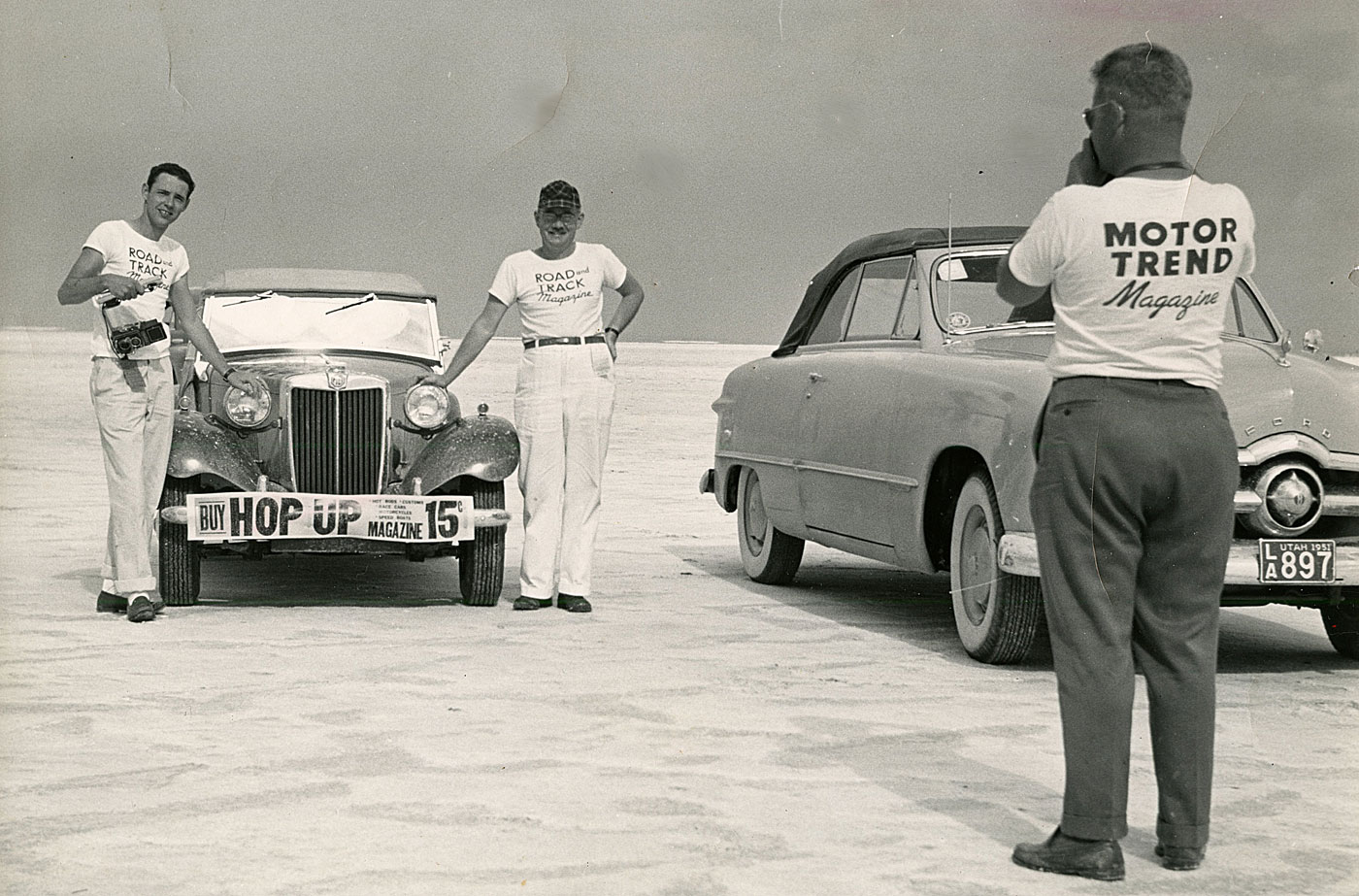
Off to a great start: Bonneville, 1951. Road and Track, Hop Up, and Motor Trend staff members gather for the Bonneville Speed Week. Jerry Cheseborough is on the far left, that might be Oliver Billingsley on the other side of the MG. Motor Trend photographer unknown. Courtesy Jim Sitz.
By Pete Vack and Jim Sitz
From the VeloceToday Archives, April 2021
Ed. note: Most of the information below was provided by historian Jim Sitz, who was a witness to the early years at the magazine, via emails to me over a period of weeks in 2020. He also was in the possession of the rare photos taken at the Road & Track offices in 1951, obtained from the Billingsley collection in the early 1990s. We have not been able to determine who took these photos or under what circumstances. Any questions regarding these photos can be sent to the Editor at vack@cox.net.
You Bet Your Life
In 1952, while Groucho Marx was gambling his future on the new-fangled TV with a show called “You Bet Your Life”, a thirty-nine-year-old engineer in California with a bright, enthusiastic wife, a new son and a MGTC was betting that the sports car fad was here to stay. In fact he was betting his family’s entire future on a sports car magazine that was deeply in hock. It had been offered to other magazine publishers but turned down, and one wouldn’t even take Road and Track (no ampersand in the early days; the “&” in the title was introduced in 1954) for just the bills. But staff members John and Elaine Bond were determined to save the magazine and were fully aware of its potential of a magazine devoted to the growing sports car movement. They decided to take a huge risk.
Although the Bonds were always closely associated with the success of Road and Track, they didn’t establish the magazine. Writing in R&T, June, 1972 Bond recalled those early years. “Many readers seem to think that Elaine and I founded Road and Track, that isn’t true, we merely kept it from foundering when we took it over in November of 1952.” No one ever seemed to ask who did, until in 1998, automotive historian and fact checker Jim Sitz decided to take the time and trouble to find out how it all began. He tracked down Bill Brehaut who was living in Palm Springs, California.
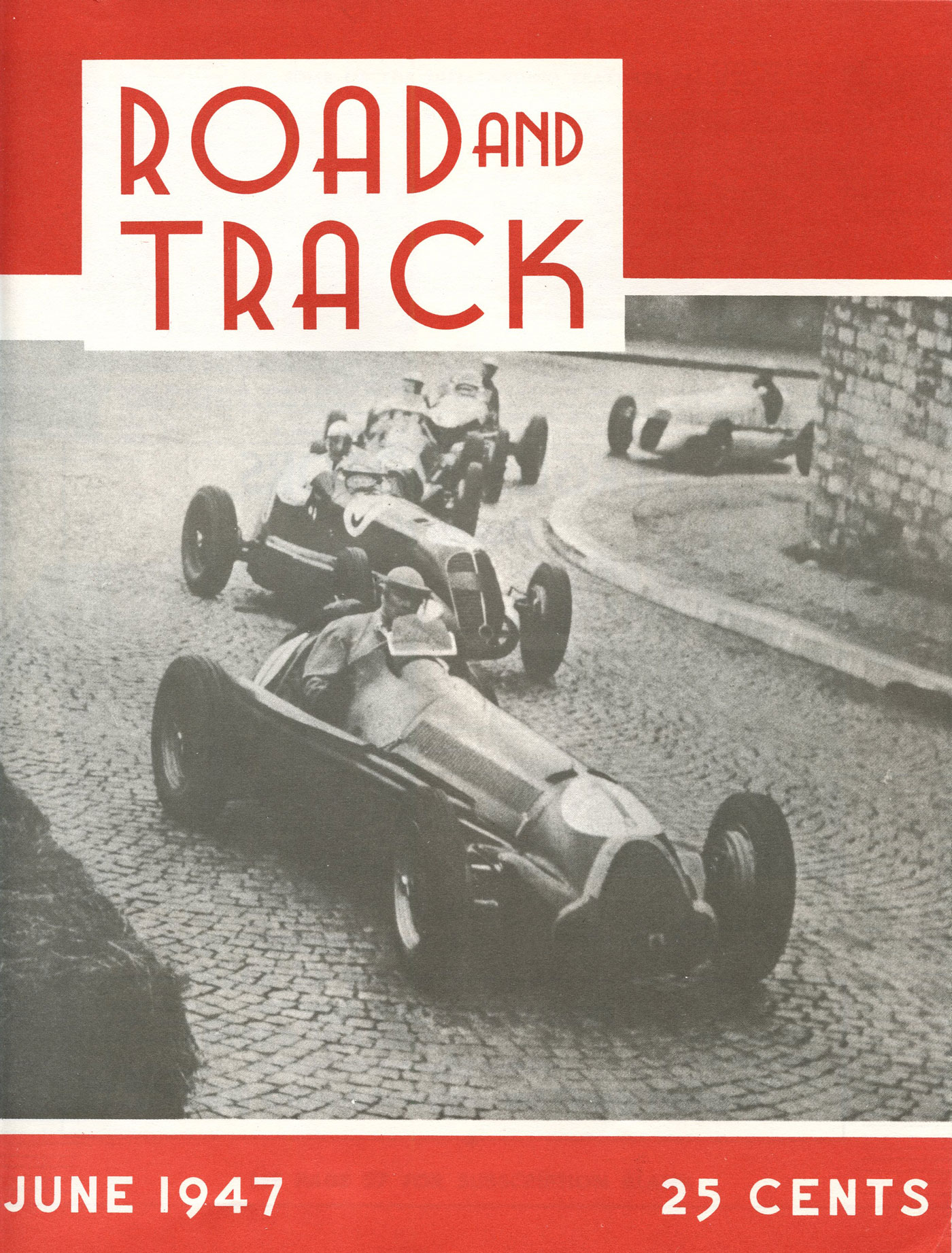
Volume 1 Number 1 featured the Alfa 158. In the time period from 1952 through 1972, Road & Track ranked in the top five among automotive titles that provided circulation details. It started with a monthly print volume 18,600 and grew to 64,000 in 1975 (a compound annual growth of 6.3%). It competed with Motor Trend, Hot Rod and Car and Driver. But in the early years, would-be angels like Tommy Lee and Secondo Guasti bailed out, as they saw no future in the new magazine and were surprised it did survive at all!
Brehaut et Fennessy
William Brehaut, Jr. was an engineer who worked for Republic Aircraft out of Long Island and a car enthusiast. In early 1947, he realized the potential for a magazine about foreign and domestic cars, as well as racing. Teaming up with Joseph S. Fennessy, Brehaut put together a very slim magazine of only 32 pages, and named it Road and Track. Sitz recalls that Brehaut only had money to print one issue. “They printed a few thousand copies of Volume 1 number 1 for June, 1947, and sent one half to New York City and the other half to Los Angeles.” That wasn’t the way to attract the large numbers of subscribers (for only $3.00 a year) and at 25 cents per copy, printing and postage costs were probably nowhere near covered. But traditionally, magazines needed a huge cash investment to get them through the first few years. That was something Brehaut did not have.
Then, Brehaut moved to Burbank to work for Lockheed and took the magazine, such as it was, with him. Once in California, Oliver Billingsley came to work for the magazine for free to keep it going and worked for free, as Billingsley had a military pension to live on.
It took almost another year to produce Volume 1 number 2. Despite the help of Billingsley and a new “Report from Europe” by dealer/writer/racer Roger Barlow, the editorial sounded dire. “It is vital that enthusiasts support Road and Track in this difficult period by sending us their subscription NOW.” (sic) After having sent $3 almost a year before with no issues forthcoming, car enthusiasts could not be blamed for ignoring the editor’s pleas.
But there was a lot of interest. Letters poured in with the same message, “Road and Track is what I’ve been waiting for…” In the magazine’s editorial for May 1948, it was noted that “Everyone seemed to want more and more of the pictures of European road racing and advance passenger cars…The development and growth of all American ‘sport car organizations’ is to be assisted in every manner possible.”
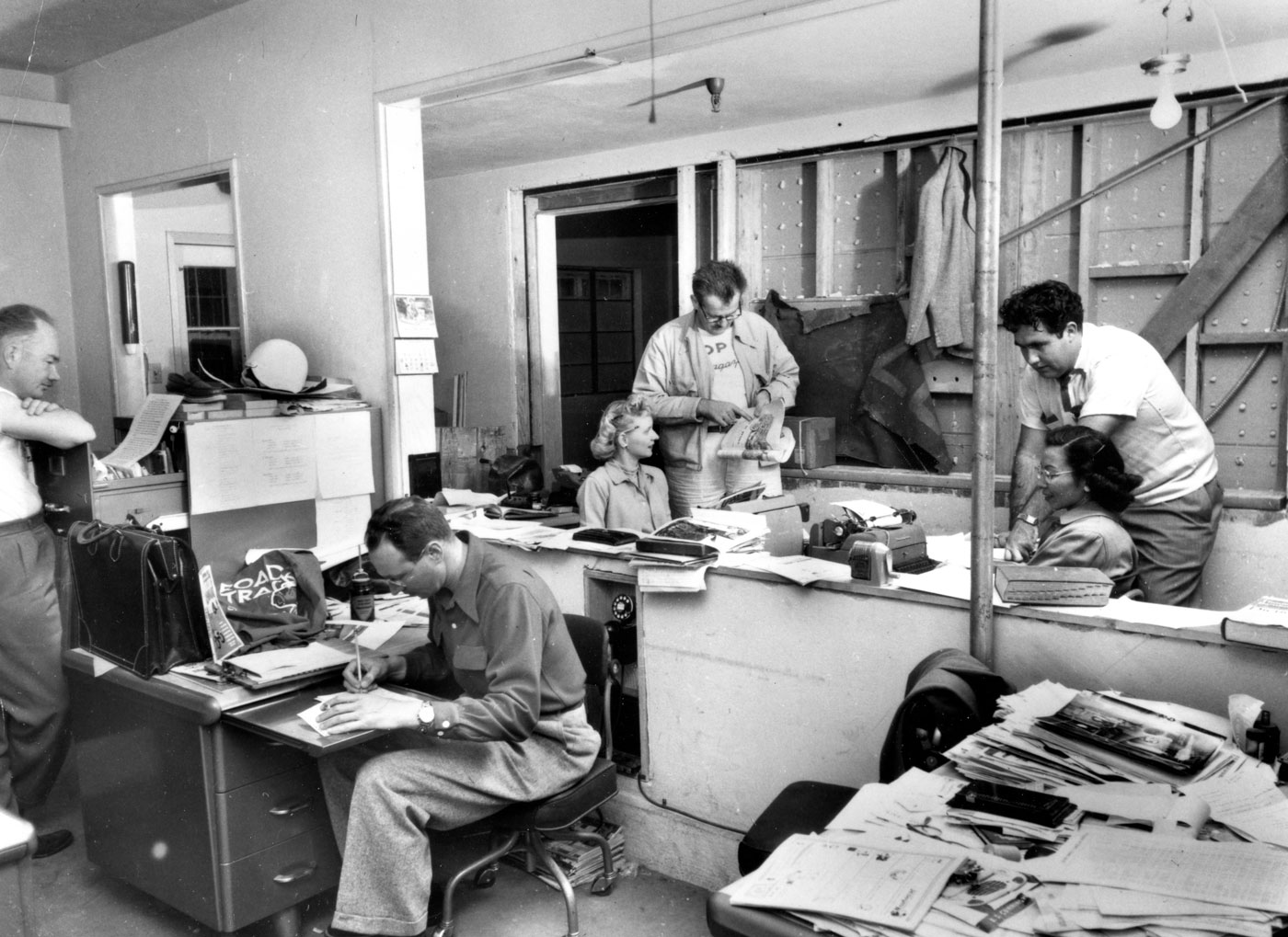
Rare photos of R&T’s first office in Glendale, California. Oliver Billingsley can be identified with the R&T shirt and mustache, Bob Dearborn is standing up next to the office lady. The date is November 1951 and as you can see, the office is very crowded, probably squeezed between two printing offices at the 540 West Colorado Blvd address. – Jim Sitz
The tiny, largely unpaid team managed to put out another issue the very next month, and it featured an article entitled, “What is a Sports Car” by John Bond, who worked just down the street from the office at Kurtis-Kraft. While the sports car had been defined by the British prior to the war, Bond knew that Americans would simply identify a sports car as a convertible. “The reason for this reply, he wrote, “is readily apparent. It is that no sports cars have been made in this country since the days of the Stutz, Mercer, and more recently, the Duesenberg.” The influx of British sports cars to the U. S., according to Bond, caused many people to wonder why similar cars were not made in America. But the term needed clarification, so Bond, an early member of the SCCA, sent out 200 questionnaires to have the member take a shot at defining a sports car. Summing up the many and varied responses, Bond wrote, “A sports car is a car between a racing car and a production car,” which meant that almost anything goes. And perhaps, it was loosely defined in order to draw more people to the pages of Road and Track.
Dawn of the Bonds
The magazine struggled on; June was followed by August and then a lapse until February, 1949, when Bond appeared on the masthead as an associate editor, opposite Brehaut. But things went from bad to worse. No monthly issues were mailed to those hopeful subscribers for the rest of 1949. Finally, in December of 1949, Road and Track once again appeared on newsstands. In the January 1950 issue, a reader wrote, “I subscribed a year ago and have received only two issues. My year’s subscription is up now; at this rate each copy cost me $1.50! Kinda expensive!”
Again the editorial had to answer the question of what happened to Road and Track? In a word, finances. According to Sitz, “Brehaut had offered the mag to Fawcett Publications in New York for free if he could stay on as editor but they turned him down. In an attempt to keep it afloat, in 1950 the price was raised to 35 cents an issue and the yearly subscription to $3.50 but by this time, Brehaut gave up on the magazine.
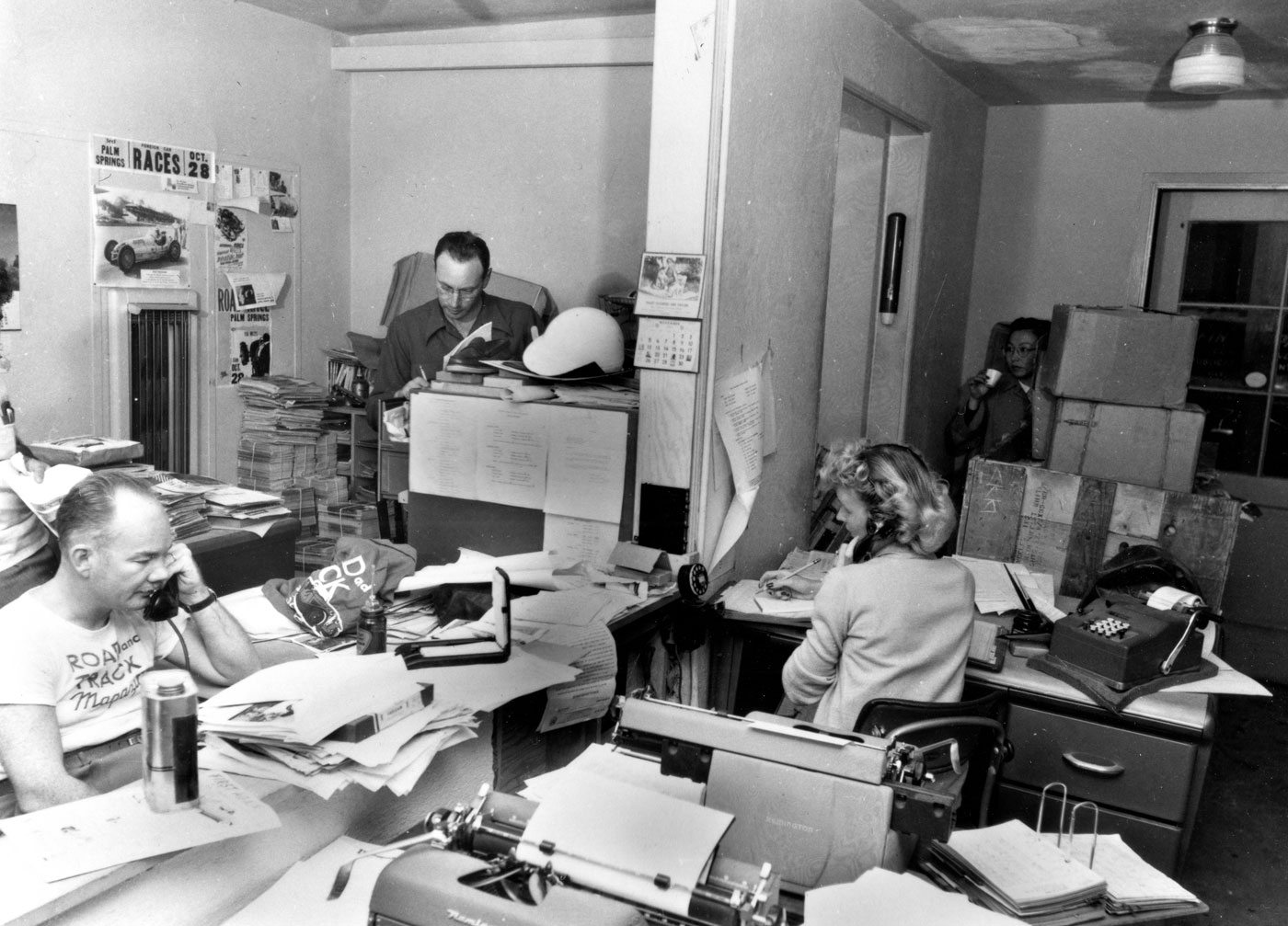
Another view of the Road and Track working space. 1951 was a big year for the team at Road and Track. They actually produced 12 issues in a year. But it would take John and Elaine Bond to get the magazine out of hock.- Jim Sitz
Oliver Billingsley was now in charge and from 1950 on, they produced an issue almost every month from then on. Bond became the Technical Editor, and Brehaut stayed on the staff as well. Money was coming in but printing costs and mailing were still escalating. Their credit was no longer good with the printer, who was located next door! Something had to give. Brehaut was eased out of his position. He had just 22 per cent ownership, and some was sold to Henry Manney early on, and associate editor Bill Quinn, whose mother loaned him $5000 to “rescue him from loading baggage at airport,” as Sitz recalls. “Quinn’s mother also bought Bill a new Jaguar too, and was the envy of all of us.”
In 1952 the printer, who by then effectively owned the magazine due to unpaid bills from previous editions having caused deep indebtedness, said it could have no more credit. To save the fledgling magazine and secure its future, John Bond reportedly agreed to sign a promissory note for 80,000 dollars (roughly $800,000 today) and took control of the magazine. Whatever the amount, it was up to the Bonds to make the magazine succeed and work off the debt. They would then own the magazine. The staff was fired, opening the door to young freelancers, but it was still tight. Those were scary days, but Bond maintained his sense of humor and he joked about his massive note to his young friend, Jim Sitz, “Hey that’s eight Ferraris.”
Bond thought they were lucky but it was a lot of hard work. “In 1952 we had just six employees. Everyone doubled. The receptionist, for example, took all the calls, took care of the 3000 subscribers, and did most of the bookkeeping.”
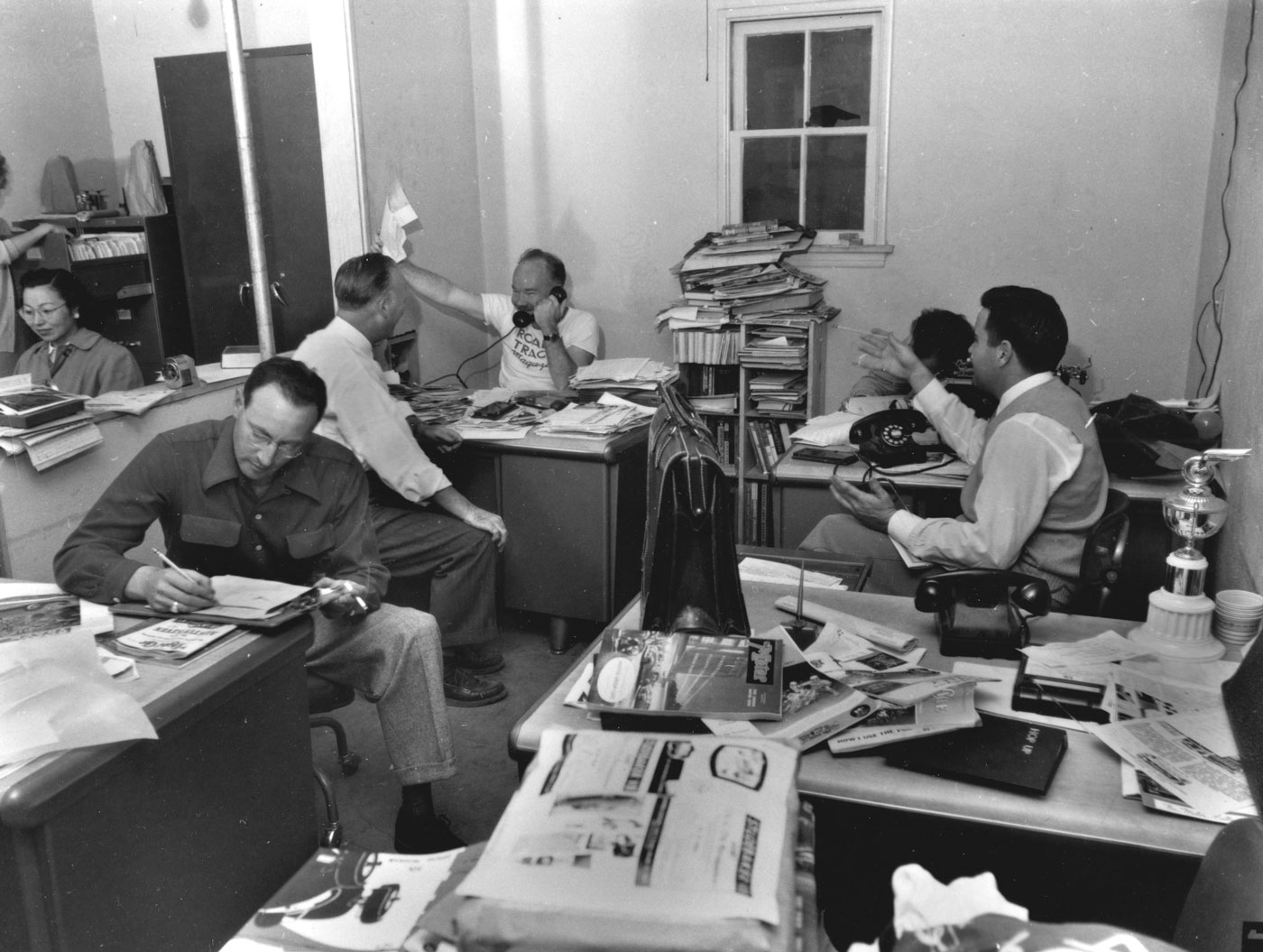
The last of the rare 1951 office photos obtained from Oliver Billingsley’s wife in the late 1990s. Perhaps readers can help identify the other people in the photo. We believe that the man in the dark shirt is ad manager Sam Weil.
Now out of the magazine business, Brehaut moved to San Diego in 1953. Sitz recalled that “Brehaut found a job at Consolidated Aircraft and in the following years, imported many intriguing Italian cars for re sale, and of course, placed the ads in the new classified section of his old magazine.”
In new hands the circulation grew. Bond wrote that the growth “…wasn’t spectacular but it was steady.” The gamble was paying off.
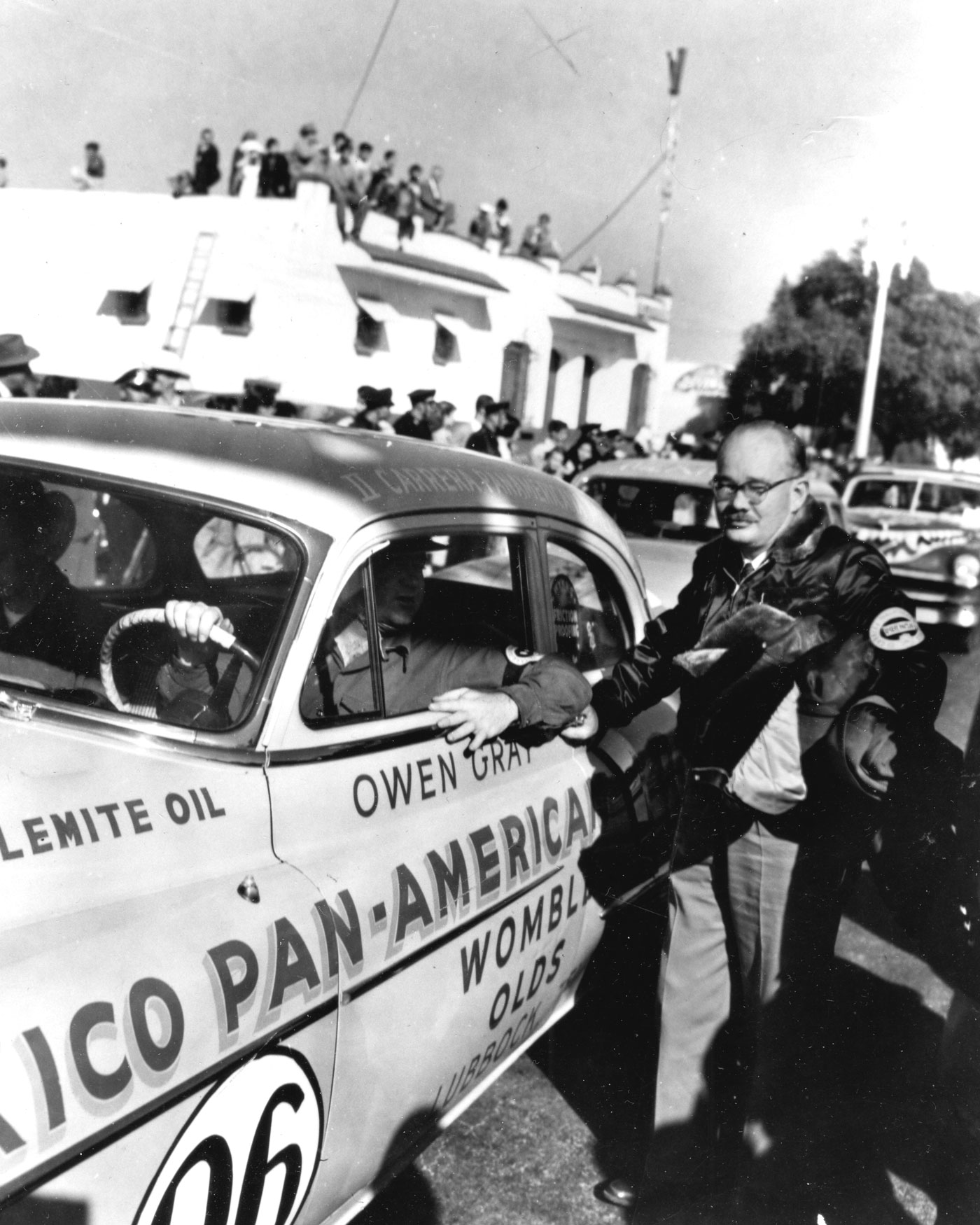
Oliver Billingsley with a Mexican Road Race entry lined up for the 1951 event.
Part 2: The Bonds take over
John and Elaine Bond’s son John Jr. and daughter Lee tell us about their parents. Stay tuned!
Road and Track issues and covers from 1947 to 1952 courtesy Jim Sitz:
1947
JUNE 47 ALFA GP CAR
1948
MAY 48 TALBOT LAGO
JUNE BLUE CROWN INDY CAR
AUGUST MIDGETS AT ROSE BOWL
1949
FEB 49 DELAHAYE AT CIROS CLIUB
DEC 49 EDWARDS SPECIAL
1950
JAN NARDI OF JOHN EDGAR
FEB BRM 16
MARCH CISITALIA
APRIL ROVER TURBINE
MAY BALDWIN SPEC
JUNE NOVI INDY CAR
JULY/AUG 4 SCENEES OF BRIDGEHAMPTON
SEPT FERRARI GP
OCT CADILLACS AT LE MANS
NOV COLOR! SAOUTCHIK BODIED CADILLAC
DEC SAOUTCHIK RENDERING
1951
JAN STORY SPECIAL
FEB BRASS RAD CADILLAC
MARCH BLUE ALFA COUPE FARINA
APRIL MG TD RED
MAY 4 FRAMES MORRIS, MG RILEY, SIMCA
JUNE RENDEREING MODERN MERCER
JULY FERRARI OF KIMBERLY ALFA 2900 OF PHIL HILL
AUG TALBOT LAGO BLUE CAB,
SEPT MERCEDES 540
OCT ALFA 2900 OF DR FARINA
NOV BUGATTI GP CAR
DEC STUNNING NIGHT SCENE OF TALBOT LAGO COIUPE
Road & Track addresses from 1951
1951 THRU 56
540 W. Colorado Blvd, Glendale CA
1957 THRU 59
8244 Vista Del Mar, Playa Del Ray CA
1960 TO 1962
834 Production Place
Newport Beach CA
1963
1499 Monrovia Ave
Newport Beach CA
The copy of Road and Track that I first saw in 1953 changed the entire direction of my life!
Very interesting Jim. A wealth of information there.
Fifty years ago my Brother and I would fight to see who got to read that months issue of Road and Track. There have been other good magazines as well, however I still believe R and T to be the best car magazine. I miss it, and after having thrown away tons of old car magazines I still have quite a collection of old Road and Tracks.
My first copy of Road & Track was a 1959 issue with Phil Hill in his Ferrari Grand Prix car at Monaco! I would go down to the drug store and buy the latest issue when it came out…I never looked back.
Jim and Pete, many thanks for this. That 1951 Olds Super 88 that Billingsley is standing next to ended up 13th that year. Rocket 88’s were a hot ticket. But the new 331 Hemi in an over weight Chrysler Saratoga finished 3rd, right behind the two winning Ferrari’s! No wonder we started putting American V8’s in sports cars starting about then.
My first Road & Track edition was bought in Tampa around 1967. I had to traverse the seedy adult section of the shop to get to the extensive automobile area. I learned a lot about life in that news stand.
Thank you Pete and Jim. It was just as interesting this time as it was the first.
Fabulous History Jim! Can’t wait for Part II.
Rex McAfee
PHOTOS REALLY SHOWED HOW MUCH THE PEOPLE INVOLVED WANTED TO SEE IT SUCCEED WITH THE WORKING CONDITIONS THEY HAD.
JOB WELL DONE LAD.
Wonderful history! Thanks, Jim, and others who put this together.
I have fond memories of early R&T. Bernard Cahier’s Grand Prix reports, later Henry Manney’s marvelous write up. The very first thing I ever wrote that got published was a letter to R&T signed Juan Manuel Misshift. As I recall it they never asked for my real name. The letter included commentary on the immortal racing Cyclops. I subscribed on and off for many years, but finally stopped when R&T had devolved into just another car mag. Automobile, under Donald C. Davis and Jean Lindamood was much more interesting.
Not unlike others here, R&T played a pivotal role in shaping my automotive sensibility from an early age. The first issue I can remember reading (while in grade school) was Dec. ’65, featuring Jim Clark and his Lotus F-1 on the cover.
I look forward to reading Part II of this article. Thank you.
In those days I lived at 2825 Oakland Drive on the south side of Kalamazoo, just outside the citylimit. Easy walking distance to Oakland further south was a drugstore with an excellent array of magazines of all kinds. That’s where I found R&T very early in its history. And the other “buff” magazines that formed my knowledge — especially Hot Rod and Mechanix Illustrated with its great McCahill road tests. Good memories!