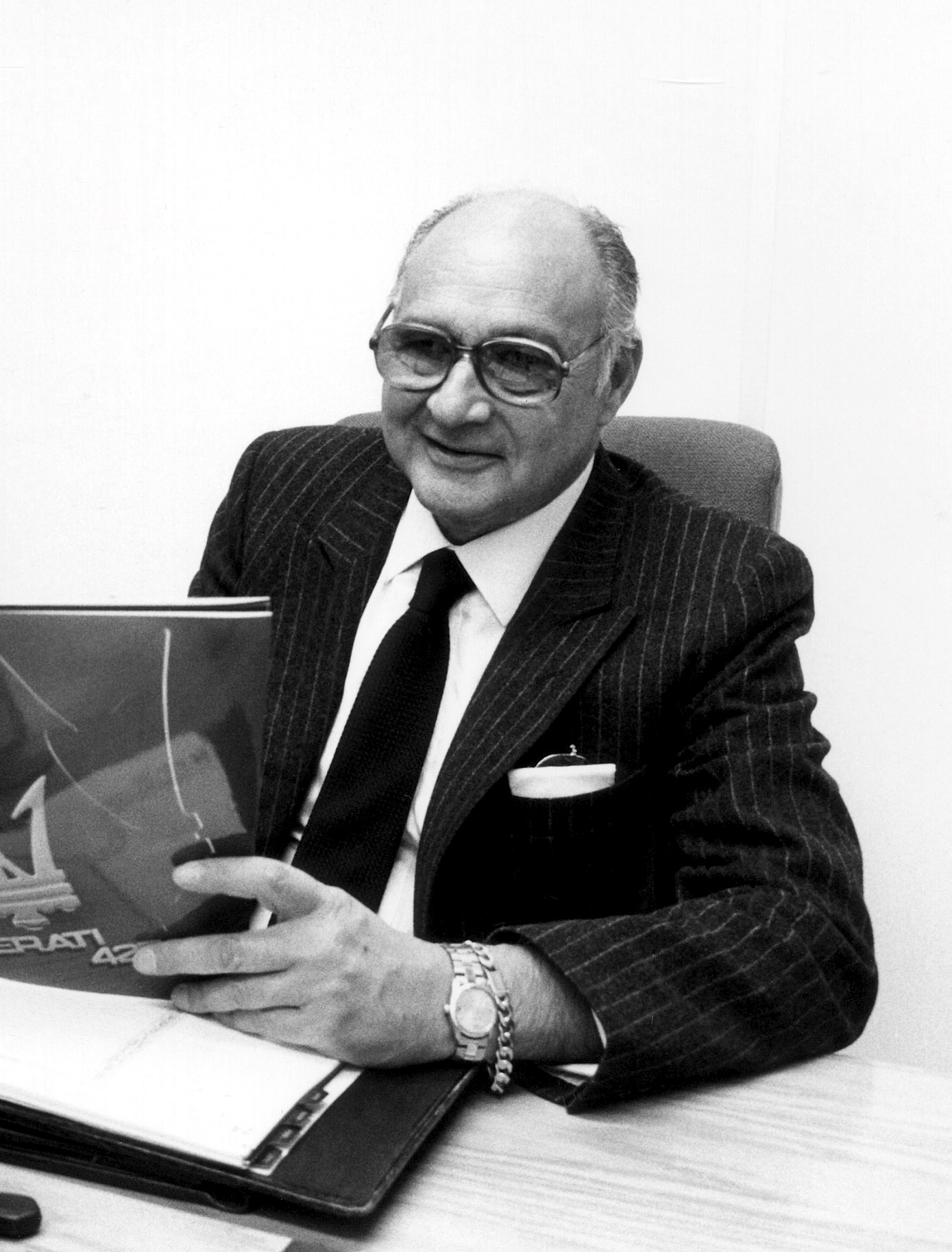
Mario Tozzi-Condivi
By Giles Chapman, from his book, “Three Million Miles in a Volvo and Other Curious Car Stories“
When we received Giles Chapman’s latest book we thoroughly enjoyed the short bios and interesting stories that comprised “Three Million Miles in a Volvo and other Curious Car Stories”. These are just perfect for the VeloceToday format, and here is the third in a series.
For over 50 years, the line of communication between Maserati and Britain crackled through the razor-sharp mind of ex-pat wheeler-dealer Mario Tozzi-Condivi.
Details of Mario’s early life are unclear. He was born in Rome in 1924 and became a Second World War fighter pilot, flying a rather lame Fiat against Spitfires but surviving unscathed. Towards the end of the war, he spent a week marooned in a mountain village with, by chance, one Dr De Minicis of the Automobile Club d’Italia; the abundant car talk apparently led to meeting Maserati proprietor Adolfo Orsi. Mario then departed for London in 1947. With a growing grasp of English, and trading cars to pay his rent, he was chasing his fortune as Orsi’s contract man, seeking customers for Maserati’s batteries, horns, sparkplugs and machine tools.
The trade went both ways, though. Maserati was planning its 3500GT for a 1957 launch, and it needed components that simply weren’t available in Italy. “No-one else but Ferrari built live-axle cars anyway,” said Anthony Cazalet, who knew Mario well. “So he organised a lot of the British parts Maserati used. It was all Jaguar stuff, really, including the Dunlop disc brakes. Even the engine was almost an aluminium XK.”
The 3500’s heater really established him as an efficient fixer. The original was an over-complex, feeble and costly unit designed by Maserati engineer Giulio Alfieri; Mario scoped Smiths Industries in north London and negotiated a supply of cheaper, ready-made heaters, which worked perfectly. “Alfieri was livid,” laughed Cazalet. “He wouldn’t speak to Orsi for three months!”
A Lancashire car dealer won the British Maserati car concession, but the business quickly folded, allowing Mario to step in. He did this with London dealer Taylor & Crawley, the set-up giving the wily Italian half the business. This stake became part of Mario’s Alfa Romeo agency, Chipstead Motors. The company took over Roy Salvadori’s Elmbridge Motors (Roy had been in cahoots with Mario for years after he “helped” as a streetwise go-between for Cooper in Italy, identifying, according to historian Doug Nye, races with the juiciest starting money and bonuses), and attracted investment from racing-mad Marks & Spencer millionaire Jonathan Sieff.
In 1965, Chipstead Motors splashed £200,000 originally generated from sales of M&S socks and pants to buy the Cooper Car Co. propelling the partners into Formula 1. Mario was able to strike an engine deal that saw Maserati’s legendary V12 dusted off, revamped and installed in a Cooper chassis, and the car brought victories to John Surtees and Pedro Rodriguez.
Yet Sieff and Salvadori then ousted Mario from their empire. Cazalet said they forced him out when he couldn’t raise the cash to buy his stock options over 48 hours. “He was furious because he’d been working flat-out selling the cars, front of house,” said Cazalet.
But no-one was going to do Mario over. His Maserati pals ensured the concession transferred to his new company, MTC Cars in London’s Westbourne Grove. When Citroën insisted Maserati sales be handled from Slough in 1969, Mario switched to importing De Tomasos – including some fearsome, right-hand drive Panteras – although Maserati returned to his clutches in 1975.
The wider public knew Mario because Maserati and De Tomaso test cars featured in magazines carried his treasured MAR 10 number plates. “He was the consummate salesman,” recalled Cazalet. “A bloke would walk in with a clubfoot and dodgy left arm, and Mario’d sell him an Alfetta with horribly heavy clutch and a ghastly gearchange. He never stopped. He had no leisure activities at all.”
Actually, not quite true. Mario was something of the ladies’ man, enjoying the swinging ‘60s from his Little Venice bachelor pad. He dated actress Tracy Reed, who appeared in Dr Strangelove. He wed a mysterious older woman and had two children, but the marriage collapsed and Mario finally settled down with Diana Cave-Hawkes, a model who famously appeared in Ryvita ads fighting The Inch War.
Rapid expansion led MTC into bankruptcy in 1981, but he still managed to offload its assets, including several ageing Meraks, to Subaru importer Robert Edmiston. “Mario said to me: ‘E bought my ce-me-te-ry of car parts – I tucked ‘im up with the whole lot,’ “ mimicked Cazalet in a husky growl.
He bounced back in 1986, bringing the right-hand drive Maserati Biturbo to the UK. Cazalet was appointed technical director. However, they only sold 100 cars before currency swings and terrible quality caused the new company to go bust too. Mario bought a house in Tenterden, Kent. Yet calls from the old country – to help run Maserati and Moto Guzzi for Alejandro De Tomaso – now saw him spending more time in Italy, or jetting round the world troubleshooting. As a board member, he frequently deputised for De Tomaso after the ailing tycoon’s stroke in 1993. Mario’s daughter Loretta administered his own affairs from the Isle of Man; he’d brought her up, and he trusted her totally.
Mario died of cancer in 2000 in a Modena hospital. It was entirely predictable because he’d been a ferocious chain-smoker for decades. People who worked for him loved his warmth, and were always astonished at his energy. “He was unbelievably kind to me,” recalled Anthony Cazalet. “He treated me like a surrogate son.” The awful irony of that statement is that Mario’s own son Richard flew from Australia to be at his father’s deathbed, and returned with an inheritance that he spent on a speedboat. Shortly afterwards, he dashed it on rocks and killed himself.
About the Author
The early 3500GTs had drum brakes and only received Girling disc brakes later in the production run. As for the heating system produced by Smith Industries “working perfectly”, I beg to disagree. I have a 1963 3500GT model and the heating system is still a nightmare because of its complexity.