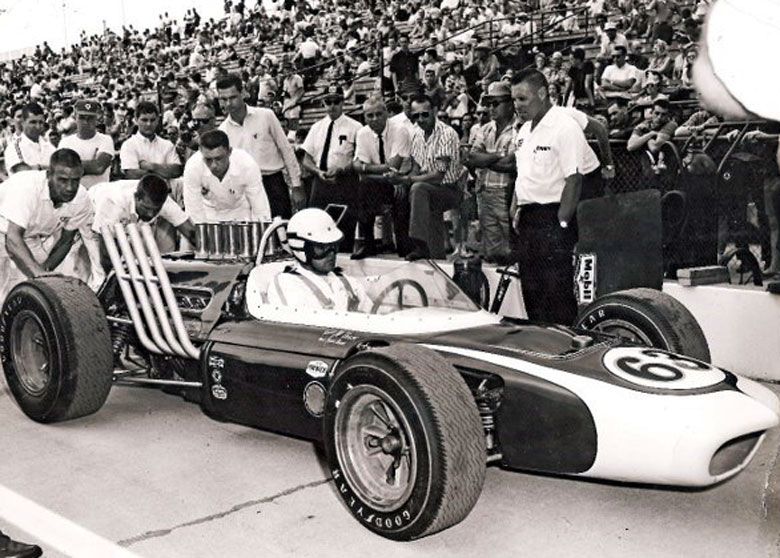
The Larry Shinoda sculpted Weismann-Maserati heading of for qualifying before the engine destroyed itself. (Unser Archives, Indy 500 Museum)
Story by Graham Gauld
In my last column I talked about the first Maseratis to visit Indianapolis; but how about the last one?
Yes, it puzzled me too so I started to go through the records. I will not bore you with the various Grand Prix Maseratis from the pre-WWII era that came, saw, but did not quite conquer the Indianapolis 500 but I can tell you many of those cars stayed in action long into the 1950s with different owners and sponsors.
But by 1956 Tony Parravano, who shot to fame in the mid 1950s with a raft of fancy Italian sports racing cars, had the idea of modifying two of his Maserati 450S sports car engines, reducing the capacity to 4.2 liters, and build a Maserati-engined car for the 1957 Indianapolis 500. At the same time, the US Internal Revenue Service had begun to investigate him and early that year they filed charges of tax evasion. He fled to Mexico only give himself up to the Rev boys early in 1960. Three days before his trial, due in April 1960, Parravano disappeared and was never heard of again.
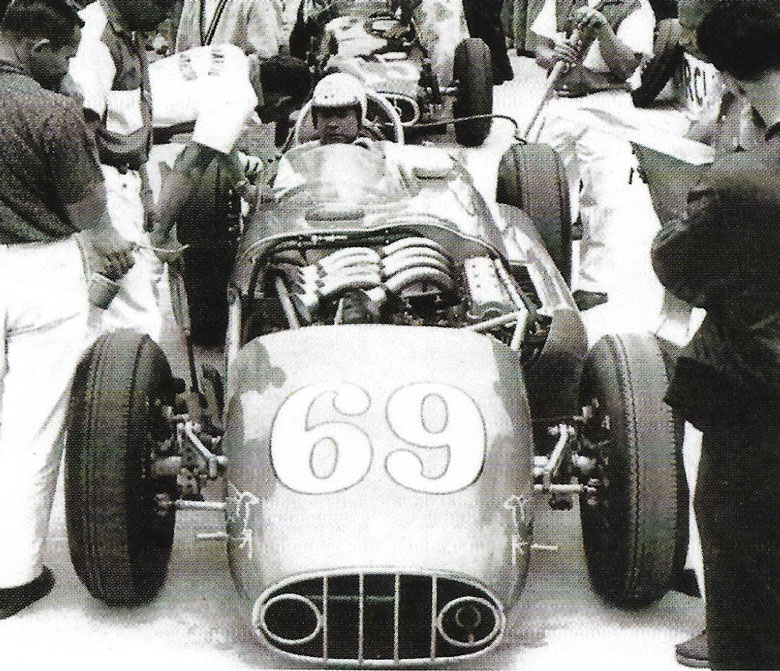
Templeman in the Offy Maserati at Indy in 1959. It failed to quality. Photo courtesy Willem Oosthoek.*
The engines were bought from Parravano’s estate by another great entrant of the period, Frank Arciero, who had helped Dan Gurney on his way in racing. Arciero had the same idea, bought a Kurtis-Kraft chassis and put one of the Maserati engines into it. He had ditched the Italian Weber carburetors and replaced them with Hillborn Travers fuel injection, got rid of the starter, modified the fuel system to run on alcohol and pressurized it. Arciero chose as his driver Clark “Shorty” Templeman, a multiple midget car champion, who had raced in his first Indy 500 in 1955 and was now 42 years of age. Templeman warmed to the car and was soon lapping quickly but there was a problem. In fitting the Maserati engine, due to the fact that Indianapolis was a high speed banked track with only left hand corners, the oil began to squirt out of the breathers rather than be fed back to the dry sump and Templeman was called in. The car was withdrawn and that appeared to be that.
Six years later, in 1965, a Maserati-engined car returned to Indianapolis. This time it was the Weismann-Maserati powered by the same Arciero engine.
The Weismann-Maserati was designed by Pete Weismann with the help of mechanic John Mulrine. Weismann was a talented engineer who had formed Weismann Transmissions in Costa Mesa, California. It was a good-looking car aided by the fact that he had encouraged famed General Motors and Ford stylist Lawrence Kiyoshi “Larry” Shinoda to design a shapely body.
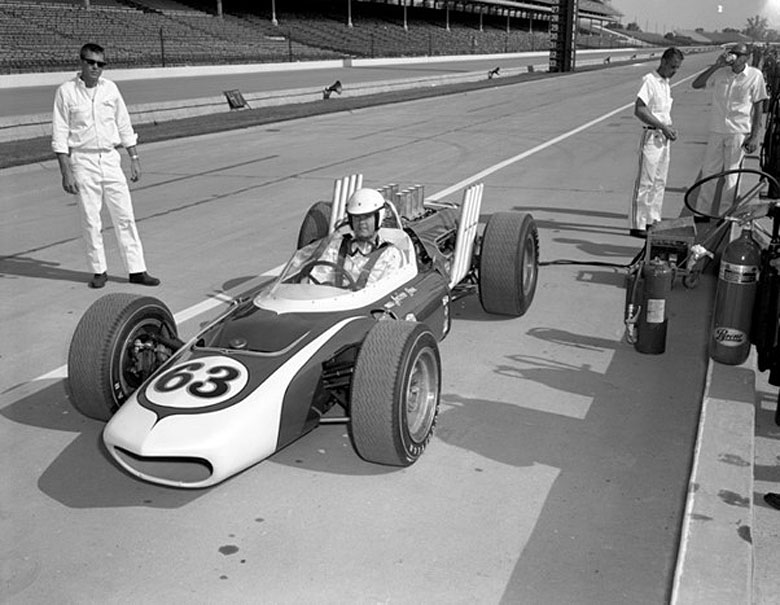
A youthful Al Unser in 1965 at the wheel of the spectacular Weisman-Maserati, the last Maserati engined car to arrive at Indianapolis. ( Photo Al Unser archive, Indy 500 Museum)
The Weismann car did not start out with a Maserati engine, however, but with a conventional Offenhauser that he borrowed from J C Agajanian, who apparently owned the car, and it was the youngest member of the famous Unser family, Al Unser Sr., that Pete Weismann chose to drive it. Young Unser ran the Weismann-Offy on one occasion before the car was sold to Frank Arciero then given the Maserati engine.
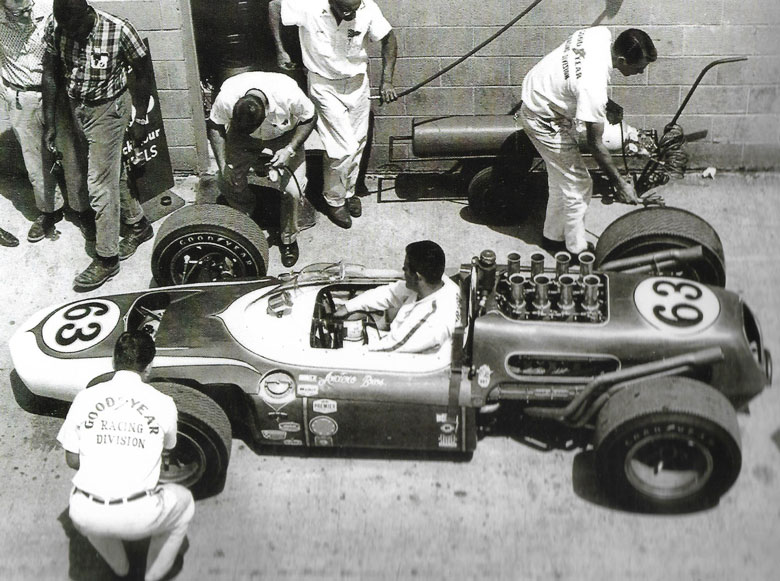
Unser waits as the Goodyear folks do their thing at Indy, 1965. Bob Tronolone photo courtesy Willem Oosthoek.
A few years ago, thanks to my good friend Dario Franchitti, a three-time winner of the Indy 500, I was able to get Al Unser on the phone and he told me the story.
He explained that he knew Pete Weismann at Indianapolis when his older brother was racing there, and he also knew Frank Arciero because when Al was racing at Pikes Peak, Arciero was employing his brother Bobby. Unser recalls how the Indy ride came about. “After that first race in the Offy powered car, Pete Weismann, my brother Louis, Bud Gilbert and Frank Arciero all came together to take me to Indianapolis as a rookie.”
So was Al able to do any testing of it with the Maserati engine before the rookie tests?
“Oh no, we barely had it ready. It was on a very, very low budget and Frank didn’t want to spend any more money than he had to, but it was worth the gamble. My brother Louis and Bud Gilbert were the mechanics and Pete Weismann and Frank Arciero were the owners of the car. Frank put up the engine and Louis and Bud put it in the Weismann chassis.
“We had a hard time persuading USAC to let me have a test because they didn’t think I had enough experience and they actually turned me down once or twice. However, Rodger Ward, a past Indy winner and the driver’s representative, stood up for me and told them he had seen me race at Milwaukee and eventually they said ok.”
At that crucial driver test Al found the car simply did not have the power of the Ford and Offy engines but he actually had been quick enough to at least pass his rookie test driving the Weisman-Maserati. Then it came to the official qualifying and it was Al’s brother Louis who decided the only way to get the car sufficiently powerful to qualify was to add some nitro to the fuel mix.
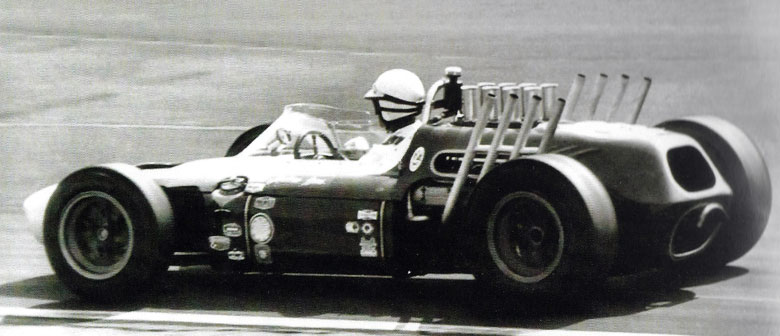
They tried different exhausts systems but only nitro could raise the power. Bob Tronolone photo courtesy Willem Oosthoek.
It worked: “The car was transformed and it flew, but on the third lap the engine blew and that was it. I was later told that when the engine blew the smoke cloud was the biggest ever seen at Indianapolis!
“I came back to the pits and sat down with my head between my legs. Then in walked A.J. Foyt and said to me that if I came over to the garage I could drive his back-up car, a new Sheraton-Thomson Lola-Ford. Well, as A.J walked out the door I followed him like a shadow and so qualified for the 1965 500 with the Lola.”
In the race A.J. Foyt was on pole position with the Lotus-Ford and had a tremendous battle with the ultimate winner, Jim Clark, but Foyt’s engine blew and he retired. Al Unser finished in a creditable 9th place in this, his first Indy, and was to go on to become one of only three drivers to have won the Indianapolis 500 four times. He sadly died just two years ago having added another chapter to the Unser Family legacy.
Perhaps Maserati’s history of success at Indianapolis is not great by modern standards but Indianapolis has always been such a specialist event, calling for considerable expertise with banked circuits, that incomers have found the prospect of success daunting.
Today, of course, it is now an Italian manufacturer whose chassis has dominated Indycar racing: Dallara.
Footnote: Would it surprise you to know that a Maserati or Maserati-engined car appeared sixty-two times in the Indianapolis 500 from 1930 to 1965?
Mind you, the majority of the Maseratis were cars that kept coming back to the race year after year with different drivers and sponsors. No fewer than seven of them took part in the 1950 race, albeit four of them with Offy engines, but in the end, thanks to Wilbur Shaw and the 8 CTF, Maserati were to twice win the Indianapolis 500 .
*Our thanks to Willem Oosthoek for allowing us to use the photos that appeared in his excellent book, Maserati 450S, written with Michel Bollée.
Excellent Story! Thank you.
– Andy Evans
Lovely story and great to read something so ‘different’ and unique.
Hi Graham:
Interesting story. Too bad the 500 is now run with identical chassis. No room for the adventurous and different, like Smoky’s cars.
Was nitro legal ?
says Graham…
John
Well it must have been at that time and certainly the adding of nitro to an already fairly stressed engine would certainly have caused a bit of a bang; however that is what Al said over the phone so I am willing to accept that it was so.
Graham
I remember when it all took place hoping the Maser would make it to the race for Frank