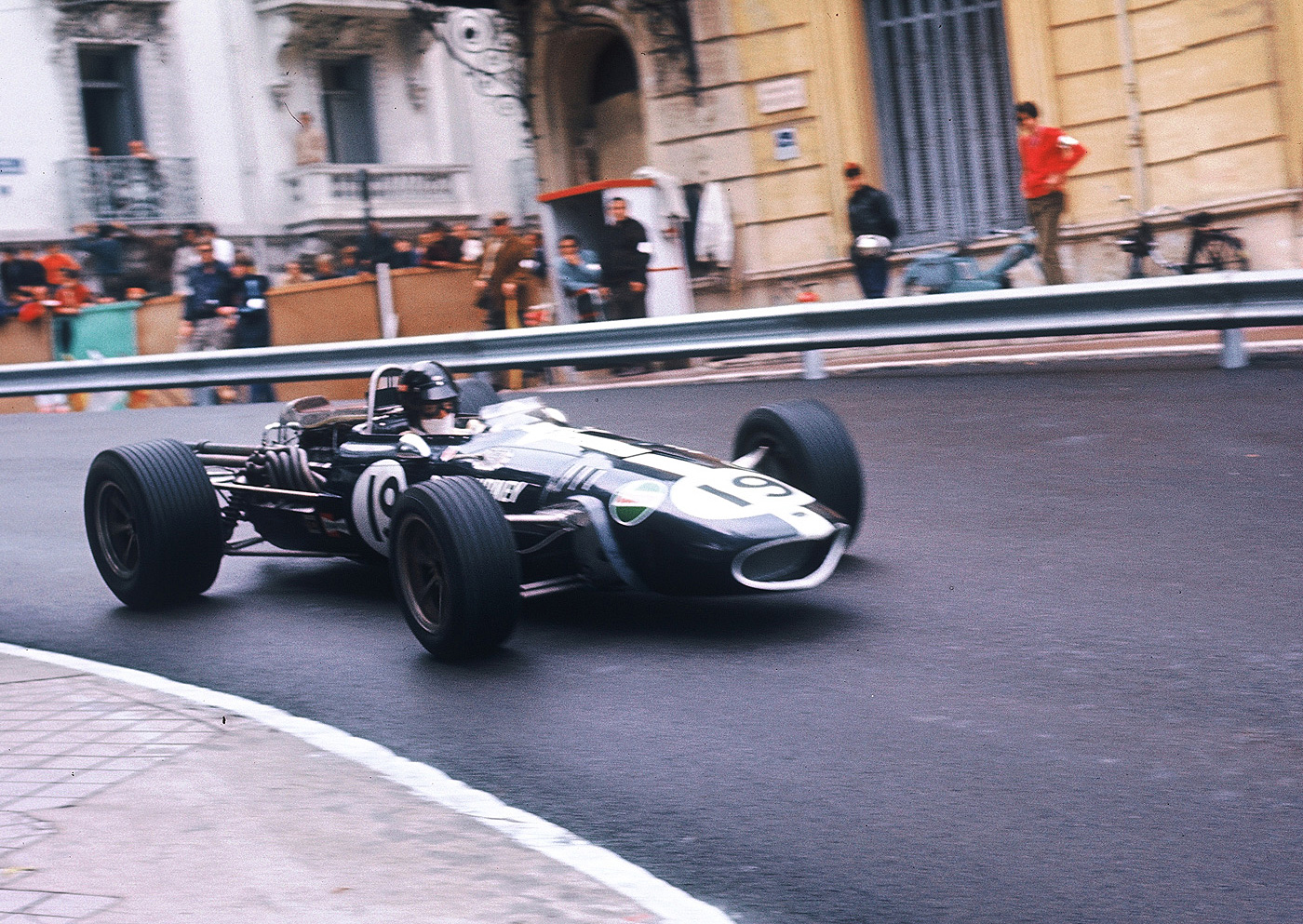
The beauty that didn’t fly: the Eagle 1G Weslake by Dan Gurney. He qualified 16th and last, 1.32.9, and lasted 9 laps only in the race.
Story and photos by Aldo Zana
If you are suffering from Grand Prix abstinence you might be interested in remembering the Monaco F1 Grand Prix from so many decades ago, now akin to a fictional tale of times bygone. It was May 1968 when France and, later, the whole of Europe, were on the verge of profound social, economic, and cultural changes: students in Paris had started what went into the history books as “La revolte de mai”, the May revolution. The whole country was either on strike or shut down.
Monaco’s Monte Carlo remained a quiet enclave where life went on undisturbed, and the F1 circus gathered there for the usual glamorous race on Sunday, May 26. The Grand Prix followed the opener of the 1968 world championship at Jarama, Spain. It was the second race after Jim Clark’s tragic death at Hockenheim.
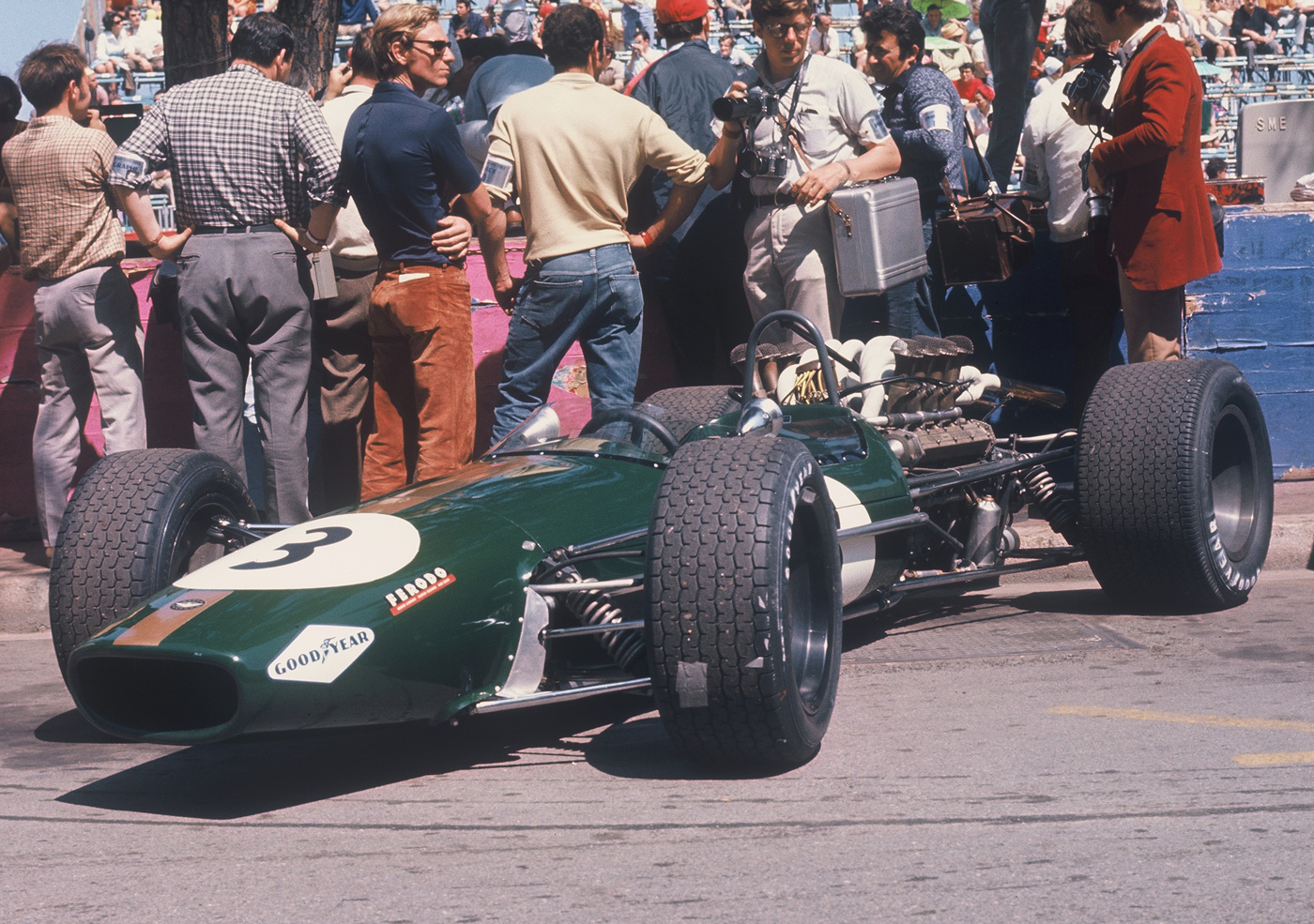
The Brabham Repco by Jochen Rindt ready for the race. He qualified fifth on the grid, 1.29.2, and was out of the race at lap 8.
Ferrari was missing due to a last-minute protest against the safety of the circuit where Lorenzo Bandini had died the year before.
Another no-show was Jackie Stewart, with a wrist in a plaster cast after an incident in an F2 race at Jarama at the end of April. His place at the wheel of the Matra MS10 Ford was taken by a young 26 year old French débutant with excessively long hair and an uncontrolled will to win: Johnny Servoz-Gavin. He managed to qualify in the front row alongside polesitter Graham Hill in the Lotus 49B.

Jo Siffert, Lotus 49 Ford entered by Rob Walker, recorded an exceptional qualifying: third, with the same time of Johnny Servoz-Gavin, 1.28.8, 6/10th from the poleman Graham Hill.
The qualifiers were only 16, yet what a parterre de rois they made. From row 2 to row 7: Jo Siffert, John Surtees, Jochen Rindt, Richard Attwood, Bruce McLaren, Jean-Pierre Beltoise, Pedro Rodriguez, Denny Hulme, Piers Courage, Jack Brabham, Jackie Oliver, Lucien Bianchi.
The eighth and last row was for Ludovico Scarfiotti’s Cooper T86B BRM, and Dan Gurney, struggling as always with the Weslake engine on his aesthetically wonderful Eagle 1G.
Two didn’t qualify: Jo Bonnier, McLaren M5A BRM, and the Swiss privateer Silvio Moser, in the Brabham BT20 Repco.
A race gone by
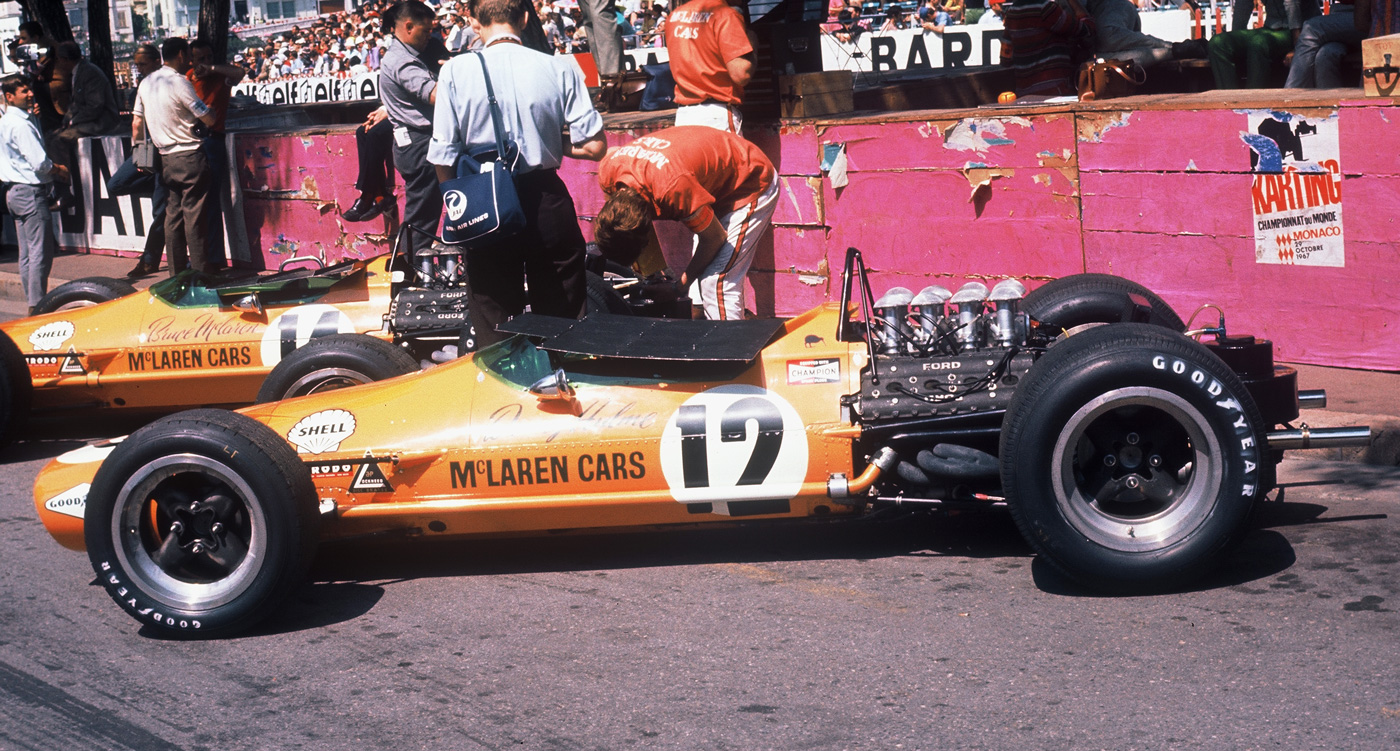
On the sunny Sunday May 26, 1968 the McLaren M7A to be driven by Denny Hulme is readied for the Grand Prix. Note the shortened nose, a typical solution to improve the visibility of the driver to avoid curbsides.
The race, shortened to 80 laps instead of the classic 100, turned into a kind of demolition derby with 11 DNFs due either to various failures or harmless yet mechanically fatal contacts with the curbsides and the few Armco barriers.
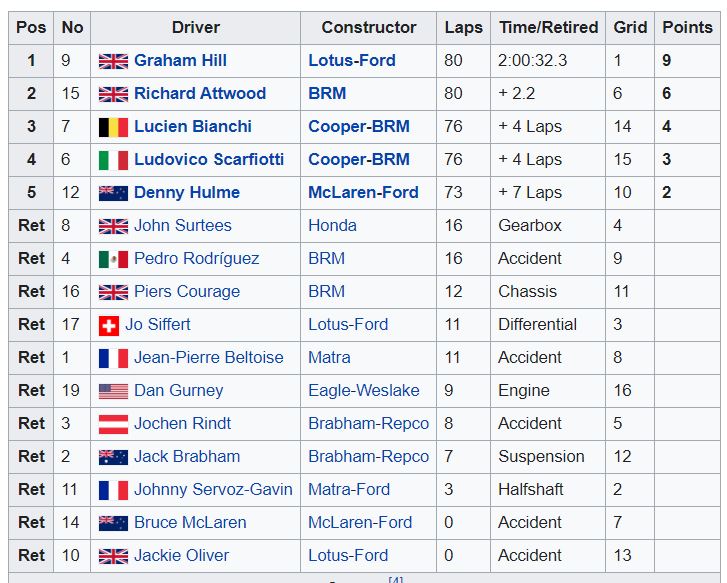
Following a short-lived show by Servoz-Gavin on the opening lap, Graham Hill took the lead and no one managed to usurp him. Dick Attwood had the race of his life and crossed the line in second by 2.2 seconds. The two Cooper BRMs, slow but safe, finished with Bianchi in third, and Scarfiotti in fourth, four laps behind the winner. Graham Hill won it in 2hr 00 min 32.3 sec at the record average of 78.273 mph (125.238 km/h).
Oh, how nice it was
To better understand what an F1 race in those times was like, let me add some personal notes. Monaco is only 190 miles away from Milano, where I lived. I drove my Fiat 500 and found a decent accommodation in Menton, a few miles from Monte Carlo. There were no traffic jams and no problem parking along any side streets at the edge of the circuit.

Matra selected Monaco for the maiden race of their full-French single-seater powered by the heavy and cumbersome V12 Matra engine. The driver was French too: Jean-Pierre Beltoise. He qualified in 1.30.3, 1.5 sec slower than Servoz-Gavin on the Matra Ford. Despite being on the descent to the Mirabeau, note the raised front in acceleration.
The media contingent was quite small. I got the “Photographe” brassard no. 65. And I think they assigned them in alphabetical order. Monaco has always been the paradise of car racing photography, even more in those times. You could walk undisturbed along the whole circuit. The sole separation from the F1 drivers was the white paint on the curbsides: you were just a few inches away from the cars in the race. No restrictions, no safety nets, just a few low Armco barriers. You could even cross the track at your own risk!

I remember choosing a nearly suicidal position a couple of yards past the apex of the fast Casino corner, about two yards from the driver in the cockpit and a few inches away from the inner front wheel. What great shots were possible there!
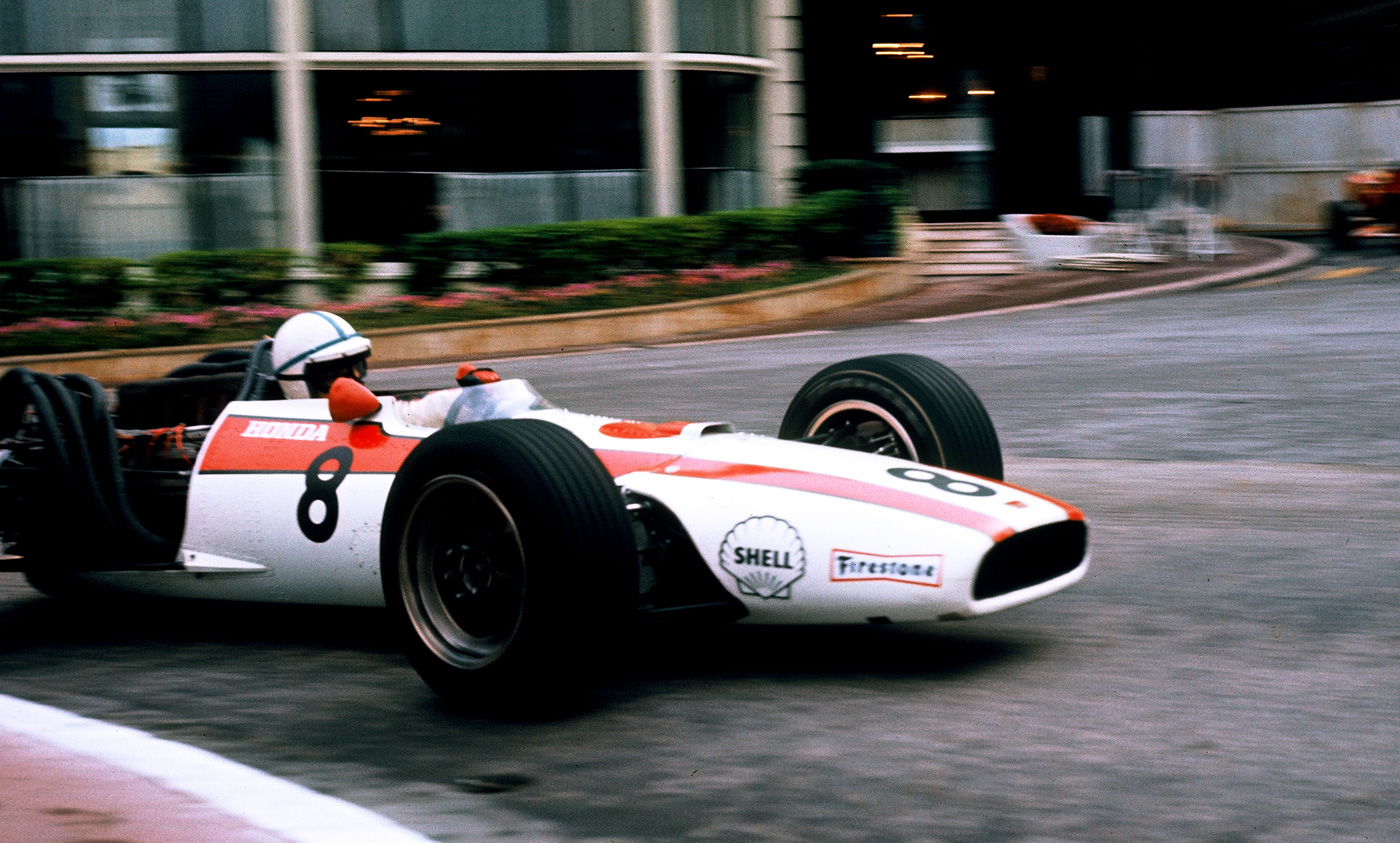
John Surtees, Honda Ra 301, in the Casino Square with the Cafè de Paris in the background. He qualified fourth, 1.29.1, and was out of the race at lap 16.
I also found that one of the best places to shoot was from the inside of the Mirabeau corner: a position today not only strictly forbidden but also impossible to reach. Another wonderful place was the apex of the old Gazomètre corner, which today no longer exists, at the end of the Boulevard Albert 1er, the last corner before the start-finish line. Kneeling on the wooden side strut you could frame the driver working hard on the steering wheel in a sky-like view.
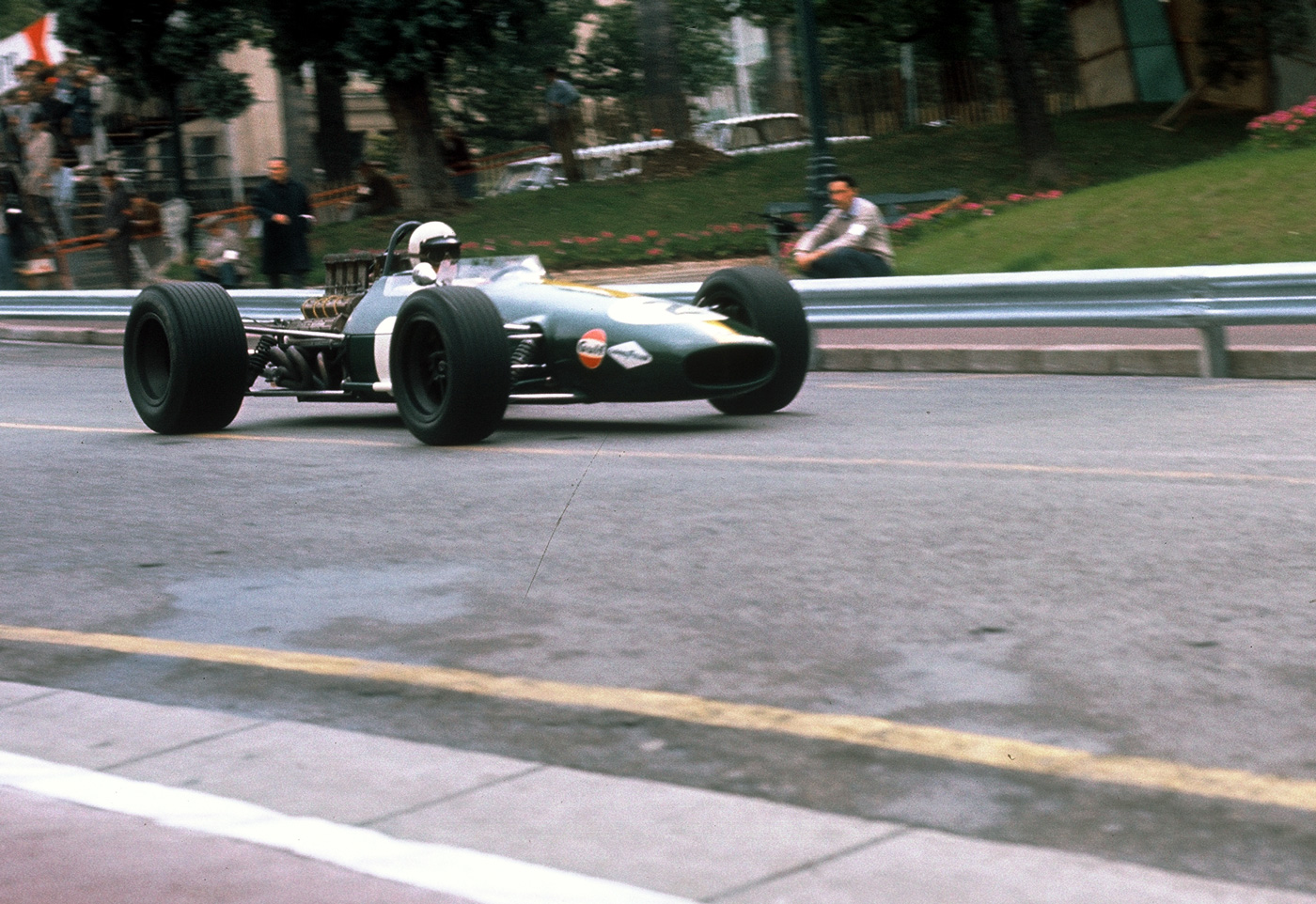
Jack Brabham, Brabham Repco, on the way down to the Virage du Mirabeau. He qualified 12th, 1.31.2, slower than his team-mate Jochen Rindt. In the race he was out at lap 7.
I shot the color photos in this article using my spare camera, a 35 mm Voigtländer with a 50 mm lens and a 50° ASA Ektachrome film: the digitalization of the slides made them lose some sharpness. The film was quite slow on Saturday when practice began under a grey sky just after a midday shower. My professional Nikon camera was reserved to B/W films: at that time, no Italian motor magazines published color photos. My B/W shots of the 1968 race can be seen in the following article. (Monaco in B&W)
Those were the days. I was a young LT in Germany. When a couple other LTs suggested a 3-day pass to go to Monaco, I was in. We left Friday night and arrived in Monaco on Saturday as the F3 race was ending. We could find no accommodations, so we threw our sleeping bags among the bushes of a little garden, and slept the night. In the morning, we bought tickets for the race and found ourselves seated in the front row of bleachers on a bridge that crosses the course just before the cars reach the harbor and tunnel. I can’t imagine being allowed in a place like that now. I panned the cars leaning over the bridge rail as they came down the hill and went under us. As a Lotus fan, I was pleased that Hill won, although I was first rooting for Gurney – saw him win at Spa in June 1967.
Please forward the link to the B&W version of the 1968 Monaco GP , it doesnt appear at the bottom of the article. Thanks
Thanks for reminding us; link now in place.
This contribution gives little credit to the impact of the first GPs of the 68 Season for the French public. Jarama and Monaco were overshadowed by the “events” of May and June 1968, but since Maurice Trintignant’s win 10 years before, no French driver had been seen leading a F1 GP. On top, they were driving a Made-in-France MATRA MS-10 fired by the best engine of the period,the DFV Ford Cosworth.
Jean-Piere Beltoise had been firmly leading in Jarama before having to stop for a minor oil leakage and finishing fifth after having set the lap record. Graham Hill won, a soothing result after the tragedy of Hockenheim.
JPB having the honor to give the MATRA-MATRA MS11 its maiden run, Johnny Servoz-Gavin replaced Jackie Stewart at the wheel of the Ken Tyrrell managed MS-10.
Johnny was a hugely talented driver with the looks and life of a playboy. He led during 4 laps before retiring. It was never cleared whether he had brushed a guard-rail or if the driveshaft broke on its own. The rim was intact. Servoz became a F2 Europe Champion the next year, before quitting motor racing in Monaco 1970 as Jackie Stewarts team mate. He hadn’t recovered from a wounded eye during a rallye cross during the winter. He died untimely aged only 64.
JPB became F2 Champion in 69 and was a brilliant Monaco winner in the pouring rain 1972. This was BRM’s last victory. Jean-Pierre died from a double stroke aged 77. He pioneered France’s comeback in F1.
I was on honeymoon near Portofino and persuaded my new wife that a day trip to Monaco was a good idea. We rented a car and started early. I recall it was a hot day and we had no tickets for the Grand Prix, but it only cost a few francs to get on a standing only stand at the Gazometer, which was a great spot to see the cars sweeping round the bay to the hairpin.
Cars were dropping out like flies and Graham Hill was unchallenged, although Richard Attwood got close. I suspect Hill was trying to make the race more interesting for the enthusiastic crowd. We drove back sunburned but happy. A great day out (at least I thought so).
Sorry, tipping mistake: J.-P. Beltoise was F2 Champ in 1968, after Jacky Ickx and before Servoz, all of them on a MATRA MS7 Cosworth, the basis of the future F1 cars.
Outstanding photography and great article! I will always remember this particular Monaco GP due to the exploits and mishaps of Johnny Servoz-Gavin…incredible qualifying time, three laps leading and then…boom. Johnny at this time featured in the same society pages as the ‘other Johnny’ (Hallyday). I remember a photo of him in the company of actress/model Bulle Ogier . Then Johnny quit F.1 almost as quickly as he had entered….early in 1970. Word was that he suddenly found that the personal risks in racing were unacceptable. He left Tyrrell and Francois Cevert became Jackie Stewart’s new teammate.
I had a friend from school who attended a Monaco GP, probably that one, and stood beside DSJ.
Robert had had polio in the New Zealand epidemic of 1947 or so, and also wore a beard. He was escorted to the border of Monaco and invited to leave.