• Skip to primary navigation
  • Skip to main content
  • Skip to primary sidebar

VeloceToday.com

The Online Magazine for Italian and French Classic Car Enthusiasts

  • Home
  • Subscribe
  • About
  • Contact
  • Donate
  • As Found

dalton watson

One Family, Five Fantuzzis

September 26, 2022 By pete

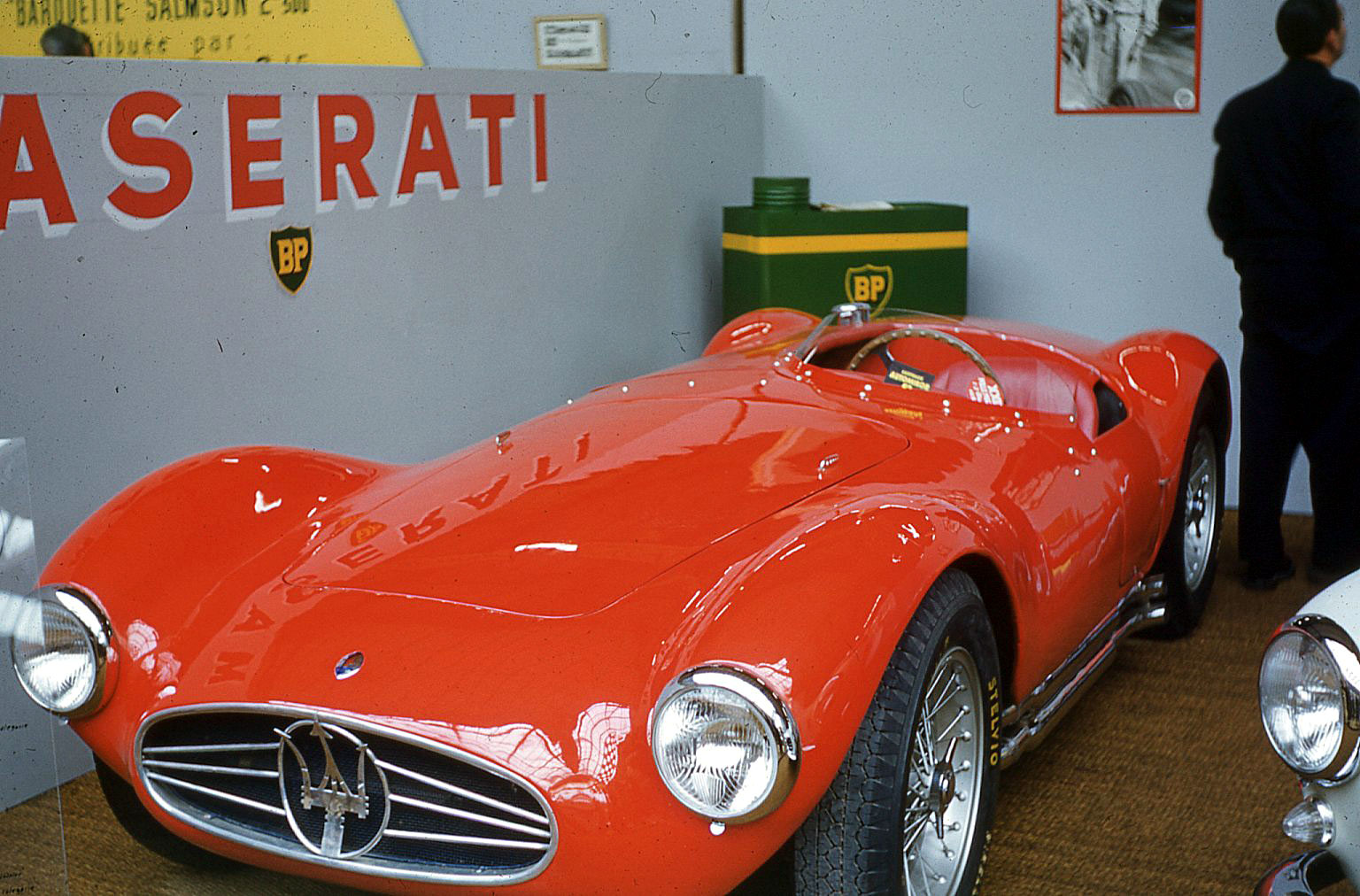
Uncle Gerry Vack got the ball rolling by photographing 2079 in Paris, 1954.

Story by Pete Vack

We’ll call them Fantuzzis, for more than anyone else Medardo Fantuzzi inspired the coachwork of the A6GCS. Perhaps Ermanno Cozza, who was actually an employee at Maserati at the time, gives us the most accurate summation of who was responsible for the design. In his autobiography, Maserati at Heart, (Nada 2018) Cozza describes the phases of construction which involved drivers, mechanics, and designers. He wrote, “The most striking example was without doubt was the launch of the A6GCS/53, which debuted in that year’s Mille Miglia, winning its class with Emilio Giletti. The engine was a version of the A6GCM unit revised by Gioachino Columbo, while the bodywork built by Fantuzzi, was also fruit of an idea by Colombo.” (p43). (Not all of the A6GCS cars were constructed by Fantuzzi’s shop: Thirty three of the bodies were constructed at nearby Fiandri and Malagoli.)

The new Maserati was beautiful, purposeful, as curvy as Gina Lollabrigida and influenced several of our family members. We came up with five Fantuzzi A6GCS Maseratis connected to the Editor’s family. Rest assured that no one actually owned any examples of the real thing. But here’s our story anyway. [Read more…] about One Family, Five Fantuzzis
Tagged With: Bob Hanninen, Carrera models Maserati, dalton watson, dalton watson books, Dinky Toy Maserati, Gerry Vack, greg vack, Jean Francois Blachette, Maserati A6GCS, maserati books, maserati history, maserati models, maserati sports cars, TOPP cards, walter baumer

Lamborghini: At the Cutting Edge of Design V 2

August 1, 2022 By pete

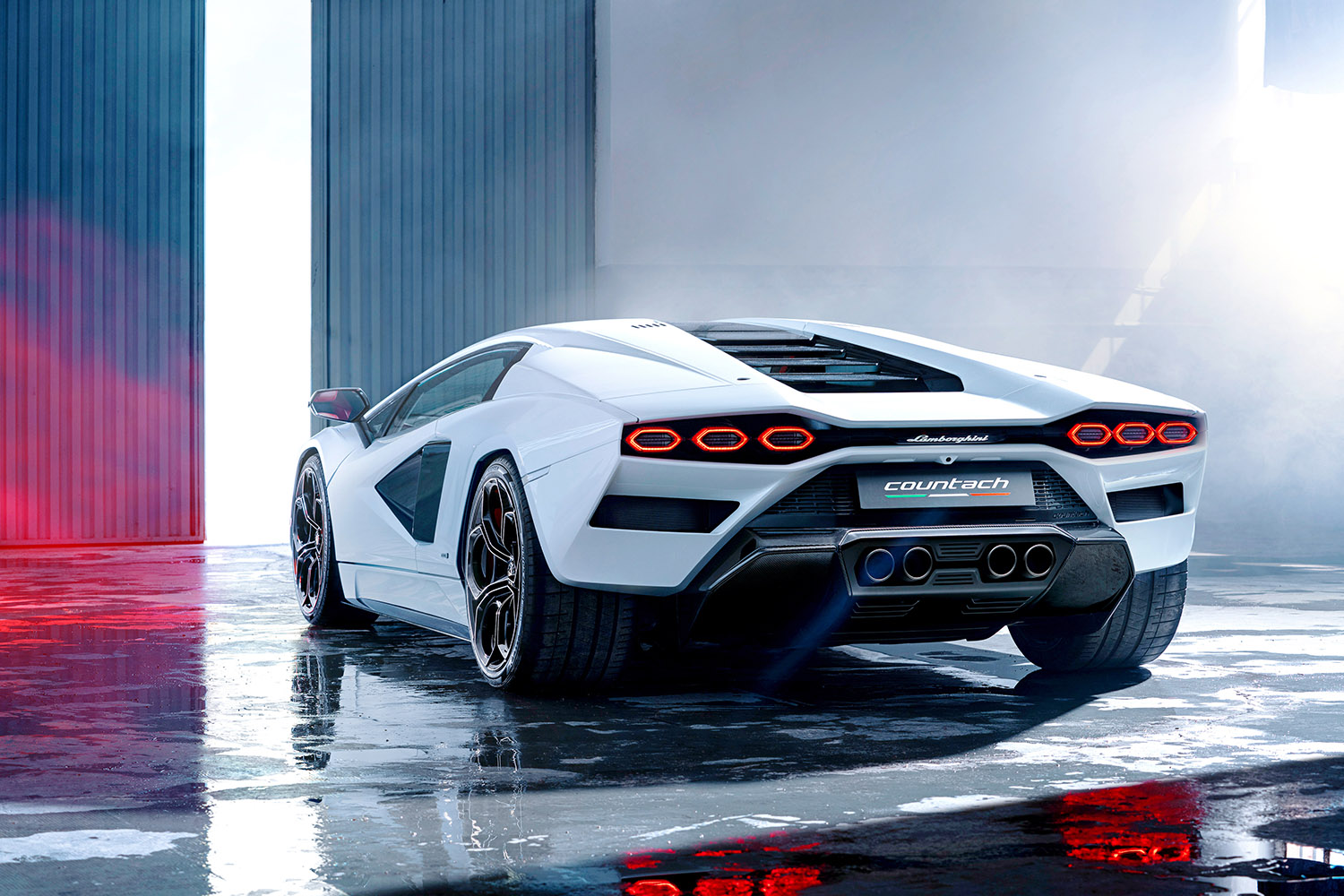
Forever Young and looking toward the future: The Lamborghini Lp1 800-4

Lamborghini: At the Cutting Edge of Design
By Gautam Sen with Branko Radovinovic and Kaare Byberg
ISBN 978-185443-317-6
784 pages, 2 volumes, hardcover, dustjacket, slipcase
1070 illustrations
U.S. $250

Review by Pete Vack
All photos from the book

Read review of Volume One

Review by Pete Vack

While you and I got old, Lamborghini, under Mimran, Chrysler and Audi, somehow managed to stay forever young. And thank goodness for that. Gautam Sen’s Volume Two of his epic Lamborghini, At the Cutting Edge of Design, leads us into unaccustomed territory, taking us from the Silhouette to the Terzo Millennio, from Mimran to Audi, detailing the models we’ve rarely thought about and introduces us to rare variations we never knew existed. Naturally, we are aware of the supercars and hypercars that were developed by Lamborghini in the 1990s to date. But not by any means too familiar; too many models, too many owners, too much money, too fast and too furious. [Read more…] about Lamborghini: At the Cutting Edge of Design V 2

Tagged With: bertone, Buying a Lamborghini Miura, chrysler, dalton watson, design forum, Dick Ruzzin, Espada, Filippo Perini, Gautam Sen, Jota Miura, Lamborghini Espada, lamborghini marzal, Lamborghini Sian, Lamborghini Silhouette, Luc Donckerwolke, Luigi Marmiroli, marcello gandini, Marzal gandini, Miura design, Walter de Silva, who designed the Miura, zagato

Arguments on the Origins of the Miura

July 25, 2022 By pete

lead

From the VeloceToday Archives, 2016

VeloceToday recently completed a two-part book review on the work of Marcello Gandini authored by Gautam Sen. We are also reviewing a book about the De Tomaso Mangusta, by ex-GM designer Dick Ruzzin. In October, author and collector Paul Wilson allowed us to spend some time with his Lamborghini Miura. The three are uniquely qualified, if not over-qualified (read bios at end of the article).

This content is for Premium Subscriber members only.
LoginSubscribe

Tagged With: dalton watson, design forum, Dick Ruzzin, Gautam Sen, marcello gandini, Miura design, who designed the Miura

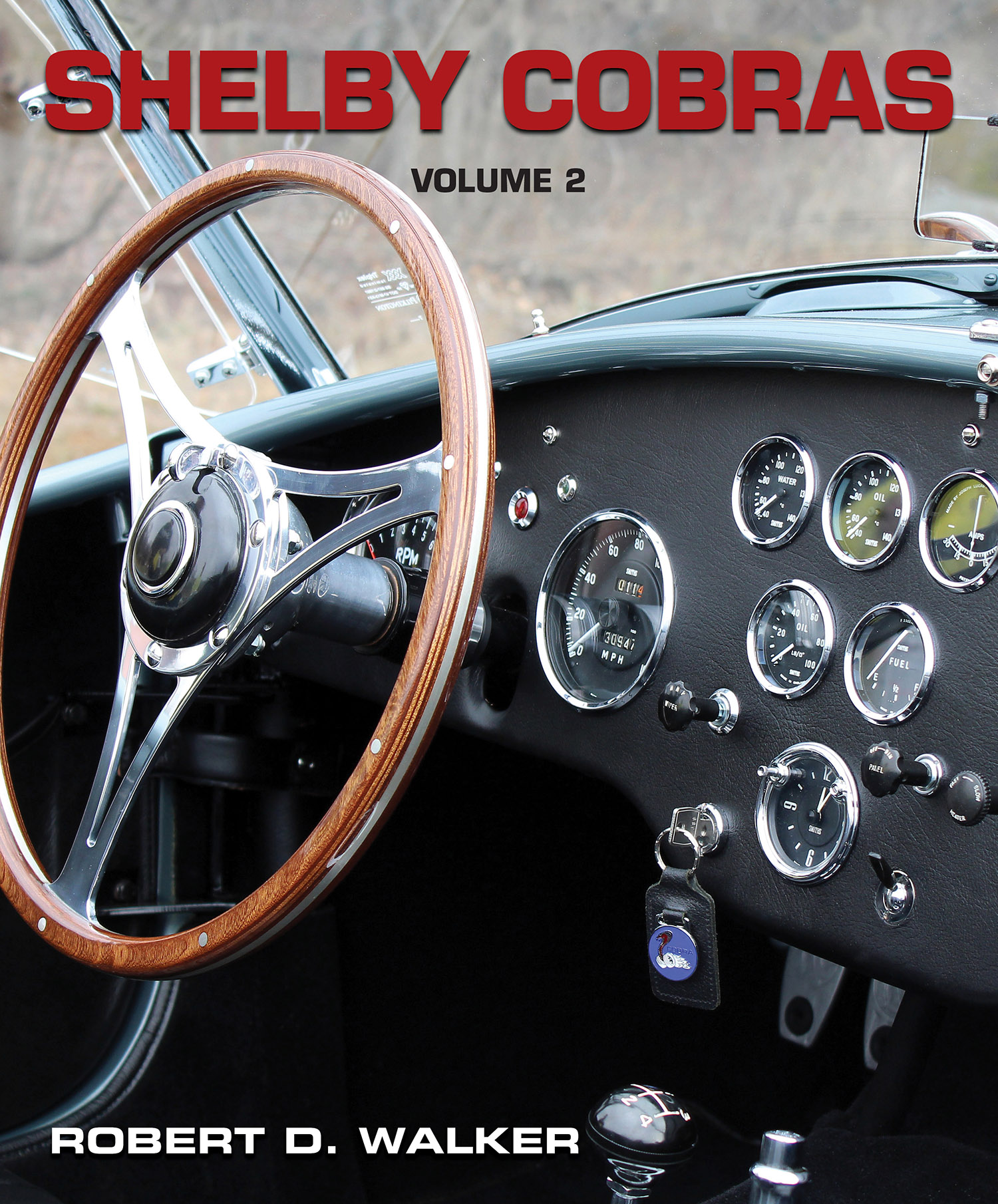
Cobra MK I Chassis History, Vol. 2 Reviewed

January 31, 2022 By pete

Review by Pete Vack

Read review of Volume 1

Hey Little Cobra…

Oh no, we are not going to bring up that old ditty…
Oh, yes we are, because in Volume 2 of the Shelby Cobra book, author Bob Walker has revealed the full story about the song that made the Cobra famous. Or was it the other way around?
[Read more…] about Cobra MK I Chassis History, Vol. 2 Reviewed

Tagged With: carol connors, Cobra CSX 2001, Cobra CSX 2006, dalton watson, Dalton Watson fine books, Herbie Hancock, Hey little cobra, Robert D. Walker, Shelby Cobra, The Definitive Chassis by Chassis History of the Mark I Production Cars

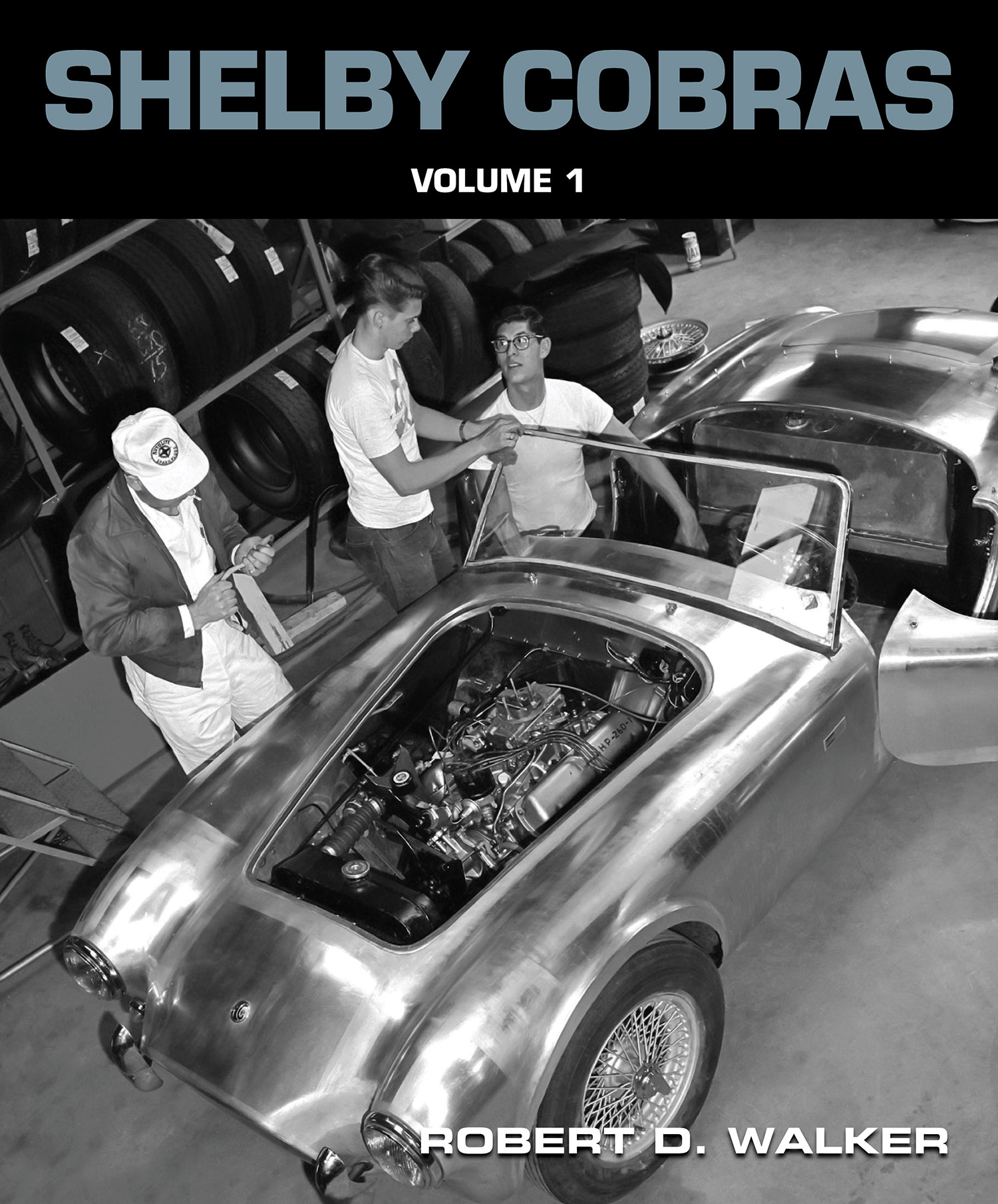
Cobra MK I Chassis History, Vol. 1 Reviewed

January 24, 2022 By pete

Review by Pete Vack

Shelby Cobras: CSX 2001 – CSX 2125
The Definitive Chassis-by-Chassis History of the Mark I Production Cars
by Robert D. Walker

Order Here

In 1963, 23-year-old jazz musician Herbie Hancock, flushed with money from his hit, “Watermelon Man” walked into Kriesler’s auto showroom in Manhattan, eyed the white and red sports car on the floor, and said, “I’d like to buy the Cobra.” It was Hancock’s first car. “I had only driven an old Dodge my father had bought me for college.” The price was $5,825 plus taxes and license. [Read more…] about Cobra MK I Chassis History, Vol. 1 Reviewed

Tagged With: Cobra CSX 2001, Cobra CSX 2006, dalton watson, Dalton Watson fine books, Herbie Hancock, Robert D. Walker, Shelby Cobra, The Definitive Chassis by Chassis History of the Mark I Production Cars

Excerpts from “The Thrill of the Chase”

July 21, 2020 By pete

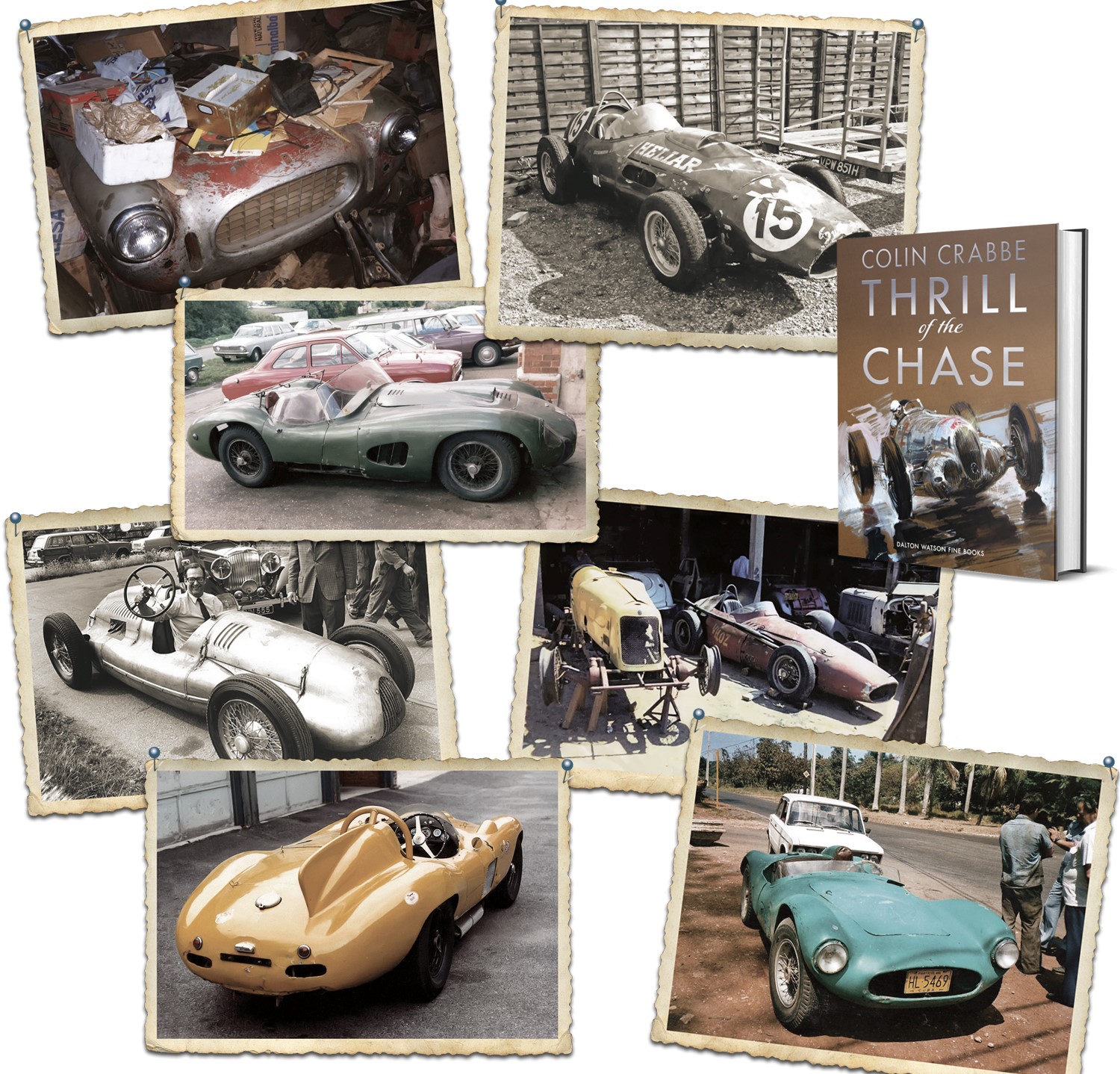
For those of us brought up in less interesting circumstances, Colin Crabbe’s life is something out of J. K. Rowling and Hollywood. Parents with connections to royalty, castles and ghosts, public schools, the ruins of mediaeval abbeys were all a part of his young life. Colin Crabbe never lost sight of the wonderful past that surrounded him which would eventually drive him to become one of the world’s great car collectors. Below, we have excerpted paragraphs from his autobiography; this segment focuses on his youth, and the next segment will deal with some of the fantastic cars he has found and raced. Edited and published with permissions from the publisher and author. BTW, the publisher is running low on copies, so order now!.

[Read more…] about Excerpts from “The Thrill of the Chase”

Tagged With: Colin Crabbe, dalton watson, Thrill of the Chase

A VeloceToday Design Forum

December 20, 2016 By pete

new-forum

VeloceToday recently completed a two-part book review on the work of Marcello Gandini authored by Gautam Sen. We are also reviewing a book about the De Tomaso Mangusta, by ex-GM designer Dick Ruzzin. In October, author and collector Paul Wilson allowed us to spend some time with his Lamborghini Miura. The three are uniquely qualified, if not over-qualified (read bios at end of the article).

Also, we are offering FREE to VeloceToday readers, a PDF of the first 52 pages of “Gandini, Maestro of Design” (read review). This gives you, our readers, a chance to join in on the discussion and read the complete fascinating story of Gandini and Miura. Click here for details.

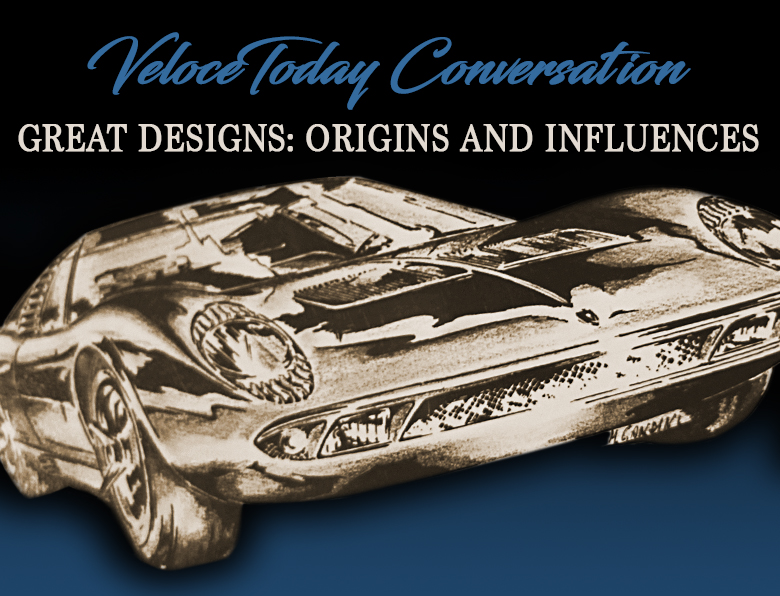
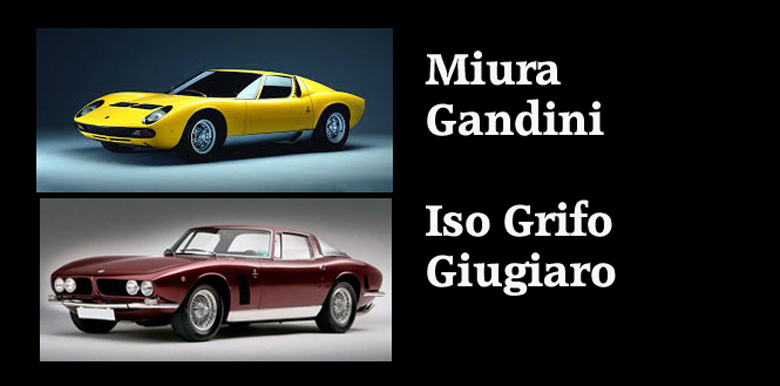
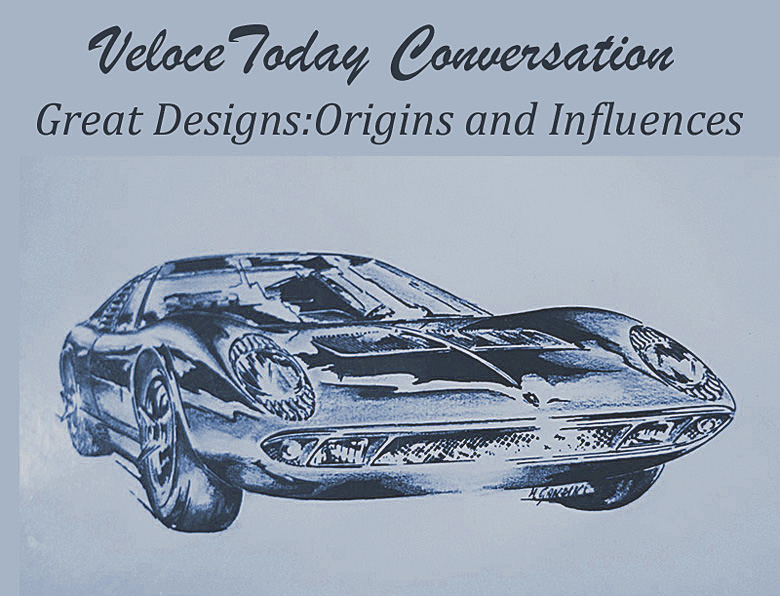
While discussing the Gandini book (in which he was quoted), Ruzzin offered some thoughts about the nature of the Miura design. “When an artist sits down to do his work, all of his lifetime experiences and values come to bear on what he is trying to create. This is inevitable and cannot be prevented, as art is a reflection of the essence of the artist’s intellect in the form of sculpture, music, painting, or car design.” Although no one is challenging Gandini’s role as the designer of the Miura, the images that Ruzzin sent along were nevertheless thought-provoking.

In short, Ruzzin presented this argument:

ruzzin-780 [Read more…] about A VeloceToday Design Forum

Tagged With: dalton watson, design forum, Dick Ruzzin, Gautam Sen, marcello gandini, Miura design, who designed the Miura

Talbot-Lago Grand Sport Book Review

March 5, 2013 By pete

Click here for details and to order from Dalton Watson

Reveiw by Pete Vack

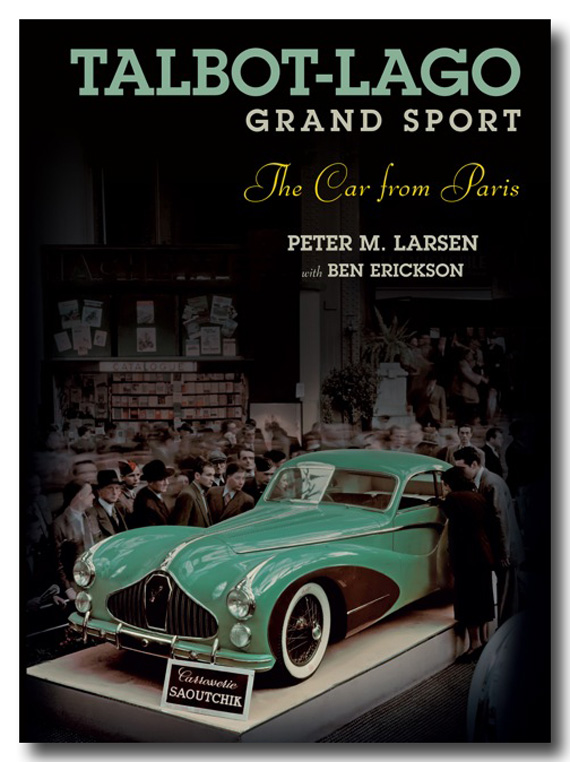
The “Talbot-Lago Grand Sport” arrived in a very heavy box, and like a Russian matryoshka doll, this was opened to find a luxurious 14.5 x 9.5 x 3.5 inch carrying case with handle, profusely illustrated with the cover material printed in full color. That in turn opened to reveal an even more luxurious 13 x 9 x 3 inch slipcover, which in turn harbored a slick, high quality two-volume set of the “Talbot-Lago Grand Sport”. Standard volumes are $350, with a limited number (600) of copies. Leather bound editions are $650 and only 100 copies.

We are sure most of our readers are aware of this line of Talbot-Lago cars, called Grand Sports. They can be seen occasionally at auctions, major concours, in select museums, and at important retro events. But such sightings are rare, fleeting, scattered throughout time and space, never allowing one to grasp the meaning, numbers or depth of the species. Most knowledgeable enthusiasts could probably not put forth a useful definition of the Talbot-Lago Grand Sport, much less recite how many were built, coachbuilders, where they are today and what they look like. Even co-author Peter Larsen, in the introduction, had to explain that the book was specifically about the Talbot-Lago Grand Sport, a rare model which did not include the more famous pre-war Figoni et Falaschi teardrop coupes based on the T150SS chassis.

MYSTERY CARS
The amount of information available about the Talbot-Lago Grand Sport (TLGS) is truly meager and as scattered as the appearance of the cars themselves. The Grand Sport model was not acknowledged in the original Georgano Encyclopedia, completely overlooked in William Stobb’s “Les Grandes Routieres”, mentioned only briefly in an excellent article on the automobiles of Tony Lago in “Automobile Quarterly’s” V23 No 4. An Internet search will reveal images and videos of several of the cars, some good information from our friends at Coachbuild.com and some auction company information, but all scattered and incomplete. Wiki is notably short on the Grand Sport. The bibliography in the “Grand Sport” book lists six books – most in French – that pertain directly to Talbot-Lago, and that’s probably pushing it. In short, there is not much out there.
That’s precisely what makes the Peter Larsen/ Ben Erickson “The Talbot-Lago Grand Sport” so interesting, valuable, entertaining, informative, necessary, compelling, and a thrill to read. For the first time, the Talbot-Lago Grand Sports have been tracked down, gathered, defined, explained, photographed and detailed, chassis by chassis. It is overwhelmingly new and fresh information. Many of the cars have not been seen in years; a few are in private collections unknown even to the authors; some – though very few – have just disappeared, and most are now and have been kept in Europe.

WHAT IS A GRAND SPORT
The Grand Sports were Tony Lagos’ supercars, the top of a very expensive line. Based on the pre-war Grand Prix chassis (with a 2.65 meter wheelbase and later 2.80 meter) they were given coachwork by Figoni, Saoutchik, Dubos, Franay, Graber. The T26 was virtually the same 4.5 liter Marchetti-designed hemi-head used in the Grand Prix Talbots of the era, minus the aluminum block, dry sump oil system and with different carburation, most using 3 Zenith carbs. This resulted in the most powerful French road car built at the time, with at least 190 horsepower on tap. The Wilson preselector gearbox was the same unit as used in the race cars as well. The chassis consisted of massive steel girders, independent front suspension via transverse leaf spring, and a live rear axle under the frame located by leaf springs. It was archaic but light. A huge 120 liter fuel tank meant long periods without stops but little space left for luggage. In a very real sense, a road-going GP car. Larsen figures that from 1947 to about 1950, between 29 and 35 Grand Sports were built on both 2.65 and 2.80 meter wheelbases.
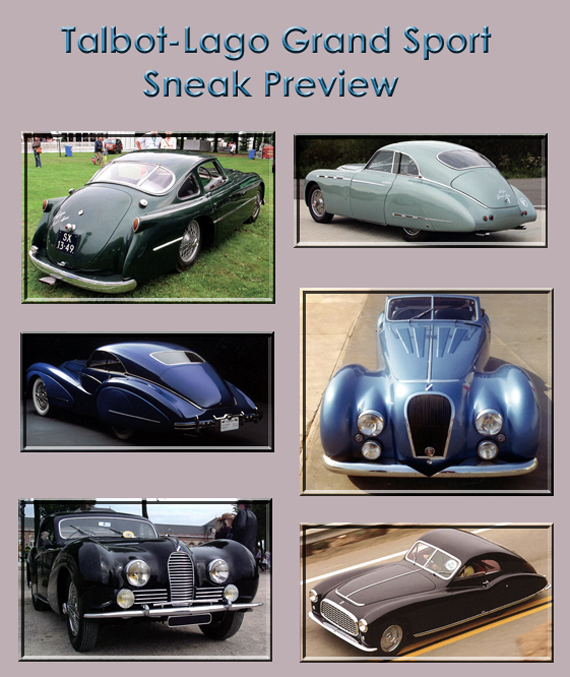
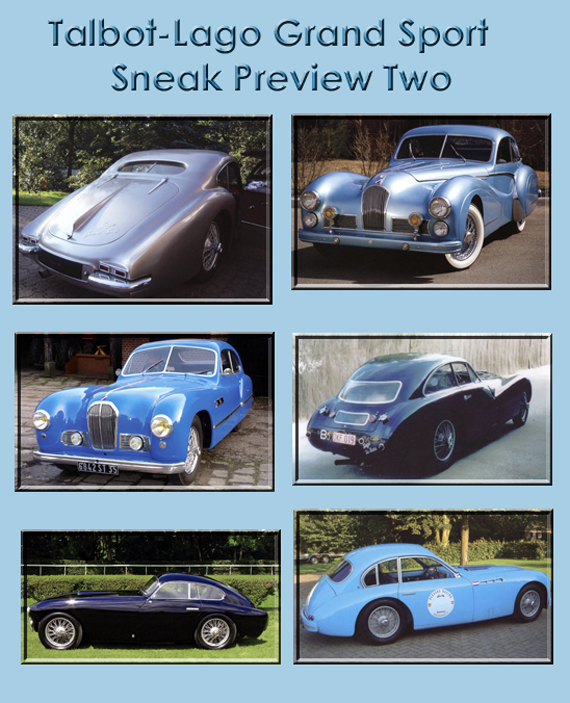
With coachwork more art than automotive, the Grand Sport, as the book’s PR would have it, was “chic, ritzy, aristocratic with a superb pedigree that gave it instant admission to the elite gatherings at races and concours, no questions asked”. The coachwork that graced the Grand Sport chassis ranges from the bizarre and odd, to beautiful and advanced, from lithe racing barchettas to svelte coupes. Each is unique, most are stunning.

LAGO RECORD VS GRAND SPORT
Allow us to digress for the benefit of our very astute readers who may wonder about the difference between the Grand Sport and the more common Lago Record: In the post-war era, the Talbot-Lago line consisted of the 6 cylinder T26 Record and Grand Sport, and the 4 cylinder Talbot-Lago “Baby”. The normal T26 Record used the same engine as the Grand Sport but produced 170 hp, using only two Zeniths. The Record chassis was much longer at 3.12 meters; the weight was 1280 Kg. As a post-war design, the Record feature coil spring independent front suspension. However, Lago’s goal for the Grand Sport model was to use whatever resources at hand to quickly create a lightweight high-performance chassis at low cost, hence the use of the pre-war GP chassis. It was 47 cm shorter and 430 Kg lighter than the new Lago Record. That the GP chassis made use of a transverse-spring front suspension was perhaps a necessary compromise. While it was seemingly a retrograde step, it made sense and Lago figured he could market it as a “perfected road car chassis, which has much of the power, road holding and strength of my Grand Prix racing machines.”

A NECESSARY OPUS
In the realm of French and Italian cars, we can only compare this new work to Christian Huet’s book on Gordini (in French only) and Simon Moore’s Alfa Romeo 2.9 and 2.3 volumes. In many respects, though it covers fewer individual chassis, the TLGS does it better, making use of more outstanding color photography as well as historical black and white images, complemented by outstanding layout and presentation. Like Moore and Huet, Larsen and Erickson are relentless detectives, tracing each car as far as possible from its birth to the present day. In most cases, where and whenever possible, the authors consult with the current owners and provide photos of the cars as they appear at time of publication. This with a considerable amount of historic images in both color and black and white, leaving little left to wonder.

Like Moore, they are not professional writers per say and at times the text can annoy. But any such annoyances are readily tossed aside as the full impact of the material presented simply blows one away. Perhaps unfairly, but in light of the overall magnificence, we care less if a rare word (“bespoke”) is over-used, or if certain peculiarities are repeated (on six different occasions calling Coatalen to task for spending too much on racing). Written off is a mistake attributing Rocco Motta as the coachbuilder for the Renault/Marquis (read story). Tony Lago was perhaps a bit less than the authors admit. More information about the post-war Talbot line and less about the Pons plan would have been nice. This ain’t Shakespeare, but it is a breathtaking revelation of the most hidden, most outlandish, most artistic, and often the most beautiful cars on earth.

VOLUME 1
While Moore dealt with a very well-known subject matter, the team of Larsen/Erickson knew that they would have to set the scene for the actual serial number saga. Volume 1 includes a fairly in depth history of the S-T-D year but focuses on the story of Tony Lago, his triumphs and repeated problems trying to keep his firm alive and solvent while he upheld the honor of France on the race tracks and the Paris salons. The authors have done their research here, bringing in new facts about the life and death of Talbot, the heartbreaking bankruptcies, the mistakes and the competition, but alas, no one yet knows much about the private life of Tony Lago.
Technically, there is a chapter on the history and workings of the Wilson pre-selector gearbox, the chassis, and yet another about engines that would power the fabled Grand Sports. They are not in great depth, but enough to garner a good understanding of the components. The chapter on the Wilson gearbox was most welcome.
Much to our delight, Volume 1 also contains fairly substantial histories of the coachbuilders that clothed the Grand Sports. How much do you know about Dubos, Antem, Besset, Pennock, and Contamin? Altogether the authors found eighteen different coachbuilders and/or designers responsible for the Grand Sport bodies. Each one is given a chapter. Only Farina, Saoutchik, Graber and Motto were familiar to this reviewer in any depth.
Alas, nowhere in Volume 1 is there good photos of any of the 35 plus cars that are described in Volume 2! The authors wanted to save the subject shots for the second volume. At first this was rather annoying, as there were plenty of references to the Grand Sport series. Then I (egad, pardon my first person here!) decided to go with the flow. I carefully digested Volume 1’s 238 pages, while absolutely refusing to even open the cover of the larger, heavier 407 page Volume 2, which I knew consisted of all the chassis numbers. Something told me I’d be into something good.

THE TREASURES IN VOLUME 2
Admittedly, not jumping into Volume 2 takes some self-discipline, but it was worth it. For every night I would discover a new and interesting if not bizarre car which I had never before or rarely seen. Or seen only in grainy Road & Track photographs, or in photos take in the poor light of museums or obstructed by asses and elbows of the concours field. But here they all were in both color and historic images, almost large that life, with details and histories. Each chapter was to be saved and savored, each one a treasure, even to one who is admittedly pretty jaded in terms of automobilia by now.
This leads to a problem; one can be devastated when the last of the 648 pages are turned, the last car unveiled, the last morsel tasted.
This is a huge book, an important book, and a superb effort, well worth the money. The price of entry is mitigated by the high probability that it is an investment which will grow in value.
In the next few weeks, we’ll give you further insights and previews of a few of the Talbot-Lago Grand Sports. Yeah, you too, can wait!

Tagged With: dalton watson, French luxury cars, Talbot, talbot grand sport, talbot lago

Primary Sidebar

     SIGN UP BELOW TO RECEIVE VELOCETODAY EVERY WEEK FOR FREE


       EXCLUSIVE ARTICLES ABOUT 

    EXTRAORDINARY AUTOMOBILES

PositiveSSL

Recent Posts

  • VeloceToday for March 3, 2026
  • Sports Car Racing at Midland, TX 1960-62
  • Smith’s Alfa Vintage Racing Chronicles
  • Squarebacks to Love
  • The Final Word on Squarebacks!
  • Sports Car Racing at Midland, TX, 1959
  • Tripoli 1939: Italian Job That Mis-fired
  • Gauld Checks Out the Ferrari Estate Car
  • Juan Manuel Fangio Tribute
  • Sports Car Racing at Midland, TX, 1958-59
  • Behind the PBS SOCAL Story: My Extra 5 Minutes of Fame
  • Sharp’s Retro Part 4: French Classics
  • Sharp’s Retro Part 5: Interesting Others
  • Sharp’s Retro Part 6: Art and Neat Stuff
  • Sharp’s Retro Part 1: Ferrari
  • Sharp’s Retro Part 2: Alfa and Lancia
  • Sharp’s Retro Part 3: Fiat and Others
  • Amore mio Ardea
  • Bill Warner finds the Don Vitale Nardi
  • Thornley Kelham, the home of the Lancia Bandit
  • The Legends of Bob Gerard
  • Retromobile 2026, First Report
  • Graham Gauld on Nardi
  • Gauld and the Auburn Douze
  • The Races of Life, a Review
  • The Selected Works of Aldo Zana
  • Aldo Zana at the Monaco Grand Prix, 1968
  • Wilson’s 6C 2500: Will it Fit?
  • Panning for Gold Part 2
  • Robert F. Pauley explores the SCCA parking lots

Copyright © 2026 · VeloceToday.com · Privacy · Sitemap

MENU
  • Home
  • Subscribe
  • About
  • Contact
  • Donate
  • As Found