• Skip to primary navigation
  • Skip to main content
  • Skip to primary sidebar

VeloceToday.com

The Online Magazine for Italian and French Classic Car Enthusiasts

  • Home
  • Subscribe
  • About
  • Contact
  • Donate
  • As Found

gordini history

Seven Glorious Gordinis

February 25, 2020 By pete

By Pete Vack
Photos by Hugues Vanhoolandt

From the VeloceToday Archives, April 18, 2013

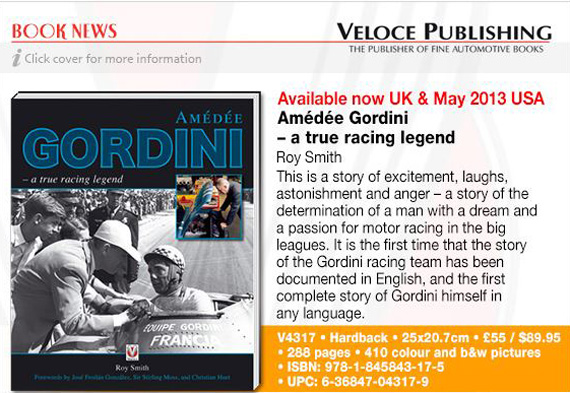
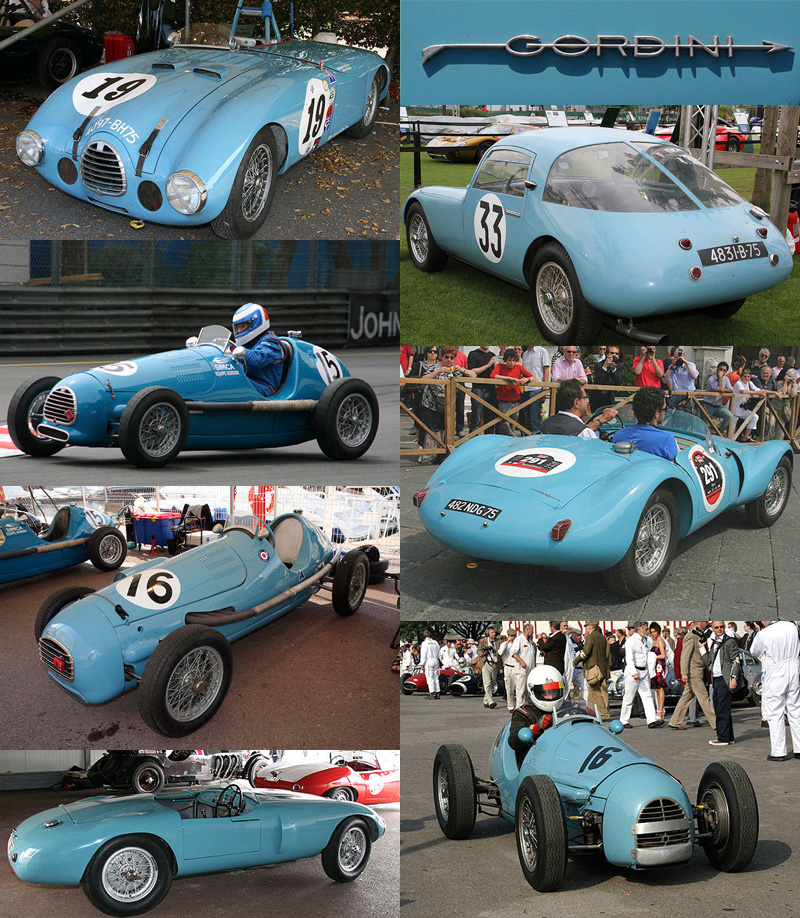
Thanks to our man Hugues Vanhoolandt, we are able to present these Gordini photos, listed by chassis number, for this article. They were taken at a variety of events from 2008 to 2013. And, thanks to VeloceToday contributor and author Roy Smith for his book Amédée Gordini, a True Racing Legend.

Before VeloceToday contributor Roy Smith wrote his comprehensive book on Gordini, the only source of in-depth information about the cars was Christian Huet’s amazing book, on the subject. Published in 1984 in French, Huet traced the history of Gordini, plus all known cars.
This content is for Premium Subscriber members only.
LoginSubscribe

Tagged With: amedee gordini, classic gordinis, gordini 02gc, gordini 06gc, Gordini 17S, gordini 19gcs, Gordini grand prix, gordini history, Jean Behra

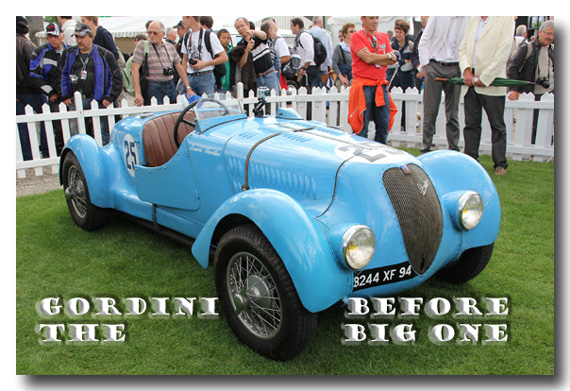
Gordini’s Pre-War Racers

October 24, 2017 By pete

By Pete Vack
From the archives, April 4, 2013

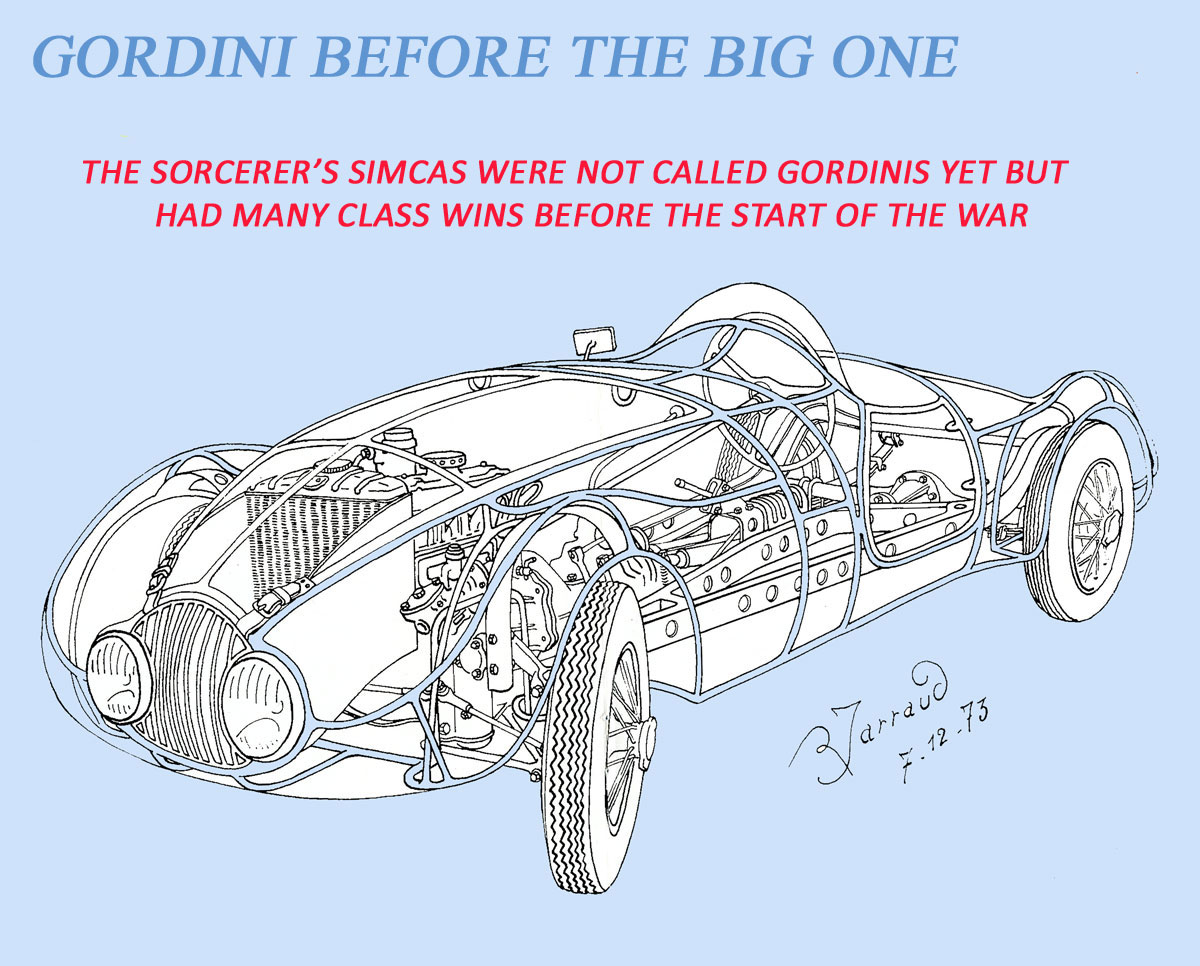
As Graham Gauld has written, Gordini’s racing prior to the 1950s was both significant and interesting. Here we’ll take a look at a few of the prewar Simcas modified by Gordini.

While he had not yet given his name to his cars, Gordini’s modifications to the Balilla Sport, the Simca Cinq (Fiat Topolino) and the Simca Huit were very successful – in fact one might argue Gordini was almost as successful before the war as he was after!

This content is for Premium Subscriber members only.
LoginSubscribe

Tagged With: gordini at le mans, gordini history, gordini huit, Gordini pre war, gordini simca, le mans gordinis, simca cinq, simca gordini, simca history, simca huit

Gordini, Driven!

June 13, 2013 By pete

By Ed McDonough
Photos by Mike Jiggle

Read Part 1

Read Part 2

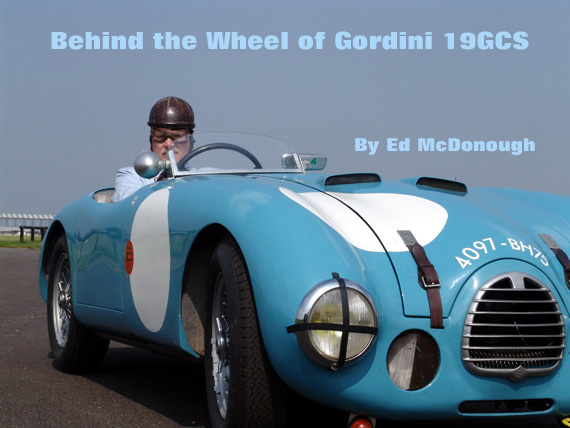
As it happened, I test drove the Gordini at Silverstone on the same day as I had driven an F2 Ferrari 500, both cars having been raced by some of the most charismatic drivers ever to get behind the wheel of any racing car. Both cars had Maurice Trintignant connections, but the Gordini had led Le Mans with Jean Behra in this very seat…can you get your head around that?!

This content is for Premium Subscriber members only.
LoginSubscribe

Tagged With: classic gordinis, driving a Gordini, ed mcdonough, eddie mcguire, gordini 19gcs, gordini history, gordini race cars, gordini sports racers, racing gordinis

Driving the Gordini Sports Part 2, Chassis History

June 6, 2013 By pete

1950 Gordini

Chassis 19GCS made its first racing appearance at the 1950 Le Mans as a 1.5-liter car, driven by Andre Simon (here) and the boss's son, Aldo. They retired after 6 hours.

Ed McDonough continues with the history of chassis 19GCS
Color Photos by Mike Jiggle
Historical photos from the collection of Eddie McGuire

The car you see here, chassis19GCS made its first public appearance on the Gordini stand at the 1949 Paris Motor Show. It was originally intended that all the new cars would appear at the 1949 Le Mans race, but single-seater events had taken priority. Maurice Trintignant and Robert Manzon drove 18GCS but retired, and 19GCS made a gentle entry at the Paris Show with its ohv 1.5 engine, a four-speed gearbox, and the light alloy body helped it to weigh in at only 650 kgs. The engine was known as the T15.

1950
Though it had an easy start in the racing world, 19GCS would have a reasonably hard…and long…life. It ran at Le Mans for the first time on 25-26 June, 1950 with Andre Simon and Gordini’s son Aldo driving with car number 34, but it was forced to retire. Andre Simon joined the Gordini team at the beginning of the year. The car was quick at Le Mans but the gearbox broke after six hours. It then was raced, still in 1.5-liter format, three times in July at the Mont Ventoux Hillclimb, the 12 Hours of Paris and the Rouen Sports Car Grand Prix, driven by the various members of the Gordini team. At the end of August it appeared in the rather obscure Coupe Rhineland. It must be remembered that there were an unusually large number of monoposto races going on in this period and the Gordini resources were stretched to the limit.

The 1951 Le Mans Simca-Gordini team; Pictured is #37, chassis 19GCS, driven by Pierre Veyron and Georges Monneret. It retired with engine failure.

This content is for Premium Subscriber members only.
LoginSubscribe

Tagged With: driving a Gordini, ed mcdonough, gordini at le mans, gordini classics, gordini drive, gordini history, gordini sports cars, history of gordini

Gordini Gallery

April 18, 2013 By pete

By Pete Vack
Photos by Hugues Vanhoolandt

Recently we published two articles about Gordini before WWII., Gauld on Gordini and Gordini Before the Big One. This week, Hugues Vanhoolandt gives us a post war Gordini Gallery, consisting of photos taken all over Europe since 2008.

Before VeloceToday contributor Roy Smith wrote his latest book, Gordini, the only source of in depth information about the cars was ChristianHuet’s amazing book, on the subject. Published in 1984 in French, Huet traced the history of Gordini, plus all known cars.
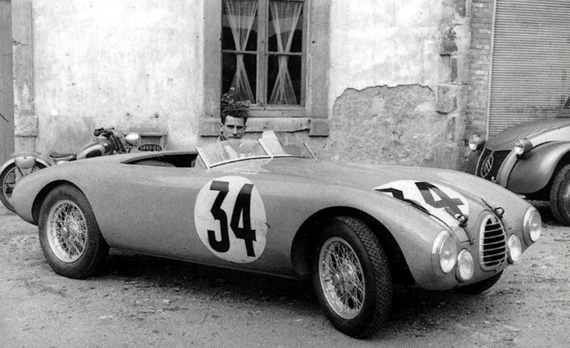
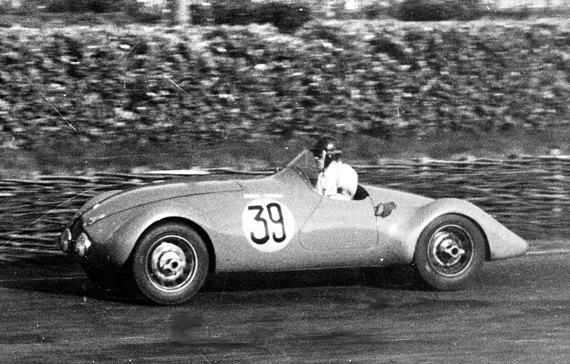
Huet’s task was made a bit easier because there were very few Gordinis ever built; every chassis was a race car so race events and photos provided a field for research. In 1957, when Amedee Gordini retired his cars from racing and went to work with Renault, he wisely sold many of the remaining Gordinis to museums throughout France. The largest recipients of were the Schlumpf brothers, who in 1960 came into the possession of 13 of the 32 post war Gordinis. Other cars were kept by their owners, hidden away until it became affordable to have them restored.

While at the very same time Ferrari blithely went about destroying his old racecars, the Gordini’s enshrined in the museums ensured that his remarkable and beautiful jewels would never die, enhancing his own legacy and history. Since the 1990s, many of the ex-museum cars have come into the hands of those who wish to see them in action once more. Some 56 years after Gordini retired his cars, a few now appear at selected events such as the Monaco Historics and Goodwood. Few, if any, can be seen in the US, although in 2001 one did appear at the Monterey Historics.

Gordini’s cars were a unique combination; French, Italian, exquisite and fast. The rarity and successful race records plus the drivers such as Behra and Fangio, make them as desirable as a mid-fifties classic could possibly be. Information, photos, specs, and tests were sparse and even less well known in the U.S. Fred Wacker was one of the few Americans who actively raced a Gordini, and he did so in Europe. Gordini brought cars to race in the Carrera Panamericana but the cars returned to France. For years, Gordinis remained mysterious and unknown, and since most were in museums, few ventured out to vintage race car events.

As related in our earlier articles, Gordini was supported heavily by the new Simca company prior to the war. This support continued after WWII and the cars were known as Simca Gordinis. Then came the disastrous 1951 Le Mans, when all four 1500cc Gordinis retired. It was too much for Simca’s M. Pigozzi; he pulled his financial support for Gordini and from that point on the cars were known only as Gordinis.

A note about chassis numbers and Types. Postwar, Gordini created an 1100cc formula car much like the Cisitalia D46. These were called T11s. Over the years most T11s were modified and upgraded to T15 which were, for the most part, 1490cc. T15s were often upgraded or changed to sports racers, such as 18s. Each had a unique chassis number, generally in order of initial construction; 02 GCs, 06 GS, 18GC, etc. The letter ‘s’ after the numbers or suffix would mean a sports model. Engines had Types as well, T15 at just under 1500cc being the most common. Almost all chassis had a “immatriculation” number, or license tag. It can get confusing and thankfully in this case there are only 32 chassis to track, and all the work has been done by Huet and recently updated by Roy Smith in his new book on Gordini. (Smith’s book is completely different and takes the Gordini saga right through to the Renault years and beyond.) We’ve asked Roy to check our assumptions below and we thank him for his corrections. However, that does not guarantee that all of the below information is 100 % correct.

Note that Ed McDonough will be featured driving s/n 19GCS coming up in VT, and we’ll take a much closer look at s/n 33 in the near future.

Finally, thanks to our man Hugues Vanhoolandt, we are able to present these Gordinis for this article. I imagine he has been wondering if we’d ever use them!

Gordini Gallery

Chassis number 02GC
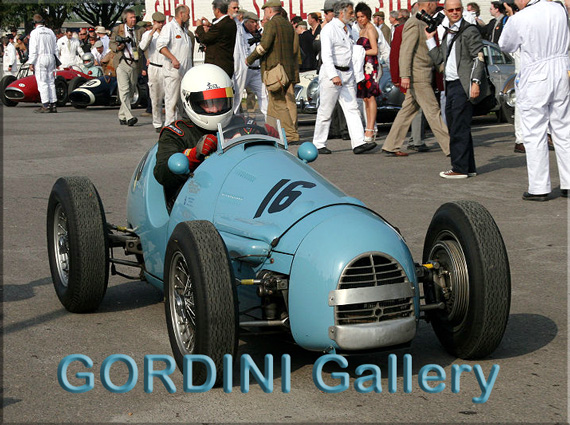
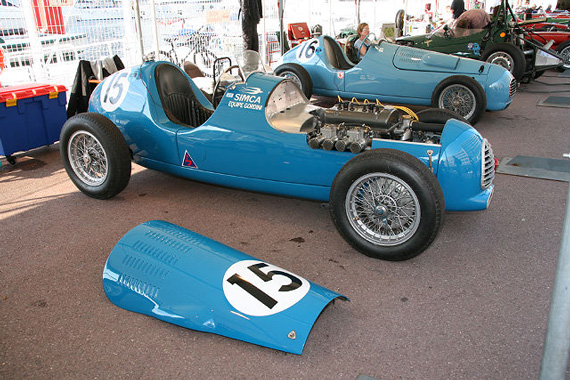
Number 15 is a monoposto, original chassis number 02GC, constructed in 1947. It was driven by Gordini himself at the Torino GP in 1946, before he decided to retire from racing. Maurice Trintignant also took part to some races in this particular car. Driven at Monaco in 2008 by Jean-Jacques Bailly (F).

02GC began life as an 1100 cc, but today has a DOHC Gordini head, bigger wheels and tires for the extra power. Almost all Gordinis were upgraded through the years.

[Read more…] about Gordini Gallery

Tagged With: gordini, gordini 02gc, gordini 06gc, gordini 19gcs, gordini 20s, gordini 22, gordini 36s, gordini book, gordini gp, gordini history, gordini racers, hugues vanhooldant, roy smith

Graham Gauld on Gordini

April 4, 2013 By pete

Gordini on the way to winning the Index at Le Mans in 1939. Graham Gauld Archives.

By Graham Gauld

Does anyone remember the Fodor guides to hotels, restaurants and the like? Back in 1957, Fodor sent me a review copy of their then-new guide to Italy. It arrived just as I was planning my first trip to Modena, so I looked up the area. I came upon a small hotel, the Albergo della Rocca, in the tiny village of Bazzano to the north of Modena. It was a great choice because it was run by the Rochi family as a typical Italian family hotel. Occasionally Enzo Ferrari came there to dine, but many years later I discovered that Bazzano had another role to play in the history of motor racing. It was the birthplace of Amedeo Gordini.

Amedeo’s father was a horse dealer but died in 1902 when Amedeo was only three years of age. However, it was not long before cars entered his life as Modena was a hot bed of motor sport and was one of the towns used on the Giro d’Emilia car event. (I say car because in 1909 the first Giro d’Emilia cycle race took place and also visited Modena.) Gordini was enthralled and that was it; he was going to become a mechanic, and at the very young age of 10 he took up an apprenticeship in an engineering shop in Bologna.

A man named Weber was an early influence on Gordini. Photo by Mary Decker Vack

This content is for Premium Subscriber members only.
LoginSubscribe

Tagged With: amedee gordini, gordini, gordini bio, gordini cars, gordini history, gordini racing, Graham Gauld

Pre-War Gordinis and Simca Huits

April 4, 2013 By pete

Photo by Hugues Vanhoolandt

By Pete Vack

As Graham Gauld has written, Gordini’s racing prior to the 1950s was both significant and interesting. Here we’ll take a look at a few of the prewar Simcas modified by Gordini.
While he had not yet given his name to his cars, Gordini’s modifications to the Balilla Sport, the Simca Cinq (Fiat Topolino) and the Simca Huit were very successful – in fact one might argue Gordini was almost as successful before the war as he was after!

Although having established his Suresnes Fiat garage in about 1927, Gordini didn’t gain much traction until 1935, when the Balilla began to come into France in numbers. Before that, Gordini had struggle to derived speed from the Fiat 514, introduced in 1929. It was a solid if not stellar replacement of the 509; with 1438cc, the four cylinder flathead would allow the production car about 55 mph. More or less representing Fiat, Gordini prepared a 514 Torpedo much like the one in the photograph, to enter the Course de cóte de Suresnes, a trial up the Mont Valérien. The prize was given to the slowest car! Not only that, he won the event in both 1933 and 1934, gaining him the title “The King of Slow Drivers”. But even then, Gordini realized that any publicity was usually good publicity.

The 1438cc Fiat 514 of 1929 was a slow car, but not perhaps as slow as it was made out to be by Gordini. Fiat photo.

This content is for Premium Subscriber members only.
LoginSubscribe

Tagged With: gordini at le mans, gordini history, gordini huit, Gordini pre war, gordini simca, le mans gordinis, simca cinq, simca gordini, simca history, simca huit

Primary Sidebar

     SIGN UP BELOW TO RECEIVE VELOCETODAY EVERY WEEK FOR FREE


       EXCLUSIVE ARTICLES ABOUT 

    EXTRAORDINARY AUTOMOBILES

PositiveSSL

Recent Posts

  • VeloceToday for March 3, 2026
  • Sports Car Racing at Midland, TX 1960-62
  • Smith’s Alfa Vintage Racing Chronicles
  • Squarebacks to Love
  • The Final Word on Squarebacks!
  • Sports Car Racing at Midland, TX, 1959
  • Tripoli 1939: Italian Job That Mis-fired
  • Gauld Checks Out the Ferrari Estate Car
  • Juan Manuel Fangio Tribute
  • Sports Car Racing at Midland, TX, 1958-59
  • Behind the PBS SOCAL Story: My Extra 5 Minutes of Fame
  • Sharp’s Retro Part 4: French Classics
  • Sharp’s Retro Part 5: Interesting Others
  • Sharp’s Retro Part 6: Art and Neat Stuff
  • Sharp’s Retro Part 1: Ferrari
  • Sharp’s Retro Part 2: Alfa and Lancia
  • Sharp’s Retro Part 3: Fiat and Others
  • Amore mio Ardea
  • Bill Warner finds the Don Vitale Nardi
  • Thornley Kelham, the home of the Lancia Bandit
  • The Legends of Bob Gerard
  • Retromobile 2026, First Report
  • Graham Gauld on Nardi
  • Gauld and the Auburn Douze
  • The Races of Life, a Review
  • The Selected Works of Aldo Zana
  • Aldo Zana at the Monaco Grand Prix, 1968
  • Wilson’s 6C 2500: Will it Fit?
  • Panning for Gold Part 2
  • Robert F. Pauley explores the SCCA parking lots

Copyright © 2026 · VeloceToday.com · Privacy · Sitemap

MENU
  • Home
  • Subscribe
  • About
  • Contact
  • Donate
  • As Found