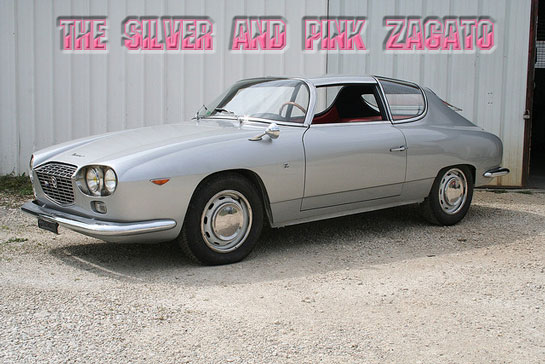
This immaculate Flavia Zagato was on Flickr, for sale in 2008. Credit Chill in Zonda.
A Close Encounter of the Third Kind
By Pete Vack
The brothers Zagato didn’t have a great deal of luck with Lancias.
The Appia Zagato was always too long and too little. Although somewhat successful in the Italian 1100cc events, the street version was underpowered and overwheelbased, and the 1100cc engine strained at anything like racing speeds. From the front it was attractive, but the side view and rear view failed to delight. From the same era, the Abarth, Alfa and the Bandini Zagatos (only one built), were far more pleasing to the eye.
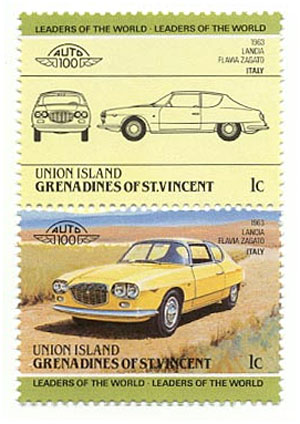
Whatever one thought about the lines, the Flavia Zagato did make a good stamp.
The Zagato’s next attempt on the Flaminia chassis, was the most pleasing of the GT coupes, particularly the covered headlight versions. The Fulvia Zagato was perhaps the prettiest of the lot, but not, however, as pretty as the standard Fulvia coupe, whose beautifully balanced lines were attractive from any angle. The Zagato variant was pretty in a clumsy fashion, not the best of the Zagato efforts, as it made use of lighting fixtures that were taken straight from family sedans produced by Peugeot! The Fulvia Zagato had a decent competition record, but nothing to write home about.
The last production Lancia Zagato was the Beta-based convertible. However, it was neither a Lancia nor a Zagato, but a FIAT-based Lancia and not really a Zagato design, but assembled at the Zagato premises. So we shall not mention it further.
But the most outrageous, and least well known Lancia Zagato was the 1.8 liter Flavia. Designed by Ercole Spada, Zagato’s main man of the era, it possessed some earlier Zagato motifs, such as the windows into the roofline, which harkened back to the Panoramic Fiats of the early fifties. It was streamlined, but Zagato did not work with a wind tunnel. They worked by feel, drew the car up on a full sized board and then started hammering. Once on the road, it was tested with the traditional tuft of cloth method.
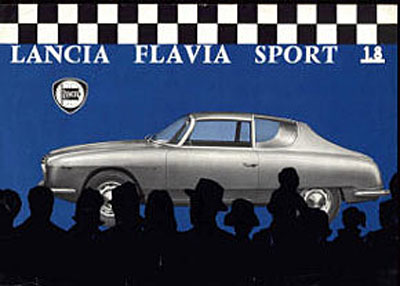
See the people? They are looking at the Flavia Zagato but you don't see their expressions.
Prior to the construction of a larger facility in the late 1960s, Zagato worked primarily in aluminum, and the quest for saving weight carried over into the interior and even the paint. Paint was applied sparingly, in two or three very thin coats. Needless to say, the paint did not survive long. The interiors were also thin, particularly the vinyl. The dashboards were hammered out of very thin aluminum, and often not covered with anything but crackle finish paint.
The Flavia Zagato was one of the cars built to those specifications. Some were all aluminum, but the example I owned was mostly steel. “Mine” was a a very original car, well maintained and with no serious rust aside from the rear leaf spring supports, which seemed endemic to most Flavias.
Admittedly, I was, or am, a devotee of the Zagato brothers; finding a good Flavia Zagato was a particularly interesting experience. Other Zagatos had passed through the garage, including an Appia Zagato, an Abarth Zagato, and an Alfa 2600 Zagato. But the Flavia Zagato was the strangest of them all.
It was, as were many Zagato’s of the era, silver, and when new, featured a bright red vinyl interior, rather more luxurious in appointments than the Abarth and Appia. Competition work was obviously a secondary consideration; this Zagato, like the 2600 Alfa, was a road going GT car. The chassis was unmodified, complete with the stock steering wheel which turned the front wheels very slowly, fine for a large sedan but not a Sports/GT car; the instrument cluster came straight out of the First series Berlina, including the horizontally moving speedometer! The gearbox was controlled by a rather long, spindley lever, and somehow the car never let one forget that it was indeed, front wheel drive.
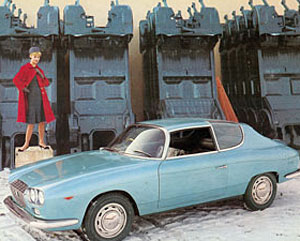
Another ad for the Zagato featured a model in front of a line of chassis. Well, she had a nice chassis anyway.
The body design, was, as mentioned, outrageous. Despite having owned many vehicles known for their head turning ability, the Flavia Zagato was the hands down winner in that category. Combined with an interior which had sadly faded from bright red to a blushing bright pink, the car generated almost too much unwanted attention. Silver and pink are a pretty outrageous color combination for a GT car.
As the lines were so truly astonishing, and only about 250 Zagato bodied Flavias were made, it was obvious that at some point in the future (this was almost 20 years ago) this car would be worth a great deal more than what we paid for it.
After a few months, we parted ways with the Zagato, at roughly seven times less than what it would be worth today. It was not enough time to really get to know the car. In fact, we never really gave it a chance.
Or, perhaps, it never gave us the chance.
I owned a Fiat Abarth Zagato Aleman in the early ’60’s. I bought it from a woman in San Francisco who had just come back from Italy but was returning to get married.
I have hardly ever seen any information on this car and wonder if mine was a rare variety. I believe they were never inported to the US, but can’t confirm that.
Anyone have any information or pictures of this car?
Eric
Too bad Mr. Vack focuses on bodywork; I wonder if he appreciates the underpinnings: the Flavia/Fulvia drivetrains/chassis were extraordinary: conceived at the same time as Issigonis’s Mini- as Lancia’s new path of FWD only; their last RWD car was the Flaminia. I had both Flaminia Sport and Fulvia Sport Zagatos over the years as daily drivers, in Italy and elsewhere. The Fulvia was simply the best car I have ever owned: a worthy successor to every narrow-angle V-4 Lancia from the Lambda onwards. The self-contained subframe design was even more innovative than the Mini, and still holds lessons for designers. Not least Subaru, which shipped Flavias to Japan for copying- and was able to easily add AWD to the flat-4 crucifix layout. DK Adams
Nice to read something on the special Flavia Zagato. Zagato made an even more outrageousely styled short wheelbase version of it with a lowered body and an E-type style opening bonnet for the Targa Florio.
By the way, the writer of this article mentioned ‘his’ Flavia Zagato was mostly steel compaired to other versions. That seems strange as all Flavia Zagatos had full aluminum bodywork including all opening panels.
Production figures were 726 for the similar bodied 1500 and 1800 models.
Pete, I really don’t know where to start on this one!
The first sentence, “The brothers Zagato didn’t have a great deal of luck with Lancias” would have poor Elio knocking down your door. The greatest commercial AND racing success of all Zagato’s was the Lancia Fulvia Sport (in number of sales and victories). Their success at Daytona and Sebring alone is worthy of a book (forced to run as a prototype because of the 1.4 liter), winning class while running aganist 2 liter pure racercars. Elio’s personal victories in his Fulvia Sport number in the dozens. Somewhere is a picture of him next to his white Fulvia Sport and it is literally covered with trophies.
Commercially, over 7000 Fulvia Sports were built, and it really put Zagato on the map financially.
As mentioned above, the real “beauty” of these cars is under the skin. The first “W” engine layout I believe, with an eleven degree V and a block only about one foot long, able to extract well over 150 hp at 9000 rpm in 1.4 race form in 1968/69. The DOHC design is unlike any other. No wonder Lancia went under, these cars were a technical marvel, with no expense spared. The transaxle looks like an F1 box of the day.
Pete, I know your a Zagato fan, so we will let you slip on this one! Best, Denton
In September, 1969 I think it was, I was hitchhiking north out of London on the A1. There are a couple of roundabouts still in the suburbs where cars go slow enough to be able to see you thumbing and with room enough to stop if they so wish. It was a warm early evening. I was going home to Cambridge about 50 miles away and for a reason I cannot remember I was car less. Into the roundabout way too fast was a left-hand-drive Lancia Flavia Zagato on Italian plates. I stepped back knowing that before my very eyes was a wadding about to happen. Well, he recovered, got it sorted, and stopped. I rode on the wrong side of car – at a screaming high speed – all the way there. Said driver, a wealthy, flamboyant Italian youth, was on his way to language school in Cambridge – which he needed badly, I learned this, because before each stop light he looked at me and asked “My turn?” We never stopped once. You need not ask, yes, it’s my favorite car!
I think Eric Hasenbeck has himself slightly confused with his Abarth model names. It sounds like he is referring to an Abarth Allemano, and if he is then it can’t also be a Zagato! Allemano created the coachwork on a number of Abarth types, from tiny 750s up to 2400cc 6 cylinder coupes and spiders.
They’re all covered in the better books on Abarth, which are generally available through good motoring booksellers.
The Appia Zagato in the general Appia brochure was accompanied by a drawing of a dachshund wearing a little checkered blanket…they knew what the car looked like! The 6″ shorter wheelbase GTS, with open headlights, was advertised with a top speed of 117mph as compared to the GTE’s 93 (although mine would do about 100). I should’ve bought one in ’64 and mopped up H Production in the SCCA; in those “almost stock” days my regular Appia Zagato was moderately competitive with the Bugeyes, all of us running stock wheels and those racy Michelin X tires. I have the last Flavia Zagato 1800 made with Solex carbs before they switched to Webers. Zagato also built a two-liter series with Kugelfischer injection. About that time they quit wrapping the rear side windows into the roof, and, I think, eliminated the slight inset of the rocker panels. My car is mostly steel, by the way. I wish I could find original alloys for my Flaminia Zagato and the Flavia Z too–never saw photos of an Appia Z with mags.
p.s. The Appia Zagato GTE has the most luggage room per cc of displacement of any sportscar/gt in the world, and the Flavia Zagato is a full 4-seater.
Since we have so much reader interest in this subject, I hope we can get one of our readers to help us do a full length in depth article on the Flavia Zagato. I welcome, enjoy and in most cases agree with all of the comments so far. My old Flavia Zagato, as far as I can recall, was a good bit steel, much like my Alfa 2600 Z was. But that was a long time ago and I could be wrong. Keep the comments coming; the great thing about the Flavia Zagato is that it inspires so much discussion.
Pete Vack
I lived in Iran in the mid 60’s as a teenager and around the corner from our house was a Zagato in silver with red leather and always had the rear window cranked up for ventilation, yes the rear window opened at the bottom for flow thru ventilation a inch or two. I always thought the car was great. Also the head tech for PanAm bought a Peagaso Z102 from the Shah but it took him over a year to get the car as they had to remove all the gold interior bits and had them recast in brass.
There were two Allemano coupes sold at European Motors in San Francisco in ’61 or ’62 Martin Swig may have sold them. I owned one of them and had it serviced at Griswold’s when he was in Oakland.
Never owned a Flavia Zagato, although I did nearly buy one, but I still have a Fulvia Sport Zagato in my barn, must get that back on the road. That too has an opening rear hatch for ventilation, about 2 inches at the bottom, driven by a windscreen wiper motor. A clever release allows the hatch to manually be opened fully. What style.
great article, indied a special design, my father had one and we drove in 1965
from holland to switserland , cruising speed was topspeed about 180 km p/h
we sit in the back of the car and it felt like a airoplaine, no windnoise and roomy
because of the backwindow in the roof.
fulvia sport second serie had peugeot 205 coupe rear lights, not sedan. first serie
used nsu prinz rear lights.
toly, try squadra & corsa in holland for finding your alloys, perhaps the can help.
Oh come on… dachshund! What were those marketing people thinking? I always thought that Zagato’s treatment of the Appia was superb, even if it took them several attempts at getting it right. Sure, the Flaminia Zagato had better proportions, but the Appia Zagato (there were more than one variation) was sweet. My former Appia Sport – in which I commuted daily for 5 or 6 years – was a kick to drive, and was the last of the series. It was also the last of its kind that one could find on a Fort Wayne used car lot with the price written on the windshield with white shoe polish! But that was back in ’77. A few months later I brought home a non-Zagato find – an Aurelia GT2500 with 12,000 miles on it. Time has flown, and I still have the Aurelia, and I wish I held onto to the Appia, as well. The virginal Aurelia now has about 29,000 miles on the clock.
“But the most outrageous, most powerful and least well known Lancia Zagato was the 1.8 liter Flavia.”? Indisputably the most outrageous, but the most powerful–by far–was the Flaminia SuperSport. And I’m with Toly on the short wheelbase Appia Sport.
I have a 1.8 Flavia Zagato Injection RH drive. It was the 1966 Sydney Motor Show Car. Only two were imported into Australia by Lambda Motors and mine is the only known survivor of 9 built with fuel injection and Borani steel /alloys. We used to service this car in the mid ’80s and I bought it accident damaged (front end). I have only recently managed to get a front end and will be rebuilding the car. They may not be the most asthetic-looking vehicle but many Zagato models were slightly off beat. We have raced and rallied a Fulvia Zagato to the centre of Australia which was no mean feat. There is still a 1.6 Fulvia Zagato being raced in Historics in Australia. We have also two Lancia Beta Zagato Spiders, one a 2000 the other is a 1600 that belonged to Gianni Zagato and was the car that was used as a prototype for modifications to the roof and chassis, with a chassis no. of 005. There are many Zagatos in Australia from Appias to Flaminia Sports and Super Sports.
Hi ! Fulvia Zagato Sport – ” Not very sucessful !” Where have you been ? “Appia Zagato sport – too long !” one of the most slippery aerodynamic and beautiful body designs to my eyes. The Flavia Zagato sport was an echo of the Design changes going on in Italy at that time. Some of the modern furniture was a bit ‘ off the wall ‘ look up the Milan Design exhibitions in the late 60’s. Conventional styling has never been Zagato’s thing.
That’s what I like to hear!! Zagatos always conjure up many colorful opinions…We’ll fix up the ‘most powerful’ phrase, as Ed Levin was indeed correct about the Flaminia being more powerful. Horsepower at least has some measureable, non abstract figures. BTW the author also owned an Appia Zagato, Alfa Zagato, and an Abarth Zagato so he also writes as an owner.
Ed.
And by the way the chassis must’ve been modified: an Abarth exhaust for a Flavia sedan will NO WAY be configured to fit a Flavia Sport. Al Cosentino even gave me my money back!
Zagato cars are not for everyone and were haute couture, will always be so.
Many things about the design just are so provoking ,gentle,beautiful and thoughtful.
The Lancia mechanicals are themselves a joy to behold.
I had a Flavia sedan IE, early type, a beast on steroids.
The one car i really wanted was a Flavia Zagato Sport,so elegant.
There is something very pleasing about the cars and they are a delight to drive.
As someone said of the Fulvia Coupe, “The best car i ever owned”.
I beg to differ with Graham Earl. My Abarth was definitely a Zagato Alleman model. I have the owner’s handbook to prove it.
I purchased it from a woman in San Francisco who purchased it in San Francisco in the early ’60’s. This coupe model looked a lot like a small Porche. I have also seen an Allemano Spider as well.