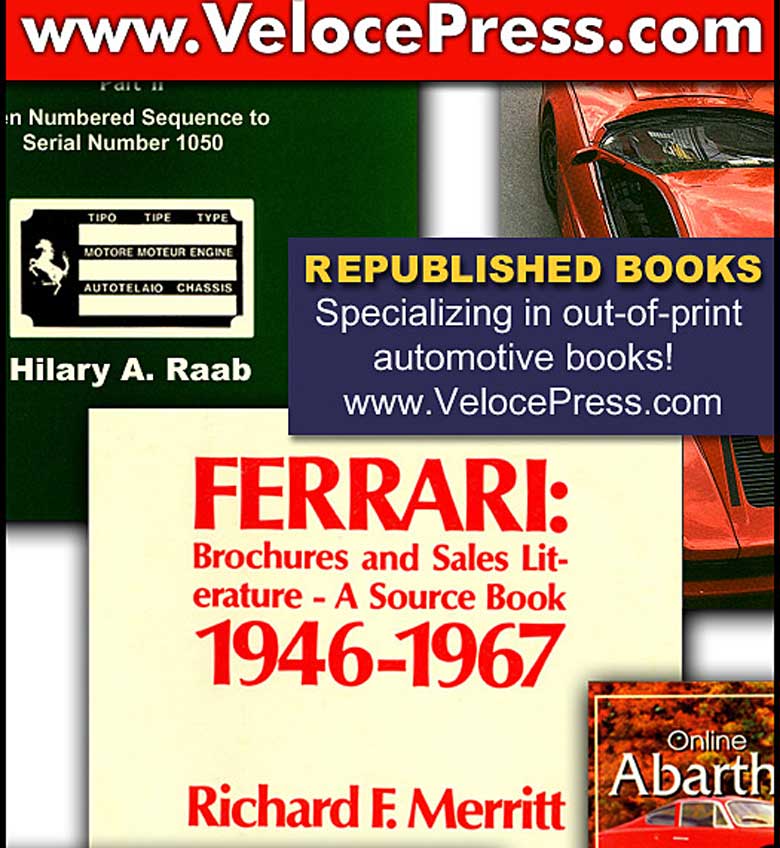
VelocePress (also still in business) preceded VeloceToday and by 2002 was reprinting books from Dick Merritt, Hilary Raab, as well as the Abarth Buyer’s Guide.
Story by Pete Vack
VeloceToday.com was born in a time of massive change and turmoil as the publishing industry came to terms with the digital age. The motoring website, now celebrating its 25th anniversary, was the result of a phone call in 1999 from out of the blue. “Hi, I’m Stephen Glenn calling from Reno Nevada. My partner Allison Reed and I are establishing a business and a website called VelocePress. We’ll scan out of print books and reprint these and sell them online via print on demand. We liked your Illustrated Abarth Buyer’s Guide, and wondered if you’d like to see that republished.”
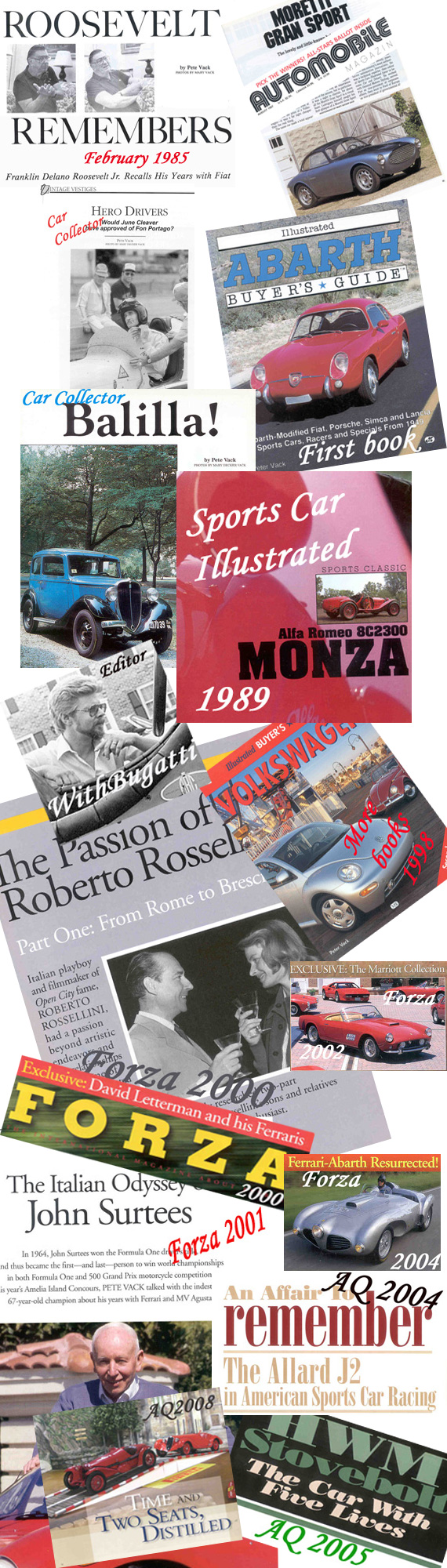
Glenn had caught me at a good time, transitioning from writing articles for major magazine to writing books like the Abarth Guide and the follow up, the Illustrated Volkswagen Buyer’s Guide. By 1995, my photographer, soulmate and wife Mary had put down her Nikon film cameras, leaving a huge gap in our erstwhile writer/photographer team. And I knew I was witnessing, and actively participating in, a major change in the world of publishing and photography as they went digital. Stephen’s idea was to use the advanced digital scanning technology and combine it with the ‘fast press,’ print on demand capabilities to market out-of-print car books. It sounded interesting. Below is a montage consisting of images from many of the magazines we wrote for between 1984 and 2002.
Desktop Publishing
As early as 1986, Ford Heacock had implemented Macintosh MacWrite programs for Vintage Motorsport. In June of 1986, Time magazine featured an article on desktop publishing, mentioning Ford and Vintage Motorsport. Heacock then sent us a new Mac pc with which to write our stories and send them to him via US mail. Huh? Yes, we put our story on MacWrite 3 inch plastic disc, put that and Mary’s black and white photos or color slides into an envelope and mailed them to Ford. It was a revolution and we loved it.
In the meantime, working as a network engineer for AT&T meant that I learned about the digital revolution first hand as the entire communications industry converted from analog to digital equipment and facilities. But taking the Ford Heacock-supplied Mac desktop computer to my office at AT&T meant that we no longer had to rely on the control freak computer gurus who ran one mainframe computer for everyone. Suddenly I could design and map complex private line networks for major companies like GE and Dupont using programs like MacDraw. My bosses were impressed and allowed me to work at home where I could draw up networks on my Mac. All thanks to Vintage Motorsport.
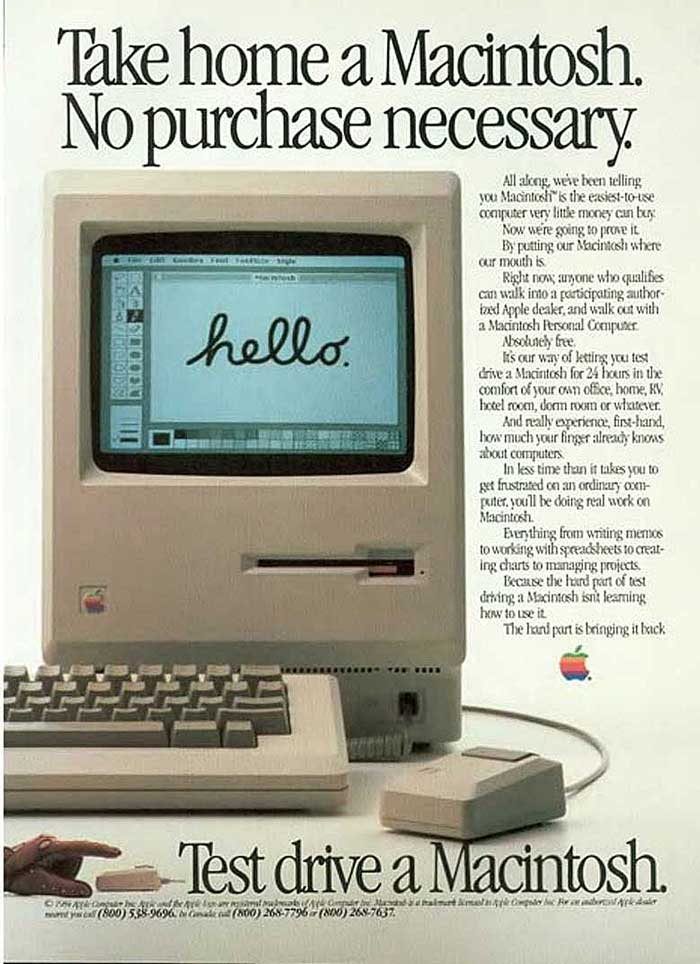
The Mac was not connected to the internet yet, but was a home computer that offered a word processor and drawing programs.
It wasn’t long before the digital revolution came to photography as well, and had been improving rapidly. Moving on to Tellabs in 1998, I served as an engineer to facilitate the installation of Tellab’s super switches which handled everything from telegraph circuits to high speed data circuits on fiber. To do that, we bought a Sony Mavica digital camera which used the same 3 inch discs that were in the Mac. It was huge, clumsy, with limited resolution, but did the job, much better than the old Polaroid.
Both text and photos were now digital, and we had access to both. New pcs now came with a hookup to the growing internet, though transmission was often dial-up modem (modulate and de-modulate) but high-capacity cable service was already in place. This was right around 1999 and that’s when Stephen Glenn called.
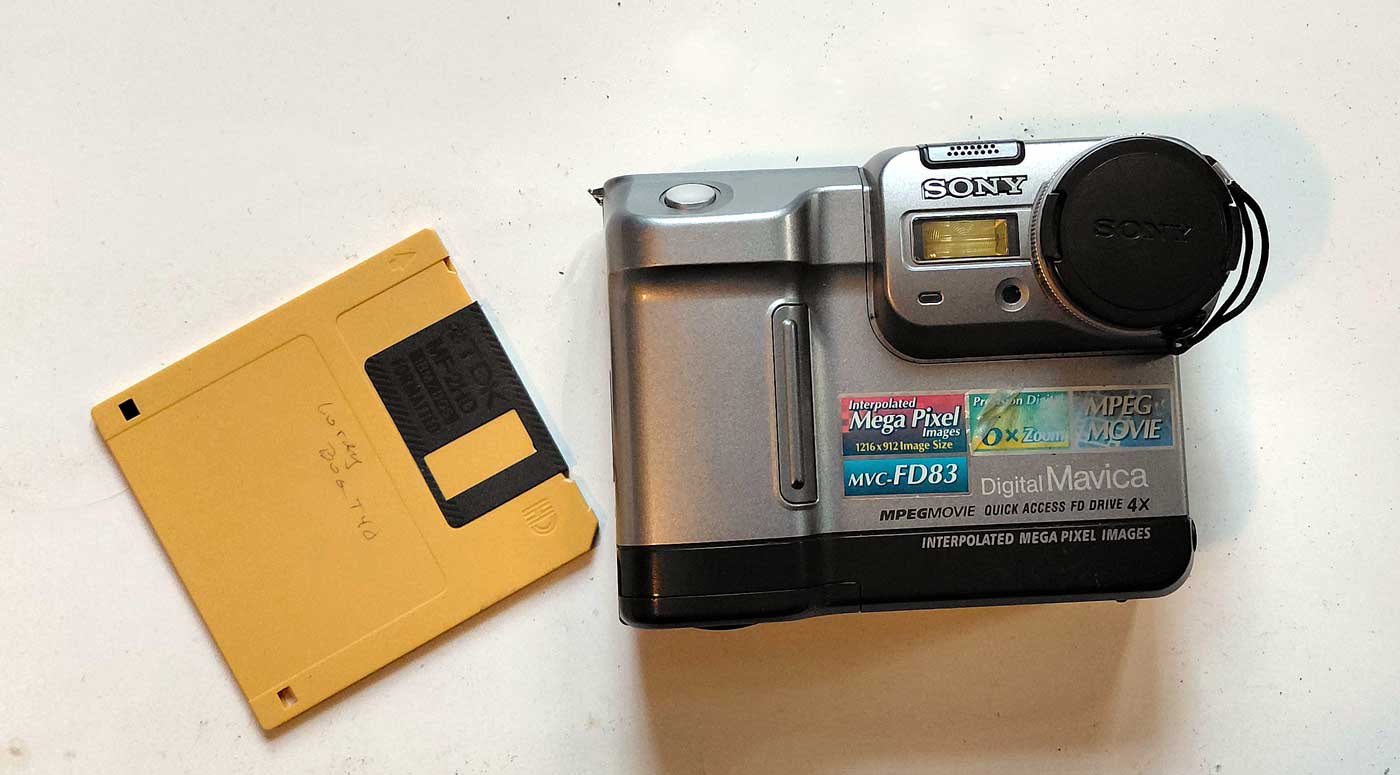
The Sony Mavica with a three inch diskette.
Both Stephen and Allison were very computer savvy, and knew that the power of the internet combined with websites and platforms would transform everything. Their idea to scan and print on demand books like the ours, then selling them on a dedicated website sounded like a new direction and who knows where it would lead. I called Tim Parker at Motorbooks International to secure the copyright for the now out-of-print Abarth Guide, Allison carefully scanned each page, and the second edition of the Abarth Buyer’s Guide was born. Stephen and Allison bought the rights to many other automotive books as well, and by the fall of 2000 they were ready to launch the new venture at Concorso Italiano. VelocePress was on its way. Stephen also mentioned that we should discuss creating a website magazine to help promote the sale of books on VelocePress. That too sounded interesting.
Everything had been accomplished via phone and emails, and we had never met or even exchanged photos, and video meetings were not yet possible, smart phones had not yet been invented. We agreed to meet in Monterey. “But I have no idea what you look like or how to find you,” complained I.
“Look for the guy with the Mohawk,” said Stephen.
Peter:
That was a thrilling time for magazine publishers to explore digital methods. Doing The Star from 1982 through 2007, I was part of the switch, too. In about 1992, we were the first to send an entire issue digitally to our printer, and later he told me that he was the first to print a magazine from a digital file, so The Star was among the world’s first magazines to be produced digitally.
Do you suppose Veloce Press would be interested in reprinting my Illustrated Mercedes-Benz Buyer’s Guide? I hold the copyright. Another candidate would be my book Shelby Cars in Detail, published in 2008 by David Bull. Who should I contact at Veloce?
Thanks, and Happy New Years!
Frank Barrett
Great story Pete. Thank you for sharing.