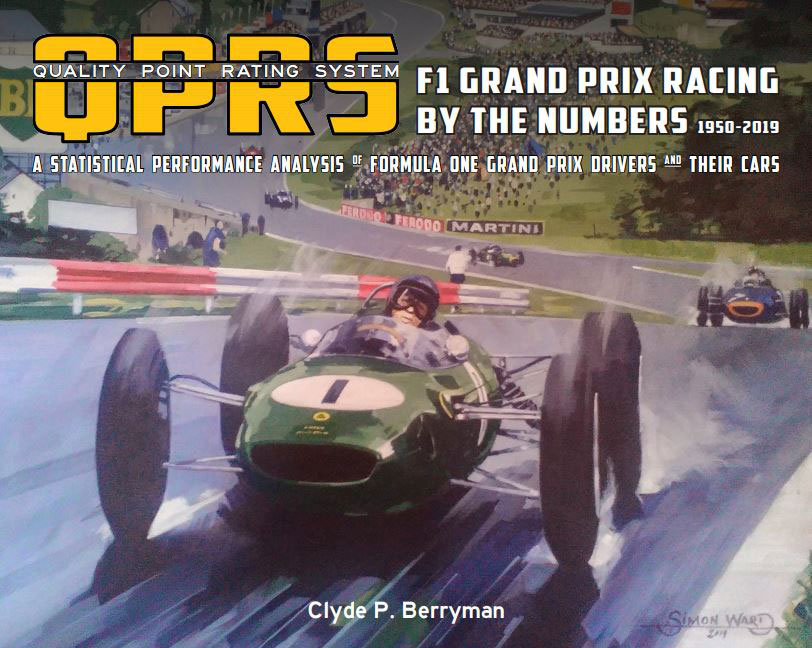
Does this book answer the question of who was greater, Hill or Andretti?
Review by Pete Vack
From the VeloceToday Archives
Clyde Berryman needs no introduction here, but then again maybe so. For it appears that Clyde is not only a model and diorama maker but a statistician as well. (Click to see the Berryman Dioramas) His first statistical rating project was a record of National College Football (he is also a football fan) which was so good it was included in the annual NCAA College Football Record Book. He loves statistics, loves to analyze results with all existing information, and loves Grand Prix racing. So, he invented his own system to rate Formula 1 drivers from 1950 to 2019, and attempts to answer that age old question, was it the driver, or was it the car?
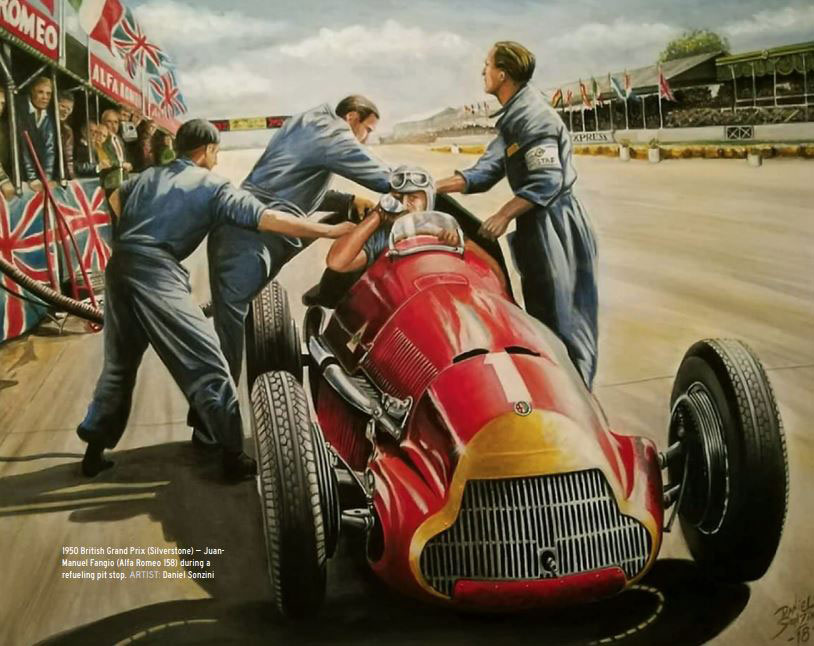
Fangio: Alfa, Ferrari, Maserati. How much of his success was due to the cars he drove?
Berryman explains:
This book evolved as a result of my own lengthy statistical analysis of Grand Prix drivers, their cars, and the results which they achieved. I devised a mathematical formula rating system which I call the Quality Point Rating System (QPRS). With this, I tried to rate the cars and the drivers separately and then compare these ratings with how the Overall Rating (combined driver and car) matches up with the historical record. By attempting to separate the relative performances of the car and driver to the extent possible, we come up with many interesting and controversial observations. The most difficult results for many of us to accept is that sometimes ‘great’ drivers in the common perception are only great because they truly had the benefit of the best cars in the field during a significant portion of their careers. How would they have done at the wheel of lesser cars? How would the seemingly skilled drivers of more mediocre machines have fared if they had gotten the opportunity to drive the best cars out there? Do the best drivers always end up at the wheel of the best cars?
But hasn’t this been done before? As Graham Gauld points out in the Foreword, various books have published car and driver stats but Clyde’s book takes this information to a new level. Wrote Gauld, “To reach his conclusions he chose to elaborate on the plain and obvious statistics of qualifying time trials, wins and placings to factor in the effect of race retirements due to mechanical reasons, rule changes, technical developments, and the relationship between the relative performances of drivers in each of the decades.”
In addition to charting his own QPRS ratings, decade by decade, year by year, Clyde has included the standard World Championship standings and results for comparisons. Very handy for many of us; there once was a time that we might remember the F1 races held in 1957 and recall who won, and who was the World Champion. But how many of us can recall the stats from the year 2005? Clyde includes them all, along with his own QPRS ratings, clearly labeled as such, for Driver ratings, Car ratings, and Overall, (Driver and Car). Therefore, it serves as a useful historical reference work for the entire Formula 1 era.
While The Rating Game feature outlines the principles behind the QPRS rating methodology, there are sections which describes the changes which have made F1 very different over its seven decade history, and the book is divided into decade-long chapters with summaries and analysis of each decade of racing. There is an incredible amount of information between the covers.
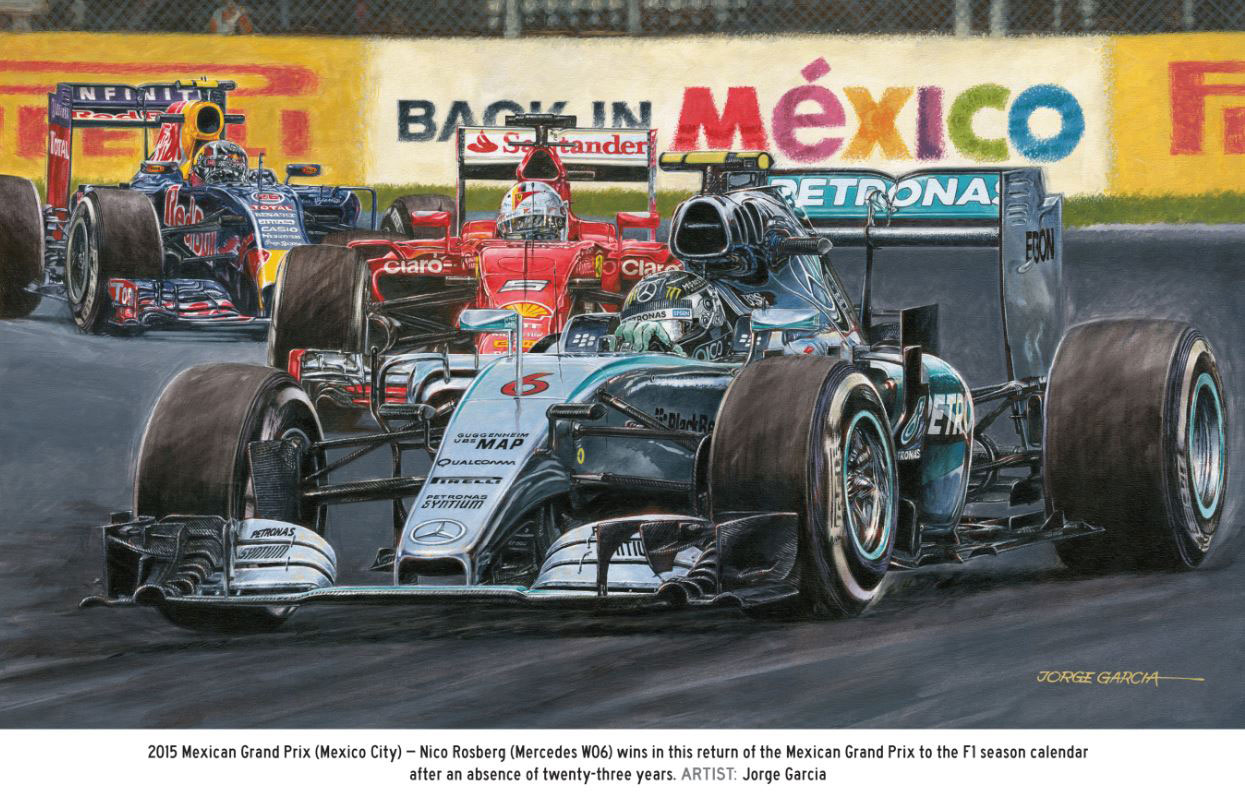
Another example of the superb artwork in the book. And, a reminder of the 2015 season. Was that Nico’s year?
But what should one do about images for such a book? Early on, as he was planning the makeup of the book, Clyde came up with a brilliant idea. Instead of using actual historic photos from the usual sources, Clyde sought out leading motorsport artists from around the world, explaining the book project to them (including his well-known artist-wife Gulay who has done a few auto racing-themed paintings). The results are stupendous, providing a colorful backdrop to the statistical QPRS charts. And instead of just putting the artists name in the captions, Clyde included an appendix that listed all the artists and how to get in touch with them.
Combining result listings, circuit diagrams and artwork calls for a unique layout, and Clyde called on the best layout person around, Jodi Ellis, to put it all together. Dalton Watson publishers Glyn and Jean Morris took the time to help make the book more understandable to both F1 experts and novices of Formula 1 history. Ellis, who always insists upon truly helpful indexes, included Cars and Manufacturers, Circuits, then Drivers to make reference work a joy.

The list of Conclusion Tables from the book.
Berryman took all the relevant information and created 11 “Conclusion Tables.” Those tables whose titles begin with ‘QPRS’ are career-long ratings based on the annual ratings and reflect how well the driver did in head-to-head racing against his contemporary rivals. Those tables which begin with ‘All-Time’ also take into account the relative competitiveness of F1 during the years each driver raced and adds this to the rating. Competitiveness is an ever-changing factor and can be quite important when comparing drivers from different eras who never actually raced against one another out on the circuit. As Berryman points out, “Comparing drivers from vastly different eras is like comparing pilots who flew biplanes in World War One to those who fly Stealth jet fighters today. It took entirely different driver skills to pilot a 1957 Maserati 250F around the Nürburgring than it does to drive a 2014 Red Bull-Renault RB10 around Catalunya.”
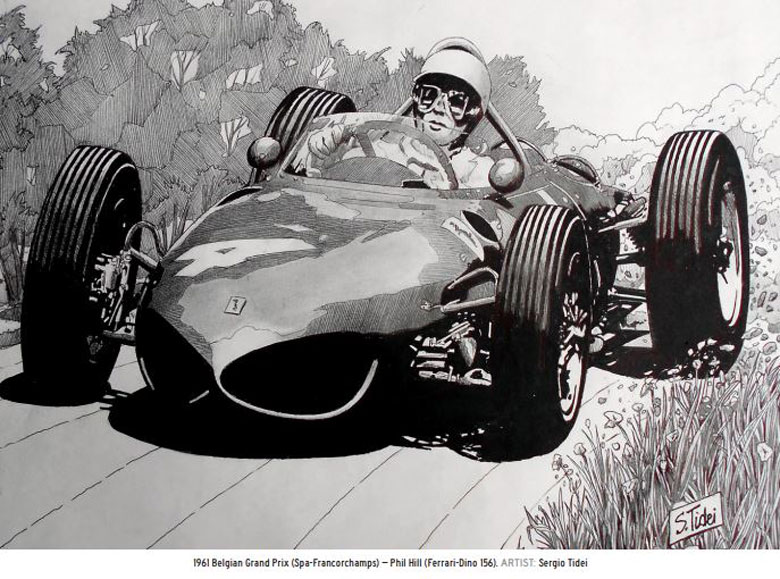
Hill at Spa, 1961.
Berryman did so anyway and since we are currently running features on Mario Andretti and Phil Hill, we asked Berryman to tell us who the better driver was, given his mathematical QPRS:
Andretti would come out ahead as the stats in the book demonstrate. The ‘math’ for each driver’s career-long QPRS rating (actual head to head competition against contemporary drivers) would be calculated in the same manner as the Jean Alesi example provided in The Rating Game feature while the All-Time comparison standings would also take into account the competitiveness factor of the respective years during which they each raced. Here too, Andretti would have the advantage. This is not to detract from Phil Hill’s performance. Both Andretti and Phil Hill were legendary drivers in a wide category of motor sports (unlike with many of today’s F1 champs). They won across various series – F1, sports/prototype, etc. Mario was already a USAC/Indy legend when he tackled F1 seriously and Hill raced (and won) wherever Enzo Ferrari would send his drivers – F1, Le Mans, Targa Florio or Mille Miglia. My book, however, rates them strictly on their respective records in F1 Grand Prix racing. They both drove the best car in the field during their respective F1 World Championship years.
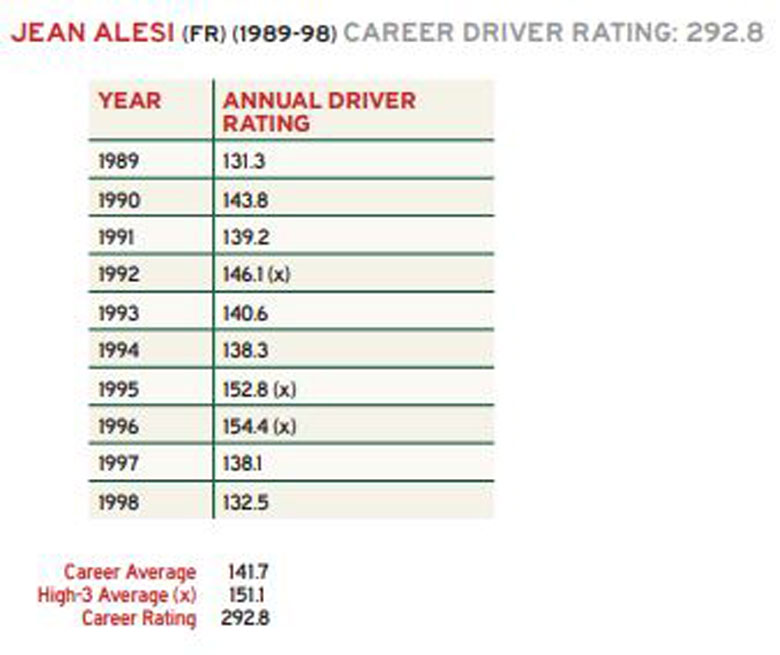
The Jean Alesi table, see above paragraph.
On the QPRS Top 100 chart, Hill ranked in number 53 position with a QPRS rating of 289.3. Mario came in at number 38, with a ranking of 298.4. But Clyde has promised us a deeper look at how QPRS ranks a wider number of American drivers who have participated in F1 in a future column…and there may be some surprises! At the same time, not satisfied with this massive 540-plus page tome on the F1 (post-1950) era, he is currently doing research on the pre-F1 period of Grand Prix racing (1906-1949) for a possible companion volume he hopes to publish at a later date.
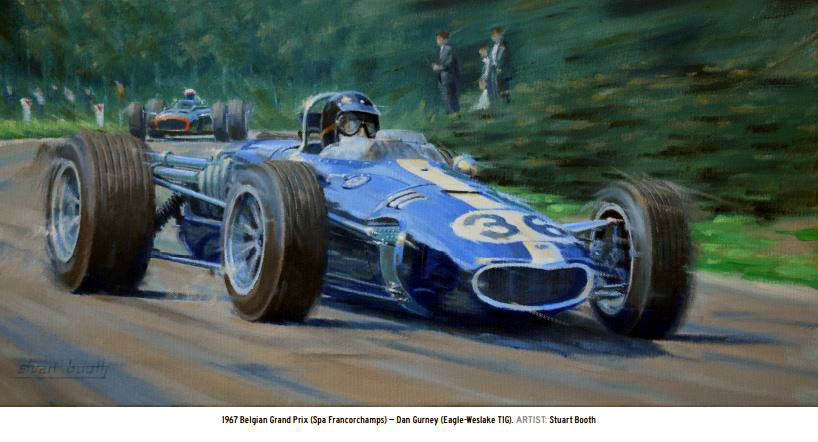
Let us not forget Daniel Sexton Gurney, shall we. But how does he fare on the Top 100?
So, let the QPRS ratings game begin! But buy the book first!
Quality Point Rating System (QPRS): F1 Grand Prix Racing by the Numbers (1950-2019)
By Clyde P. Berryman
Dalton Watson Fine Books, 2021
ISBN 978-1-85443-315-2
Hard cover with dust jacket
286 x 229mm (landscape)
544 pages
More than 232 original art and 77 illustrated track maps
Our Price: $95.00
Shipping Costs: FREE SHIPPING TO USA AND UK. Shipping to all other countries will be charged one flat rate for first item, additional books in the same order are shipped for no additional s/h charge.