From the VeloceToday Archives, April, 2011
By Pete Vack
In Part I we described how Savonuzzi created the 202 Cisitalia, a new DOHC engine to power a new line of Cisitalia, designed a record-breaking motorboat and more. But his career had hardly begun. Part II takes him from Ghia to the exciting work with Chrysler Turbines to Fiat and retirement.
Going to Ghia
In 1953 Giovanni Savonuzzi went on to Ghia, which at the time was a hotbed of activity and anonymity. Chrysler was there; Boano had left and a series of freelancers were hired, including Michelotti and Frua. Everyone was doing something and individual accomplishments were somehow left behind, even Chrysler’s Virgil Exner’s. It wasn’t until David Burgess-Wise was doing research for his book on Ghia in the 1980s that it became clear that the famous Ghia Chryslers, in particular the gorgeous K models, were in fact Chrysler designs, handed to Ghia for their translation into metal. 1 It was, perhaps, the kind of environment Savonuzzi enjoyed, but it was not the place to polish his star. Ironically, he became more famous for his work at Ghia than for anything else, before or since.
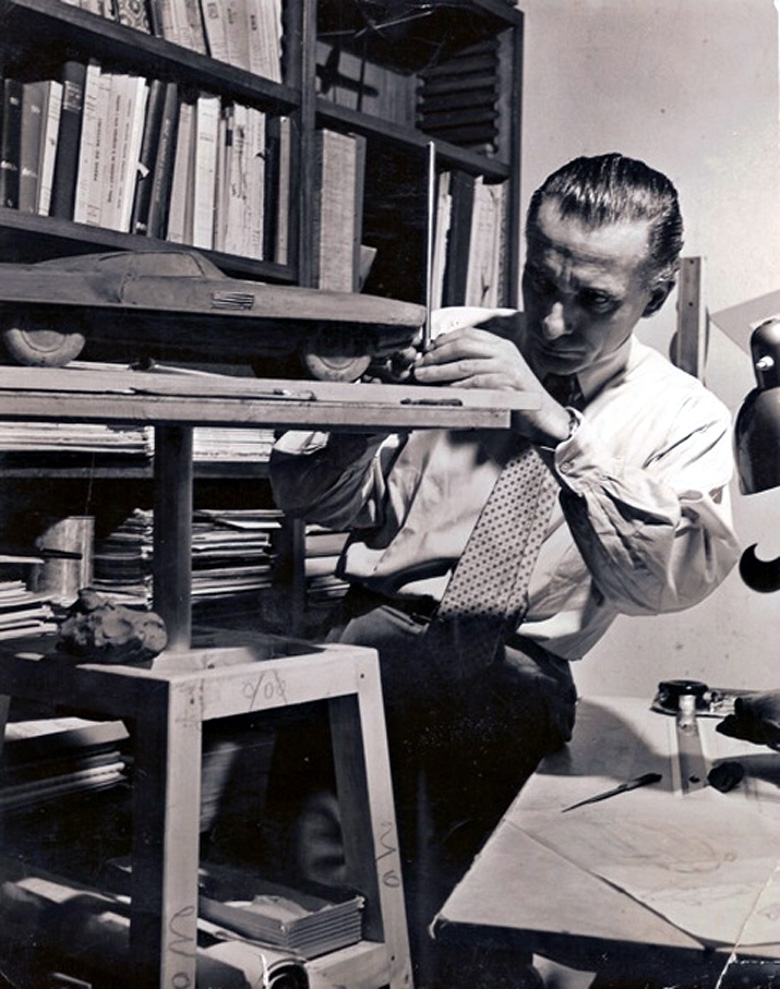
At Ghia, Savonuzzi worked with the small windtunnel at the Turin Polytecnico.
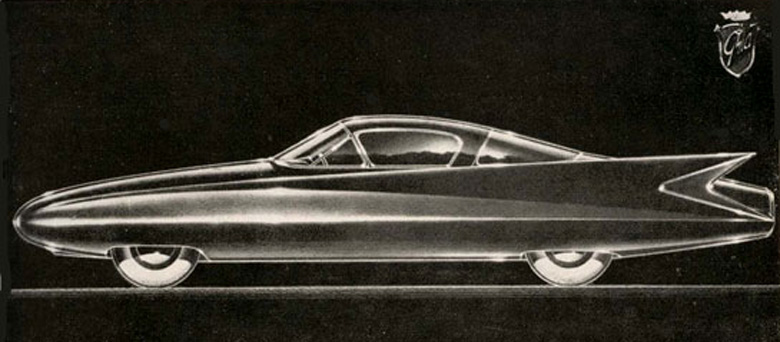
We can definitely attribute to Savonuzzi his work on the Ghia Alfa and Fiat series, as mentioned above, and Gilda. His title was “Technical Director and Product Planning and development of body styling.” He was making use of the wind tunnel at the Politecnico of Turin to create finned wonders, following through on his original concept of finned rear fenders first seen on the Cisitalia coupe. Former Ghia designer Filippo Sapino noted that “Savonuzzi’s [work] shows the origins of the aircraft maker. It can be said that Eng. Savonuzzi was the inventor of the fins, certainly [as applied to the automobile]…with the Gilda [Savonuzzi] anticipated all the competition.” Furthermore, according to Sapino, it inspired Mercedes Benz stylist Bruno Sacco, who was a young apprentice at Ghia for a short time. “When Mercedes introduced a car with tail fins, I thought perhaps Sacco was expressing his passion for the Gilda.” 2
Pioneering efforts in the wind tunnel
Savonuzzi’s aerodynamic studies proved a bit ironic. His work influenced Detroit’s stylists, but they would go overboard with the fins motif and be soundly thrashed for poor design by the very people who put the Savonuzzi-designed Cisitalia 202 on a pedestal. For years the Ferrari 375 America, SN, known as “Super Gilda”, was criticized by Ferrari enthusiasts and later Ferrari historians for the use of exuberant fins. Yet the design was a logical development of Savonuzzi’s years of work in the wind tunnel, his experiments with Gilda, and the record breaking Nibbio II designed for Count Lurani.
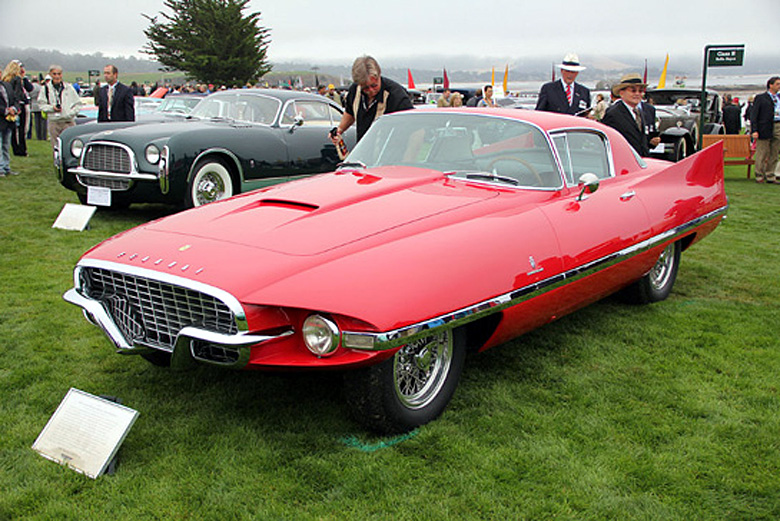
This 1956 Ferrari 410 Super America, serial number 0473SA was not for Chrysler and was influenced only by the wind. Photo by Hugues Vanhoolandt
Savonuzzi’s work in the wind tunnel was reflected in other Ghia designs, including the Adventurer II and the Chrysler Dart. It is difficult to say for certain how much influence Savonuzzi had on other Ghia projects, which was not unusual for the era. As the participants in the 2001 Ghia conference agreed, the coachbuilding firms such as Bertone and Ghia were not eager to make stars of their designers. It was not until the era of Giorgetto Giugiaro in the 1960s that the individual designers stepped out from behind the drafting tables.
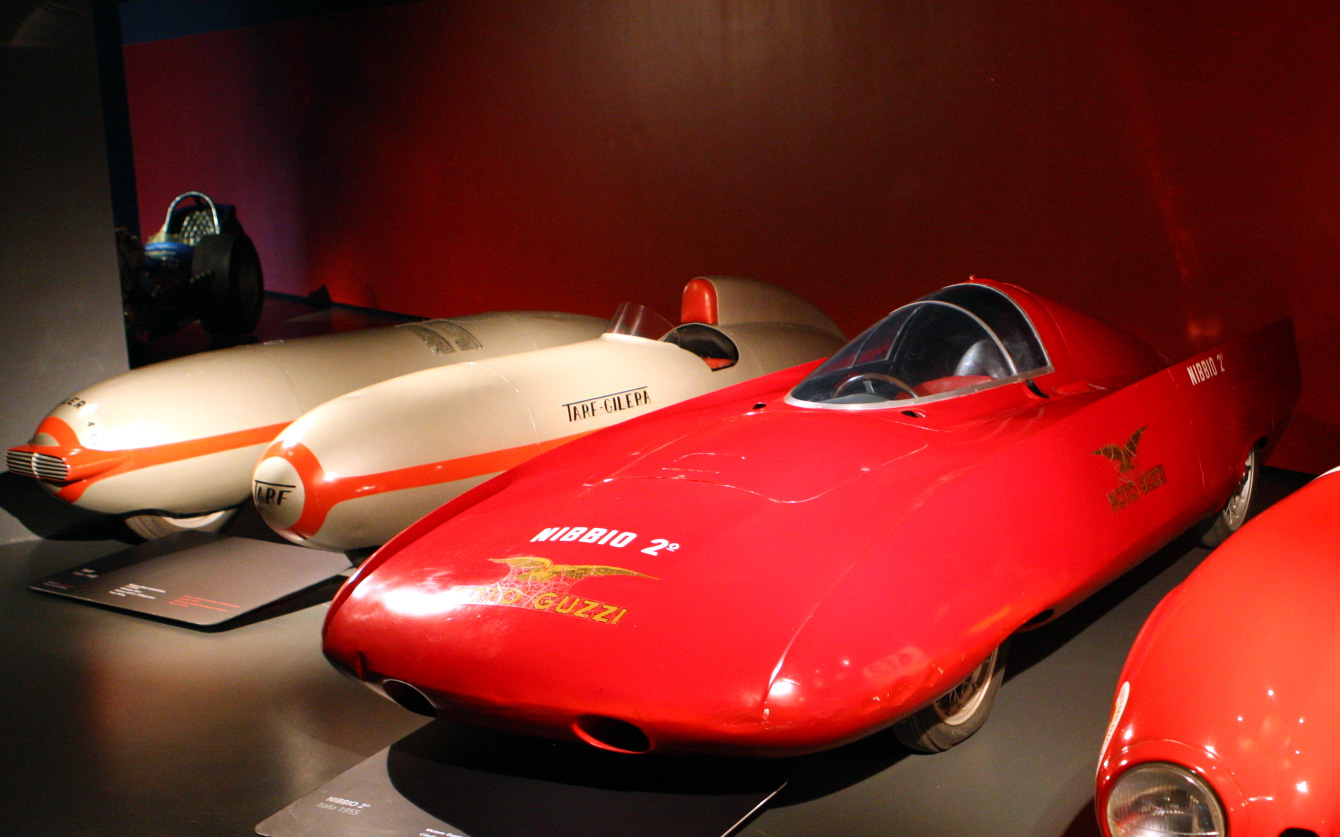
The record-breaking Nibbio II designed for Count Lurani. Jonathan Sharp photo
Gilda, the star of the 1955 Turin show, was so dramatic that it transcended the normal anonymity and demanded that the designer be known. Gilda jetted Savonuzzi to fame, to Chrysler, and to notable posterity.
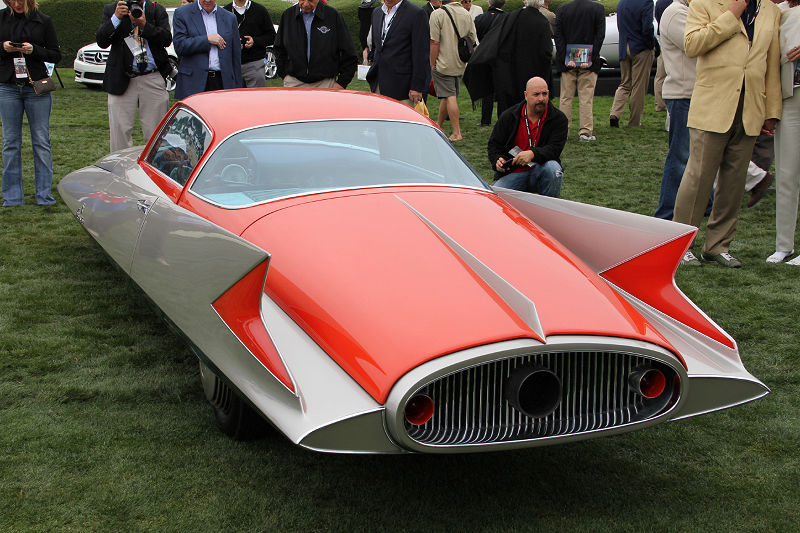
Gilda made Savonuzzi famous. Hugues Vanhoolandt photo
But years later it was clear that Savonuzzi thought his major accomplishments were with the Turbine at Chrysler. It surprised and delighted him that interest began to develop around his ‘classic’ cars with the work on Cisitalia and Ghia. But he always felt that his years at Chrysler trumped all.
Reaching for the stars
In the mid 1950s, Chrysler had a large department dedicated to defense and space contracts. After spending many years in the aero division at Fiat, it was the chance to work on the space program that attracted Savonuzzi to Chrysler. Ghia was crawling with Chrysler execs at the time, and Savonuzzi recalled that “One day I asked one of the Chrysler executives if there was the possibility to get into the ‘space’ department. He said he was not sure but anyway offered me a job in Chrysler.” 3 In 1957, at the peak of his career, an Italian to the core, Savonuzzi began his ‘American adventure’ and went to work as an Assistant Chief Engineer in the growing and interesting Automotive Turbine Department.
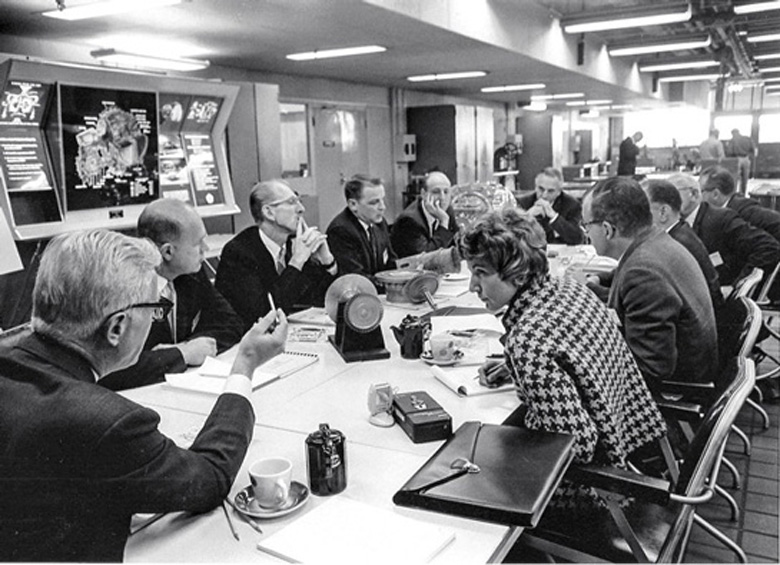
At Chrysler, Huebner, left, holds court. Savonuzzi sits at the far end of the table.
There is much to be said about Chrysler’s George Huebner; the problem was that he made sure of that. To his credit, he virtually created the Chrysler Turbine program and made it happen. Although he was an engineer and scientist, Huebner’s job was to obtain funding (usually from other departments at Chrysler) and promote and manage the project (at this he was good, very good). Huebner’s efforts nearly succeeded; in the end, the turbine driven automobile was defeated by cost and the new emission controls that came into effect just as the turbine was almost salesworthy. But according to Budd Mann, an engineer who worked with Huebner, “… [Huebner] made this project his whole career, perhaps even to the detriment of others, who should have received a bigger share of the research pie.” 4 Huebner’s ability to make himself a legend was well known. With expensive suits and over six foot in height, Huebner was easy to spot in the many PR photos taken during the era. In an environment noted for lack of humility, even his co-workers noted that Huebner didn’t lack for ego. Others thought Huebner acted almost as if he were royalty. Many worked, few were credited. After a few years, Huebner’s domineering, winner-take-all, grab-the-headlines personality took its toll, even on the quiet and unassuming Savonuzzi. Despite his shyness, he knew he was responsible for a great deal and naturally wanted to be noticed in the New World for his efforts.
The Ghia Chrysler Turbine
Savonuzzi devoted eleven years to Chrysler, beginning with his appointment as Assistant Chief Engineer, Gas Turbine Research in 1957, to his departure in 1969. There are over 30 patents filed in Savonuzzi’s name, most from his years at Chrysler and his continued work on Turbine research at Fiat, a clear indication that Savonuzzi’s time at Chrysler was well spent. It was so well spent that in August of 1962, shortly after the death of David M. Borden, Huebner promoted Savonuzzi to Chief Engineer, Automotive Research, heading seven departments including Gas Turbines, Diesels, Chassis, Suspension, and Brakes, Experimental Mechanical Design, Mechanical Laboratories. He was in charge of “three head engineers, forty engineers and about two hundred people between technicians and mechanics.” 5
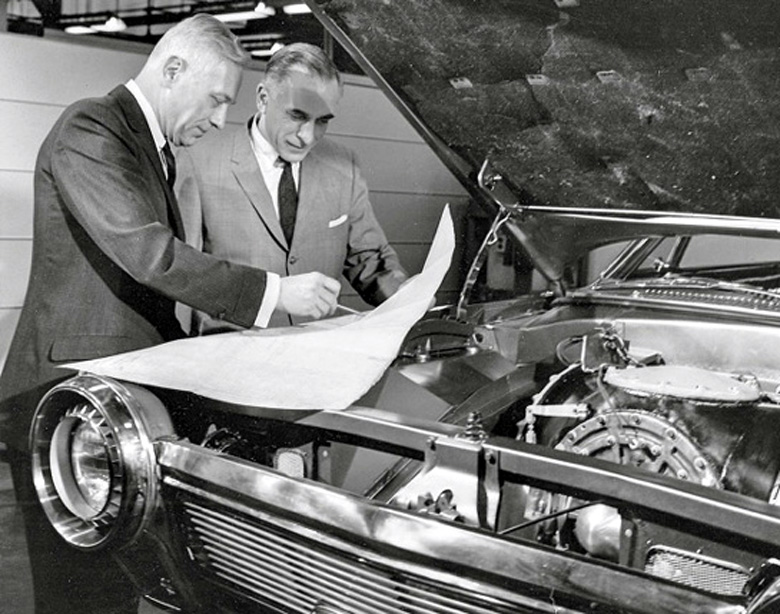
Huebner, left, poses for a PR photo, while Savonuzzi quietly listens, holding his words.
By the early 1960s Chrysler was ramping up for the production of the fifty-odd Ghia prototypes that would be tested by selected individuals across the U.S. Savonuzzi’s contacts with Ghia, his technical and design knowledge were invaluable and great progress was made. Ghia actually constructed all of the Turbine test cars, and although the attractive body was credited to Elwood Engel, Ghia “was given great latitude in cleaning up Engel’s drawings,” according to Steve Lehto. We don’t know if Savonuzzi had a hand in the design, but several key elements are very familiar.
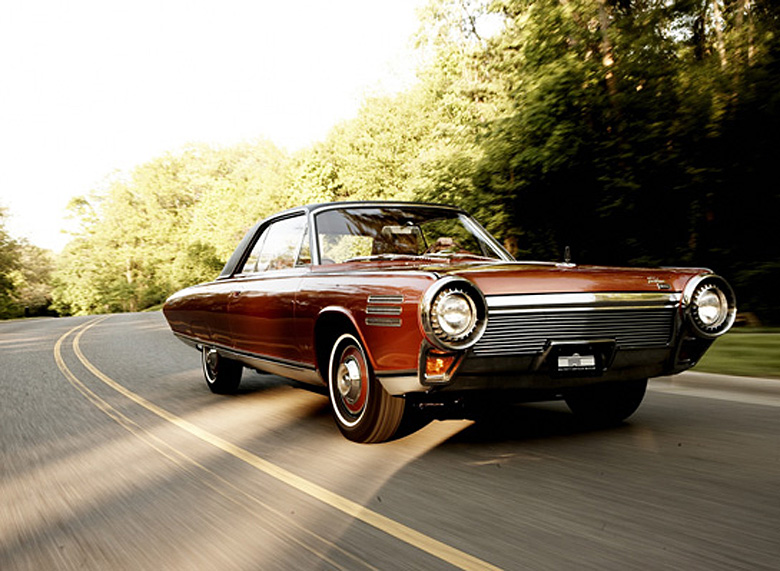
The Chrysler Turbine was built at Ghia from sketches by Elwood Engel. But Ghia refined the design.
The test prototypes were handed to eager families with a great deal of publicity. Huebner was on top of his game, but his chief engineer was already fed up. Savonuzzi wanted out, having had enough of Huebner’s grandstanding. In May of 1963, Mario Boano wrote to Savonuzzi, offering him a chance to manage Ghia after the death of Luigi Segre, who was Ghia’s guiding light for so many years. But Savonuzzi could not accept, and he related to Boano the story of how he had been dealing to return to Fiat, negotiating with his old friend Dante Giacosa, when just as he was ready to leave he found himself “…unable to leave Chrysler and the whole affair was an embarrassment.”
And in 1963, he again found himself in a similar situation: Chrysler had made him an offer he could not now refuse. Savonuzzi made it clear to Huebner that he wanted to leave due to the fact he was not given any recognition for the work he was doing. Huebner, in response, simply told Savonuzzi that if he left he would cut his pension and benefits to zero.
A return to Fiat
Deeply dissatisfied, Savonuzzi nonetheless continued his work on the Chrysler Ghia Turbines. He was often seen driving a white prototype (dressed for use in the movie “The Lively Set”) around Franklin, Michigan. But exactly what he did during those years remains a mystery. There is good reason to believe that after Savonuzzi finally returned to Fiat in 1969, Huebner methodically destroyed all evidence of Savonuzzi’s work, effectively erasing him from the history of the Chrysler Turbine. Archivists at Chrysler have been unable to find a trace of Giovanni Savonuzzi.
In 1969 Savonuzzi turned to Giovanni Agnelli at Fiat, who gave him the position of Director of Research and Development, and more important, made up for the pensions and benefits Savonuzzi was sure to lose from his departure from Chrysler. Savonuzzi finally departed and, true to his threat, Huebner reduced his monthly pension to a mere $27.00 per month.
At Fiat, Savonuzzi worked on alternate forms of automotive propulsion, including electric cars. But he had already come to the conclusion that for the foreseeable future the most viable method to conserve energy would be with met with an internal combustion engine car built with high standards of efficiency, a fact still valid today.
Savonuzzi at home with one of the Turbines ready for the movie ‘The Lively Set’. Savonuzzi is pointing to the car as if to say, this is ‘my’ design.
“Is it any wonder,” says his daughter Alberta, “that my father kept a boat in the South of France, and would sail straight out to the horizon on a regular basis. I always begged to go with him because it was the only time he would open up and talk. But you had to be really far out with no land in sight….”
Giovanni Savonuzzi retired from Fiat in 1977 but continued to work as a consultant to Fiat and other organizations until his death in Turin on February 18, 1987, at the age of 77.
Notes
1 Ghia, Ford’s Carrozzerria, David Burgess Wise, Osprey, 1985
2 Conference: Carrozzeria Ghia, Turin, March, 2001
3 Interview with Giovanni Savonuzzi, Piero Casucci, Grandi Automobili 1985.
4 Quoted in Chrysler’s Turbine Cars, Lehto, Chicago Review Press, 2010
5 Letter to Mario Boano from Giovanni Savonuzzi, dated June 4 1963
Our thanks to Alberta Savonuzzi, for her help and materials which made this article possible.