Story and photos by Jonathan Sharp
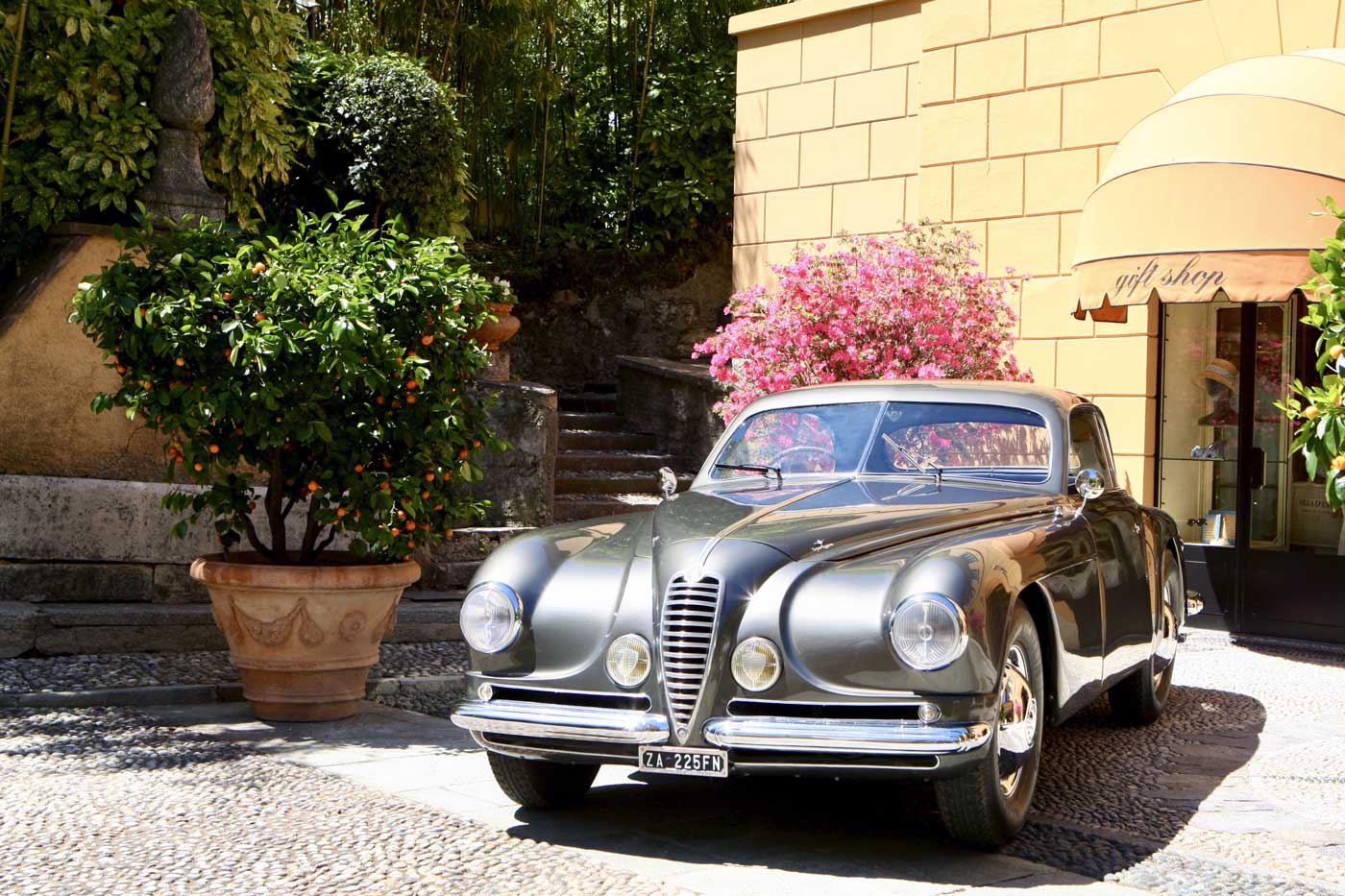
May 21-23 2026. It was the light that first struck me, My wife and I had arrived in Como the day before and it was hissing down but Saturday morning dawned bright and sunny and not too hot. Hotel Villa d’Este lies slap-bang on the shores of Lake Como about 2km from Cernobbio, and at the time I arrived all was quiet and serene with the sun glinting off the lake and the concours entrants parked mainly in the dappled shade of the trees. The Riva boats were bobbing gently in the hotel’s small marina, and parking an Alfa Romeo 2500 SS ‘Villa d’Este’ outside of the hotel’s gift shop…very classy. It was going to be a very good day.
An interesting set of classes again this year covering everything from pre-war to brand new concept cars but I will let the following photos tell the story of a great event and I apologize because there is a lot to look at!
Class A

On public display for the first time in 103 years, Marco Gastaldi’s 1923 S.P.A (Societa Piemontese Automobili) Tipo 23. S.P.A was founded in Turin in 1906 by Matteo Ceirano and Michele Ansaldi and prior to WW1 was know for producing technically advanced automobiles, racing cars and aircraft engines. Following the start of the war the company switched focus to producing military trucks and aero engines, becoming a major industrial concern. Once the war was over S.P.A tried to regain a strong foothold in the automobile market with various new models but the Tipo 23, built between 1923 and 1925, was to become one of the company’s final passenger car models.

In 1926 the company came under the control of FIAT due to financial difficulties, car construction was halted and the company once again concentrated on trucks and military vehicles. In 1947 S.P.A was fully integrated into Fiat and the name was discontinued. The Tipo 23 was powered by a 2.7 litre four cylinder engine producing around 70 hp driving through a four speed transmission via a prop shaft to the rear wheels. This example was ordered in 1923 by Turin based hauler Signore Pietro Vigo with coachwork by Carrozzeria Garavini and remained in family ownership until 2024. The Tipo 23 is totally original, the only parts replaced have been parts subjected to wear and is the only known survivor.

From the Oldie Box Collection. 1926 Rolls Royce New Phantom 1. Ordered in July 1926 by Major Ramsay Hill, this Long wheelbase Barker & Co Enclosed Drive Cabriolet, as favored by the then Prince of Wales, was specified to the highest standard to include fittings made from birds-eye maple, a folding armrest for the front seat, a second toolbox located under the nearside step, loose down stuffed pillows, Cavalry Twill upholstery, Stephen Grebel Headlights, a CAV spotlight, brightly polished shutters for the radiator, and a Roi-des-Belges snake head horn. Delivered to the Major at the Cavalry Club in Piccadilly in October of that year, the coachwork is fully convertible and allows for three configurations: open chauffeur’s compartment and enclosed rear, fully closed, or fully open. The rear compartment is fitted with fold-away occasional seats, a cocktail cabinet and trinket tray, and a retractable partition.

The Audrain Collections 1927 Mercedes Benz 630K. Listed as the only known example fitted with a lightweight Sport Touring drophead body by British Coachbuilder Thomas Harrington Ltd. Factory records indicate that the chassis was delivered to British Mercedes Benz on the 13th April 1927 then dispatched to Thomas Harrington Ltd in Brighton to be fitted with the elegant and sporty coachwork it still wears today. Unfortunately the first owner’s name has been lost to the mists of time.

From the Singleton Collection, 1930 Cadillac V16 Roadster by Fleetwood. This Series 452 V16 Roadster was delivered to its first owner, Floyd Becker from Roseland, New Jersey, on the 16th May 1930. Becker had specified the vehicle with a myriad of optional features including body colored 20 inch-wooden spoked artillery wheels, a rack for rear mount spare wheels, modified seat upholstery and special map pockets in the doors. Finished in Cannon Smoke shade with a double trim line in Aztec Red the purchase price came out at an outstanding $5896.40, slap bang in the middle of the great depression. Later the Cadillac was to pass through the collections of Briggs Cunningham and Miles Collier.

Hans Jorg Hubner’s 1931 Delage D8 was supplied new in right hand drive form via the London Smith and is fitted with a very restrained four seater convertible body by Chapron.

Peter Reynolds’ 1934 Rolls Royce Phantom II was constructed in the ‘short Continental Chassis’ form tuned specially for sporty driving, finished at the Derby factory in April 1934 and then shipped to Gurney Nutting to be fitted with a “Sedanca Coupe” body as designed by A.F. McNeill. Finished in black, the completed Sedanca was delivered via HR Owen to H.C.O Garnett, an officer in the Royal Horse Guards in Windsor.
Class B

The Auriga Collections 1937 Mercedes Benz 54OK Special Coupe by Sindelfingen was delivered to a Mr Rayzberg in Switzerland who retained the car until after WW2.

Judged best in show, Stefano Martinoli’s BMW 328 Bugelfalte is to my mind simply stunning. Built in 1937, chassis 85032 was a works entry at Le Mans and the Tourist Trophy amongst numerous other international events. In the autumn of 1939 the car was disassembled by the racing department and reassembled for the 1940 Mille Miglia with an open streamlined body. The unusual Bugelfalte (trouser crease) edging atop the front wings was the work of Wilhelm Kaiser of the styling department and earned the roadster its nickname. The brakes and gearbox were updated and the power output raised to 130 bhp. With the chassis weight reduced to just 725 kilograms it became a much more rapid machine. For the 1940 Mille Miglia five BMW 328s lined up at the start, two coupes and three roadsters.

Car 71 the “Bugelfalte” finished sixth whilst the Touring bodied Coupe 328 took victory. Following the end of WW2, 85032 ended up in Moscow under post war reparations ending up in the hands of Artem Ivanovich Mikoyan of MIG jet fighter fame. In 1972 Mikoyan’s son swapped the car for a brand new Lada. Never fully restored, instead it has been meticulously preserved as an eye witness to European motor sport history.

Thomas Maoli’s 1935 Duesenberg Model J Dual Cowl Phaeton by LaGrande, chassis 2558, is one of only 15 examples, out of a total of 481 model J’s, of a small series of factory bodied examples developed extensively by Gordon Buehrig from the LeBaron designed Sweep Panel Phaeton to achieve smoother cleaner lines whilst still retaining the characteristic layout of the car’s flanks. Originally used as a demonstrator at the company’s New York factory for over a year before being sold on the 28th October 1936 to the 26 year old Hugh Bancroft Jr.

Entered by Martin Gruss. In 1935 young Belgian banker and Bentley enthusiast Claude Lang commissioned the coachbuilding company Vesters & Neirinck to construct a unique body for his 3.5 liter Bentley chassis B114DG. Requesting an elegant fixed head coupe with a low roof, sleek lines and clear Art Deco influence, Lang was very involved in the body’s design and construction. The chassis was supplied by Etablissements Andre Pisart, the official Bentley dealer for Belgium and then bodied at Vesters & Neirinck. Of the eleven custom bodies that Vesters & Neirinck built on Derby Bentley chassis the two considered the most elegant were commissioned by Claude Lang.

Jason Schneck’s 1936 Auburn 852 Supercharged is unusual in that, rather than being fitted with the Gordon Buehrig designed factory steel body, was supplied as a chassis, plus bonnet, radiator grill and fenders to Monsieur Sadovich, proprietor of the Auburn Cord Duesenberg showroom in Paris, who commissioned Parisian coachbuilder Jean-Henri Labourdette to clothe the chassis in a semi fastback design that was deliberately free of excessive ornamentation, the resulting body representing an unusual combination of American engineering and European coachbuilding. The car remained in France until 1967 when it returned to the USA where, possibly, it may have once been owned by the actor and entertainer Maurice Chevalier!

Thomas Price’s 1939 Bugatti 57C chassis 57798 was ordered in the autumn of 1938 by Dr Andre Chauvenent, a long-standing Bugatti customer, via the Bugatti dealer J.B Arnaud. It was fitted with a custom Aravis body from Ganglof. Correspondence between Ganglof and Arnaud shows the design to be derived from design drawing 3888 (8th August 1938) and design drawing 3942 (25th November 1938) plus the addition of various smaller items including headlight grills. Delivered in January 1939, Chauvenet played a major role in the French resistance during the occupation but both he and his Bugatti survived the war. In 1946 the Aravis was sold to an owner in Switzerland where it remained until the 1980s when it was exported to the USA.

HMG van der Anker’s 1928 Bugatti Type 37 is one of the final eight examples constructed and as such featured the larger brakes of the Type 44. The car was ordered by Charles Faroux, a close friend of Ettore, editor-in-chief of the magazine La Vie Automobile and co-founder of the 24 Hours of Le Mans. Shortly after purchasing the car he sold it to Parisian post impressionist artist Rene Durey who kept the car for nearly three decades until his death in 1959. In the late 1960s the car passed into the ownership of French nobleman Jean de Mortemart before being sold at auction in Paris in 1972 where it was purchased by the grandson of French aviation pioneer Louis Bleriot.
Class C

Corrado Lopresto’s 1947 Isotta Fraschini 8C Monterosa. Chassis No 5 was the last prototype built and wears a unique two door coupe body by Carrozzeria Touring. The 8C Monterosa was created as a technical and stylistic basis for a possible production model. Forgoing the usual front engine rear drive format the 8C featured a rear mounted V8 engine designed by Aurelio Lampredi during his one year stint with the company. The chassis was the work of engineer Fabio Rapi. With an output of 115 bhp the 8C had a top speed of 106 mph. The Touring Coupe was first shown at the 1947 Paris Motor Show, then at the Milan show later in the year, and the Geneva show in 1948. In 2017 chassis 05 was completely restored and then presented at Pebble Beach.

Robert Bishop’s 1953 Pegaso Z-102 Touring, one of six similar examples clothed by Touring. First presented at various concours events such as the 1954 San Remo Concours d’Elegance before being sold to Spanish industrialist and racing driver Jose Maria Caralt. Originally fitted with the 2.8 liter V8 engine, shortly after Caralt started to race the Pegaso the larger 3.2 litre V8 engine was fitted.

Alain Lecocq’s 1955 Alfa Romeo 1900 C is one of approximately 40 examples of the most competition focused model produced, namely the SSZ by Zagato. The SSZ had a slightly larger capacity four cylinder engine with a higher compression ratio, sharper cam profiles with larger valves and Weber carbs. The bodywork was constructed of extremely light aluminum with plastic side windows to reduce weight even further. This example was delivered new to Madrid in February 1956 and in May 1956 finished second at a race at an airfield in Madrid. The current owner found the car in a scrap yard in 1976 and had the car restored in 2023-24.

Don Ghareeb’s 1957 Cadillac Eldorado Brougham when new cost $13500, far more than any other Cadillac and even more expensive than a Rolls Royce Silver Cloud. The Eldorado Brougham was a stand alone model complete with its own Fleetwood coachwork. Each example was hand built with particular attention being paid to the interior and its fittings which included stainless steel drinks tumblers that were held in place magnetically, a built in vanity case containing perfume, powder puff, lipstick and comb, a cigarette case, tissue dispenser, and leather bound note pad with matching pencil. The car ran on air ride suspension, had power windows, electric door locks, electric seats with memory function, air conditioning, and an auto release parking brake. In total 704 examples were constructed of which this example is number 221.

Mark Hoplamazian’s 1959 Lancia Flaminia Sport is an early series car with covered headlights which was completed on the 23rd June 1959 finished in Lancia Blue with Lancia Pelle Blu interior.

James Jones’ 1953 Mercedes Benz 300B Cabriolet D is a very rare example of what was considered one of the most exclusive open top ceremonial saloons of the 1950s. The D version of the 300 produced from 1954 was also known as the Adenauer named after the first Chancellor of the Federal Republic of Germany. Unlike the Cabriolet A and Cabriolet B which had two doors, the Cabriolet C and Cabriolet D had four doors and was designed to carry state officials and dignitaries. Only 87 examples were constructed in the first year of production with this example being delivered to a doctor based in Frankfurt am Main.

Entered by John Stafford III, this 1958 BMW 507 was ordered by Oscar Liebmann via US importer Max Hoffman complete with Fish Silver paintwork, a pearlescent paint finish that used guanine as an additive that was only specified on two cars. Other equipment included a hardtop, Rudge knock off wheels, a Becker Mexico radio, and sharper cam profiles. Liebman, a native German, was an avid BMW fan and had founded the AMOL Precision business in New Jersey and in 1950 became the first official BMW motorcycle dealer in the USA. Liebman and his wife decided to travel to Germany for the hand over of the 507 which took place on the 21st April 1958 at the premises of BMW dealer and motor cycle legend Georg Meier in the Bavarian town of Starnberg. He then drove to his old home town of Jena and through the Alps before having the 507 shipped to the USA.

Nancy and Ron Rosner’s 1960 Ferrari 400 Superamerica SWB chassis 1945 SA is one of 25 examples built of the model in short wheel base form (2.42 m rather than the 2.6 m of the LWB) and is the third of a total of seven short wheel base Cabriolets built. The first owner was Mr Helmut Horten, a German businessman living in Switzerland. In January 1961 the car was registered in Milan under Horten Italiana S.r.l. and remained in Italy until 1964 when it was exported to Germany and then later to the USA before returning once again to European shores in 2015.
Class D

Laurentiu Stratulat’s 1965 Ghia G230S was the first Spider prototype (out of a total of four prototypes, two coupes and two Spiders) and is the sole surviving Spider prototype. First shown at the 1965 Turin Motor Show, the Ghia G230S was the result of Ghia, seeking a new vision for its future, teaming up with American entrepreneur Burt Sugarman to build an exclusive grand tourer with which Chrysler could test the market. Originally the hand built coachwork was penned by Sergio Sartorelli, then subsequently refined by a young Giorgetto Giugiaro. A purpose-built monocoque was attached to a lightweight tubular chassis developed by Gilberto Colombo and the running gear was made up using Fiat components and an Abarth tuned 2.3 liter six cylinder motor producing 150 bhp. Following the unveiling at Turin the car was shown again at San Francisco and again at the 1966 Barcelona Motor show before disappearing from public view for several decades. The current custodian obtained the car, which has remained in remarkably original condition, in 2002.

Thierry Dehaeck’s oh so elegant 1969 4.7 liter Maserati Ghibli, originally supplied by Sport Auto Rome S.p.A to a Mr Matacena for the princely sum of 8 million lira, making it one of only 55 (out of a total 125 Spiders) destined for the European market.

Another car “up from Rome” Ronald Stern’s ex Gianni Agnelli Ferrari Testarossa Spider by Pininfarina.

Jorg Wolle’s 1988 Aston Martin V8 Vantage Volante is in what is known as ‘Prince of Wales’ specification, to mirror the example purchased by the then Prince of Wales, Prince Charles, namely the Vantage engine and chassis but without the more aggressive Vantage bodywork. This example, finished in Balmoral Green with beige trim, was later converted to left hand drive and fitted with the 7.0 Liter V8 conversion.


You had me at bugelfalte. What an amazing show!
on the 1965 Ghia G230S
the engine was a 6 cylinder, not four, elaborated by Abarth and sold in various other projects, the Allemano coupe & spiders, for example, and by Fiat itself in their Coupe (Y have no recollection of it being used in the regular Berlina (sedan)
On the Peron 212 Ferrari, I’m sure you know the it was at the Paris Salon and when bought by him, Enzo accepted the request and changed the paper work and metal card for that of an older and used model, so it could enter Argentina as a USED car (not a new one) and pay less taxes…
Another ‘detail’ on Juancito’s life
Wowzaa! There is nothing restrained about the hood ornament/radiator cap on the Delage. And I have to wonder if William Lyons hadn’t seen the BMW 328 Bugelfalte prior to designing the XK-120. A truly amazing show.
As an old Tatra fan, I was interested in the rear-engined Monterosa. It has its own Wikipedia page, unfortunately with only words and carrosserie. Looks as if the V8 was hung behind the rear wheels again, requiring heavy luggage in the nose