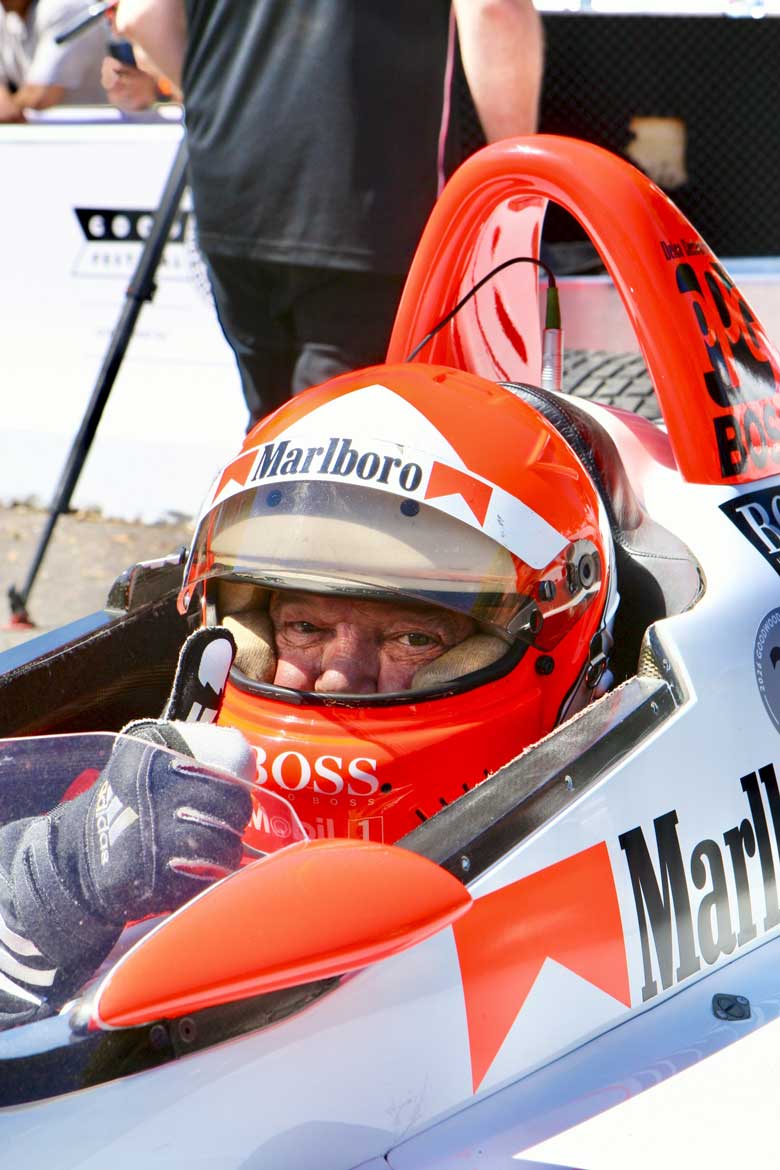
Al Unser Junior in the 1994 Penske Mercedes PC-23, ‘the pushrod car.’ Here he gives Sharp the thumbs up.
Story and photos by Jonathan Sharp
Jonathan Sharp has been reporting from Goodwood since 2012.
The final stop on my boiling hot July tour of the stately homes of England: Goodwood for the Festival of Speed. The theme for this year’s event, ‘Rivals-epic racing duels,’ produced a fantastic cross section of entries from steam cars to Hybrid F1 cars, with some excellent pairing of cars being demonstrated on the hill side by side: Ferrari 330 P3 / GT40, Alfa Romeo P3 / Bugatti Type 51, the Blitzen Benz and the Beast of Turin etc.
Talking of GT40s, the highlight for many had to be the sight of the 1st, 2nd and 3rd place GT40s from Le Mans in 1966 being driven together by the Andretti family with a staged line up in front of the house as per the famous photo finish at the original race. Throughout the weekend the vast crowds enjoyed various Goodwood balcony moments starting with Damon Hill, celebrating 30 years since his F1 World Championship, on the roof of Goodwood House doing a guitar solo which was pretty much drowned out by the daytime firework display going on beside him. The biggest balcony moment was without doubt when Lando Norris and Valentino Rossi were introduced to the crowd, Lando being a huge fan of Rossi. John McGuiness, the 23 times Isle of Man TT winner had his moment on the balcony on Friday, as did Gerhard Berger on Saturday.
On Sunday it was the final of the timed shoot out, and on the Cartier lawn it was concours time with the ‘Cartier Style et Luxe.’ The infield contained the FOS Future lab, which one day I may actually visit, various new road cars were having their first public viewing and to the right of the start line the Supercar Paddock, which contained loads of supercars, most of which looked the same to me; must be an age thing! So all in all lots to see and do.
So much in fact that to cover the whole event is going to take more than one issue so lets start with the first two classes, ‘The rivals-pioneer to playboys’ and ‘rivals Mulsanne to Molecomb’ and precede that with a few images of the drivers.

‘The Morecambe Missile’, John McGuinness, 23 time Isle of Man TT winner, 47 podiums and 118 race starts.

Sebastien Loeb, nine time World Rally Champion, prepares to take his 2013 875 BHP twin turbo V6 Peugeot 208 T16 Pikes Peak monster up the hill.
The rivals, pioneers to playboys

1898 Benz Velo, the first internal combustion engined car to be produced in volume. Behind is Duncan Pittaway’s 1893 Salvesen Steam Wagonette.

The Salvesen started life in Scotland three years before the Red Flag act was repealed. Duncan says performance is limited and slowing down, which involves putting steam into the opposite side of the piston, is ‘tolerably useless.’

1907 Mercedes 120HP, with 120HP at 1400 rpm this Mercedes was one of the fastest cars of its time. The Mercedes first appeared at the 480 mile French Grand Prix of 1907 held in Dieppe. In April 1908 Dario Resta recorded a half mile average speed of 95 mph.

From the Technik Museum Sinsheim, 1909 Benz 200HP ‘ Blitzen Benz.’ Built by Benz & Cie and related to the contemporary Grand Prix car, the Blitzen set records on both sides of the pond. In 1909, at Brooklands, Victor Hemery attained a speed of 126 mph for the flying kilometer, and at Daytona Beach, Bob Burman managed 141.7 mph over a mile.

1909 Christie V4, the last in the line of front wheel drive race cars built by John Wilkie Christie. Christie was a pioneer and amongst many of the car’s innovations was the V4 engine using separate cylinders attached to what was in essence a structural engine block. At the Indianapolis Speedway it hit a speed of 100 mph and at Daytona Beach in 1910 was timed at 111 mph.

William Metcalfe’s 1924 Bentley 3.0 litre Super Sports, not just demo’d but entered into the timed shoot out, clocking a time on Sunday of 72.86 seconds.

Julian Majzub’s well campaigned 1927 Bugatti Type 35B. Raced in period with victories including the Thomas Fotherington win in the Esher Lightning Long Handicap, and Kay Petre’s Ladies 124 mph lap record at Brooklands.

From the Louwman Museum, 1932 Maserati 8C 3000. The last racing car to be driven by Sir Henry ‘Tim’ Birkin. It was during the 1932 Tripoli Grand Prix that Birkin burnt his arm on the exhaust before the start of the race following which he contracted blood poisoning and died shortly after.

From the Brooklands Museum Trust, John Cobb’s 1933 Napier Railton, Brooklands Outer lap record holder at 143.4 mph, the fastest ever car to lap.

Lukas Huni’s Bugatti Type 51, chassis 51127 was driven by Benoit Falchetto to victory at the Circuit du Cap D’Antibes.

The Auriga Collections 1934 ex-Scuderia Ferrari Alfa Romeo P3 Tipo B. Later sold to British racer Charlie Martin, who drove it to victories at Brooklands and Donington in 1936.

Seen for the first time at the show, The Auto Union Lucca Rennlimousine recreation built by Crosthwaite and Gardner. In February 1935 Hans Stuck drove the original on a new stretch of Italian Autostrada near Lucca to 199 mph average over the flying mile.

Audi Tradition’s 1936 Auto Union Type C. Powered by a 550 bhp V16 and with a swing axle rear suspension, only the best could tame it. In 1936 Bernd Rosemeyer, in a Type C, won that year’s Grand Prix drivers title.

Mercedes Benz Classic’s 1937 W125. Built to the 750kg formula and powered by a circa 650 bhp straight eight, Rudolf Caracciola won three times to secure that year’s title and the team a 1-2-3-4 finish in the driver’s championship.

Audi Tradition’s 1938 Auto Union Type D. Built to comply with the new 3.0 litre engine formula, the Type D used a supercharged V12 and a De Dion rear axle in place of the earlier swing axle. This example is the car that Hans Stuck drove and, having survived the war, ended up behind the Iron Curtain before being extracted in the 1990s and restored by Crosthwaite & Gardiner.

Entered by McLaren Mastercard Formula 1 team, 1976 McLaren Cosworth M23, the chassis that James Hunt used to finish third in that year’s Japanese Grand Prix thus clinching the world title by one point from Lauda.
The Rivals, Mulsanne to Molecomb

From a private collection, 1966 Ferrari 330P3/412P chassis 0844 was originally constructed as a 330 P3, winning the Monza 1000km before competing against the GT40s at Le Mans that year. At the end of 1966 the chassis was converted to 412P spec before finishing third at the 24 Hours of Daytona driven by Pedro Rodriguez and Jean Guichet in February 1967.

1966 Ford GT40 chassis P/1046, the winner, in the hands of Bruce McLaren and Chris Amon, of the 1966 Le Mans 24 hours.

From the Sytner Automotive Collection, 1970 Porsche 917LH chassis 043, which finished second at the 1970 Le Mans driven by Gerard Larrousse and Willi Kauhsen.

The Macaluso Foundation 1980 Lancia Beta Monte Carlo Turbo. This chassis debuted at the Mugello 6 Hours taking victory in the hands of Riccardo Patrese and Eddie Cheever, leading a Lancia 1-2.

Rivals. 1988 Porsche 962 which, driven by Hans Stuck, Derek Bell and Klaus Ludwig, finished second at the year’s Le Mans behind this, the winning Jaguar XJR9 of Jan Lammers, Johnny Dumfries and Andy Wallace.

Alexander Sebold’s 1983 Fitzpatrick Racing customer Porsche 956 which finished fifth at that year’s Le Mans.

From Mercedes Benz Classic, 1990 Mercedes Benz C11. Whilst Jaguar won the 1990 Le Mans with the XJR12 it was Mercedes Benz with the C9 and C11 which won the World Sportscar Championship. This C11 first appeared later in the season in the hands of Jochen Mass and Karl Wendlinger, primarily as a spare car before appearing again at the 1991 Le Mans.

BMW Group Classic’s 1997 McLaren F1 GTR ‘Long Tail’ chassis 26R, third place finisher at that year’s Le Man.

Mercedes Benz Classics’ ex-Klaus Ludwig/Ricardo Zonta 1998 CLK GTR, a model with dominated International GT racing in the late 1990s.


Leave a Reply