
Vaca Valley, May 1960. Bob Drake in the Lubin Birdcage battling Sammy Weiss in the former Jack Brabham Cooper Monaco. They finished 1-2 in this Cal Club event. (photo: Willem Oosthoek Collection)
Story by Willem Oosthoek
From the VeloceToday Archives, February 2020
In a previous three-part article, we focused on Joe Lubin of Beverly Hills, original owner of chassis 2452, the very first Tipo 61 Birdcage Maserati built in 1959. But the car’s history is much longer, since it was successfully raced in period under three subsequent owners.
Chassis 2452 took the start in an astonishing 50-plus races (including preliminaries) from December 1959 into early 1963, winning overall victories in a good number of them. This happened during a time when last year’s sports racer was often an also ran, so this Birdcage must have been something special. Only two Italian-owned 2-liter Tipo 60s (chassis 2460 and 2465) had a longer competition history, no doubt helped by the proximity of the Maserati factory when it became time for repairs and parts. Things were not that easy for a Birdcage located on the West Coast, a model that developed a reputation for breaking its stressed chassis tubes and for cracking its exhaust system due to a heavily vibrating 4-cylinder, 2.9-liter engine. So, let’s have a look at the people responsible for the success story of chassis 2452.
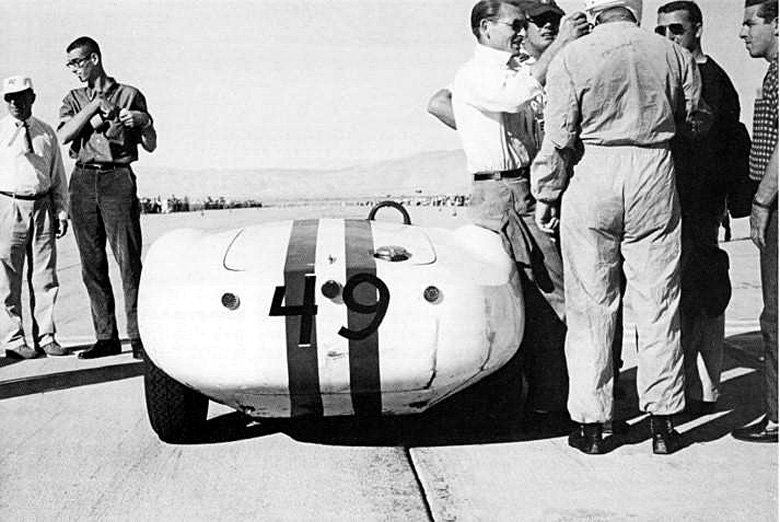
Palm Springs, January 1960. Stan Sugarman, future owner of chassis 2452, helps Bob Drake fasten his helmet. The event would be the Maserati’s first feature victory (photo: Bill Motta)
After Bob Drake’s victory at Phoenix in early May 1960, Joe Lubin sold the Birdcage to his good friend Stanley R. Sugarman. Sugarman originated from Los Angeles, where he received a degree in aeronautical engineering. Now a Phoenix-based industrialist, he previously raced a Porsche 550RS himself and had also fielded a Ferrari 750 Monza for his one-time Phoenix mechanic, Jim Connor. Drake raced the car in two more events under Lubin’s livery of white-and-blue-stripes, likely a condition in the sales agreement. At Santa Barbara at the end of May, after placing fourth in the prelim, Drake claimed victory in the Cal Club feature over Bill Krause, who raced his own D-type Jaguar with Chevy power. During the SCCA’s early June event at Laguna Seca, Drake won the prelim and was well on his way to victory in the feature when, five laps from the finish, the Maserati’s transmission seal failed. It left Drake with only one operational gear and Ken Miles’ Porsche RSK managed to pass the stricken car just before the checkered flag. In nine race weekends, Drake’s tally was five feature victories, two second places and two DNFs.
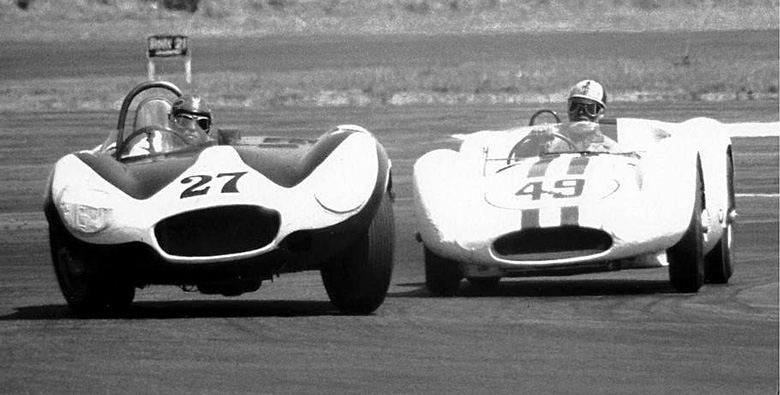
Santa Barbara, May 1960. With the Birdcage still in its Lubin colors but owned by Stan Sugarman, Bob Drake chases Bill Krause in his Chevy-powered Jaguar D-type. Krause won the prelim but had to concede to Drake in the feature. (photo: Willem Oosthoek Collection)
New owner Sugarman kept the services of Bill Rudd to maintain the Birdcage and would repaint the car in an orange red with white stripes. The small roll bar was also replaced by a sturdier version. In its next appearance at Pomona in late June, it was Jim Connor at the wheel, who had to get used to the car. He finished the weekend in second place in the prelim and the feature, in both cases behind Old Yaller 2 driven by Max Balchowsky. While Drake used race number 49, Connor selected number 48 as his favorite.
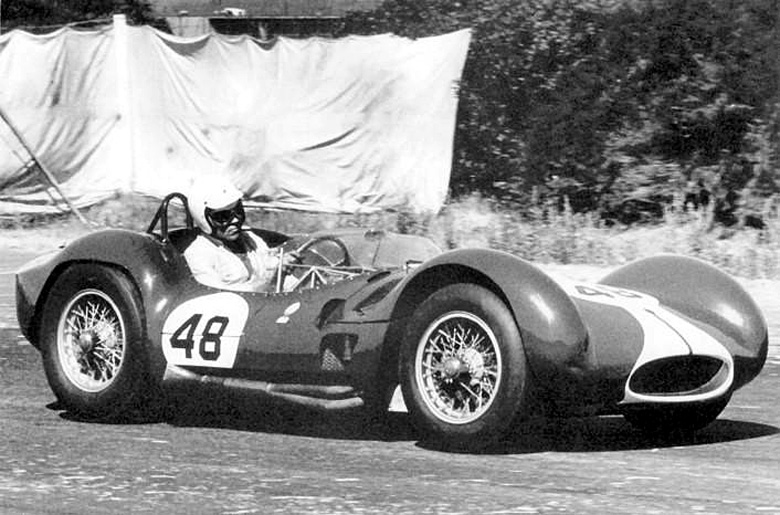
Santa Barbara, September. Competing without a clutch, Jim Connor is on his way to victory in chassis 2452. It had been repainted in an orange red and a more effective roll bar was installed. (Willem Oosthoek Collection)
The next three outings turned up a perfect score, with overall wins in both the prelims and features at Vaca Valley (SCCA, early July), Santa Barbara (Cal Club, early September) and Cotati (SCCA, mid-September). Racing fans called the Birdcage “the hottest car on the West Coast.” Both the Santa Barbara and Cotati victories were unexpected. At Santa Barbara Connor had lost his clutch in practice. Bill Rudd disassembled the unit twice, to no avail since the release levers had worn out. Connor needed a push start once the rest of the grid had taken off, having to shift without the benefit of a clutch. However, Dick Morgensen’s and Jack Graham’s Testa Rossas had no answer to the flying Birdcage. At Cotati a similar situation arose, this time because of an unwilling starter motor after the solenoid had worked itself loose. Despite a push start from the tail end of the grid, and a subsequent pit stop to check on an increasingly noisy gearbox, Connor managed to beat Emil Pardee’s Porsche RSK and Dave Ridenour’s Costin Lister/Jag to the finish.
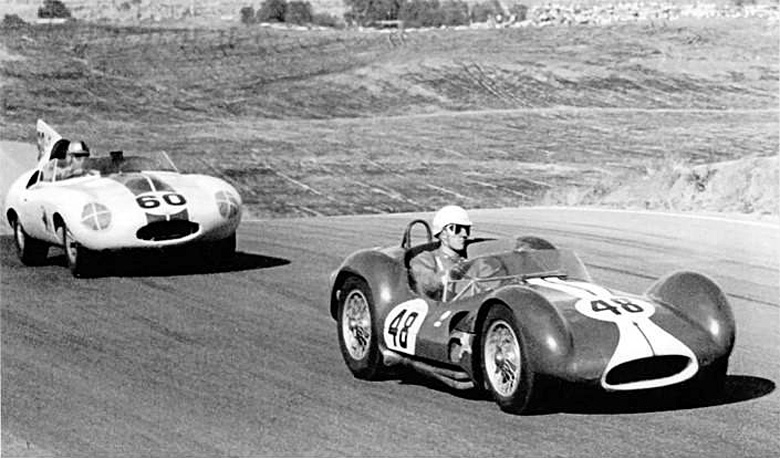
Riverside, October 1960. Jim Connor and the Sugarman Birdcage are leading Jack Brabham in the Jaguar E2A, entered by Briggs Cunningham. While running eighth overall by mid-race, Connor’s transaxle let him down. (Willem Oosthoek Collection)
Much fiercer competition lay ahead at Riverside, for the October Times Grand Prix, a professional race sanctioned by USAC. Among the competitors were newer and improved Birdcages, as well as the first Lotus 19s in the U.S. Connor qualified 12th fastest at 2’07”76, while the pole-setting Lotus 19s did laps of 2’00”93 (Dan Gurney) and 2’03”62 (Stirling Moss). Bill Krause, in the latest version of the Birdcage Maserati, recorded 2’03”90 for the third spot on the front row. By mid-race Connor ran eighth overall when the transaxle of his Birdcage broke, joining both Lotus 19s into retirement. Krause’s new Birdcage, owned by Maserati Representatives of Beverly Hills Inc., claimed a popular victory.
Things did not look well for chassis 2452. The two-heat Pacific Grand Prix at Laguna Seca was scheduled one week after Riverside, but no transaxle parts were available for the car. At Riverside Jim Hall had to rely on his older Maserati 570S, after his own Birdcage blew its engine in practice. And the twisty Laguna Seca course was not exactly suitable for Hall’s 570S, nicknamed “the white whale.”
Quick wits, Sugarman and Hall partnered up. Hall offered the healthy transaxle of his disabled Birdcage for the stricken chassis 2452, provided he could race the car himself instead of Connor. Sugarman agreed and Bill Rudd, who did the installation, must have selected the perfect gear ratios for the track: the oldest Tipo 61 in existence outqualified all the newer Birdcages. Hall claimed the second grid position in 1’17”8, with only Moss’s Lotus 19 faster thanks to a lap of 1’17”3. Krause’s Birdcage equaled Hall’s time, but did so later in the day and had to start from the second row.
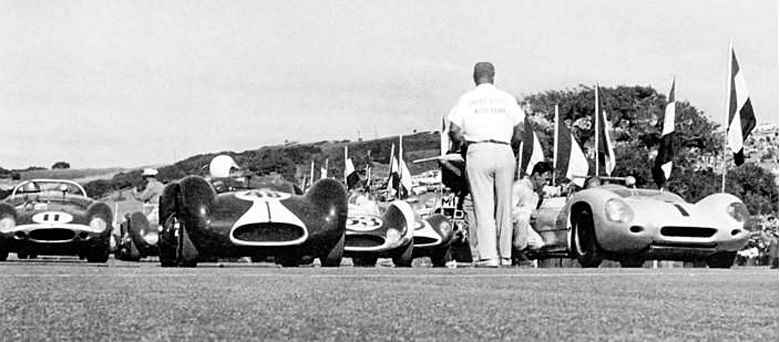
Laguna Seca, October 1960. In the Pacific Grand Prix Jim Hall placed the Sugarman Birdcage on the front row, only beaten by Stirling Moss’s Lotus 19. (photo: Willem Oosthoek Collection)
In the first heat Hall led the field for 15 laps until Moss passed him and that is how they finished. Heat two started just like the first one, with Hall in first place until Moss took over again after eight laps. Augie Pabst’s Scarab also managed to pass the Sugarman car, while Hall and Krause began a battle for third place in Birdcages that were evenly matched. Two laps before the finish Krause outflanked Hall in turn 9, forcing Hall to take evasive action while hitting some haybales. Krause slowed down and gestured Hall to go ahead, but the encounter had knocked out the fuel pump of chassis 2452. The Sugarman Birdcage was parked at the start-finish line to wait out the rest of the heat, finishing in seventh spot. The combined heat results gave Hall third overall in the borrowed car. Moss was the overall winner.
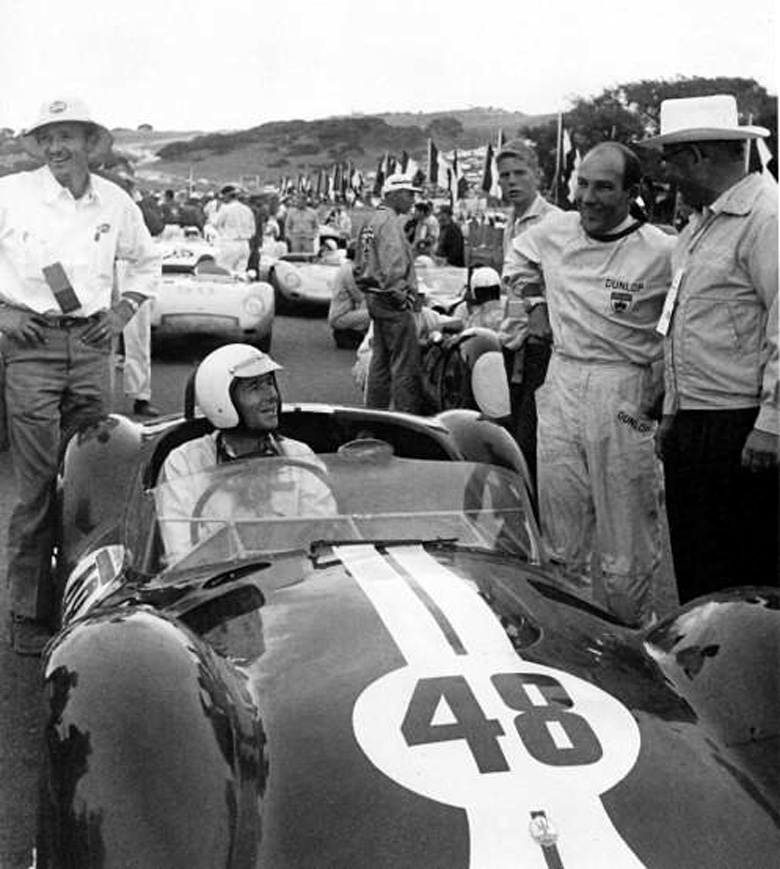
Laguna Seca, October 1960. Lining up on the front row for the second heat of the Pacific Grand Prix, Jim Hall cracks jokes with Stirling Moss, winner of the first heat. (photo: Willem Oosthoek collection)
After Hall took his transaxle back to Texas, the Sugarman Birdcage was forced into a rest of almost a year. It is likely that the owner had no interest in financing a new transaxle until closer to the 1961 round of lucrative professional races on the West Coast, where sizeable purses were to be gained. However, on October 12, 1961, the car changed ownership unexpectedly. It went to Harry Finer, who made his fortune in the New York garment industry. In May 1961 Finer had taken over George Humiston’s bankrupt Maserati Reps of Beverly Hills dealership. Although Krause had won the 1960 Times Grand Prix for Humiston, the driver had noticed that the GT Maseratis ordered for the dealership’s retail operations were piling up in warehouses. They were selling much slower than anticipated. Krause’s winning Tipo 61 (chassis 2469) fell victim to the dealership’s financial woes as well and it was sold to Chuck Sargent in January 1961.
The circumstances of chassis 2452’s ownership transfer to Finer were interesting, since Sugarman had no intention to sell. His long-time mechanic Bill Rudd was no longer available, having moved to Reno to work for Bill Harrah. Maserati Reps of Beverly Hills became the only local operation that could repair chassis 2452. Finer promised a free repair in exchange for having first choice of driver. He wanted Bill Krause, hoping that his wins would lead to improved Maserati GT sales. Although Sugarman did not come back with a firm answer, a new transaxle was installed, and the car was finished just before the October 1961 Times Grand Prix at Riverside. Finer entered the car for Krause, the 1960 winner, but Sugarman, denying any formal agreement, entered it instead for his regular driver, Jim Connor.
Connor practiced chassis 2452 early Thursday before the race, but in addition to Finer, the sponsoring Los Angeles Times wanted Krause, who had major crowd appeal, in the car as well. In the meantime, the sponsor would not allow the Birdcage on the track for practice or qualifying. The dispute was resolved at the last moment – three days before race day – when Finer offered to buy the Maserati from Sugarman, who had little choice. By now the car had been repainted white with red scallops.
Next week, Part 2, Bye Bye Birdie…
Leave a Reply