
Jack Deren with Penske in the center.
By John R. Wright
Photos from the Jack Deren collection
We remember John J. “Jack” Deren of Carbondale, PA, 92, who died November 6, 2026: From the VeloceToday Archives, March 2023
Jack Deren has packed more restorations, race prepared cars and time at race tracks all over the country than anyone I can think of off the top of my head. Over the years I have been going to the vintage weekend at the Glen I have talked with Jack off and on but he’s always been too busy to sit down for long. However, on a Glen vintage weekend in September of 2022, I sat down with Jack at breakfast. Our breakfast turned into lunch, and while he talked I took notes. What an interesting racing career he’s had with ups and downs but mostly interesting times.
He’s done every car from hot rods to CanAm cars and he’s worked with so many drivers it took him about fifteen minutes to list them all and he would be the first to admit that there would be more if he could remember them all.
JW: Jack, you said you don’t remember wanting to do anything but work on cars.
Deren: The year I graduated from high school in 1952, I received a full two -year scholarship for mechanical design to the Spring Garden Institute of Technology in Philadelphia, and I graduated in 1954. In 1952, I also won second place among Pennsylvania entries in the annual auto design/craftsmanship competition sponsored by General Motors’ Fisher Body Craftsman’s Guild. The prize money was enough to buy a ’36 Ford 3-window coupe. I turned it into my first hot rod.
JW: Let’s turn to your involvement in the racing world. When did you go to your first race?
Deren: I’m not sure but it was around 1954-55. I went to Elkhart Lake with a couple of Philadelphia Sports Car Club guys like Al Bochroch and John Milos. It was in 1958 I got my first pit pass with Teddy and Timmy Mayer. That’s when I was working with Roy Gane for Roger Penske.
JW: Tell us about working with Roy Gane at Updraught Engineering.
Deren: I worked for Roy at Updraught and then for Roger Penske part time. I started out as a “gofer,” but I helped Bob Webb build the Zerex special. There was a lot of volunteer work in those days. Bob did the body work on the car, and Harry Tidmarsh did the final prep and paint. I should say there was a lot of bitching about Roger’s car out west because he was from the east and won Riverside in October of 1962 in that car. While I was working with Bob Webb, I got to know Karl Kainhofer who was working for Bob Holbert at the time. My first cross country trip was to take Bob Holbert’s Porsche RS61 to Riverside and Laguna Seca and to help Karl’s crew with it. Bob gave me a brand new ’61 Buick station wagon and an open trailer for the trip, mostly on the old Route 66. I said, “Wow, a new station wagon!” Bob replied, “The best race car in the world has to get to the track, doesn’t it?”
The Penske Years

Bob Webb working on the Zerex Special.

Say, isn’t that a Cooper F1 chassis?

Well, yes, But is it also a sportscar? Where does the passenger sit?

LA Times, October 14th, 1962 with Penske in the completed car. He won.

Rear view: Ford Galaxy taillights?

In LA, October 1962.

In its final form…note the cockpit. This was probably the next year, 1963, after cockpit modifications were made.
JW: How did you become involved with Oscar Koveleski? Tell us about your time with him.
Deren: After Roger decided to get out of racing, I wanted to stay in racing. Roger had been racing in Vineland, New Jersey and Giant’s Despair and Berwick road races and I got to know Oscar because he was racing there at the same time I had a shop in Norristown, and I built hot rods. I decided to move to Scranton, nearer my birthplace of Hazleton and I joined up with Oscar to form Auto World Racing. Oscar had acquired a Ferrari chassis 0588 with no drive train from a garage in Texas. I installed a Chevy engine and a 4-speed Corvette tranny. The Ferrari suspension was set up with a DeDion axle. At the time, there was no narrow independent rear which would handle the power. I took a Chevy Impala 12 -bolt live axle and cut it down to bring the wheel bearings as close to the differential as possible. Axles then had to be cut and re-splined to suit. We raced that car for two or three years, beating a number of “real” Ferraris. I heard Chinetti tried to buy it to get it off the track. Oscar asked him what he was going to do with it and he replied, burn it! Eventually, we sold it to Andy Warhol who painted it yellow! He was planning on making a movie- “The Yellow Ferrari”- spoofing “The Yellow Rolls-Royce.” The movie was never made.
JW: Eventually that car went to England. Tell us how that came about.
Oscar and Car 54

Ferrari 0588 would become Car 54 Where are You? named after a popular TV show of the day.

Could be 2 or 7 depending on the race.

Oscar with the now Ferrari-Chevy courtesy of Jack Deren.
Deren: Oscar was wanting to move up to another car. The ex-Penske/Wintersteen Cooper Monaco was available, so he sold the Ferrari to a collector/dealer by the name of Tiny Gould. The car did go went to England, where we were described as “American butchers,” for cutting up one of four Ferrari Monza 875 S’s! And it was the only one with the fin behind the driver’s head rest. The car was eventually restored to original, and it went on to sell at auction for millions of dollars. It wasn’t the first time Oscar committed “sacrilege.” He had a 1947 Cisitalia Nuvolari roadster which he wanted to make more streamlined by lowering the cowl, body center, deck lid. When he cut it up, he cut right through the Cistalia name on the inside fender well! I eventually restored this car for Ron Kradjian who wanted it back to original. Luckily, I was restoring another ’47 Nuvolari roadster for Gary Ford, so I used his trunk lid to make a fiberglass copy of the proper shape – but that car is a whole other story.

Yellow Ferrari, Cobra outside Autoworld.
JW: Now, tell those of us who don’t know, what was Oscar’s day job?
Deren: Oscar ran Auto World, a mail order company. He sold model cars and drivers’ equipment. His dad, Tony had a hobby shop in Scranton that specialized in Hudson Miniatures model cars. Oscar’s race cars were one way he advertised the business. Until 1971, they ran under the Auto World name; then, he briefly picked up sponsorship from model-car maker, Jerobee. Eventually, Auto World lost ground to other sellers who could place bigger orders with manufacturers and sell for less and so he closed it.
JW: Now let’s talk about the cars Oscar raced and which you maintained.
Deren: While he was racing the ex-Penske Cooper Monaco, Oscar was sitting talking with Phil Remington who told him that Ford was getting out of racing. Phil said, here are two King Cobra chassis, a pile of Cooper parts and a Shelby Daytona Coupe. The list was on one sheet of paper. Oscar bought everything because of all the Cooper parts. It was all shipped east at no extra charge. Soon afterwards, we got a call from Don Nichols who said he was going to be a NASCAR guru in Japan and so we sold him the Daytona Coupe for what we had paid for the whole package! Of course, those cars now go for millions.
JW: Quite a sum.
Deren: Nobody ever thought old racecars would be worth that much. We got rid of old racecars and that was that. Nothing was more obsolete than last year’s racecar. We wanted the latest cars.
JW: Then there are the replicas or tribute cars.
Deren: Of course, they should be identified as replicas and built to period specs. Should we allow them to race in vintage events? If you have the real one, why not build a replica and bring it out? There are a couple of Grand Sport replicas which come out but don’t race for points. Race organizers want cars to fill out the grid. I’ve heard that there was a British group who had 5 components of a car and rebuilt it. They felt that if you had 3 parts and created a car, it would be a “restored car.” That’s legit.
JW: Can you give me another example?
Deren: I had Oscar’s old Cooper which he had crashed at the Hershey Hill Climb. I took parts from that car and put them on the third bare chassis we had from the batch we had acquired from Remington. The rusty old frame was outside and since I didn’t want it to be bought by somebody might rebuild it as “the original” I cut it up in pieces and scrapped it. We used to say – jokingly – that there were more McLarens still running than were built in the first place.

Jack Deren with driver Oscar Koveleski in the McLaren.
JW: Tell us of Oscar and your involvement in the CanAm years.
Deren: I was Oscar’s chief mechanic for the team from 1969 to 1971, when he decided he could no longer afford the time and expense of the CanAm season. Because Oscar knew Teddy Mayer – they both lived in the same area – he bought a 1969 McLaren M6B, right off the floor at the London Race Car Show. It was Oscar’s first CanAm car after the Cooper.
JW: Oscar had some problems at his first race with the car at Cumberland.
Deren: Cumberland was an airport course. The car ran great until Oscar spun out. The lower suspension was bolted to an A frame and it tore loose. McLaren sent us a drawing of the A frame and told us they hadn’t got around to making it heavier. We put a 3/16” metal frame wrapped around that part of the car for better strength. For example, the steering arm’s three bolts were all loose but safety wired! Teddy said the car had been assembled in a hurry just for the show – now he tells us. Then one of the mechanics said “We sell you an assembled car and it’s up to you to make it a raceable car.’ With that car Oscar won several hillclimbs and SCCA class championships. He ran it in the CanAm beginning in 1969, but the car was severely damaged when my shop was destroyed in a natural gas explosion that September. The McLaren’s roll bar held up the collapsed building’s roof and giving me room to crawl out. I spent the next 10 weeks in hospital with severe burns. Oscar wanted to continue with McLaren and because of his connection with Teddy Mayer, he was able to buy one of the two McLaren M8 high-wing team cars available for the 1970 season. Lothar Motchensbacher bought the other one.
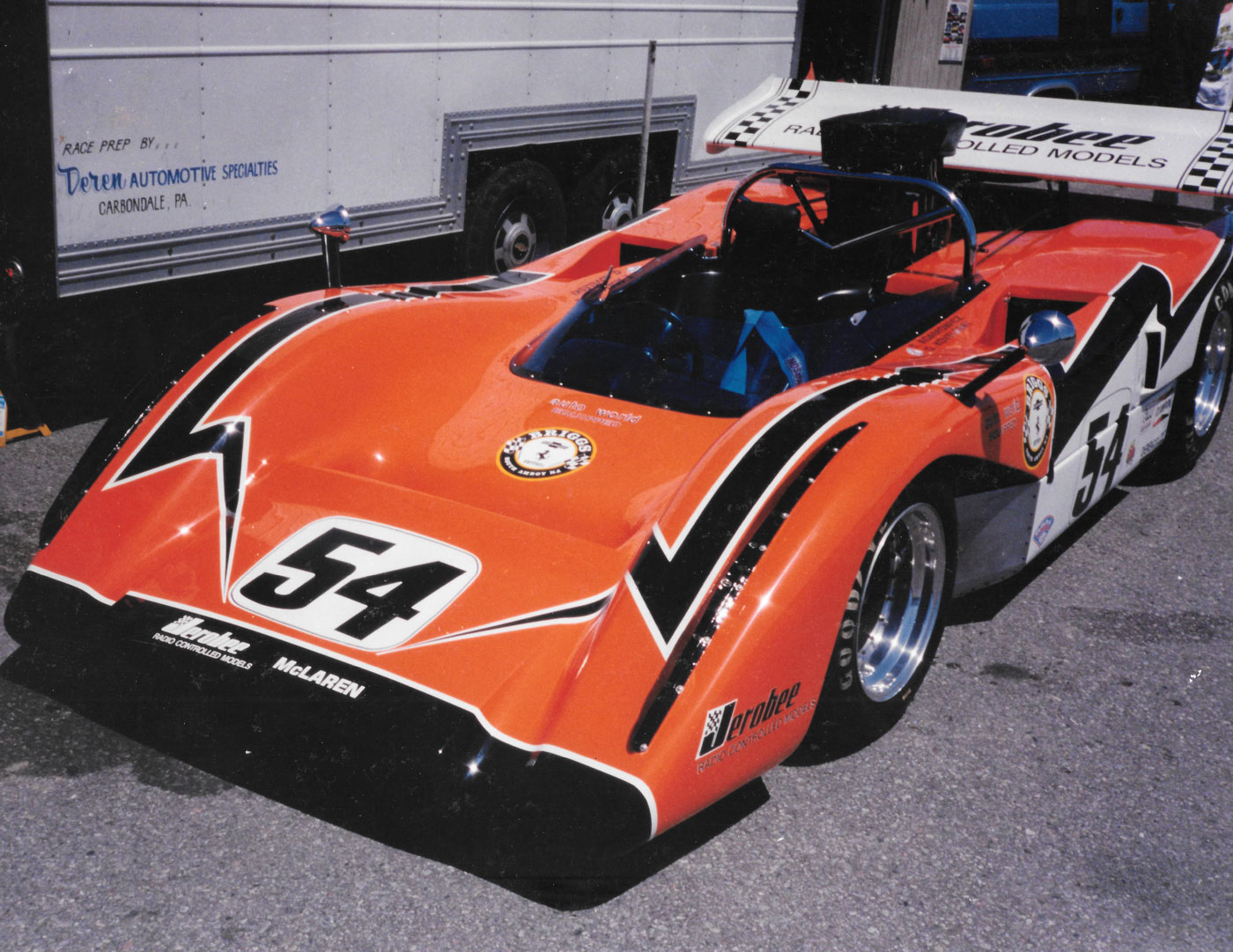
The high wings were causing problems, so lower wings were readied for the new McLaren.
JW: That high wing eventually had to come off, you told me.
Deren: The wing came off because people were building copycat high wings were losing wings. They mounted the struts directly to the uprights – without the rubber mountings McLaren used -and they were breaking from vibration. The rules changed. Now, the wing had to be no higher than 41 inches and had to be mounted to the frame.
JW: However, you soon took the measure of the car, which you told me was relatively easy to work on.
Deren: That M8B, I could take it all apart in four hours so I could magnaflux anything on the car and do post-race maintenance. That was all because of the McLaren team’s massaging of the car’s components. It was made to come apart easily.
JW: Now back to Oscar.
Deren: Oscar wasn’t a bad driver, but he had to do everything like sort out the car during practice, stuff like that. We had no test program to prepare the car for any particular track. He go into the car driving it as it was. In an early practice session at Mid-Ohio, he was far off the pace and complained about the car to Bob Bondurant. Bob took the car out and almost immediately was 3 to 4 seconds faster. He then sat down with Oscar and asked him what he had been doing at each point on the course and told him what changes to make. By the end of the weekend, Oscar had picked up that 4 seconds. Afterwards, he said, “I never knew I had so many bad habits.” Oscar also hillclimbed in his cars. Hill climbing was more dangerous, strictly running against the clock. The roads were heavily crowned, with rocks and trees all around, and you were trying to go 11/10ths. He held the record at Giant’s Despair for many years with the M6B. He would not run the M8B there as he felt it had too much power to be safe there.
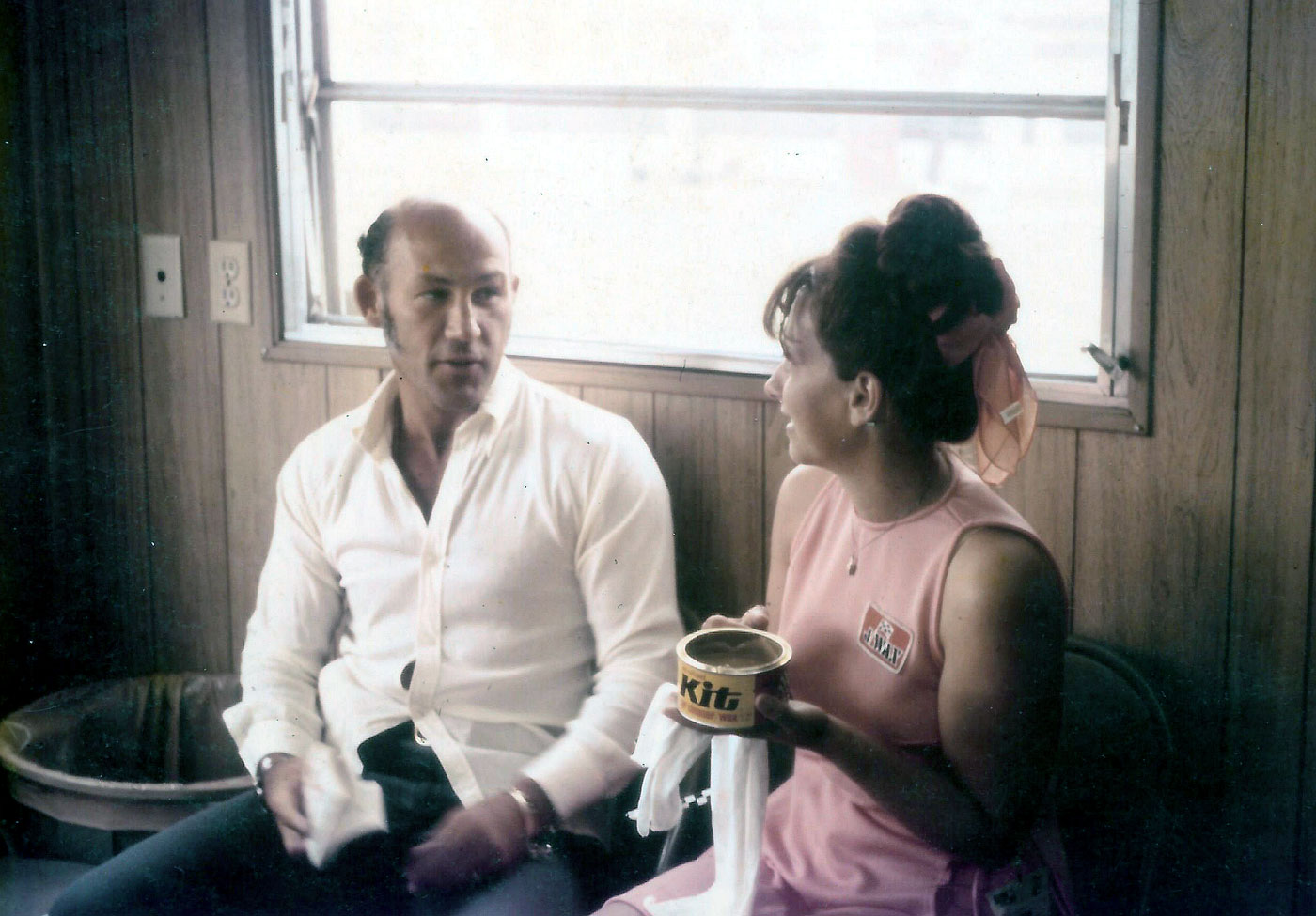
Stirling Moss and Mrs. Jack Deren discuss the pros and cons of Johnson’s Wax at the hight of the Can Am series.
JW: Tony Adamowicz also drove for you, didn’t he?
Deren: Early in the 1971 season, Oscar decided that the car deserved a driver who get the most out of it and so he chose Tony. “Tony A to Z.” Tony had a top -notch driving background. He was very alert to what a car was telling him. For example, at a race at Laguna Seca, he suddenly felt a slight vibration and instantly shut the engine off. We later found out that the crankshaft had broken. Tony had reacted so quickly that the bearings on either side of the crack weren’t damaged. We used to say that if a car could talk after Tony had finished a race in it, the car would be panting. That’s how hard he drove. Tony was one of the three founders of the PRDA – Polish Race Drivers of America. Of course, Oscar was the main guy, backed up by Tony and Brad Niemcek.
JW: Tell us some more about the M8.
Deren: It was a very different car from the M6B. Oscar said the M6B handled much like the Lotus 23. With the wide tires it was very easy to slide around. The M8B would stick tight and then suddenly break loose And race car wise it was the difference between night and day. It was so easy to take apart. For example, the rear axle U joints. You would usually have to use a press on them. McLaren honed them out so that you could press them out with your thumb. The rest of the car I could take apart in four hours. You see in racing, everything has to be done right now. If we were in a race, the SCCA only allowed two people over the pit wall. After a practice session, in the paddock, everything had to be done Right Now.
JW: You told me you got into the habit of having tool boxes filled with tools with for a specific task.
Deren: Yes, you would have a tool box filled with parts for the transmission, one for the front left suspension, etc.
JW: You worked on other cars as well, didn’t you? Some of them less reliable and more fragile than the McLaren.
Deren: Yes, I did. There was the Lotus 30 of Peter Regna and we installed a Ford 351 in place of the original 289. If you can imagine it, the seat belt mounts were installed in the fiberglass body work! We built a subframe for that seat mounting to make it safer for the driver. The 30s were a very flexible car. At Lime Rock when another driver got in his car and when he jumped up and down in the cockpit, the belly pan touched the ground!
JW: You told me that some drivers want to change everything on a car when you’ve already given them a car they should be able to drive easily. You came up against that idea with Derek Bell in the BMW M1 at Sebring.
Deren: I did. Kenper Miller was driving and Derek arrived. Sebring liked to get showcase drivers. Derek arrived, went out in practice a, came back and said, “Jack I need this and that” – 5 or 6 things. I replied “The spares package didn’t arrive from Munich yet. What you’re sitting in is what you’ve got.” He then sat in the car for some time clearly thinking how to compensate. Then he went out and went 7 seconds faster. He drove around the problem. Drive what you’ve got! And Karl Kainhofer told me that Mark Donohue had once told him, “I thought, do I want to be an engineer or a driver? I just drove the car to its limit.”
JW: Can you give us another example of how someone can be encouraged to go faster?
Deren: As I recall, with Penske Racing there were auditions for driving the second TransAm car on a Monday at Kent. Mark took the car out to set a base time, but then Roger took the same car out and set a lap time half the guys auditioning couldn’t beat!
JW: You also got to know the drivers and mechanics well, didn’t you, Jack?
Deren: I got to know many of them, but we were never what you would call “friends.” We all seemed reluctant to become too close to a driver because you might be going to his funeral the week after a race. Oscar felt the same way. Racing was more dangerous then than it is now. I did have a personal connection with Mark Donohue. My aunt was his babysitter and his kids as well.
JW: You stayed in racing after Oscar left the CanAm series, preparing cars for Kenper Miller’s BMW team
Deren: 1977 began my long association with BMW. That January Kenper Miller bought Peter Gregg’s 1975 BMW CSL. Peter, Brian Redman, and John Fitzpatrick had won the 1976 Daytona 24 Hours in that car. We ran the car – just as we got it – to FIA specs at six races that season. Our best finish was a 2nd place at the season-ending Daytona. That winter, I made a number of changes to stiffen the chassis, which IMSA rules allowed. After the first practice session for the 1978 Daytona 24 Hours, Kenper said, “This feels like a completely different car.” In 1978 we ran 11 IMSA races, setting 3 qualifying records and 6 fastest laps. In 1979, we ran three races, setting more lap records.
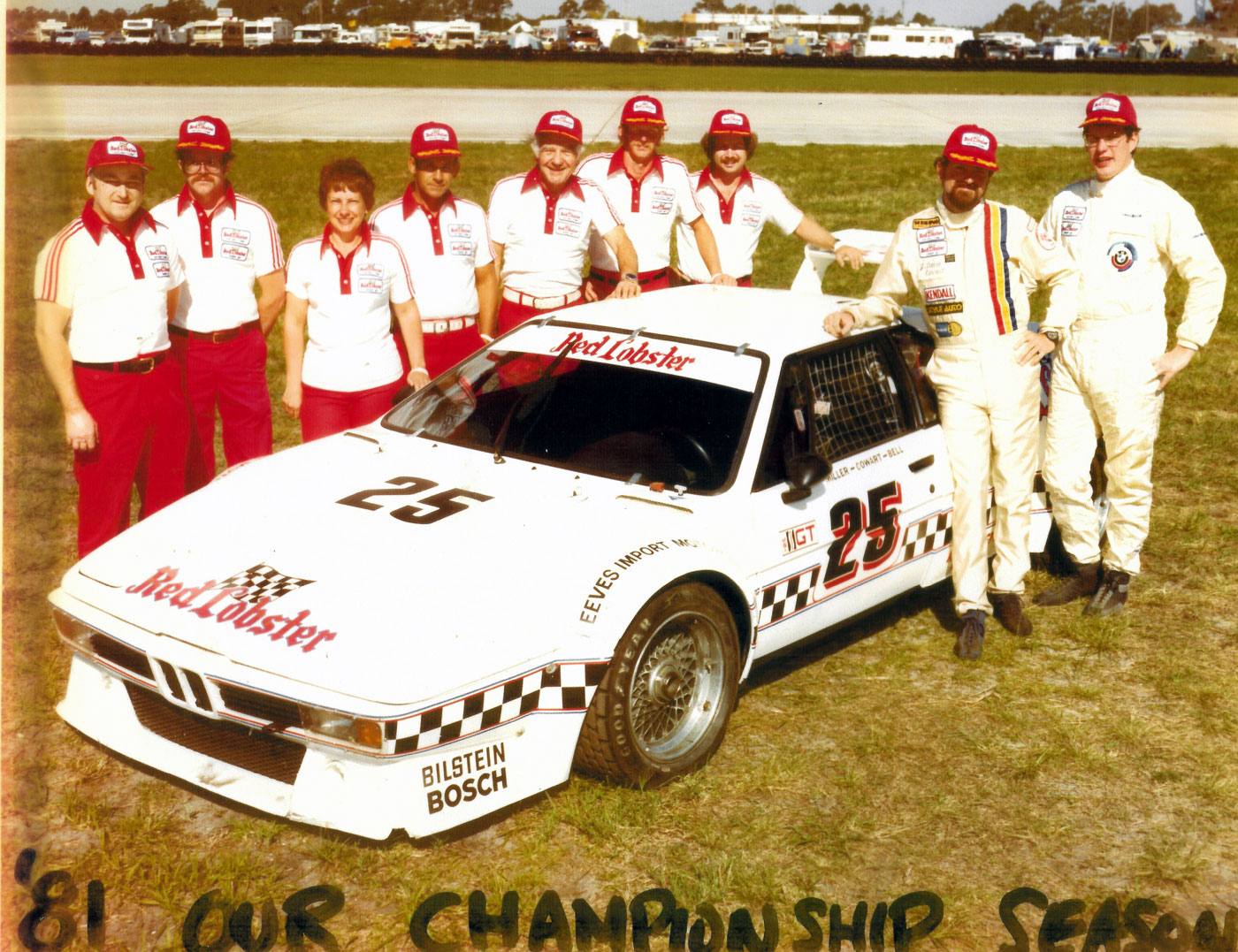
This BMW M1 Procar was prepared to IMSA specs
CSL#59 is currently owned by Kevin Ladd. We took it to Daytona for the 50th Anniversary celebration in 2012. There was a pre-race “demonstration” event for the previous 24-Hours winners that we called the “24 Minutes.” Brian Redman was to drive the car. We weren’t sure of the engine’s condition and didn’t want to risk damage, so Kevin asked him to ‘take it easy.’ HA! Green flag dropped – end of first lap – Brian and a GT40 were way up front. When Brian came back in his first comment was, ‘Jack this runs better than the factory car!’
After Kenper sold the CSL, he bought an M1 Procar -FIA specs. The next year, I prepared it to IMSA specs. David Cowart obtained Red Lobster sponsorship and in 1981, we won the GTO class championship. We ran 16 races and won 11, including 9 in a row. Drivers David Cowart and Kenper Miller were first and second in points – the first time that happened – and I was named Mechanic of the Year. After the M1, the team raced a pair of March cars – 82G and 83G. The 83 was the one painted like a lobster.
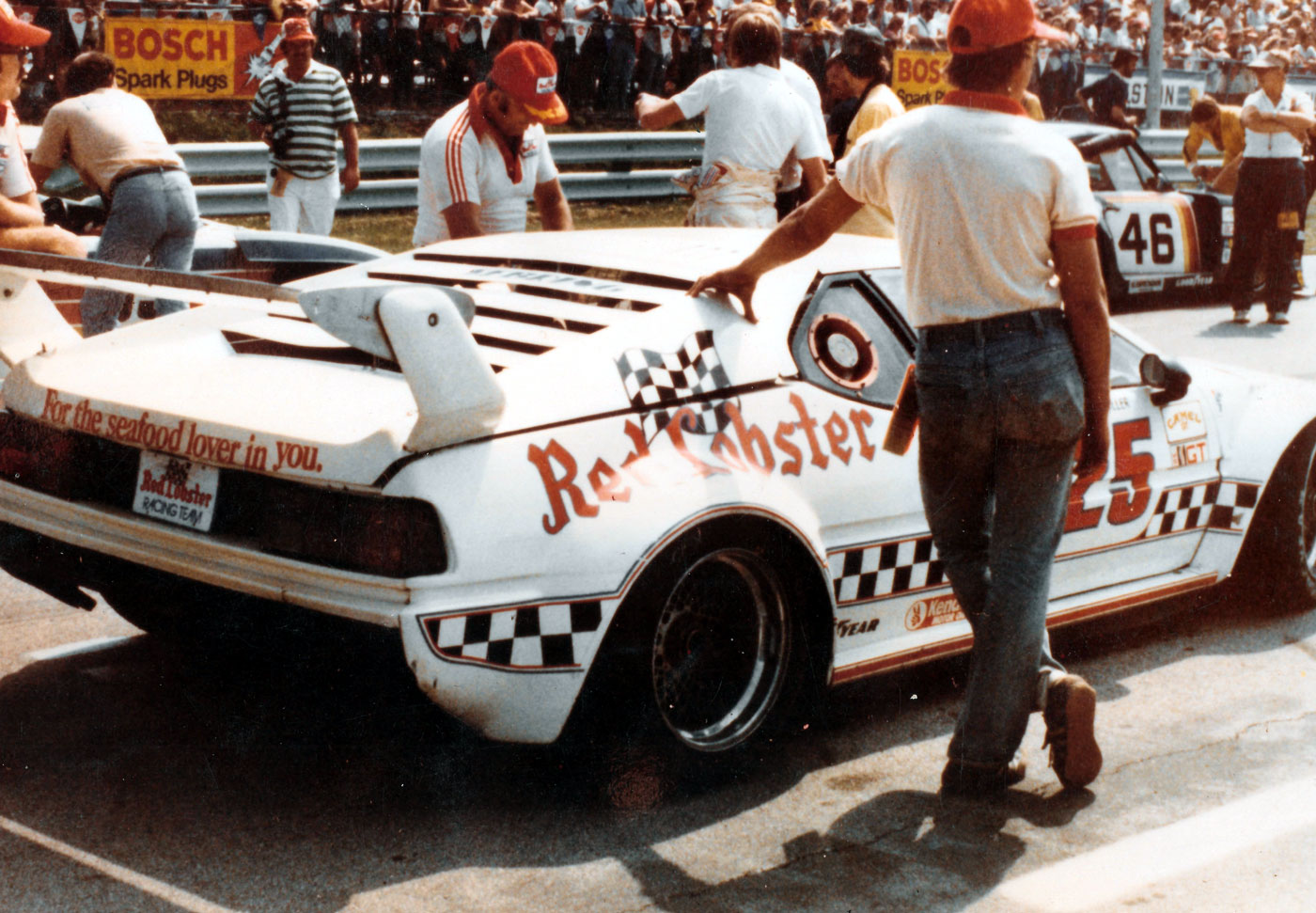
David Cowart obtained Red Lobster sponsorship and in 1981, we won the GTO class championship.
JW: You have wound down racing activities were concentrating on restorations. Can you tell us what you have worked on?
Deren: In 1992, BMW Motorsports celebrated its 20th anniversary at Moroso and Sebring. I prepared nine cars for that event. In 2003, at the Lime Rock Vintage Weekend, it was the 25th anniversary of the M1. We brought the “Red Lobster” BMW M1 and he BMW 82G for Kenper Miller. Brian Redman gave press rides in the M1. In the past, I’ve restored race cars like the 1982 March “Red Lobster” GTP car for Jim Leeward and an ‘85 March GTP for Ed Mueller. Right now, I have in the shop an M1 Procar, an ’86 Corvette hillclimber, a 1980 MGB, a ’54 Austin-Healey and a 1939 Jaguar SS 100. I’m, 88 years old now and have now stopped turning wrenches!
JW: Thanks Jack for all the stories and the history.
Leave a Reply