They Don’t Get Much Bigger!
Story and photos by Graham Gauld unless othewise noted
Someday I might write a book about conventional industrial designers who also designed cars.
People like Giorgetto Giugiaro – who, apart from cars, designed Italy’s first high speed trains – or Raymond Lowey who designed the Studebaker Avanti but was best known for his industrial work.
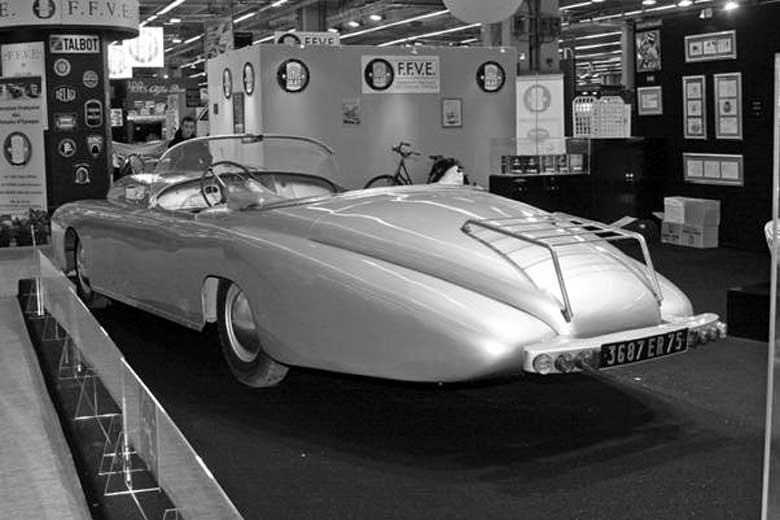
Then there was Frenchman Paul Arzens whose major contribution to car design was his fabulous La Baleine, the whale, some eighty-eight years ago.
Arzens attended the famous Ecole dees Beaux Arts in Paris and was best known as a painter before becoming an industrial designer. One of his first creations was shown at the sensational 1938 Paris auto show where art-nouveau was truly reflected in cars as it also saw the public showing of Figoni et Falaschi’s remarkable Delahaye 165 Cabriolet.

Delahaye 165 cabriolet at Pebble Beach. The Whale was bigger but Figoni and Falaschi’s 1938 Delahaye 165 Cabriolet stole the show. Photo by Brandes Elitch.
At the time the Delahaye gained most of the plaudits, which may be why Paul Arzens “whale” is often overlooked and generally forgotten about.
So what was this monster that Arzen had created?
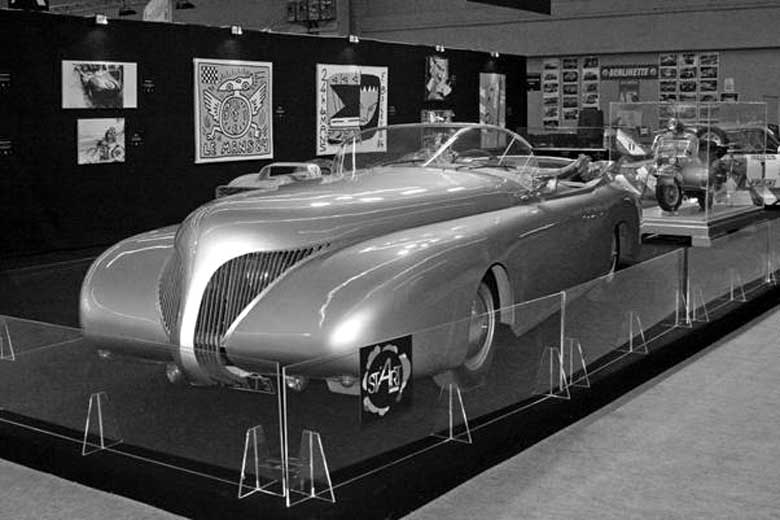
La Baleine, Paul Arzen’s streamlined monster from the front. (Photo Gauld)
He chose the chassis of a 1928 Buick Special with a 3.5 liter six-cylinder engine that only produced 68 hp.
His design of the bodywork was sensational as it was not only smooth and streamlined but stretched to 23 feet long. In terms of scale it is nearly seven feet longer than a present-day Cadillac CT5!
Arzens, when asked, explained he needed this extended rear boot space to hold his painting equipment, easels and canvases!
Despite its size and relatively puny power output, its smooth body shape allowed it to hit over 90 mph and Arzens used it as his normal road car until 1990.
Paul Arzens then did what we could call a U-turn (not with La Baleine though!) and in 1942 designed and built the prototype of what in the 1950s we called the Bubble Car. And this was called L’Oeuf, the Egg.
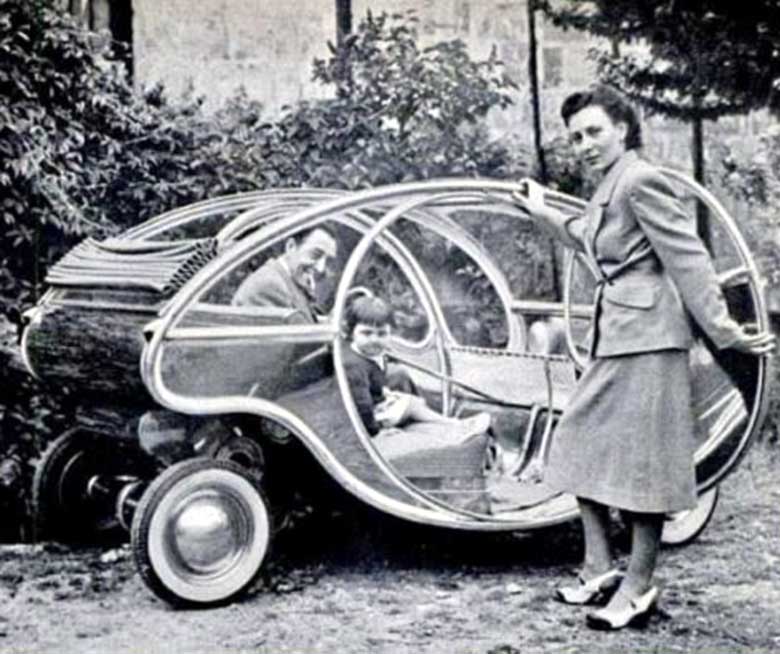
Paul Arzen’s “Egg” bubble car of 1947. Not much safety! PR photo.
This was, indeed a bubble mainly of curved plexiglass attached to an aluminum frame. For a power unit he did not turn to internal combustion but to electricity and used a total of five batteries that gave it a range of 100 kms- 62 miles.
Arzens then turned to railway trains and designed some the most iconic railway trains in post-war France, including this model below, the “nez cassé” ( Broken Nose) CC4100.
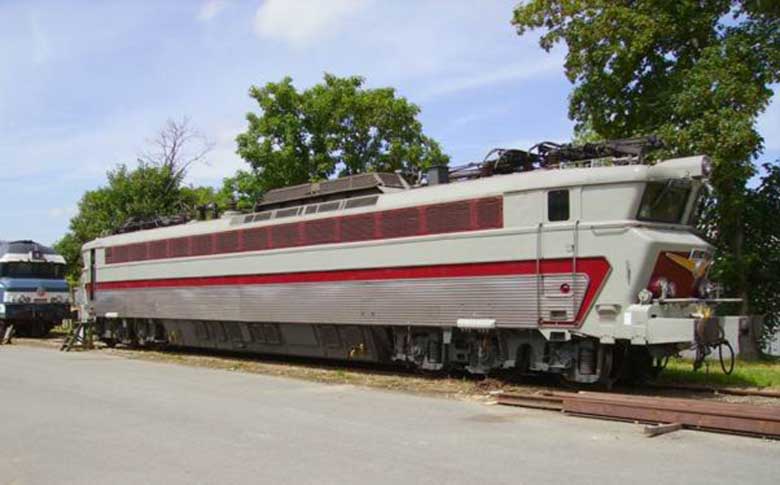
Take that, Bugatti!
If you want to see the Whale and the Egg the next time you are in France, they are housed in the famous Musee National de l’Automobile-Collection Schlumpf at Mulhouse in northeastern France.
Leave a Reply