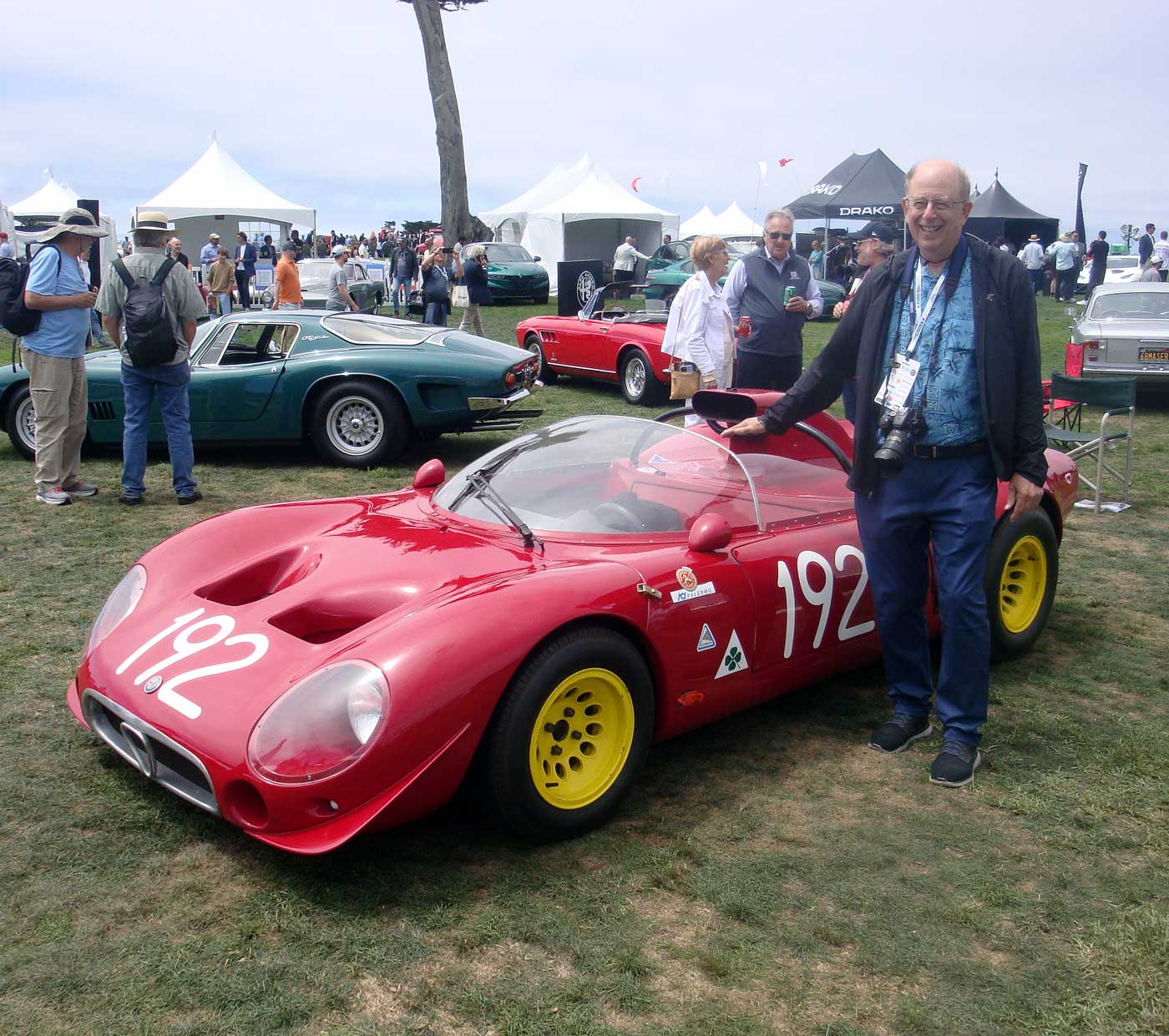
Bob Goldberg with Alfa T33. Photo by Brandes Elitch
Story by Brandes Elitch
The Alfa Romeo Association USA is a national organization supported by local chapters. If you have an Alfa, this is an organization of people who can and will help you, and Bob Goldberg is the editor of Overhead Cams, a first-class magazine every month. Even if you cannot make local events, the magazine is worth the modest membership cost by itself.
I have always assumed that every VeloceToday subscriber has at least one Alfa but for those who don’t yet have one here is a brief background of what makes an Alfa so desirable. The BBC show Top Gear is famous for saying, “You cannot be a true petrolhead if you have never owned or wanted to own an Alfa.” Truer words were never spoken.
First, there is the history, engineering, design, and culture. You might expand this further to include brand identity, the cultural significance and the very passionate Alfa community worldwide.
Second, there is the performance. The Alfa double overhead camshaft engine was actually used in their 1914 Grand Prix car, and the 6C 1500 Sport came out in 1928, using a similar motor. The Alfa used in the 1940 Mille Miglia had an electronic fuel injection system, with six electrically operated injectors.
Third, there is “The Look.” People always ask me what the most beautiful car is, and my off the cuff response is “Any late thirties Alfa with a Touring body.” One example is the 1937 8C 2900B Touring Spider. There were many beautiful models, by carrozzeria such as Bertone, Pininfarina, Zagato, and later Italdesign.
But it is not just the show cars that are beautiful, the production cars are as well. I had a Berlina, but I sold it to the “Berlina Guy” in Berkeley, probably 20 years ago. I should have kept it.
I met Bob Goldberg for the first time at Concorso Italiano, and he was gracious enough to let me ask him a few questions. I will summarize the interview here.
B.E.: Bob, how did you get involved with Alfas?
Bob: Unlike some Alfisti, my attraction did not start in high school when I saw the film The Graduate in the movie theatre. After initially driving German and Swedish cars, and other cars where I needed to fit 3 kids in the backseat, I decided that I wanted an older car that I could work on myself. My initial focus was 1960s’ British cars, but my enthusiasm waned the more I thought about their dated mechanicals. One morning while I was driving to work, I saw a burgundy Duetto going through the intersection ahead of me. The next day I switched my focus to Alfa Romeo.
The more I learned about Alfa’s mechanical underpinnings (DOHC engine, 5-speed transmission, disc brakes, etc.) the more I liked it. So, I ended up buying a driver-grade 1974 Spider 2000. Although it did fit in my garage, there was too much other stuff there (sounds familiar!) so I worked on it in the driveway on jack stands. I already had a hydraulic jack to which I added jack stands and a ramp built out of 2x12s, based on a plan that someone had posted on the Alfa BB.
Some years after I bought the Spider, I finally recalled inspecting a 1970s Alfetta GT for sale in the Chicago area, where I lived, but I did not buy it.
B.E.: Please tell us about the club, what if offers, and why someone would want to join.
Bob: Unlike other countries that have a single Alfa Romeo Club, there are actually two clubs in the US. Each was independently founded in 1958: the Alfa Romeo Owners Club (AROC), first in Chicago and then a few months later the Alfa Romeo Association (ARA) in the San Francisco Bay area. Sometime later, possibly in the early sixties, the two clubs became aware of each other and began to collaborate, which resulted in the ARA affiliating with AROC. (No club records from those years are present in the ARA archive). The affiliation lasted until around 1974 when the ARA unaffiliated. There were hard feelings which persisted on both sides for a long time, but that ultimately dissipated. Now the two clubs have been friends again for many years and collaborate on events, such as the Concorso Italiano.
B.E.: How did you become the Editor of Overheard Cams?
Bob: Most of my career was focused on building computer publishing systems. In early 2017 the then President of the ARA announced the need for a new editor as the then editor was stepping down. I did not immediately speak up. I am not a graphic designer, but I know about typography, page layout, and publishing software. A few months later, after no one else had stepped up, I did. The May 2017 issue was my first.
B.E.: Do you have a favorite Alfa?
Bob: That’s a hard question to answer as there are a few. A 6C 1750 would be lovely, as would be a type 33 Stradale, plus any Touring bodied coupe, prewar or postwar. Two more approachable (affordable) cars are the sixties and seventies Giulia and GTV, both of which always attract my attention. if you want to see the Giulias in action on the street, watch Italian crime movies from that era.
B.E.: You had a wonderful trip to Italy this year. For those of us who are dreaming/fantasizing about going to Italy for a car event, what are some of your favorite memories of your trips back there?

Bob Goldberg walking the Lucca wall.
Bob: Spectacular scenery while bicycling through Tuscany, Roman era buildings and monuments, museums, and art, food, wine, and craft beer. Of course, the cars. And the wonderful people.
For example, the lovely, non-English speaking Italian couple who ran an auto parts store in Cuneo. They patiently listened to me try to explain in poor Italian that I wanted to buy a “Made in Italy” wrench. (A regular foreign travel activity of mine is to buy a hand tool made in each country that I visit). Once they understood my request, the man wrote out the name and location of a store in a cursive script that later took me many minutes to decipher. His recommendation turned out to be a major tool store, where I purchased a 10 mm and 13 mm Beta wrenches, two common sizes needed to work on Alfas.
Chatting with Sergio Nada, the manager of the Liberia dell’Automobile in Milan while browsing its shelves (Sergio is the son of Giorgio Nada). I mentioned that I owned some of the Alfa books on display and pointed at the two-volume Alfa Romeo Production Cars from 1910 by d’Amico and Tabucchi. Sergio told me that he did the nine-month long production of those volumes! That of course led to a long discussion about what software he used then (Quark) and what he uses now.
Bob Goldberg adventures:
Leave a Reply