By Pete Vack
“Back in 2015, VeloceToday’s editor Pete Vack came searching for that fellow Diggens, and in particular an illustration of Jean-Pierre Wimille. Seems that he remembered my work for the British magazine, Thoroughbred and Classic Cars. And that was many years ago, in the 1970s!” – Rodney Diggens
From this relationship developed a three-part series about Rodney’s life in the UK, published in 2024, from growing up in London during the Blitz, to becoming a very well known artist, to working with the great team at T&CC.
Along the way we talked about the books of Bill Bryson, compared our little towns of Williamsburg, USA and St. Albans in the UK, and shared our experiences with the indomitable Morris/Austin Mini.
A couple of years passed, Diggens, always enjoying our stories in VeloceToday, kept in touch as he left his home in St. Albans, got a bit older (he is 89 now) and was often stymied by the latest smartphone technology (now how do I download VeloceToday?)
And then one day last week a package came via Fed-Ex no less, and it was a Duesie. The package measured 18 by 24 by 4 inches and took two people 20 minutes to open. In very small writing was a return address, and we could see it was from Rodney, now living in Petersfield, Hampshire. It must be one of his prints, but why so heavy?
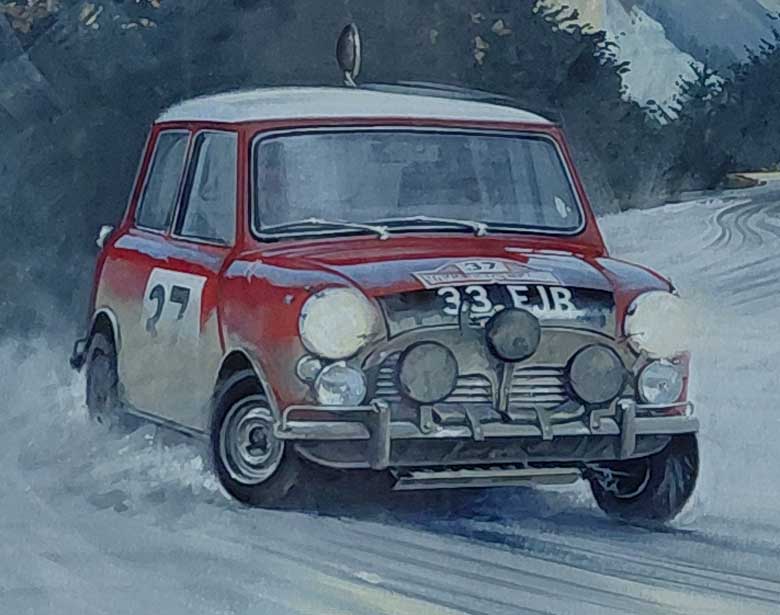
As we opened the last box, we found a beautiful wooden frame with plexiglas protecting one of Rodney’s best works. I recognized it immediately, and looking on the backside proved me to be correct; It was the Paddy Hopkirk/Henry Liddon in the 1964 Monte Carlo Rally, which they won.
And below that was written, “Gouache on board.” I didn’t know what to think. It must be a print. No one sends an original work…not a print, not a reproduction, but a painting done with gouache medium, which according to Google AI, “gouache is an opaque, water-based paint made of natural pigments, water, and a binding agent like gum arabic. Often described as opaque watercolor, it allows artists to layer light colors over dark ones and dries to a smooth, velvety, and completely matte finish.”
On the other hand, who would bother to frame, package, and ship overseas via Fed Ex a mere print? What has Rodney done here?
I had to ask. Yes, he said, it was the real deal. And in a brief note, Rodney said, “Dear Peter, Please accept the enclosed my way of saying a sincere ‘thank you’. You did us proud!”
One of those moments we’ll never forget.
Rodney’s awesome gift brought forth Mini memories and I was remembering a few of the often hilarious Mini stories that we experienced. But concurrently, I was working with Philippe Defechereux, author of “Watkins Glen, The Street Years 1948-1952,” and “James Dean: From Passion for Speed to Immortality,” who had just told me that he also had a Mini in the mid-sixties. Now if you have ever owned a Mini, you will have many Mini stories to tell and Philippe was no exception. I sent him a photo of Rodney’s gift and it hit a chord:
The Monte Carlo Rally and the amazing Mini victories! (1964-66). It made the Mini, Cooper version or not, ultra popular among young men throughout western Europe. In Belgium, my friends and I lived through all that just as we were reaching driving age – 18 in EU to this day – and university. We all wanted one. Courtesy our fathers, my best friend and I eventually got one; his black, mine blue. Since our hometown lay at the northern fringe of the Belgian Ardennes, with Spa-Francorchamps being only 10 miles to the south, but through two-lane roller-coaster roads, it was the car to have. Especially since the town of Spa in the early 60s also had the hottest discotheque in Belgium, called “Le Bric-à-Brac.” We would go there until late every weekend, sometimes Fridays and Saturdays. The only question between my friend and I was always, do we take the blue Mini or the black one? This went on through the end of university in Liège. Later, I took my Mini to Rotterdam in the Netherlands, where I worked for a year in basic banking to learn Dutch. There, of course all the roads were straight and flat. It was still great fun to drive, and I got to love the Dutch people. In all, I kept my blue Mini for five years, until it was time to fulfill my American dream and fly to America. My father soon sold it. No regrets only extremely fond memories.
That is just the tip of the iceberg, and we’ll have many more Mini stories in a later article.
In the meantime thanks to Rodney Diggens for the wonderful work of art and shared memories!
Below are links to all the previous articles about Rodney Diggens…


Leave a Reply