by Ken Gross
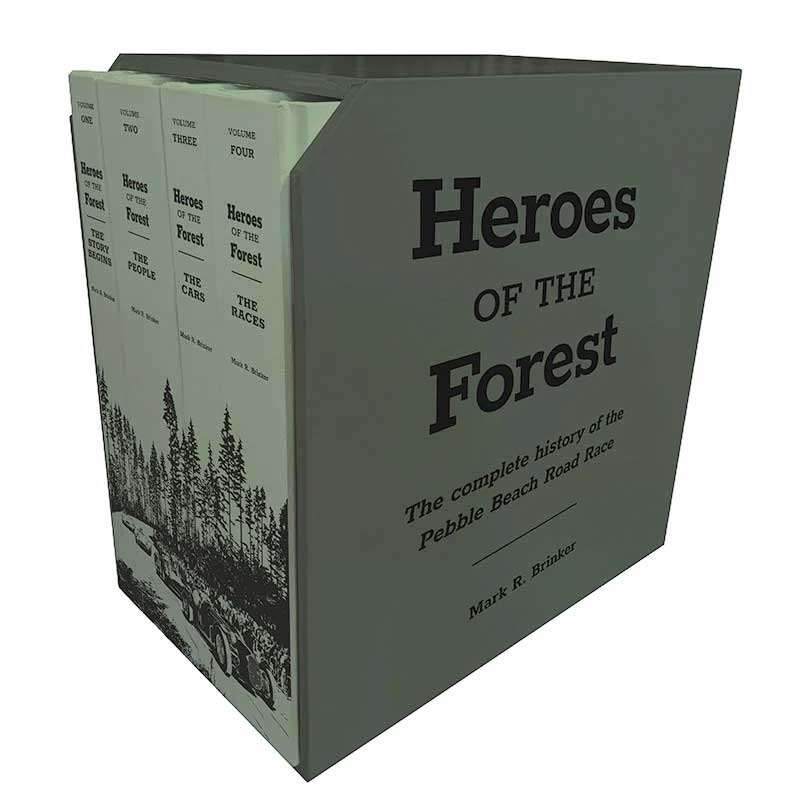
You’d expect a masterpiece from Dr. Mark Brinker, after his superb, multi-volume books on “Japan’s Most Astonishing Automobiles” and “The Amazing Denzel Sports Car.” And you won’t be disappointed with his latest effort — “Heroes of the Forest.”
The historic Pebble Beach Road Races, contested on the twisty backroads of the scenic Del Monte Forest, in Monterey, California, for seven remarkable years, from 1950 to 1956, attracted the top drivers and the best sports cars in the country. The grids included production models, many of which were modified, and clever homebuilt specials. More than a racing odyssey, this was a fabulous social event, set in a gorgeous location, with posh patrons hobnobbing among a host of drivers, both amateurs and professionals. The course was wickedly fast. With towering pines and glacial boulders located scarily adjacent to the impossibly narrow road, it could be deadly. Hundreds of cars competed until (spoiler alert) Ernie McAfee’s fatal crash in Bill Doheny’s Ferrari 121LM led to the establishment of the Laguna Seca Race Track.
But the Pebble Beach Road Races, while they lasted, were glorious.
Mark Brinker’s highly entertaining, exciting and scholarly, 300,000-word, 1,700-page epic brings you every car, every driver, every record, and every tiny detail. There are more than 1,500 photographs alone — many of which have never been seen — along with historic catalogs, magazine covers, period advertisements, remarkably in-depth driver portraits and 180 detailed race result charts. And there’s more to it than that. In the early days of amateur racing in California, there was bravery laced with naivety, celebrities mixed with amateurs, and more than the hint of danger. It’s all here, expressed in four action-packed volumes that ensure that the excitement of the Pebble Beach Road Races will never be forgotten.
Volume 1, “The Story Begins,” presents the in-depth background that establishes how amateur sports car racing began in the United States and sets the scene for the Pebble Beach Road Races. It could have been a stand-alone book by itself.
https://heroesoftheforestbook.com/pages/volume-1-the-story-begins
Volume 2, “The People,” presents the drivers, amateurs and professionals, the colorful team owners, individual car owners, mechanics and all the interesting folk who were involved in the racing events in the Del Monte Forest. It’s a cast of hundreds because everyone who was anyone in that era raced there — famous names like Phil Hill, Sterling Edwards, Jim Kimberly, Masten Gregory, Ken Miles, Roger Barlow, Carroll Shelby, Lou Brero, Ernie McAfee, Jack McAfee, Richie Ginther and John von Neumann, were joined by the likes of Cy Yeador, Bill Murphy, Skip Hudson, Lou Fageol, Pete Lovely, Bill Pollack and Henry Manney III. This list doesn’t even scratch the surface. There are 60 biographical studies of the drivers and the supporting cast.
https://heroesoftheforestbook.com/pages/volume-2-the-people
You’ll meet the event organizers, people like Bill Breeze, Julian and Gwenn Graham, John Bolt “Jack” Morse, and Kjell Qvale. Noted car owners like John Edgar provided the fast mounts that less wealthy but talented drivers needed. And the great mechanics and fabricators are all there, with legendary names like Max Balchowsky, Emil Diedt, Willis Baldwin, Chuck Manning and Phil Remington. Brinker presents all these racing pioneers with detailed biographies, copious images, insightful comments, memorable quotes and accurate race records for Pebble Beach and beyond, over many careers.
Volume 3, “The Cars,” details every marque that raced, along with year-to-year chapters on the myriad road race specials that made these contests so colorful.
https://heroesoftheforestbook.com/pages/volume-3-the-cars
Volume 4, “The Races,” presents every contest in remarkable detail. No minute point is spared. Not one…
https://heroesoftheforestbook.com/pages/volume-4-the-races
As an added bonus, the books feature a number of well-placed, easy-to-use QR codes, so you can click on them for YouTube original films of the races themselves. The system works perfectly. Flickering black and white images clearly show how narrow the tree-lined forest course was, and how nail-bitingly close the competition was as well. In the beginning, much of the Forest road was unpaved. In one such clip an announcer says, “For those of you who never had the privilege to attend any of the six Pebble Beach Road races, you never forgot the sight and sound of the cars, especially the big cars, coming through the trees, especially in the fog. It’s something that we will always remember.”
And the stories are really exciting, with drivers who went on to become legends.
Phil Hill at Pebble Beach Road Races
Take Phil Hill, who loved the Pebble Beach road races. He won the Pebble Beach Cup in the inaugural 1950 event, his first major victory, in a hot-rodded Jaguar XK-120M that he’d modified with a bored-out 3.6-liter engine. Hill lightened the car, and fitted specially made alloy wheels. The twin cam Jaguar engine was strong but the wheels proved to be a mistake, so he reverted to the stock factory wheels instead. The race wasn’t easy. Hill’s clutch had exploded in practice, and it remained fully engaged. That misfortune would have stopped many drivers, but not Phil Hill, a skilled mechanic who could understand machinery on a surreal level. Hill had to start at the back of the pack, because the car wouldn’t idle on the grid, but driving like the devil possessed, he’d passed everyone else by mid-race, shifting without a clutch, and with progressively failing brakes.
Later, knowing the course well and blessed with superior equipment, Hill won the 1953 and 1955 events, driving a Ferrari 250MM that he owned, and subsequently a Ferrari 750 Monza Spyder that belonged to Alan Guiberson. When the 1955 race ended, somewhat disheveled in his dirty race clothes, Phil won the first Pebble Beach Concours d’Elegance with his aunt’s stately 1931 Pierce-Arrow LeBaron town car. A prodigious talent, Phil went on to drive Formula 1 cars for Ferrari and became F1 World Champion in 1961. The Pebble Beach Road Races were his first big opportunity and he made the most of it. Decades later, on a visit to 17-Mile Drive, Hill still remembered where parts of the old track were, despite the fact that grass and trees had overgrown the course. Brinker’s book includes an extensive record of Phil’s entire career, with many results tabulated for events that occurred long after Pebble Beach.
I can’t begin to imagine how Dr. Brinker, a noted Houston orthopedic surgeon, managed to complete this massive tome in a year and a half. When I spoke with him about the extensive research and writing work involved, he commented, “I couldn’t simply list people by names. I had to put them in context, so readers would know who they were — and in many cases, who they became.”
Pete Brock at the Pebble Beach Road Races
Pete Brock, who later designed the Corvette Stingray prototype roadster for General Motors and the aerodynamic Shelby Cobra coupe for Carroll Shelby, was an early spectator. He traveled to Monterey with his neighbor, Fritz Warren, who was an entrant for several years. “Up until that point,” Brock recalled, “all I really knew was MG TDs. Then I got to Pebble and saw Phil Hill’s incredible Alfa (8C2900) and Jim Kimberly’s Ferrari (212 Barchetta) and wow! These cars were so far beyond what I could think of at the time… or even understand. This was my first glimpse of the broader automotive world…one beyond MG TDs.”
Insightful as always, Brock shared some thoughts with Brinker about the West Coast competitors, saying… “It seemed to me that the Southern California guys were the hot racers. When they came up for the Pebble Beach event, they really added a lot. I think in many ways they were ahead of the Northern California drivers. When they showed up, everything changed. Superchargers, V8/60 engines, stripped bodies, smaller wheels, wider tires…special alloy bodies that looked like real racing cars! No question they were years ahead in development and talent! When this group showed up, headed by guys like Ken Miles, Jack McAfee, Phil Hill and John von Neumannn, it was obvious these Southerners were going to change the sport.”
Bill Pollack and John Edgar
One of the enduring visuals of the Del Monte Forest races is of an unperturbable Bill Pollack skillfully piloting Tom Carstens’ Cadillac-Allard J2, in black livery with red wire wheels and (at one time) whitewall tires! Brinker writes: “The braking and cooling systems were marginal, the shift linkage was flimsy and the Cadillac engine was gulping fuel at an alarming rate. The one thing that was working well was the accelerator pedal. As an interesting aside, when Pollack saddled up for the feature race, he immediately noticed that the gauge faces were completely covered by tape. Apparently Carstens, a wealthy business owner from Tacoma, Washington, wanted him to drive like hell without being distracted by the gauges.” That odd tactic worked, and Pollack won the Pebble Beach Cup, which was the feature that year. In the following year, 1952, the feature became the Del Monte Trophy Race, and Pollack won that too, finishing just ahead of Arnold Stubbs in a Ferrari 212 Barchetta. That’s when the infamous whitewalls appeared. Beautifully restored, the Allard is currently owned by J. Willard Marriott, Jr.
Arguably one of the most colorful team owners was John Edgar, the wealthy, hard-drinking and fast-living heir to the Hobart Manufacturing Company fortune. Edgar, who lived at the Famous Garden of Allah Hotel in Hollywood, sponsored Rollie Free on the factory-prepared Vincent Black Lightning that set a 150.313 mph land speed record at the Bonneville Salt Flats in 1948. Edgar later retained Ernie McAfee to modify and Bill Pollack to drive his supercharged MG TC at Pebble Beach in 1950 where it DNF’ed. Undaunted, the irrepressible John Edgar went on to sponsor other drivers in other state-of-the-art new cars. Driving Edgar’s Porsche ex-Works 550 Spyder (Edgar also brought a Ferrari 857 Sport) in 1956, Jack McAfee gave Edgar his sole win in the Forest, taking the Pebble Beach Cup. John Edgar-sponsored cars competed handily in five of the seven Del Monte Forest racing years, and as Brinker notes, “His team’s presence added greatly to the heft and spectacle of the events.”
These are but a few examples of the colorful characters, great cars and thrilling exploits. You could spend weeks reading this fabulous compendium, and you’ll enjoy every page. The edition is limited to 1,000 signed and numbered copies, with a fitted slipcase. The price is $495.00 and it’s sure to become a collector’s item. The book is available at www.heroesoftheforestbook.com
Note: If you’re reading this before August 16th, the Pebble Beach Concours d’Elegance will feature a symposium about the races on Thursday, August 13th, at the Concours Village, with Rob Manson, Dr. Mark Brinker, Classic & Sports Car Magazine Editor-at-Large Simon Taylor and moderator, Ken Gross. And on Sunday, August 16th, there will be two Pebble Beach Road Races classes on the lawn.
The Author: Mark R. Brinker
Mark R. Brinker is a graduate of Tulane University and Tulane University School of Medicine. In addition to his medical career as an Orthopedic Surgeon specializing in complex fractures, Brinker is an automotive enthusiast, collector, racer, researcher, author, and journalist.
Brinker’s interest in the automobile began as a child. His father enjoyed owning sports cars but never competed wheel to wheel. His uncle was a Brooklyn street racer in the 1950s and passed on his passion for sports and competition cars. His mother was, and remains, a movie buff and Mark vividly remembers falling in love with machines featured in The Racers, Johnny Dark, Checkpoint, and The Devil’s Hairpin.
After completing his training in 1993, Brinker began vintage racing 1950s sports cars, including a Devin SS, a Devin Panhard, and a Jomar Mk II. A decade of racing at Steve Earle’s Monterey Historic Automobile Races opened up a new world for Brinker who was fortunate to meet, and sometimes befriend, many of the great drivers from the Pebble Beach Road Race era.
Mark’s first foray into writing about this period was a book he co-authored with Harold Pace in 2004 entitled Vintage American Road Race Cars: 1950-1970. This led to a monthly column for Vintage Racecar Journal, which Brinker penned for more than 10 years. He has since contributed feature work for Octane, Pebble Beach Concours d’Elegance, the Petersen Museum’s Finish Line, and Vintage Roadcar. He also serves as a regular contributor to Sports Car Market .
The Reviewer: Ken Gross
Ken Gross served as the Executive Director of the Petersen Automotive Museum in Los Angeles from 1997 to 2000. His sixteen critically acclaimed automobile exhibitions have appeared at many major American Fine Art Museums nationwide. A 36-year Pebble Beach Concours d’Elegance Chief Class Judge and a 21-year member of the Selection Committee, Ken is a founding member of ICJAG, and he judges at many North American and European Concours d’Elegance. The author of 25 books, and countless magazine articles, Ken is a recipient of The Automotive Hall of Fame Distinguished Service Citation, The International Motor Press Association’s Ken W. Purdy award, the Motor Press Guild’s Dean Bachelor Award, the Society of Automotive Historians’ “Friend of Automotive History” Award, the Pebble Beach Concours d’Elegance Lorin Tryon Award, and the Lee Iacocca award.
A hot rodder for decades, Ken’s garage houses a 1932 Ford highboy roadster, a 1939 Ford convertible coupe, a 1940 Ford business coupe and a 1973 Ducati 750GT motorcycle. His wife, Trish Serratore, a retired Automotive Service Excellence executive, received the Automotive Hall of Fame Young Leadership Award in 1994. Trish owns a 1961 Porsche 356B Super 90 coupe. They live in Hamilton, VA.
I’m having a hard time waiting.
Fabulous reviews and I’m sure so very worthy. Can’t wait to get my copy and dive into it. Every book Brinker writes is better than the last one, and the very first one was outstanding to begin with
The very first minute I knew about the book, I immeadiately placed an order. I can imagine the passion and workforce needed to accomplish this book. So curious to learn about my car, the Siata 208 S spider that was raced at Pebble in 1954 by Ernie McAfee, who’s crash with the Ferrari 121LM sadly killed both himselve and the Pebble Beach Road Race in 1956.