Story and photos by Jeff Allison
Jeff Allison continues the series looking at Ferraris he photographed – this time in 1961.
The Online Magazine for Italian and French Classic Car Enthusiasts
By pete
By pete
Text by Robert Birmingham
Photos by Glen Glendenning
Road America June Sprints, 23-24, 1956
After an exuberant late 1955, an abbreviated time to sit back and smell the roses was shortened even more when the Chicago Region SCCA received approval to hold two race weekends at Road America, the first on June 23 – 24, 1956 and another on September 8 – 9. If that wasn’t ambitious enough, the National Association for Stock Car Racing’s (NASCAR) Grand National Series secured a race date in August. Clearly all involved, Clif Tufte and his extended team, local merchants and SCCA officials, had their winter hours spoken for to assure competing drivers and their respective teams, area merchants and attending fans from across the Midwest and beyond had safe, enjoyable and profitable summer. [Read more…] about Road America, 1956 June Sprints
By pete

Paul Goldsmith took the Jag MK VII to victory in the under 3.5 liter race. Photo courtesy of Bernie Silverberg Collection,
Story by Bob Birmingham
Photos by Glen Glendenning unless otherwise noted
NASCAR at Road America
On the weekend of August 11-12, 1956 a NASCAR group of mostly good ‘ol southern boys took to Road America in two events. On Saturday a 100 mile race for European and American cars under 3.5 liters and Sunday the 250 mile feature for American made stock cars. Saturday’s grid had a mixture of small European sedans, an American Studebaker and one Jaguar VII Saloon, the latter driven to victory by NASCAR’s Paul Goldsmith.
By pete
Robert Birmingham tells us about Road America’s first event
With photos by Glen Glendenning unless otherwise noted
During the late 1800s, and decades beyond, was a small, calm pastoral village in Sheboygan County, Wisconsin serving the farming community. Times were good, America was entering an industrial period and the village became a popular vacation destination. Available via the Chicago, Milwaukee, St. Paul and Pacific Railroad (Milwaukee Road) the village served many wealthy Chicago and Milwaukee families who sought to enjoy what was offered.
Quality resorts served visitors, the Schwartz Hotel, Siebkins, Pine Point, Sharps and Osthoffs, each overlooking a deep, blue lake where stately trees lined the shore. Business ebbed during World War I, picked up after but during the mid-thirties Great Depression returned to hard times. World War II continued the demise until signs of recovery in the late forties. To put it bluntly the town was not growing, business continued to laze and then something changed. The town was Elkhart Lake, Wisconsin.
By pete
Story and photos by Allen R. Kuhn
As we begin Part 2 of Panning for Gold, the above shot defies explanation, from me anyway. I have four other similar shots that look like normal car pictures. Here, it looks like the car is in pan motion with those streaks. And, what about that wheel? I have never seen one like that before. We recently showed this picture to Pete Stout of Excellence magazine. His art director asked me if I did that in Photoshop. I said I hadn’t, but that I had a theory on why this happened.
By pete

No, Richie Ginther is not t-boning that massive pylon at Riverside in 1957. Note the nose of Richie’s Ferrari is visible through the pylon, another case for the beauty of panning.
Story and photos by Allen R. Kuhn
To pan or not to pan, aye, that is the question. Whether it is nobler to read the manufacturer’s name on the tire of a Ferrari going 247 kilometers per hour, or to sense the illusion of speed when your camera is set at 1/60 of a second. That is what a pan shot does best, to relish that vision of speed with focus and clarity.
By pete
By Dale LaFollette
Photos from the collection of Dale LaFollette
From the VeloceToday Archives, October, 2019
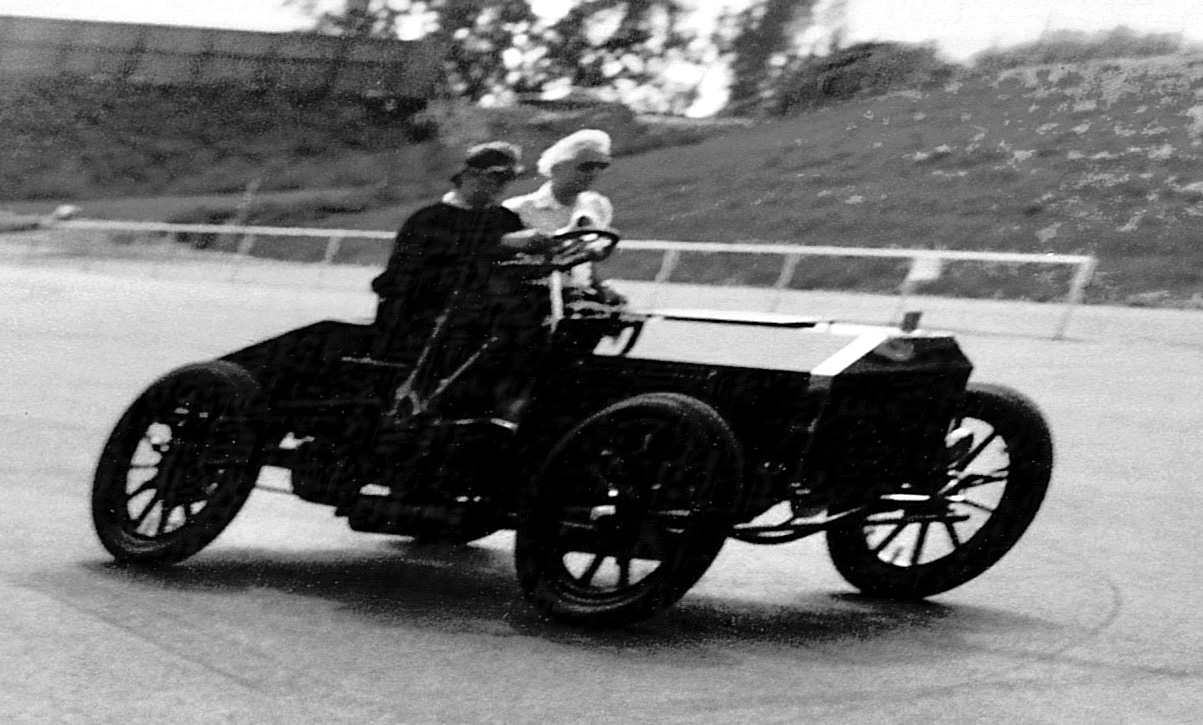
In 1980 Road & Track scheduled a day at the Portland race track where I worked so Phil Hill could test some vintage cars for articles he would be writing. On the appointed day several important old cars arrived including my favorite, a 1902 D50 Napier Gordon-Bennett racer that had been assembled from parts of the actual winner of the race. At the time the car was owned by the Harrah Collection.
By pete
By Pete Vack
Photos by Robert Pauley
From the VeloceToday Archives, October 2017
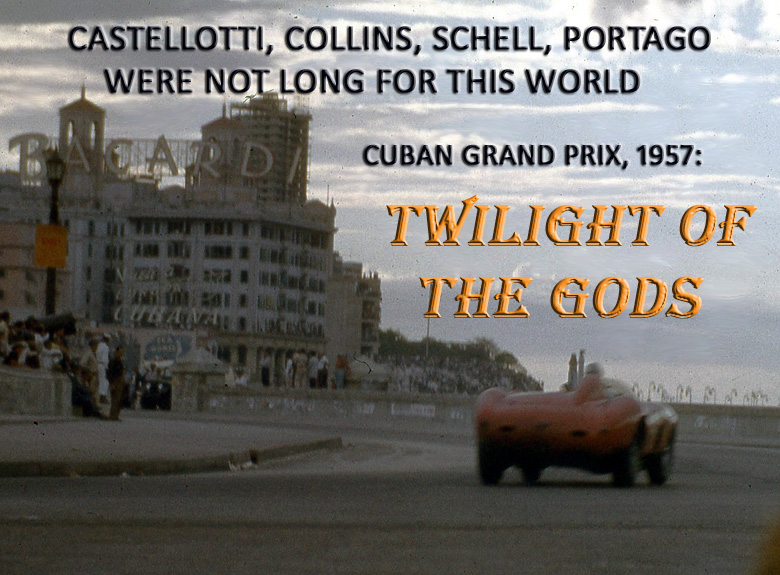
When, in 1957, Robert Pauley wanted to go to Cuba “…to get a chance to see his heroes”, he may well have added “before it was too late,” for he would bear witness to the end of a very great era of motor racing.
It was not the end, not yet. But the Cuban Grand Prix held at the dawn of 1957, was the beginning of the end of an era. Just ahead would be four significant occurrences: the rear-engine revolution, the end of the Ferrari-Maserati wars, the retirement of Juan Manuel Fangio, and the tragic deaths of a high number of first class drivers born between 1926 and 1932. Not only would we lose the hero drivers, but the classic front engine race car, the constant danger, the sportsmanship, and the romance. We need not apologize for borrowing the dramatic title from Wagner…read on and you’ll realize that this was heavy stuff indeed.
By pete

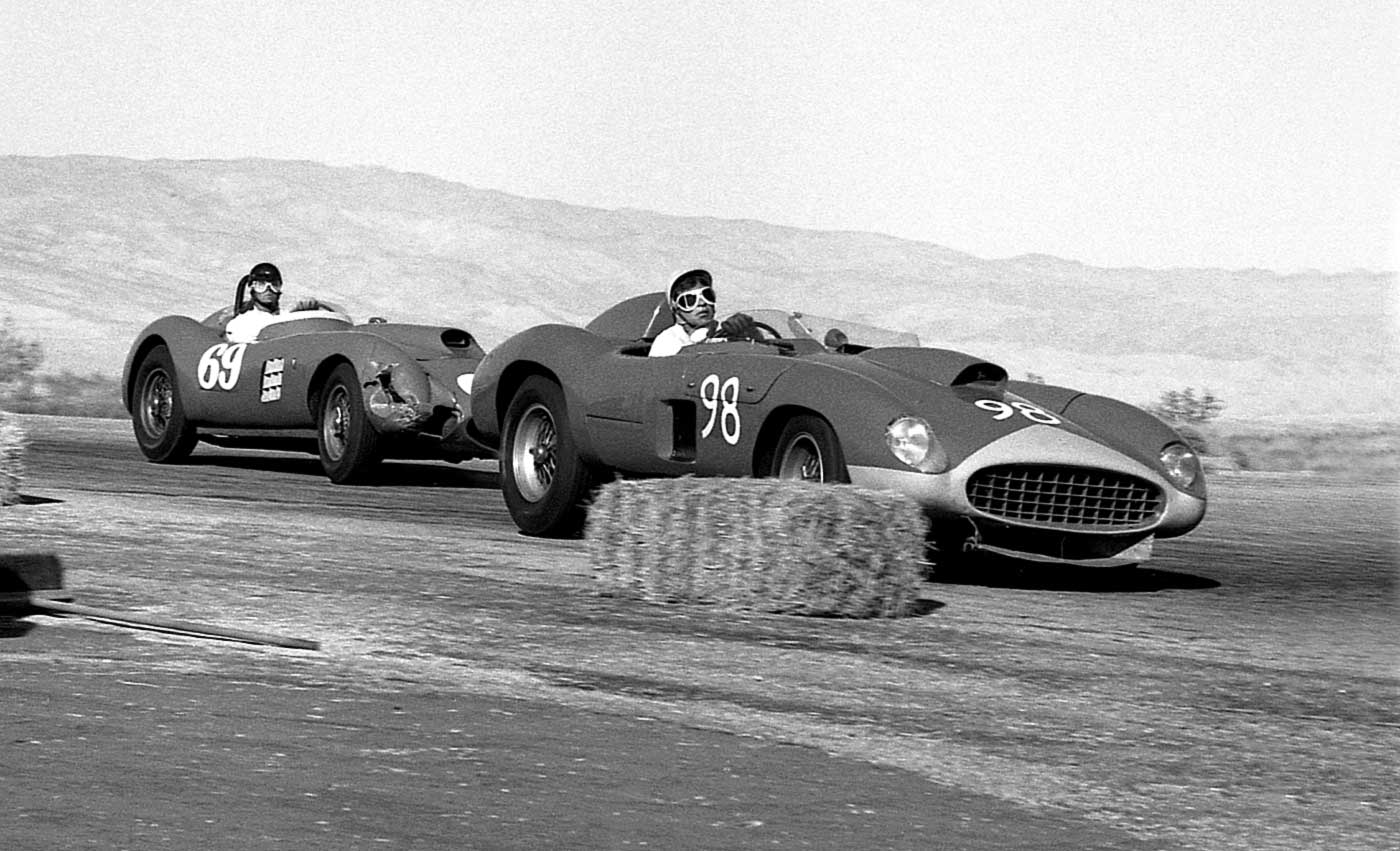
Carroll Shelby in John Edgar’s Ferrari 410S leads Dan Gurney in Frank Arciero’s Ferrari 375 Plus at Palm Springs on April 13, 1958. One of the many photos I shared with the Ferrari Archivist.
Story and Photos by Allen R. Kuhn
From the VeloceToday archives, March, 2022
I would like to start this series of short stories – they are not Galleries as before – by telling a true story about Graham Gauld, and how he saved our skin when we were in Italy/France in 2006 for our seven-week tour of the Continent. The story really began in Maranello, so bear with me….
By pete
Story and photos by Dale LaFollette
From the VeloceToday Archives, June, 2018
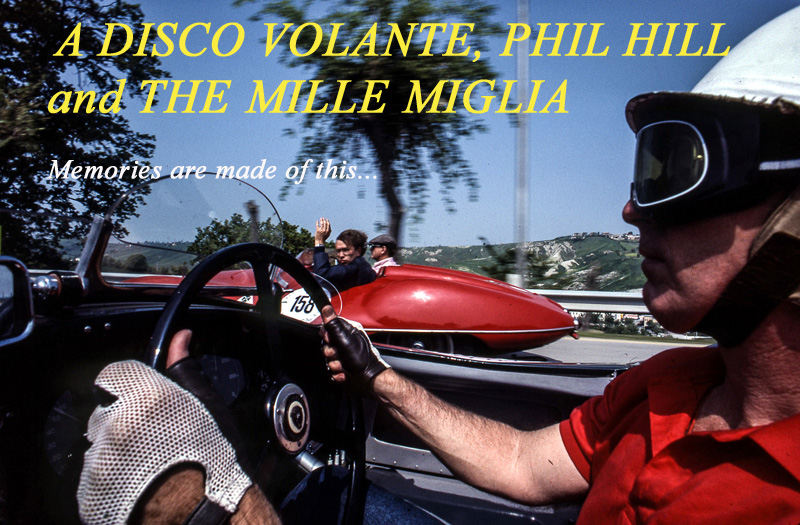
Pete asked me for photos of the Disco Volante so I had to go back to the Mille Miglia Retrospective of 1986. Wow, what wonderful memories that dislodged!
The Disco Volante was being piloted by Phil Hill and John Lamm and I was in a C-Type Jaguar that was owned by my good friend Steve Earle. Our numbers were close to each other so we seemed to be in contact for at least the first full day of the three-day event. Phil and John told me that the Disco belonged to the Alfa Romeo Museum and they seemed a little concerned about the mechanical preparation if memory serves.
By pete
Behold the art of Jim Sitz, an 18-year-old Californian who was already steeped in racing knowledge and an expert photographer when arrived in Europe in the summer of that magical, epochal, dangerous year of 1957. Sitz was not wealthy, but worked and saved for two years in order to afford the trip that would change his life forever. And after 67 years his photographs and memories are still enriching our lives.
We have assembled a portrait gallery of fourteen of the greatest race drivers of the era, adding Jim’s personal recollections including his first-hand report of Fangio’s German Grand Prix. Also herein are Jean Behra, Mike Hawthorn, Luigi Musso, Stirling Moss, Peter Collins, Oliver Gendebien, Ron Flockhart, Archie Scott Brown, Masten Gregory, Wolfgang von Trips, Phil Hill, Harry Schell and Ken Miles.
Story and photos by Jim Sitz
Lead Photo: Masten Gregory (29 February 1932 – 8 November 1985) sitting in the Testa Rossa prototype before the 1957 Swedish 6 Hour on August 11 where the car was retired with gearbox failure. A week earlier at the Nurburgring I joked with him, saying he’d should be very careful and that I’d seen him spin his C type Jag at March Field in 1953. “Oh God, you mean you were there?” he replied. [Read more…] about Jim Sitz: Faces ’57
By pete

Le Mans, June 1965. Saturday 4 PM and in front of a full house, the always spectacular Le Mans-type start. The white Maserati Tipo 65 of Jo Siffert makes the fastest getaway, but up front the Fords manage good starts as well, with Chris Amon [#2], Bob Bondurant [#7] and Bruce McLaren [#1] on the move. [Photo by Flip Schulke, Willem Oosthoek Collection]
By Willem Oosthoek All photos by Henri Beroul [Willem Oosthoek Collection], unless stated otherwise.
After the GT40 successes at Daytona and Sebring in early 1965, it was time to concentrate on the June Le Mans 24 Hours, for which a test weekend was scheduled in April.