Story and photos by Jeff Allison
Jeff Allison continues the series looking at Ferraris he photographed – this time in 1961.
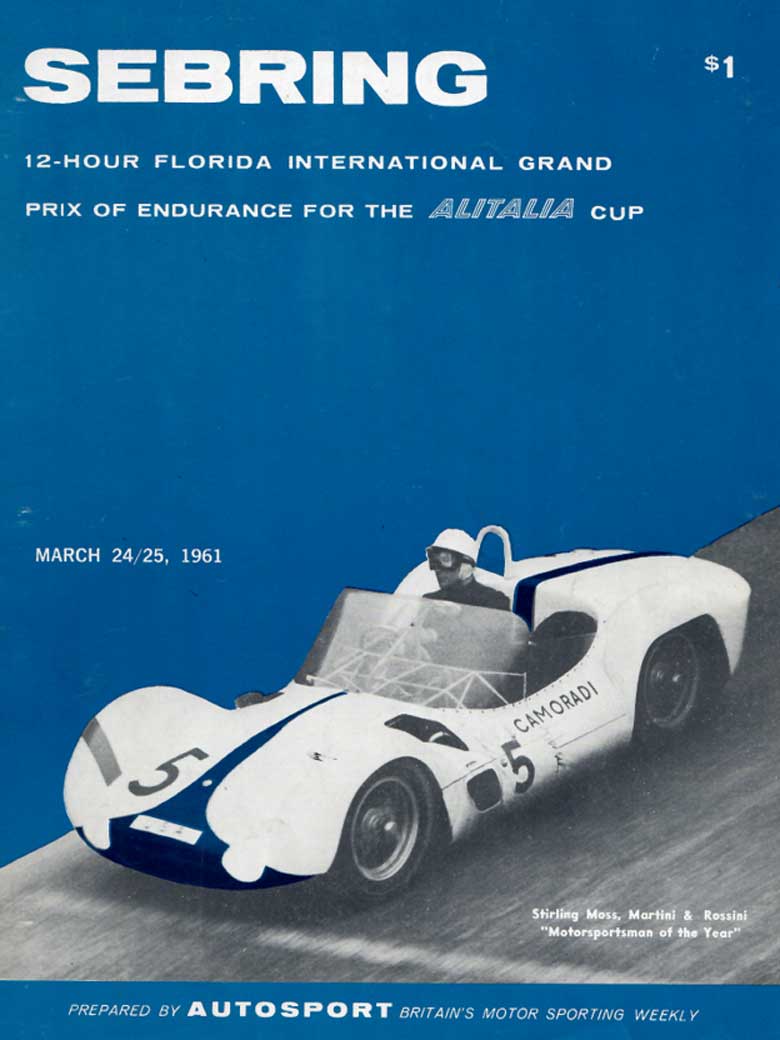
Twelve Hours of Sebring at the Sebring, Florida Airport on March 24-25, 1961
Winners Belgian Olivier Gendebien and American Phil Hill (driving) led six other Ferraris to finishes in the top ten places in their works front-engine 2953cc V12 250 TR61. It was completed in January 1961, and Sebring was its first race. Ferrari had begun to pay attention to aerodynamics, and the car featured a nostril nose, an almost all-enclosing plastic windscreen and cockpit cover, a huge, high-tail using the cut-off tail a la the KAMM aerodynamic theory, and, most importantly, a lip or spoiler on that high tail. Author Eoin Young wrote (CLASSIC CARS, March 2001), “…it was so good that to keep the secret, Ferrari told inquisitive journalists that the spoiler was to take hot air from the cockpit or to stop exhaust fumes from eddying back!” The pair took the lead in the ninth hour when the Rodriguez brothers’ 250 TR59/60 retired, and led to the finish, breaking the distance record by over forty-one miles. It was Ferrari’s fourth overall win at Sebring.
This was a year of transition for Ferrari as they raced a mixture of front- and rear-engine cars. This car, a front-engine 2953cc V12 250 TR60, was a hodgepodge of parts with the Fantuzzi-fashioned nose of a 250 TR60, and, from the windshield back, the bodywork was similar to the new high tail, squared off rear section of the new-for-1961 250 TR61. Italian Giancarlo Baghetti and Belgian Willy Mairesse started the race in this works car and were joined in the fourth hour by American Richie Ginther and German Wolfgang von Trips after their rear-engine Ferrari 246 SP retired. Chassis 0780TR climbed steadily through the field to second by hour seven and held the position to the end – albeit two laps behind the winning works 250 TR61.
The North American Racing Team entered Americans Jim Hall (in car) and George Constantine in this 2417cc V6 246 Dino Sport, which featured independent rear suspension and a sloping high-tail rear with spoiler. The car was raced by the factory at the Targa Florio (second) in 1960 and the Nürburgring 1000KM (DNF) in 1961, and was rebodied to this configuration before going to Luigi Chinetti’s NART. It finished sixth overall and first in the Sports 2500 class by completing 199 laps compared to the 210 laps of the winning Ferrari 250 TR 61 – 11 laps behind.
Originally built in 1958 as a 296 Sport with a 2962cc V6, it was raced by soon-to-be world champion Mike Hawthorn and then by the factory with a V12 engine at the 1958 Nürburgring 1000KM (third). In 1960, Luigi Chinetti was looking for the fastest Testa Rossa he could find for the Rodríguez brothers, and he commissioned Ferrari to build such a car. Using chassis 0746, the factory changed it to right-hand drive, fitted a new Fantuzzi body, converted it to TR59/60 specifications with a 2953CC V12 engine, and dubbed it a 250 TR59/60. The brothers raced it at the 1960 Bahamas Speed Weeks before Sebring. In CAR AND DRIVER (June 1961), Ferrari test and development driver Richie Ginther called their normal-looking car “…kind of a special built by the factory – and a darn good one!” Entered at Sebring by NART, the brothers led frequently until a failed generator and the attendant electrical maladies dropped them to third overall and third in the Sports 3000 class.

Ferrari 250 Testa Rossa 59/60 (Chassis 0746) and Others, Sebring 12 Hours, March 24-25, 1961-jeff-allison
Things get pretty casual during a twelve-hour race and safety didn’t seem to be an item back in 1961. On the far right, one would have thought it was safer to allow errant cars to just run off the track into the “tulies” than to run into a sand bank with the possibility of other errant cars running into the sand right behind them! I was jealous of these souls because they were so close to the cars. Exiting the Webster Turn, the 250 TR59/60 of Mexican brothers Pedro and Ricardo Rodríguez trails an Alfa Romeo, Sunbeam Alpine and MGA as the cars head to Sebring’s outback. My favorite hangout, the Webster Turn, was where I could get close enough for a good look as the brothers’ flogged the car with frantic, opposite lock and aggressive driving.

Ferrari 250 GT SWB Berlinetta (Chassis 2455GT) and Ferrari 250 Testa Rossa 59/60 (Chassis 0766TR), Sebring 12 Hours, March 24-25, 1961-jeff-allison
Talk about Behind the Fences! Americans Hap Sharp (entrant) and Ronnie Hissom, in their #10 2953cc V12 250 TR59/60, move over to pass the slower North American Racing Team #11 2953CC V12 250 GT SWB Berlinetta of Frenchman Fernand Tavano and American George Arents. This photo gives a perspective of Sebring’s wide open spaces even in the middle of the track. Sharp and Hissom were never a factor, finishing fourth overall and fourth in the Sports 3000 class by completing 203 laps – seven laps in arrears to the winning Ferrari 250 TR 61. Later, the NART 250 GT SWB was sideswiped by an Aston Martin DB4GT, losing time repairing the damage but continuing on before retiring with a failed differential.
The Sebring track wasn’t one of the most scenic with a background of airport and industrial buildings like this. This car was a veteran works car that raced at Sebring (DNF), the Targa Florio (DNF), the Nürburgring (fifth and third), the Tourist Trophy (fifth), Buenos Aires (second) and Le Mans (DNF) in 1959-1960, before going to Luigi Chinetti’s North American Racing Team. With Chinetti, it was raced at the Road America 500 (second) and the 1960 Bahamas Speed Weeks (accident) before American George Reed bought it in 1961. Sebring was Reed’s first race with the car and his co-driver was American Bill Sturgis. They finished eighth overall and fifth in the GT +3000 class – 15 laps behind the class winner. The Chevrolet Corvette of Don Yenko follows.
Sports Car Club of America Regional Races at the Bartow, Florida Airport on May 20-21, 1961

Ferrari 500 Testa Rossa C (Chassis 0686MDTR), SCCA Regional, Bartow, Florida Airport, May 20-21, 1961-jeff-allison
The Bartow Air Base closed in 1961, and the Central Florida Region of the Sports Car Club of America took advantage of its availability as a commercial airport. A 3.33-mile, 17-turn road racing course was laid out for the Citrus Century Sports Car Races. Bill Redeker of Clearwater, Florida entered this 1985cc, in-line, four-cylinder 500 TRC. The “C” indicates the car was built to comply with the requirements of Appendix C of the International Sporting Code. It was originally owned and raced in 1957 by Austrian Gottfried Köchert at the Millie Miglia, Nürburgring and Le Mans with mediocre results. Mexican Monolo Perez de la Mesa was the next owner, and it was raced at Cuba, Sebring and the Bahamas Speed Weeks in 1958 before going to Redeker and his partner Ross Durant in 1960. Redeker was fifth overall and first in the E Modified class in the 25-lap, 83.25 mile feature race.

Ferrari 250 GT Spyder California (Chassis 2015 GT), SCCA Regional, Bartow, Florida Airport, May 20-21, 1961-jeff-allison
Vivian Publicker, from Ft. Lauderdale, Florida, raced Alan Newman’s 2953cc, V12 250 GT Spyder California in the 25-lap, 83.25 mile feature race. It was originally owned by Dutch-born Jan de Vroom, who was an early supporter of the North American Racing Team. After racing at the 1960 Le Mans, it was sold to Allen Newman. It raced at the 12 Hours of Sebring on March 24-25, 1961 with Bob Publicker, Gaston Andrey and Augie Pabst, finishing twelfth overall and third in class. Some seven weeks later at Bartow, Vivian Publicker raced it as a novice, and COMPETITION PRESS (June 10, 1961) lists her as a class winner with no further details.
The author attended these races and photographed these and many more cars. His personal knowledge and memory of the events was greatly assisted and reinforced by historian and VeloceToday.com contributor Willem Oosthoek’s seminal SPORTS CAR RACING IN THE SOUTH – TEXAS TO FLORIDA 1961-1962 (2014).


Leave a Reply