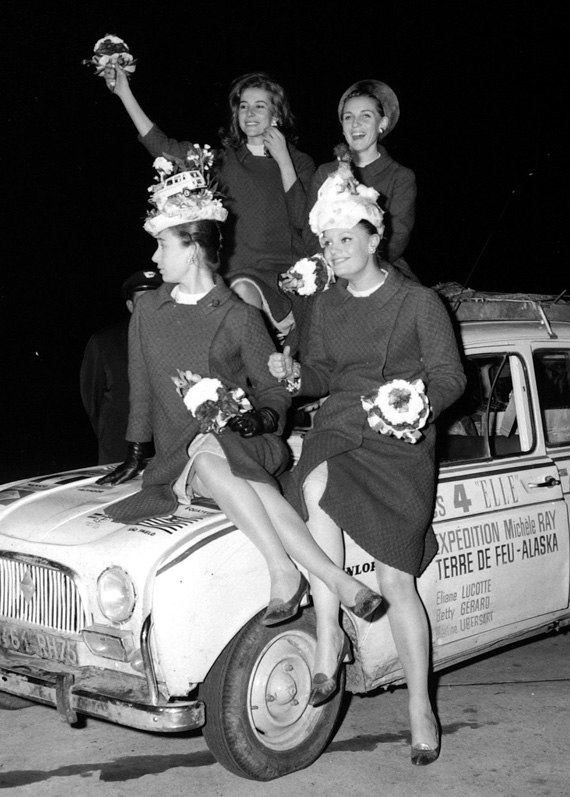
Four beautiful girls, two R4s, and an expedition the length of the Western Hemisphere leave a trail of broken hearts… From the Archives, April 2011
By Roberto Motta
Photos Courtesy of Renault Communications
Renault R4 has allowed generations of drivers the opportunity to take up the challenge of motorsports and to see the world at the same time. This tough little car competed in the 1962 East African Safari Rally (finishing fifth in class), the Monte Carlo Rally, the Expedition Michèle Ray, and the tough 1980 Paris-Dakar, all with success, proving that despite its ungainly looks, it was both reliable and versatile.
As we noted in “Celebrating Fifty Years of the Renault R4”, this small car was a huge social phenomenon. It was also a great commercial success. But the “Regie” wanted more, so to support and increase sales the company decided to demonstrate the reliability and versatility of the R4 with a series of memorable feats. We’ll begin with the 1963 Monte Carlo Rally.
Monte Carlo Rally
In 1963, just two years after the introduction of the R4, a special Super model was entrusted to drivers Jean Pierre Manzon and Hubert Melot for the Monte Carlo Rally. The R4S was equipped with a four cylinder in line engine of 845cc and a four speed gearbox. This car, number 44, was a no-frills model with a few simple modifications: Plexiglas sheets replaced the glass windows to make the car lighter; three high intensity lights were fitted to the front and steel rope was taken along for emergencies. The 1963 Monte Carlo began with 296 vehicles representing 25 nations. For an event in which only 102 cars reached the finish line, the Renault delivered promising results. Despite plowing into a wall of snow, it was one of the few finishers.

The drivers stand beside the R4 during the 1962 Monte Carlo Rally. The team only had a steel rope for emergencies.
She’s in the driver’s seat
In another unique event in 1963, Renault joined forces with the popular women’s magazine “Elle” to launch a campaign entitled “Elle prend le Volant” (“She’s in the driver’s seat”). A total of 4,200 women took part and drove examples of the 4L (Luxury) special edition, called the Parisienne.
It was dressed up for the occasion in cane work and a tartan outfit. In only 48 hours the R4L Parisienne became a proper ladies car, thus increasing its public recognition and number of potential buyers. After the success of the Parisienne, Renault decided to produce more luxurious and urban models, without losing sight of the original “blue jeans” philosophy.
Expedition Michèle Ray
Women now constituted their own market segment. In 1965, Renault management gave its support to an ambitious new adventure involving two R4Ls, four attractive French girls and a 40,000 km journey.

Michèle Ray, Elaine Lucette, Elisabette Gerard and Martine Libersart pose for the cameras before the start of their journey through the Americas.
The event–often referred to in Europe as a “raid”was called the Expedition Michèle Ray-Terre du Fuego-Alaska, and was led by an ambitious and brave young woman by the name of Michèle Ray. It was her idea to drive from Tierra del Fuego to Alaska.
Ray lived in Africa for five years before becoming a model at Chanel in Paris, where she worked for more than two years. In Africa she discovered the challenge and the pleasure of driving cars on all sorts of difficult terrain, driving thousands of miles in a variety of vehicles. She began to look for a new adventure. As she had already conquered much of Africa, she thought about a Paris to Peking trek, but there were too many political and diplomatic problems involved.
Then she decided to re-create the famous 1951 adventure of explorers Jean Raspail and Philippe Andrieu, who traveled down the two American continents in a journey that took the team nine months to achieve.
According to Michèle’s plan, two R4s with four girls would start their raid from Patagonia, the fabled “Land of Fire”, up through Argentina, Paraguay and Brazil (including Mato Grosso in the heart of the Amazon), Bolivia, Peru, Ecuador, Colombia, through Mexico, on through the U.S. and Canada and end up in Anchorage, Alaska. This would provide Michèle with plenty of driving experiences and adventures. Elaine Lucette, Elisabette Gerard and Martine Libersart completed the crew with two girls to each car. Quite naturally, the team would also meet a great number of young men on their journey.
After choosing and preparing the Renaults, the four women attended a three week program in the RNUR workshops (Regie Nationale des Usines Renault) in order to familiarize themselves with the maintenance of their R4s. Adventurers must be mechanics too.

At a press conference the women describe the journey through South America with the remarkable R4s. The strange looking hat is topped with a model of the R4.
However, during the raid, the two R4Ls did not require many repairs. A brake system was damaged at the Buenos Aires Military airport. Another repair was made to a gearbox, which had not been operating properly for about 2000 km, though no discernible reason for the trouble could be found. A windshield was shattered by a stone. After four and a half months, on Friday, October 29th, the four girls and both cars reached Anchorage.
It wasn’t until the raid had been completed and the girls were on the way to meet the Mayor of Montreal that one of the cars had a serious mishap. Michèle Ray was forced to avoid a truck on an icy road, breaking a driveshaft in the process. The R4 did arrive in Montreal, driving a bit like a crab, but the goal was achieved.

Home at last via TWA. The R4 looks a bit haggard but both returned intact. The second R4 can be seen just at the plane door entrance.
With this success, the R4 had proven itself as a car with great reliability and well suited to women drivers. Advertising campaigns focusing on women drivers began in earnest. For the R4, its strength was in its simplicity. It could cover all types of terrain equally well and could be repaired quickly and inexpensively.
Paris Dakar
Even after 1965, there were more long distant success stories. In 1979 the Paris-Dakar rally began, a grueling event still being conducted today. In that first year, 182 cars began the 10,000 km journey to the Senegalese capital; only 42 finished. The small Renault R4 Sinpar (a four wheel drive version of the R4) was driven by Bernard and Claude Marreau and finished a remarkable fifth overall and second in class.
In 1980, the Marreau brothers and their R4 (now with a Renault 5 Alpine engine), placed third, only one hour and ten minutes behind the winners. The Marreau brothers became French heroes and the Renault R4 became a symbol of a car that allowed the amateurs to compete for overall victories.
Renault 4 East African Safari (1962)
Engine: four cylinders in-line, 747cc
Transmission: three-speed manual gearbox + reverse
Brakes: drums all round
Renault 4 Super Rallye Monte-Carlo Rally (1963)
Engine: four cylinders in-line, 845cc
Transmission: four-speed manual gearbox + reverse
Brakes: drums all round
Renault 4 “Elle” (1965)
Engine: four cylinders in-line, 747cc
Transmission: three-speed manual gearbox + reverse
Brakes: drums all round
Renault 4 Rallye Paris-Dakar (1980)
A Sinpar-prepared all-wheel drive Renault 4, with a Renault 5 Alpine engine and suspension.
Engine: four cylinders in-line, 1,397cc (93hp DIN at 6,400rpm)
Transmission: four-speed gearbox + reverse
Brakes: front discs and rear drums


Leave a Reply