• Skip to primary navigation
  • Skip to main content
  • Skip to primary sidebar

VeloceToday.com

The Online Magazine for Italian and French Classic Car Enthusiasts

  • Home
  • Subscribe
  • About
  • Contact
  • Donate
  • As Found

Shuttleworth Festival of Flight Airshow

August 10, 2026 By pete 2 Comments

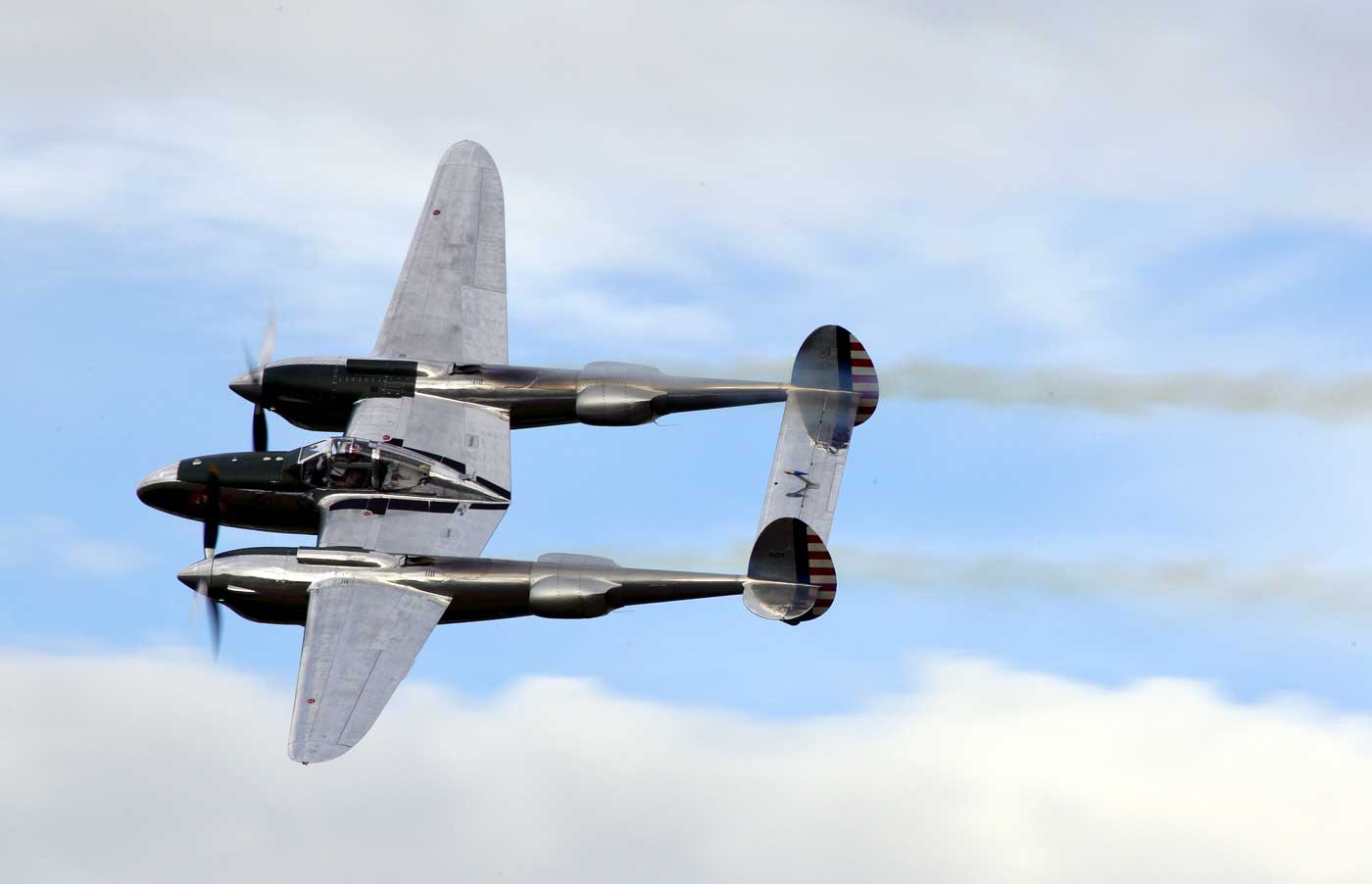
Lockheed P38L-5 SN 44-53254 Lightning. Pure poetry in motion, such grace, such poise, the elegant sound of the twin Allison V12s and definitely my highlight of the show. In fact I would go so far as to say it was one of the best displays I have seen for a long time, and I have been watching planes for many a year.

Story and Fantastic Photos by Jonathan Sharp

The final part of the jigsaw that is my month of visiting the stately homes of England was a visit to the Shuttleworth Estate in Bedfordshire for their Festival of Flight Airshow held over two days the same time as the Heveningham Hall Concours (June 26-28) so it meant another night in a hotel, which this time did have air conditioning as per the British summer of 2026 it was blooming hot. Unlike the October ‘Race Day’ event, the Festival of Flight is just an air show, but Shuttleworth being Shuttleworth meant there were still some interesting non aviation things to see before the flying commenced in the afternoon, as you will see from the following photographs.

As to the flying! What a show, hats off to the team that booked the aircraft. The start for many being an original Messerschmitt bf109 flown over from Germany and making its first appearance at a UK air show. My highlight however, has to be the aircraft from the Flying Bulls’ collection of Salzburg, Austria. It was a shame that the Grumman Bearcat could not make this trip, and their Corsair went tech (broke down) at their temporary base at Duxford on the Sunday, but never mind, we still had their P51, P38 and B25 to enjoy. I hope the following photos give you a taste of what was a great event.

In the air: The Shuttleworth Show
Scroll down for photos of the Messerschmitt 109)

This P51 Mustang ‘Frances Dell’ was constructed by North American Aviation at its Inglewood factory in California in 1944. Placed straight into storage by the USAAF where it remained unused until November 1950 when the aircraft was transferred to the Royal Canadian Air Force and given the military designation 9597. Following its service with the RCAF in 1959, 9597 was registered on the civil register as N9150R in 1960 and then later as N1335. On the 17th March 1963 the aircraft crashed near Indianapolis and in 1970 the FAA revoked its registration. In 1981 the remains were acquired by the well known Reno Air Race pilot Bill ‘Tiger’ Destefani with restoration commencing that same year.

After many years of restoration the aircraft was allocated the civilian registration C-GJCJ in 1987. In 1989 she had a new owner and was operated under the name ‘Glamorous Gal’ by James Priebe. In 2011 another mishap befell the Mustang when the right landing gear collapsed, causing major damage to the landing gear, right wing, engine and propellor. In 2012 the aircraft was sold to Carl Patrick and CP Air LLC in Broomfield, Colorado where, following restoration by Midwest Aero, she adopted the name ‘Frances Dell’ as originally flown by Lt Clark Clemons of the 84th Squadron based at Duxford in Cambridgeshire. In 2020 Frances Dell was acquired by Flying Legends GmbH in Germany.

A unique trio. Hawker Hurricane, Gloster Gladiator, and bf109 E. A sight not often seen in the skies over Bedfordshire.

Flown as a pair to celebrate air racing, be it across Continents, as in the winner of the 1934 MacRobertson air race from England to Melbourne, Australia: the De Havilland DH88 Comet G-ACSS; or Unlimited class air racing around a closed course in the form of the North American P51 Mustang 44-74427 ‘Nooky Booky IV,’ now owned and flown by the Flying Bulls from Salzburg, Austria, but previously flown by legendary test pilot and aviator Robert (Bob) Hoover as ‘Ole Yeller’

Another visiting aircraft to the show but one I managed to capture on its departure back to its home base, the North Weald based ‘Hangar 11 Collection’ of Peter Teichman. PT879, a MK IX Spitfire, left the Vickers Armstrong factory at Castle Bromwich on the 4th August 1944 and was shipped from Cardiff to Murmansk to the 2nd Sqn 767th Regiment 122nd Division of the Russian Air Force under the ‘Lend-Lease’ process, one of 1328 Spitfires supplied to Russia between 1942 and 1945. On the 18th May 1945 the aircraft crashed, possibly during a training dogfight, when it was believed to have collided with another Spitfire, its pilot Lieutenant Grigoriy Vasilevich bailing out unharmed. In 1997 the almost complete airframe was recovered from the tundra by a farmer and moved to St Petersburg, where it was located by Peter Monk in 1998 and after a great deal of negotiation was brought out of Russia to Biggin Hill in 2018 for restoration, with its first flight being on the 28th October 2020.

Simply stunning, 1945 De Havilland DH89A Dragon Rapide in the colours of Scillonia Airways. A proper Gentleman’s express.

The Shuttleworth Collections Avro 504K, built in 1918 as a K variant but converted to a radial engine 504N whilst in RAF service. Later it entered into civil ownership as G-ADEV and in 1940 was pressed into military service taking part in glider towing experiments. After the war it returned to civilian use and was converted back to K specification by Avro apprentices for the film Reach for the Sky and was then donated to the collection. Fully overhauled in 2010 and since 2011 has worn the colours of a night fighter of 77 Squadron based at East Lothian in late 1918.

Nicknamed the ‘Triphound,’ or ‘Trip,’ the Sopwith Triplane was virtually a Sopwith Pup with an extra wing and a more powerful engine. The Triplane retained the manoeuvrability of the Pup but offered an improved field of view for the pilot together with an increased rate of climb and maximum speed. The aircraft entered service in 1917 and was operated exclusively by the Royal Naval Air Service (RNAS). The collection’s Triplane is a reproduction built by volunteer members of Northern Aeroplane Workshops to original plans and is powered by an original Clerget 130hp Rotary engine. Delivered to Old Warden in 1990 when Sir Thomas Sopwith inspected the aircraft, such was the accuracy and quality of the workmanship, that he declared it to be a late production aircraft rather than simply a replica.

Among the visiting aircraft, this 1957 Auster 5 Alpha. G-APBE was awarded as a prize to the winner of a competition in the Daily Sketch newspaper. in 1959 it was purchased by the Experimental Flying Group based at Biggin Hill, who then sold it onto the Thurleigh Flying Group where it was flown by John Lewis, one of the Shuttleworth Collection’s previous chief pilots.

Owned by P & A Woods, this Sopwith Dove is a faithful reproduction built by Skysport Engineering. The Sopwith Dove was developed in 1919 as a civil two seater derivative of the Sopwith Pup single-seater fighter which had achieved much success during the war. In total, Sopwith built 10 Doves, hoping for success in the commercial market

This 1943 Avro Anson is the world’s only airworthy Avro Anson MK1. Built in 1943 at Yeadon, it serviced with No 1 Air Observers School of the Royal Australian Air Force (RAAF) based at Evans Head on the New South Wales Coast, and later the Advanced Flying and Refresher Unit at Deniliquin close to the NSW/Victoria border. In 1953 she was purchased by Greenfields Air Taxis of Albury NSW for the princely sum of £100. During her civil career she won a pylon race at Moorabbin in January 1971 and had a starring role in the 1990 TV mini series Half a World Away, about the 1934 MacRobertson Air Race where she masqueraded as Roscoe Turner’s Boeing 247D NR257Y ‘The Warner Bros Comet.’ Between 2003 and 2012 she was restored in New Zealand by Bill and Robyn Reid before being acquired in 2024 by the RAF Station Czechoslovakia collection. Behind is the Shuttleworth Collection’s Avro C19 Anson, the World’s only airworthy Anson XIX. Both aircraft did display together at the event but alas I had to depart before their late evening display slot.

The Shuttleworth Collection’s ex-Royal Canadian Air Force Westland Lysander wearing the markings of Peter Vaughan Fowler’s aircraft V9367 of 161 Squadron with whom Peter had flown.

Lizzie airborne

The Duxford based Aircraft Restoration Company’s Bristol Blenheim MK1F L6739 (G-BPIV) is the only flying example left of the 4400 examples constructed. Most of the airframe was constructed under license in Canada by Fairchild, entering service with the Royal Canadian Air Force in 1943 where it was known as a Bollingbroke, and saw serve for three years before being struck of charge and stored on a farm. In the mid 1980s the remains of this aeroplane were acquired by the Strathallan Collection in Scotland, before passing to Graham Warner and the Aircraft Restoration Company in 1988, where a full restoration was carried out in the form of a later long-nosed Blenheim IV, with the maiden flight occurring in 1993. Unfortunately, a decade later the aeroplane suffered damage in a landing accident. Early in the rebuild project the team decided to return the aeroplane to flight in the form of an earlier short-nosed example. Luckily the team already had in their possession a viable MK1 nose section. Some 11 years and 25,000 volunteer man hours later, L6739 returned to the skies in November 2014 and she has since gone on to be a stalwart of the warbird scene and an air show favourite.

Blenheim flying

This is Sally B, the darling of the European air show world since the mid 1970s. Sally B was one of the last Boeing B17s built at the Lockheed Vega plant at Burbank and was accepted by the USAAF as 44-85784 on the 19th June 1945. Too late to see war service, she was flown to Nashville for modification to TB17G configuration and used for crew training out of Wright Field from November of that year. Under the care of 2750th Air Bas Group, she was then selected for use as a research aircraft and in 1949 designated as an EB-17G and used for various research roles including, amongst others, being fitted with a man carrying pod on the starboard wingtip.

Meanwhile, in France the Institut Geographic National (IGN) had been using various B17s purchased after the war for mapping and survey work and in 1954 784 joined their fleet, being allocated the French registration F-BGSR. Based in Creil, she carried out work for the French government and others for many years, but by the 1970s it became increasingly harder to obtain spares, so the IGN replaced their B17s with other aircraft types. In 1975, pilot and business man Ted White purchased F-BGSR and ferried her to Duxford in Cambridgeshire via Biggin Hill, to begin her new life as ‘Sally B’. To this day Sally is flown at displays across the UK and Europe as a memorial to the 79,000 US airmen who died fighting in the skies over Europe, and long may she continue in that role.

From the Battle of Britain Memorial Flight of the RAF, Hawker Hurricane MKIIC PZ7865, ‘The Last of Many,’ the final Hurricane of the 14533 built. Originally flight tested by Hawker’s Test Pilot, Group Captain PWS ‘George Bulman’ who, interestingly, had also flown the original Hurricane prototype on the 6th November 1935.

Often called the ‘civilian Mustang,’ the North American Navion was developed just after the end of WW2 as a high performance four seater touring aircraft. In total over 2600 examples were built by North American Aviation, Ryan Aeronautical and TUSCO. Military versions also served with the US Army and Air National Guard. This example, G-EYVZ, is a Navion Rangemaster which featured a redesigned cabin with improved comfort and with wing tip tanks which increased fuel capacity.

Flown at the show as a three ship formation with the Navion and a De Havilland Chipmunk to celebrate the three host nations of the Football World Cup, hence the Sombrero, the Mudry CAP10B is a two seat aerobatic training aircraft first built in 1970. Developed from the Piel Super Emeraude as the CAP100, the name was then changed to the CAP10 for Constructions Aeronautics Parisiennes. This example wears the markings of Mexico’s famous Aguilas Aztecas display team.

Hawker Hurricane XIIa, built in 1942 by Canadian Car and Foundry, the airframe served with several Royal Canadian Air Force units during WW2 before being transferred to 1 Operational Training Unit based at Bagotville, Canada before being struck of charge in 1947. Acquired by The Fighter Collection at Duxford in the 1980s, the Hurricane flew again in 1989 under its civil registration G-HURI. In 2002 G-HURI joined the Historic Aircraft Collection where it was subjected to a major overhaul that was completed in 2004.

In 2005 G-HURI made history being the first Hurricane to return to Malta since the war. On the 11th November 2019, volunteers from the Historic Aircraft Collection formed the Polish Heritage Flight to preserve and share stories of the Polish pilots and crew who came to Britain to fight after their homeland was occupied. Today G-HURI flies in the markings of two 302 City of Poznan (Polish) Squadron Hurricanes that took part in the Battle of Britain on the 15th September 1940 , Julian Kowalski’s P3935 WX-D, and P9254 WX-E as flown by Tadeusz Chlopik. Only Kowalski would return to base that day, Chlopik died when his parachute failed to open near Raweth in Essex.

For many the star of the show. Making its UK air show debut, a genuine 1939 Messerschmitt bf109 E-4, the sole airworthy example of an Emil in Europe complete with an immaculately restored Daimler-Benz 601N engine. Werknummer 1983 is one of a small batch of E-4s constructed by Erla Maschinenwerk GmbH of Leipzig which was shot down near Titovka, northern Russia in 1942.

The collection’s Gloster Gladiator 1 L8032 was the last Gladiator constructed. Built in 1937 but not actually assembled until 1938. The aeroplane wears the markings of K7985 of 73 Squadron RAF, the aeroplane flown by the WW2 Ace ‘Cobber’ Kain at the 1937 Hendon Air Pageant, an event my father probably attended as an 11 year old.

Leading the Balbo the Shuttleworth Collection’s Spitfire Vc together with Nellie B, Frances Dell and the Flying Bulls’ P38. Magic! Balbo is a term used to describe a formation of aircraft in flight, named after Marshall Italo Balbo of the Italian Air Force who flew a squadron of Sea Planes to the Chicago USA before WW2. Up until a few years ago there used to be a big vintage airshow held every year at Duxford in Cambridge called ‘Flying Legends’ the show only featured propellor planes, mainly warbirds from WW2. At the end of the show the used to launch every aircraft that had a pilot and fly the formation, sometimes as many as 25 to 30 aircraft to close the show, this they used to call a Balbo after the Italian Marshall.

This is Nellie B, a P47 D-40-RA Thunderbolt built at the Republic factory in Indiana and allocated the serial number 45-49192. Nellie B’s history with the USAAF is unknown though she did serve with the Air Training Command towards the end of the war. Following war service she was stored at Tinker AFB in Oklahoma with the Air Material Command. Restored to flying status in 1952, and in 1953 she was one of a group of P47s allocated to the Peruvian Air Force for use as a front line fighter and then as a fighter trainer, remaining in service until 1967, Stored in the open until 1969 at Piura Air Base, Peru when it, along with 5 other Thunderbolts and 45 tons of spares, were purchased after much negotiation by Ed Jurist and transported to the USA. Nellie B returned to flight in 1971 and was operated by the CAF at Harlingen in Texas.

Then in 1975 she was purchased by David Tallichet and flown to Barstow-Dagget Airport where she was again stored out in the open. Jumping forward to February 1980 and having been sold to Texan Robin Collard, the delivery pilot had to make a forced landing in a field when the motor failed to deliver sufficient power on take off. Having sustained major damage, Collard, who had wished to restore her, sold her remains plus various other parts including a spare fuselage, to Jon Ward. Four years later the project was sold on again ultimately ending up with the Fighter Collection based at Duxford in late 1984. The Fighter Collection then shipped the airframe to Steve Hinton’s Fighter rebuilds in Chino, California who returned her to flight status, returning to Duxford in the markings of ‘ No Guts no Glory’ in January 1986. Sold back to the USA in 2007 she returned to the UK in 2018 and is now operated by Fighter Aviation Engineering based at Sywell.

From Salzburg the Flying Bulls’ 1945 North American B25J-35-NC serial number 44-868893. Built at the Fairfax plant in Kansas City. Throughout her life she has been an Air Transport Command hack, a radar test aircraft and a fire tanker aircraft used by the US Forestry Service. In 1995 she was purchased by the Flying Bulls and has been an airshow favourite across Europe ever since.

From the Flying Bulls, Lockheed P38L-5 SN 44-53254 Lightning. Oh, and talking about air shows from way back, to our American readers I say perhaps you fondly remember seeing a white painted Lightning gracing the skies of the USA, Well that plane, ‘White Lightning’ as flown by Marvin L ‘Lefty’ Gardner, is actually this plane, the Flying Bulls having purchased N25Y and had her restored following her crash in 2001.

On the ground, a few from the Shuttleworth Collection

The Shuttleworth family’s fortunes grew from the manufacturing of steam traction engines and farming machinery and the such like. This combination, which was running throughout the morning of the air show, is made up of a 1890 Clayton & Shuttleworth ‘Hayes Patent Straw Elevator,’ a 1919 Clayton & Shuttleworth Threshing machine driven by a 1908 Clayton & Shuttleworth 4HP portable steam engine, number 39959.

Also chuffing away all morning and making a lovely smell to boot, was this 1919 Clayton & Shuttleworth 6 nhp General Purpose Engine “Phoenix.” Works number 48279 was exhibited at the Royal Agriculture Show in Cardiff and the Devon County Show before being supplied to the Swimbridge Threshing Co of North Devon.

Now owned by Tate & Lyle, this 1914 McCurd Model C is the sole survivor and was featured in the film Chitty Chitty Bang Bang. Wallace Atherton McCurd was born in Edinburgh in 1876 but by 1901 was living in Newington, London. A civil engineer by trade but also a second hand car dealer, in 1905 he formed a limited company W.A.McCurd Ltd to buy, sell and manufacture vehicles. In 1912 the company, by now McCurd Ltd, entered the commercial vehicle market by manufacturing the 3 1/2 ton Model C which was said to be of simple design and driver proof. The buyer could specify various body styles including a bus, lorry, or van. The company continued to manufacture commercial vehicle and motor cars until 1942.

Lawrence ‘Lawrie” Bond (1907-1974) was a designer/engineer born in Preston, Lancashire who served his apprenticeship with Atkinson & Co, manufacturers of steam wagons, and later worked for Meadows Engineering. In 1944 he formed his own company, Bond Aircraft and Engineering Co, and made aircraft and vehicle components for the war effort. When his military contracts came to an end he produced his own 500cc single-seater racing car, the ‘Doodlebug’, a Type C Formula 500 racer, and in 1948 his first two seat three-wheeler, the Bond Minicar. He announced the Bond Minibyke in 1949. With post-war steel production prioritized for export, the Minibyke was constructed mainly of aluminum and was powered by a 98cc Villiers two stroke motor, giving the Minibyke a top speed of 45 mph and up to 200 mpg. In total 750 were constructed.

Tagged With: B25, Jonathan Sharp photo, Me 109, Messerschmitt bf109, P38, P51, Richard Shuttleworth, Shuttleworth air show, Shuttleworth collection

Reader Interactions

Comments

  1. Tim Parker says

    August 10, 2026 at 7:42 pm

    Fabulous! I was born within the sounds and smells of Duxford. Today, as I was devouring Sharp’s photos on my lap top there was piston-engine something – cannot see because of the trees – hot dogging it round and round close to Lake Elmo airport, Minnesota. Sight and sound together once more. Very lucky.

  2. Brandy Elitch says

    August 10, 2026 at 8:08 pm

    The photography here is beyond extraordinary. It is amazing. I cannot imagine being able to get those shots myself. This is world class photography.
    As an aside, as a Bristol owner, I really appreciated the shot and biography of the Bristol, never having seen this before.

Leave a Reply

Your email address will not be published. Required fields are marked *

Primary Sidebar

     SIGN UP BELOW TO RECEIVE VELOCETODAY EVERY WEEK FOR FREE


       EXCLUSIVE ARTICLES ABOUT 

    EXTRAORDINARY AUTOMOBILES

PositiveSSL

Recent Posts

  • VeloceToday for August 11, 2026
  • Shuttleworth Festival of Flight Airshow
  • Fiats & Friends at the British Motor Museum
  • Hail the Testadoro, again
  • The Swift Life of Archie Scott-Brown
  • Concorso Italiano returns to Bayonet Black Horse Golf Course on Saturday, August 15
  • Goodwood Festival of Speed Part 2
  • Heroes of the Forest Reviewed
  • An Artist at Road America
  • Classics at Royal Highland Showground
  • 250 F Discussion Part 2: Owner’s Manual
  • Goodwood Festival of Speed 2026
  • Royal Automobile Club Concours 2026
  • Concorso Italiano Updates
  • 1928 Amilcar: French Joy
  • Ferrari Behind the Fence: Sebring 1961
  • 2026 Royal Automobile Club Concours
  • The Maserati 250 F: Discussion and Review
  • Heveningham Concours, 2026
  • The Bora Gets a New Lease on Life
  • Hillsborough Concours de Elegance 2026
  • The Annual Bastille Day Rally and Rendez-Vous, circa 2017
  • Spa 24 Hours 2026
  • 2026 ‘Simply French’ Car Meet at Beaulieu
  • Wilton House Part 2
  • Expedition Michèle Ray and the Renault R4
  • Wilton House Concours 2026
  • Little Things Mean a Lot
  • Classic Panoramic Headgear
  • About Time: Rodney Diggen’s Art

Copyright © 2026 · VeloceToday.com · Privacy · Sitemap

MENU
  • Home
  • Subscribe
  • About
  • Contact
  • Donate
  • As Found