Story by Gary Axon
Images courtesy of Dario Pasquali
At last month’s sell-out 2026 Goodwood Festival of Speed (FoS), in among the multitude of major and important new car launches the revival of an obscure Italian marque at the event went largely unnoticed. Virtually unknown, even to Italians and most motoring enthusiasts, the long forgotten Italian Testadoro sports car brand made its international revival at FoS, 80 years after the Torinese marque was originally founded in 1946 by car loving motor racing participant Giorgio Giusti under the ‘Case dell’Auto’ heading.
Although Testadoro follows in the wheel tracks of Abarth, De Tomaso, Bizzarrini and various other once-dormant car marques in using Goodwood as the most fitting occasion to relaunch its brand to a global audience of automotive enthusiasts, Testadoro is possibly the least known of these revised names.
Unlike Abarth, De Tomaso et al, however, Testadoro never quite achieved international fame, building just nine cars in Turin during its very short four year career. This was despite famous names such as Nuccio Bertone, Elio Zagato, Uno Puma and Gino Valenzano all officially driving for the ‘Squadra Testadoro’ works racing team and winning races.
During its short life, Testadoro enjoyed many motor racing successes and produced no less than four distinct models, the latter three all created by Zagato with hand-crafted coachwork. The original 1947 Testadoro 750 Sport two-seater barchetta participated in the most important Italian post-war races, using contemporary Fiat 500 Topolino running gear, modified by Giusti to 660cc with a special tuned ‘Testadoro’ (Bronze head in Italian; the name chosen due to the characteristic gold colour of the modified Fiat cylinder head) to produced a vastly more potent 63bhp.
The Topolino B furgone (van-) based 750 Sport was soon joined in 1947 by the Zagato-bodied Drin-Drin with an advanced tubular chassis construction. These were followed with the 742cc sports racing Marinella ‘Siluro’ in 1948 and the last Testadoro model – the Daniela – in 1949.
The Testadoro name then laid dormant and forgotten until 2021 when local Torinese manager, artist and motoring enthusiast Dario Pasqualini rediscovered the brand and chose to revive it, with his key aim of using only local Turin craftsmen capable of hand-beating and shaping metal and aluminum car bodies. Once Pasqualini had obtained all of the appropriate permissions and blessings for Giorgio Giusti’s family, he was able to achieve his strong desire of revive the coachbuilding skills that used to be widespread and once typified the art of the fine and famed Torinese ‘carrozzeria’ workshops.
Famous and influential Italian vehicle stylists and coachbuilders Elio Zagato and Nuccio Bertone both cut their motor sport teeth racing a Testadoro in the late 1940s, with Zagato eventually winning the 1949 Giro della Sicilia (Tour of Sicily) in a 750 Sport. Yet this, plus multiple competition victories after the closure of the brand, failed to make Testadoro a well-known household name.
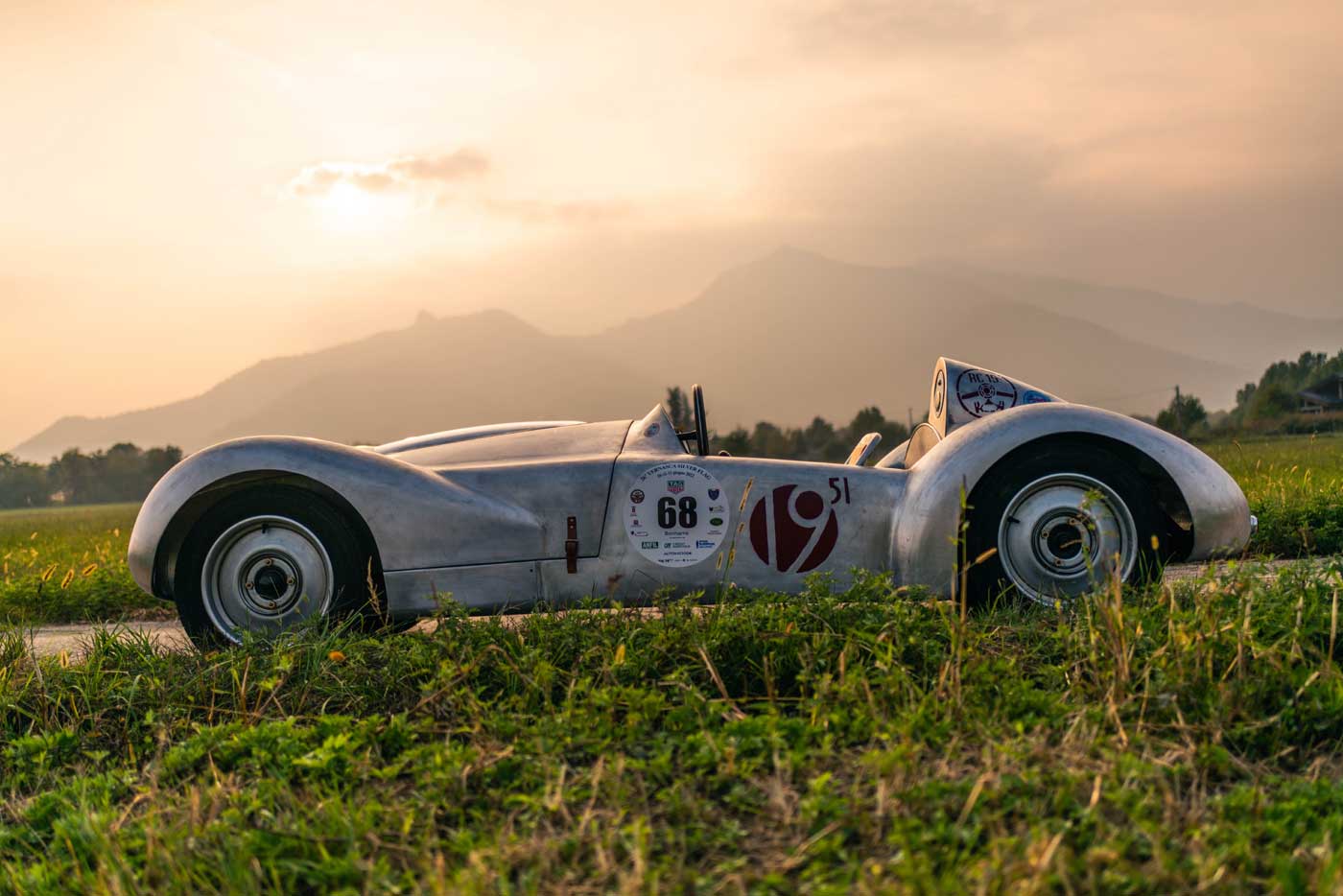
Despite Giorgio Giusti ceasing all Testadoro racing activities in 1949, in 1951 he designed a stillborn Barchetta with flowing open coachwork. Seventy years later Dario Pasqualini had this Barchetta 1951 recreated in 2021 by local Torinese carrozzeria Martelleria Giacometto using traditional hand-beaten aluminium panels, taken from Giusti’s original drawings for the model which was never completed. Pasqualini then modelled a second ‘new’ Testadoro in 2023 – the eight-cylinder Berlinette Essenziale – during a six-month live workshop performance at Turin’s Museo Nazionale dell’Automobile, to help demonstrate the traditional handcrafted panel beating of its unpainted aluminium coupe bodywork.
Fast forward to July 2026’s Goodwood Festival of Speed and a new, production-ready bespoke Testadoro Siluro made its international debut on the CAI (Caerbont Automotive Instruments Ltd) stand, current custodians of the famous old British Smiths Instruments brand.
An open two-seater with distinctive styling, intended to evoke the allure of a 1950s roadster, the new hand-crafted Testadoro combines modern technology and reliability, utilizing an ultra-lightweight alloy body allied to a Caterham SuperSeven steel tubular spaceframe chassis, developed by Caterham Cars in Dartford, Kent. Weighing just 600 kg, the SuperSeven-derived Testadoro uses a 175 bhp Ford 2-litre engine, this base unit being chosen as it is easy to service and find spare parts, and is already fully homologated for sale in Italy, plus most of the rest of the world, benefitting from modern technology such as disc brakes. Prices have yet to be confirmed due to the bespoke nature of each Testadoro build.

More information can be found here: https://www.testadoro.com/


Leave a Reply