• Skip to primary navigation
  • Skip to main content
  • Skip to primary sidebar

VeloceToday.com

The Online Magazine for Italian and French Classic Car Enthusiasts

  • Home
  • Subscribe
  • About
  • Contact
  • Donate
  • As Found

The Bora Gets a New Lease on Life

July 13, 2026 By pete Leave a Comment

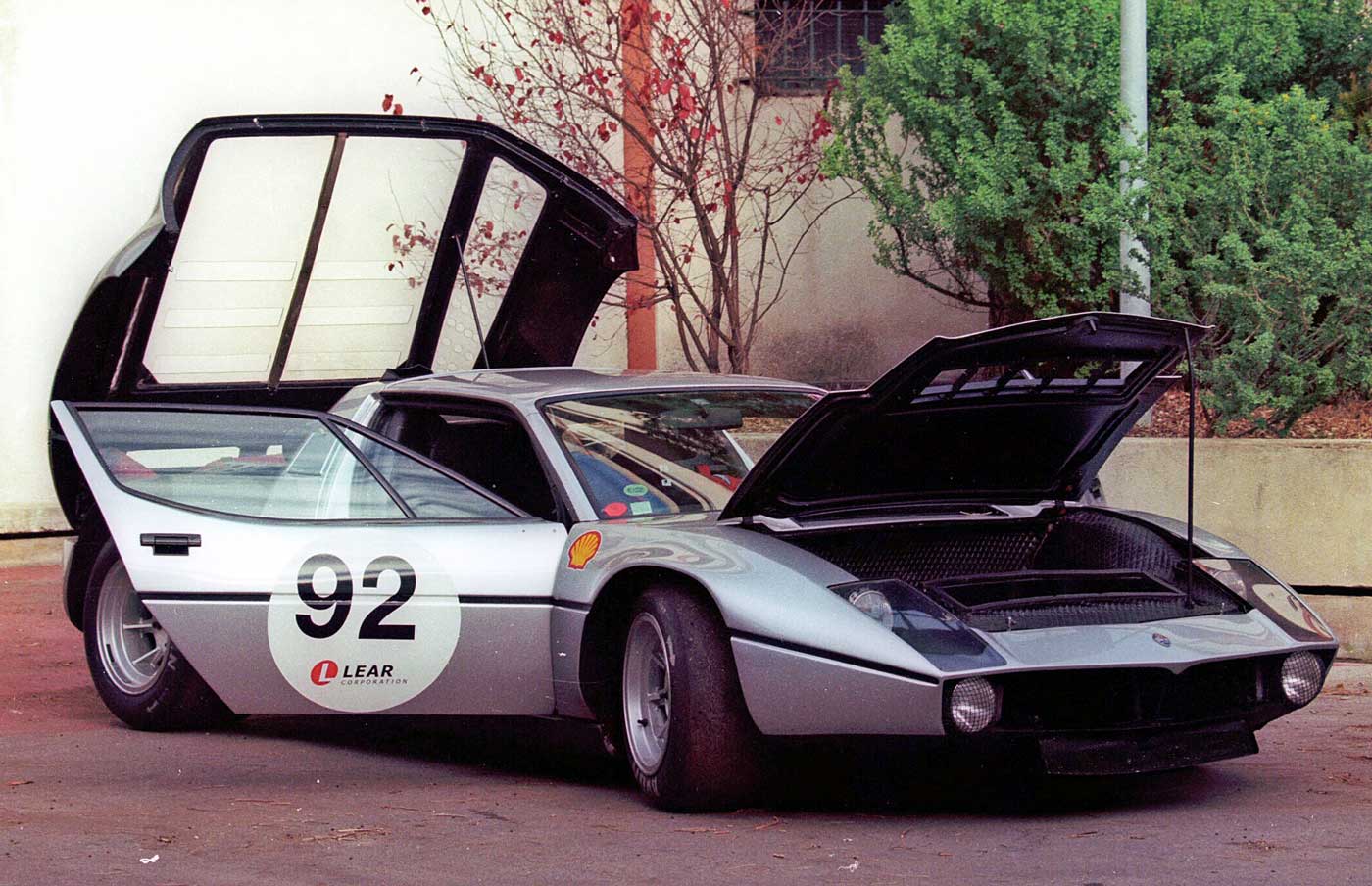
One of just two racing Maserati Bora racing models built. ( Photo Grand Prix Library/Gauld)

Story and photos by Graham Gauld

For Jean Guikas, the French race car collector and dealer, two victories in the European Shell Ferrari-Maserati Historic Challenge finals at Vallelunga in November 1999 brought a happy conclusion to his quest to prove that the 1973 Group 4 Maserati Bora was a winner.

Fifty three years ago the excitement and enthusiasm of producing two special competition Maserati Bora’s was dampened by new rules and regulations which meant they could not be homologated for international racing. That appeared to be the end of the story but it was only the beginning.

To understand what happened we must remember the state of Maserati and the world motor industry in the early 1970’s. Maserati had been having a tough time and, unlike Ferrari, did not have Fiat to fall back on.

So in 1968 Omar Orsi signed a commercial agreement with Citroen which not only guaranteed the continuation of production in Modena but an increase in the production of engines, and the development of the C114 engine destined for an up-market Citroen, the SM.

By 1973 the economic recession in Europe really hit home, Maserati were faced with industrial unrest and sales were down. They had the stunning new Bora coupe and in Paris, Philippe Cornet Epinat, a wealthy enthusiast, saw the potential of the Bora as a racing coupe.

He already owned a Ferrari Daytona and felt that a properly prepared Bora would be quicker and a much more modern car. He approached Thepenier, the Maserati distributors in Paris, and as a result two competition Bora’s were ordered from the factory.

Due to general state of affairs at Maserati both cars were built by the mechanics after normal factory hours and the first of these, chassis number AM117/3000, was tested at Monza then delivered to Paris. The idea had been for the car to be driven in the Tour de France rally and Le Mans. French grand prix driver Francois Migault had been engaged to do the testing.

Homologation of the cars for International racing was still pending when the Tour de France organizers introduced a Special class in the event which meant the car could, in fact, take part. However, Migault was seriously injured in a road accident and the car did not start.

Unfortunately negotiations with the FIA saw a letter arriving in September that year to say that as Maserati had not produced the minimum 500 Boras for sale to the public the car could not be homologated.

By this time the second chassis AM117/3001 had been delivered to the Thepenier company in Paris.

When the CSI then reduced the minimum production rate to 250 cars for 1974, the plan was to run the cars at Le Mans that year. Migault tested the cars on the little Bugatti circuit at Le Mans but once again homologation problems caused plans to be shelved.

Jean Guikas photographed in 1999 with the Bora. ( Grand Prix Library/Gauld)

Chassis 3001 literally lay for two or three years at Thepenier’s shop but he had never actually paid for the car, so Maserati took it back and promptly sold it to their Saudi Arabian distributor.

Again the car lay in a showroom for about 10 years before being shipped to the United States. It eventually arrived in the hands of Bob Rubin, the well- known collector.

Meanwhile, chassis 3000 stayed with Thepenier until the company got into financial difficulties and Philippe Cornet Epinat reclaimed the car.

Epinat then decided it would make an interesting road car and detuned it by adding a thick cylinder gasket and lowering the compression to 8:1, which made the car more tractable but reduced the power output from over 400 bhp to around 280 bhp.

Bob Rubin decided to put his Bora competition car (3001) up for sale at Robert Brooks’ first Monaco Auction in May 1990, but it did not reach its reserve and returned to the United States.

Enter now Jean Guikas who negotiated a price from Bob Rubin and brought the car back to France. Meanwhile Guikas, who was always on the lookout for interesting cars, had kept in touch with Epinat and wanted to buy chassis (3000) and eventually managed to buy the car in 1993.

This meant that Guikas now owned both of the Bora competition models. He entered (3001) for the Historic Tour de France in 1993 with co-driver Francois Fabre.

Meanwhile (3000) had arrived from Cornet. Epinat had painted it red and it was still with the street settings, so the first thing Guikas did was to repaint it silver, its original color, and then set about preparing it to race.

The competition Bora was a proper Maserati racing car and indeed was the last true Maserati racer built in Via Ciro Menotti. The ad-hoc team of mechanics started from scratch looking to reduce weight by the standard method of drilling the chassis full of holes. Open the hood and you are faced with dozens of holes drilled in every chassis member, even down the the Perspex rear side windows. The steel roof was removed and replaced with an aluminum panel and the same was done to the trunk lid.

Giorgietto Giugiaro designed the original Bora bodywork and though the competition model looked lower and meaner it kept close to the Giugiaro style. In the end the car turned the scales at just 2700 lbs. or 992 lbs. lighter than the road version! Jean Guikas planned to peel another 150 lbs off the car by changing all the side window glass for Perspex, using a lighter battery and all the other usual tweaks.

For those two competition racers the normal 4.7 liter Bora engine was exchanged for a 4.9 liter out of the Ghibli, and there were many other changes. For example, the normal Bora Citroen-based disc brakes were exchanged for big four pot discs with aluminum calipers similar to those used on the Lola T70. However the braking system retained the Citroen servo system so that one touch of the brakes and they are likely to lock up hard.

The 4.9 liter dry sump Ghibli engine is tucked well into the centre of the car to give the best weight distribution.
(Grand Prix Library/Gauld)

The regular 42mm Weber carburettors were dropped in favour of huge Webers. Another interesting addition to the competition car was a separate oil radiator at the offside rear of the car fitted with two electric fans controlled from the cockpit to keep the gearbox oil cool; and to improve the handling they were fitted with huge anti-roll bars, springs and shock absorbers.

Here Jean Guikas takes up the story :

“ Early in 1999 the Ferrari factory telephoned me and told me that, as the Historic Challenge that year would include Maseratis, my Bora would be eligible to race. So without really touching anything I took chassis 3000 to Spa for the first round.

“Remember, the car had been detuned by Cornet Epinat to drive around Paris and I just put fuel into it and drove it as it stood. With just 280 bhp I was being passed by the short wheelbase Ferraris!

“When my mechanic and I returned from Spa we took the engine out and found it was running on an 8:1 compression ratio, or the same as a Renault 5 sedan, so we started to make new pistons, but stuck to the same camshaft because it was too late to do any more before Nurburgring. The engine used in these cars was the 4.9 liter Ghibli dry sump engine and we had 50 IDA Weber carburettors, big valves, and were now producing around 440 bhp. Again, for a 5 liter engine this was still only 88 bhp per litre and my mechanic says that if we were to develop the car with a lighter crank and conrods we could maybe reach 520-540 bhp.

“A funny thing happened after Spa. We could not check out the horsepower as my mechanic’s dyno was not working, so we decided to leave Nice early one morning and take the engine in our Renault Espace to Maranello and put it on a friend’s dyno. This friend remarked that he knew an old mechanic from Maserati who lived nearby and was a demon on carburation. So we phoned him but he was out. His wife told us she would send him along to see us and two hours later this little old man came to the shop on his bicycle. He took one look at the engine and said ‘this is my engine’ and then explained that he had been the development engineer on the project and had developed 12 different versions of the Bora Maserati engine. He then asked “what compression are you running?’ and when my mechanic Gerard replied ‘ 11:1’ the old man replied “….over 10,500 rpm the engine will break” and at that he climbed on his bike and cycled off. Two hours later he came back with a big book with all the information and photos of the development of the Bora which Aurelio Bertocchi had tested at Monza.”

During 1999 Jean Guikas proved what had never been proved all those years before; that the Maserati Bora corsa was indeed something special and a race winner against the Ferraris.

Tagged With: Ferrari Historics 1990, Graham Gauld, Jean Guikas, maserati bora, Maserati Historic racing, Maserati Racing Boras

Reader Interactions

Leave a Reply

Your email address will not be published. Required fields are marked *

Primary Sidebar

     SIGN UP BELOW TO RECEIVE VELOCETODAY EVERY WEEK FOR FREE


       EXCLUSIVE ARTICLES ABOUT 

    EXTRAORDINARY AUTOMOBILES

PositiveSSL

Recent Posts

  • VeloceToday for July 14, 2026
  • Heveningham Concours, 2026
  • The Bora Gets a New Lease on Life
  • Hillsborough Concours de Elegance 2026
  • The Annual Bastille Day Rally and Rendez-Vous, circa 2017
  • Spa 24 Hours 2026
  • 2026 ‘Simply French’ Car Meet at Beaulieu
  • Wilton House Part 2
  • Expedition Michèle Ray and the Renault R4
  • Wilton House Concours 2026
  • Little Things Mean a Lot
  • Classic Panoramic Headgear
  • About Time: Rodney Diggen’s Art
  • Behind the Fence: Ferrari, 1960
  • London Concours 2026 Part 2
  • Ode to the Sportscar
  • 24 Hours of Le Mans 2026, Hypercars
  • 24 Hours of Le Mans, LMGT3 and LMP2
  • London Concours 2026
  • The Ups and Downs of the Sleeve Valve Engine
  • Fuori and Friends, 2026
  • Road America Circa 1958, Modifieds
  • Terre di Canossa Rally 2026
  • And How!
  • Villa d’ Este 2026 Classes A-D
  • Villa d’ Este 2026 Classes E-H
  • Hugues Vanhoolandt at the Spa Classics
  • Valletta Concours d’Elegance
  • Behind the Fence: Ferrari, 1959 Part 2
  • Road America, Circa 1958

Copyright © 2026 · VeloceToday.com · Privacy · Sitemap

MENU
  • Home
  • Subscribe
  • About
  • Contact
  • Donate
  • As Found