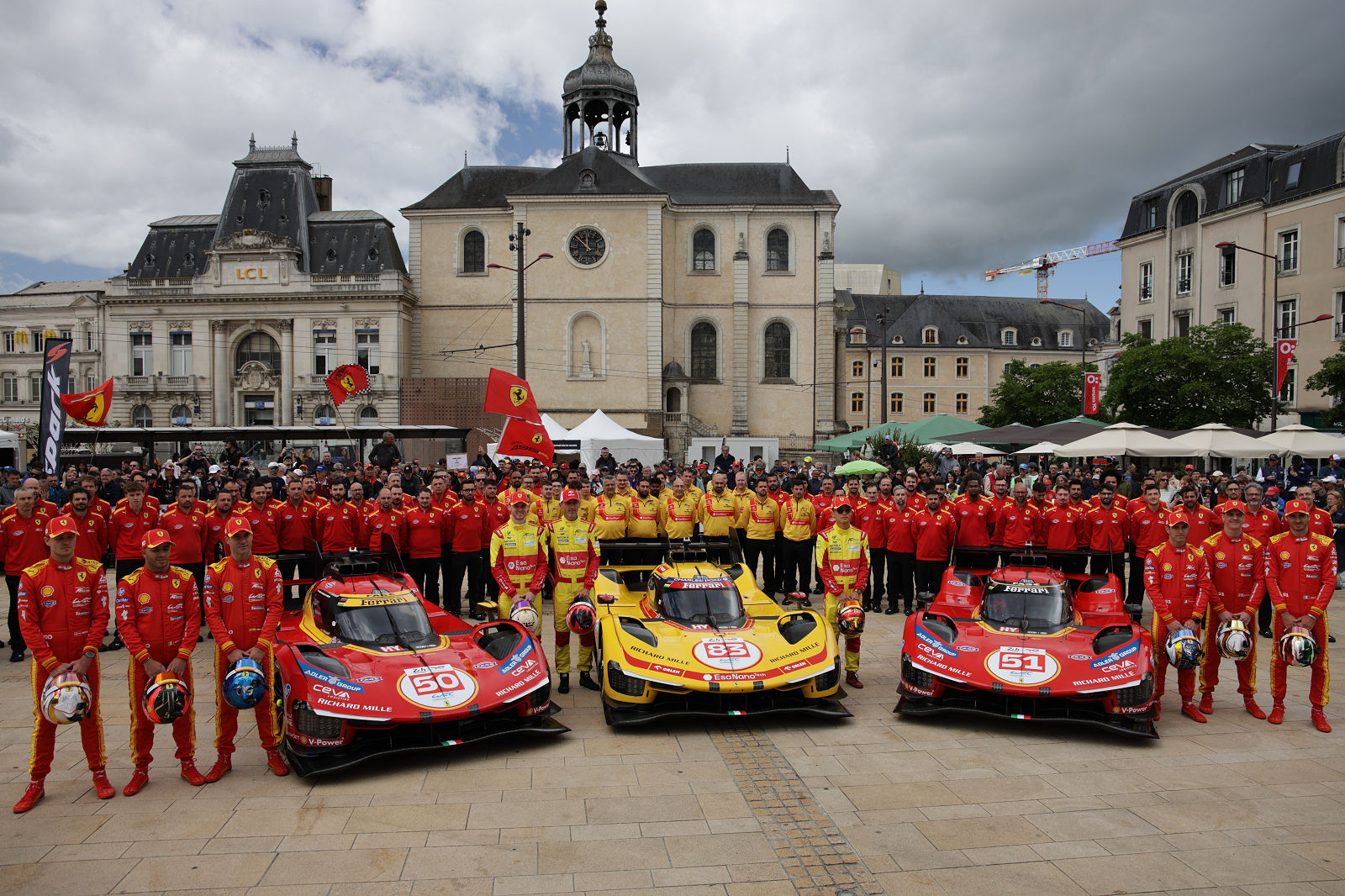
The three-time defending champions, representing the hopes of the Maranello firm thanks to the 499P, which is already making its fourth participation.
Story and photos by Hugues Vanhoolandt
This latest edition of the 24 Hours of Le Mans posed a crucial question: would Ferrari achieve a fourth consecutive victory, following the wins of the #51 in 2023, the #50 in 2024, and the #83 last year?
One initial indication was that Ferrari’s start to the season in the WEC championship hadn’t been as spectacular as in 2025, when the 499P dominated. The 499P’s best result in 2026 was a second-place finish at Imola.
From the practice sessions onward, it was clear that the Ferrari lacked a bit of performance, and this was confirmed in the race. Furthermore, technical issues and driver errors only exacerbated the performance deficit. The result was a race unlike previous years, where the leading manufacturers were Toyota, BMW, and Cadillac, who traded the top spot in turn. Let’s take a look at the entries through images.
Toyota

During the official photos in downtown Le Mans, all the teams were full of optimism. With Toyota not having won since 2022 and the arrival of numerous manufacturers including Ferrari, the pressure was on the Japanese team, based in Germany.

From the start of the race, the #7 Toyota employed an alternative strategy, refueling very early, allowing it to run without traffic and therefore be faster. In the end, the victory went to the #7 driven by Mike Conway, Kamui Kobayashi, and Nick De Vries. This is De Vries’ first Le Mans win.

The sister car, #8 of Buemi, Hartley, and Hirakawa, applied the same strategy but suffered a drive-through penalty and some brake problems. It had to settle for third place overall, which completes an excellent result for the Japanese manufacturer.
BMW

The #20 BMW posed the main threat to the Toyotas. Consistently at the front, it missed out on a second overall victory for BMW by less than 11 seconds, following their win in 1999. This second place is nevertheless an important result for BMW in the championship standings.

The BMW M Hybrid V8 #20 of Frijns, Rast and S. Van der Linde, winner of the 6 Hours of Spa, undergoing pre-race technical checks.

The #20 BMW posed the main threat to the Toyotas. Constantly at the front, it missed out on a second overall victory for BMW by less than 11 seconds, following their win in 1999. This second place is nevertheless an important result for BMW in the championship standings.

The #15 BMW had started from pole position, thanks to Belgian driver Dries Vanthoor. A collision with an LMP2 car early in the race forced it to complete a full lap at low speed, destroying any chance of a good result. A further technical problem also led to its retirement.
Cadillac

3442: The entire Cadillac team Jota in the Place de la République in Le Mans, full of hope at the time of the official photo.

The #38 Cadillac V-Series.R, consistently at the front, had a frustrating weekend. Having set the fastest time in qualifying thanks to Jack Aitken, it was disqualified for a regulations violation. Returning to the front during the race, it was forced to retire during the night due to a steering failure, once again denying local driver Sébastien Bourdais a potential victory that has eluded him for so many years.

It was up to the #12 car of Deletraz, Stevens, and Nato to brilliantly defend the colors of the Detroit manufacturer. But it wasn’t enough to reach the podium, with the #12 finishing in fourth place, 32 seconds behind the leader.

The third Cadillac entered, fielded by Waye Taylor Racing in the IMSA championship throughout the year, was at the front early in the race before gradually dropping back down the order, notably due to some penalties. It ultimately finished ninth.
Ferrari

After technical checks and official photos, some competitors, like the Ferrari #51, perform a short demonstration in the historic heart of Le Mans, here at the foot of Saint-Julien Cathedral.

The #51 of Pier Guidi, Calado and Giovinazzi, winners in 2023, will be the best representative of the Prancing Horse firm, finishing fifth. Like its sister cars, it won’t have the speed to challenge for the win and will also be penalized with a drive-through penalty following a collision with an LMP2 car.

The #50 of Fuoco, Nielsen, Molina, the 2024 winners, will be delayed by a spin, a technical issue during the night then an electronic problem on Sunday morning leading to its retirement.

As for the #83 of the 2025 winners, Ye, Kubica and Hanson, it could do no better than seventh, but only 2’35” behind the leader.
Alpine

The Alpine team wanted to achieve a great result for its last appearance at Le Mans, the manufacturer having announced earlier in the year its withdrawal at the end of the year from the WEC and therefore from Le Mans.

After running near the front of the race early on, car #35 experienced brake problems. This, combined with a lack of speed, prevented it from doing better than sixth place.
Aston Martin

For their second appearance at Le Mans, the Aston Martin Valkyries showed good potential in practice, but they failed to deliver in the race. The #007 finished best placed of the two, in 8th position, two laps behind the winners.

The #009 finished fourteenth and last Hypercar, having suffered a suspension failure in the last hour of the race.
Peugeot

A disappointing race for the Peugeot 9X8s, which were consistently at the back of the Hypercar pack. The #94 nevertheless finished eleventh, just outside the points, thanks to incidents that befell its rivals.
Hyundai

One of the unknowns of this edition was the performance of the newcomer, the Genesis Magma Racing team, representing the luxury brand of the Korean manufacturer Hyundai, which was making its first appearance at Le Mans, and only its third race in WEC.


Leave a Reply