• Skip to primary navigation
  • Skip to main content
  • Skip to primary sidebar

VeloceToday.com

The Online Magazine for Italian and French Classic Car Enthusiasts

  • Home
  • Subscribe
  • About
  • Contact
  • Donate
  • As Found

The Ups and Downs of the Sleeve Valve Engine

June 15, 2026 By pete Leave a Comment

By Pete Vack
From the VeloceToday Archives, July, 2010

For the 1923 French GP, French car builder Gabriel Voisin and his ‘spiritual son’ André Lefebvre, entered four highly advanced race cars equipped with a 2 liter six cylinder Knight sleeve valve engine, which was a mainstay of his fabulous line of luxury cars. But what is a sleeve valve engine, who was Knight and why did Voisin choose such a layout, straight from the American heartland?

To paraphrase Maurice D. Hendry who wrote of the Knight engine, Daimler of England gave it its initial impetus; the French embraced it with Gallic enthusiasm and developed it to its highest efficiency; Minerva of Belgium gave it its longest run and America built more than all other countries combined. In a short span the Knight sleeve valve engine was adopted by Daimler, Mercedes, Peugeot, Panhard, Minerva, and Voisin while in the U.S. the Stearns Knight and Willys-Knight became popular cars in the twenties and thirties. But the sleeve valve engine is now long forgotten.

In 1918, intent upon making cars rather than airplanes, Voisin acquired rights to the Knight engine. He appreciated the power and silence of the design, and furthermore it allowed him to save time and money on engine design and development.

Designers like Gabriel Voisin were captivated by the inherent silence, enormous intake and exhaust ports, ideal plug location and combustion chamber, which allowed elegant, quiet solutions with great untapped potential. In fact, the desmodromic (meaning mechanically actuated valves versus spring operated) Knight engine entirely eliminated valve springs, which would be the curse of the internal combustion engine for 100 years until the very recent use of hydraulically operated valves in F1 engines. Ironically, the engine used for European luxury cars came from the farmland of Indiana.

At the turn of the century (1899 style) Charles Yale Knight of Indiana considered the poppet valve farm engines too noisy, fragile and just plain too complex. By 1905 this newspaperman sans engineering degree had patented what would quickly become one of the most successful engines in the world. The Knight design, a significant improvement on the sleeve valve Otto engine, was simple, effective, and caught on like wildfire.

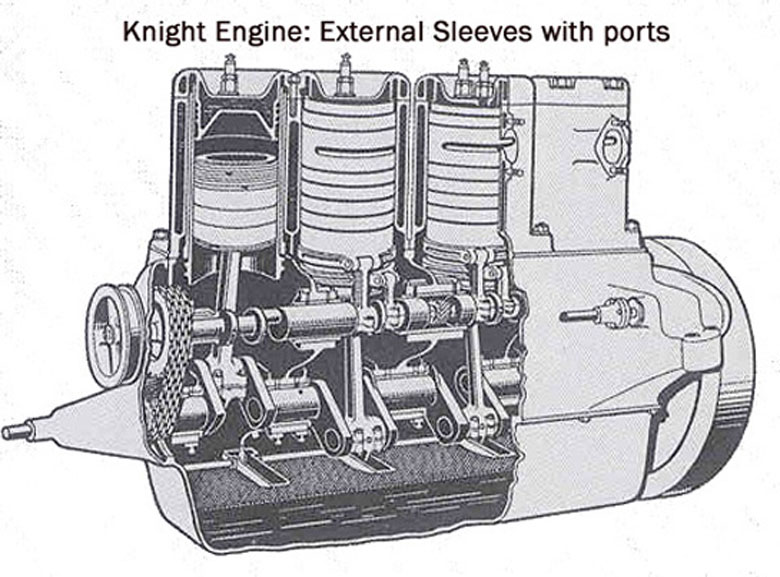
The Knight patent used a special liner machined to fit over the normal piston liner which, activated by rods driven by the crankshaft, moved up and down to close and expose holes in the intake and exhaust manifolds. (see diagrams). Today, one look will instantly reveal the downside and the eventual cause of death…the mass of unbalanced reciprocal weight. In 1905, however, engines were slow, long-stroked low-rev devices…high reciprocal weight was not a serious issue at the time.

How it works.

Voisin found and exploited the Knight’s willingness to handle amazing compression ratios “unthinkable for the poppet valve engines of twenties”. Keeping the Knight up to par with the poppets was achievable until both engine designs reached about 5000 rpm. That was about peak for a Knight design, limited by that vast amount of reciprocating mass. Voisin’s primary applications for the engine were for his line of luxury cars which required silence before speed. Voisin would later build a 5.8 liter Knight V12, and Diamler’s famous “double six”was a Knight V12.

The huge Voisin V12, with two banks of six cylinder Knight engine blocks.

Voisin and Lefebvre knew that the Knight engine, as prepared for the 1923 French Grand Prix and good for only 75 hp was no match for the DOHC Fiats and Sunbeams, or even the three valve SOHC eight powering the Bugatti T32 and surely enough, the race was dominated by the B and B Sunbeams and the Fiat 404s before retiring with supercharger problems. Voisin’s intent was to prove the value of streamlining. Lefebvre’s fifth place was not a podium but definitely turned heads.

Voisin would remain true to the Knight engine until the end, but had little control of his company by 1938 when the last Voisin rolled off the line with a Graham Six. “This indiscretion—in Voisin’s eyes—put a fitting end to the marque,” wrote Griff Borgeson. Luckily for Lefebvre, Voisin saw the writing on the wall and helped his favorite engineer to get a job at Citroen before the Voisin became just a memory.

Peugeot in the meantime, had many racing successes with their version of the Knight engine. A six liter six was immediately successful in sports car racing and a 3.8 liter four with 158 hp won the Touring Car Grand Prix in 1923, which infuriated Voisin as the car was actually designed at Voisin. Peugeot won 24 hour events at Spa in 1926 and again at Monza.

Despite attempts to decrease the heavy valve liners, the fate of the sleeve valve engine was sealed by the increased efficiency of the poppet valve engines, with improved combustion efficiencies, metallurgy and widespread use of the DOHC. The Knight was also costly to produce and burned oil. The poppet valve engine would emerge victorious, for all of its shortcomings.

By 1940, the last of the Knight-engined cars, the Belgian Minerva, ceased production, WWII began and Charles Yale Knight quietly passed away at the age of 72, a millionaire several times over. Voisin would live on to 1973, Andre Lefebvre until 1964.

Sources
Automobile Quarterly V10/4
Automobile Quarterly V13/4
The Classic Twin Cam Engine, Borgeson
André Lefebvre and the cars he created for Voisin and Citroën, Gijsbert Paul-Berk

Tagged With: desmdromic valve, knight engine, peugeot, sleeve valve engine, voisin

Reader Interactions

Leave a Reply

Your email address will not be published. Required fields are marked *

Primary Sidebar

     SIGN UP BELOW TO RECEIVE VELOCETODAY EVERY WEEK FOR FREE


       EXCLUSIVE ARTICLES ABOUT 

    EXTRAORDINARY AUTOMOBILES

PositiveSSL

Recent Posts

  • VeloceToday for June 16, 2026
  • 24 Hours of Le Mans 2026, Hypercars
  • 24 Hours of Le Mans, LMGT3 and LMP2
  • London Concours 2026
  • The Ups and Downs of the Sleeve Valve Engine
  • VeloceToday for June 9, 2026
  • Fuori and Friends, 2026
  • Road America Circa 1958, Modifieds
  • Terre di Canossa Rally 2026
  • And How!
  • Villa d’ Este 2026 Classes A-D
  • Villa d’ Este 2026 Classes E-H
  • Hugues Vanhoolandt at the Spa Classics
  • Valletta Concours d’Elegance
  • Behind the Fence: Ferrari, 1959 Part 2
  • Road America, Circa 1958
  • Building the Birdcage
  • The Magical Summer of a Maserati 6CM
  • Behind the Fence: Ferrari, 1959 Part 1
  • Lancia Stratos Zero: The Eternal Futurist Reviewed
  • WEC Spa 6 Hour, Hypercars
  • WEC Spa 6 Hours, LMGT3
  • Brooklands Italian Car Day P1
  • St Mawes Motoring Festival Concours
  • Brooklands Italian Car Day P2
  • Alfa Romeo: View from the Mouth of the Dragon Softbound Edition
  • Retro Classics Essen 2026
  • 83rd Goodwood Members’ Meeting 2026
  • Concorso Anantara: The Show
  • And How! Silverstone Grandstand named for Jim Clark

Copyright © 2026 · VeloceToday.com · Privacy · Sitemap

MENU
  • Home
  • Subscribe
  • About
  • Contact
  • Donate
  • As Found