Story and photos by Jonathan Sharp
So if you are think “I would like to do that trip” here is a run down of how my wife and I did it. The nearest airport for Lake Como is either of the two Milan airports, Malpensa or Linate, however the airline we prefer to travel with only flies to the Milan airports via Heathrow, or in the case of Linate, London City.
We are not great fans of Heathrow and London City is a bit of a pain for us so we decided to fly firstly to Turin as our chosen airline does fly there from our local airport Gatwick, then to stay a few days in Turin then catch the highspeed train (up to 186 mph) to Milan which takes an hour. Then a regional train to Como which takes about 45 minutes. Easy and not too expensive and is even cheaper if you take a regional train from Turin to Milan.
In previous years we have stayed at a lovely little Boutique hotel in the center of Como (if you ask nicely I may tell you its name) but this year left it a bit late and it was full so we booked an apartment again in the center of town and lovely and quiet. Como has plenty of nice places to eat, some pricey, some not and we do have a favorite (again ask nicely). To get to Cernobbio, the location for the Concours, well you can get the boat which is nice but very very popular so best to book or join the ticket queue at the crack of dawn. We simply caught the number 6 bus from Piazza Cavour to Cernobbio, but go early before the traffic builds up, but you can also walk its about 2 kilometers and the road runs along the lake shore so the views are lovely. We normally walk back from the event as by late afternoon the traffic is very slow but you do get to see some nice cars whilst you are walking.
A PDF with class winners is available below.
Below we cover Classes E-H and the Concept car class.
Class E

From an American private collector. 1953 Ferrari 250MM, one of 12 Spiders constructed by Vignale, originally earmarked for entry in the 1953 Mille Miglia but instead pressed into service for Ferrari’s North American launch campaign. Later at the behest of Enzo Ferrari the 250 found its way, via Luigi Chinetti, to Phil Hill who took the car to victory at the April 1953 Pebble Beach Road Races. The 250 continued to be raced in the USA by various American privateers until 1957 and having emerged from its racing career without sustaining an major damage is considered as one of the most significant survivors.

Robert Crippa’s 1953 Ferrari 340MM chassis 0294AM was completed in April 1953 with a spider body by Touring. Wearing the number 613 and with Luigi Villoresi at the wheel it lined up at the start of that years Mille Miglia only to retire after an accident. In May of the year Mike Hawthorn took 0294 to victory at the BRDC International Daily Express Trophy at Silverstone. In June the car was sold to well known Swiss privateer Hans Ruesch who, amongst other results, took third in the British Empire Trophy on the Isle of Man. Tragedy struck, however, at the Grand Prix Supercortemaggiore in Merano, Italy in September 1953 when a serious accident led to a fatality amongst the spectators. 0294 was then towed back to the factory for repair and in 1954 was rebodied by Scaglietti in the style of a 750 Monza Spider.

Rien Leeijen’s 1954 Ferrari 375 Plus was built in early 1954 and was immediately sent into battle by the factory as a works entry driven by Maglioli in the Giro di Sicillia, however an accident resulted in a DNF and the need for the front of the bodywork to be rebuilt which was done in time to allow Maglioli to again take the wheel on the Mille Miglia. This time the DNF came as a result of a small but serious gearbox issue on the Futa Pass.

In May 1954 Gonzalez had better luck, taking victory at the Daily Express Trophy at Silverstone. A month later the car lined up at the start of the Le Mans 24 Hours with Maglioli and Paolo Marzotto at the wheel, only to suffer another DNF at the eighth hour having again sustained gearbox damage. Later that year the car was sold via Chinetti to James H Kimberly who continued to race it successfully until the late 1950s.

From the Collection Abetone. Chassis 0665GT is the third of five Ferrari 250GT Tour de France Berlinettas bodied by Zagato and is the only example with faired in headlights. Completed in April 1957 and sold to Genoese businessman and gentlemen racer Camillo Luglio, who straight away entered it into the Giro di Sicilia race where, despite difficult weather and road conditions, it finished fifth overall and and second in class. This was followed by a class win at the Coppa Costantini at Monza. In May Luglio, wearing the start time number 441, took sixth place overall in the Mille Miglia. The second half of the season was also fruitful with Luglio taking sixth overall and second in class at the Aosta-Gran San Bernardo hillclimb and first in class at the Coppa Inter-Europa at Monza before rounding up the season with another class win at the Pontedecimo-Giovi hillclimb.

Davide Parmegiani’s 1958 Ferrari 250 GT Competizione “Tour de France” is the 15th of the 17 series III examples constructed and is identifiable by its faired in headlight and three vents on each B post. Originally finished in dark Amaranto red, the car was sent directly by Enzo Ferrari to German racer Wolfgang Seidel, an occasional works driver for Ferrari and Porsche and successful privateer. In one of his first outings in the car in April 1958 at the Pau 3 Hour race he finished second and on various occasions shared the car with Wolfgang Graf Berghe von Trips which included a fourth place finish overall at the 12 Hours of Reims. Between 1958 and 1959 Siedel piloted the TdF to eleven overall victories and numerous class wins in hillclimbs, airfield races, and international GT events such as Monza and Montlhery. In 1960 Siedel replaced the TdF with a 250 SWB and sold the TdF to fellow racer Manfred Ramminger who went on to claim a class victory and fourth overall at the Coupe de Paris in Montlhery.

This 1960 Ferrari 250 SWB Competizione, entered by Andrea Bianchedi, is one of 70 examples built with an aluminum body, uprated engine and modifications to the rear axle and suspension set up. This example was also fitted with the quick release external fuel filler cap. Delivered new to Dr Cesare Marchi and finished in Grigio Scuro paint with a red leather interior and, unusually for an alloy bodied car, bumpers. Unfortunately no documented race history has been found.

The Keybridge Collection’s 1962 Ferrari 250 GTO is chassis 3589GT, one of only eight examples constructed in right hand drive. Delivered new via Maranello Concessionaires to Tommy Sopwith’s Equipe Endeavour team, 3589GT made its race debut on Easter Monday 1962 at Goodwood in the Sussex Trophy with Mike Parkes at the wheel finishing in second place. Over the next 12 months 3589GT competed in eleven races notching up five wins and several first in class finishes including wins at Silverstone, Brands Hatch, Mallory Park and Snetterton. In late 1962 3589GT became part of Tom O’Connor’s Texas based Rosebud Racing Team and began competing in the USA being driven, amongst others, by Innes Ireland who took third place at the Bahamas Speed Week. At Sebring in the 12 Hours the GTO finished sixth overall and third in class. Then in 1964 Tom donated the GTO to the Victoria High School were initially it was barely used and later was left on a trailer behind Joe Kortan’s house in Ohio where it endured 15 years of the climate of Ohio before being discovered and fully restored by the Swiss Collector Englebert Stieger. Steiger’s family retained the GTO for three decades before the GTO underwent a further meticulous factory restoration at Ferrari Classiche before being acquired by its current custodian.
Class F

Johan Lont’s 1954 Fiat 8V Berlinetta is from the second series and was first registered to Emanuele Quartara from Genoa in March 1955. Quartara frequently competed in the 8V in hillclimbs and national GT events up until 1958 and it was whilst he was still competing in the 8V that he sent the car to Zagato to be rebodied as per Elaborata specification.

This 1963 Mercedes Benz 300 SL Roadster, entered by Eric Blumencranz, is one of the last examples constructed and as such benefits from having the alloy engine block, which in itself saved 45 kilos in weight. Supplied to its first owner in May 1963, it has been preserved in completely original condition including its white (Code DB50) paintwork, black interior trim (Code 953) disc brakes and original hardtop. Please note the snow chains on the rear to match the skis on the luggage rack.

1964 Shelby Cobra 289 chassis CSX2475, now owned by Elad Shrage, was delivered to its first owner, Jack Armstrong of Massachusetts, by Knoxville Cobra Sales Co, Tennessee. Ex-factory equipment fitted included a hard top, side screens, wind wings, tinted sun visors with rear view mirrors, and a removable roll bar, all of which the Cobra retains. In addition the first owner added an oil cooler, aluminum oil sump and safety kit. The Cobra remained with Armstrong until 1982 and since then has passed through the collections of various owners including Prince Rahim Aga Khan. An exceptional example of an original condition Cobra.

Blink and you will miss it but Thomas Shannon’s 1969 De Tomaso Mangusta is a movie star. In the movie Kill Bill:Volume 2 director Quentin Tarantino had the character Bill drive a Mangusta, “Mongoose kills snakes.” Originally supplied by Auto Engineering in Lexington, Massachusetts, the Mangusta remained in the hands of the first owner until 2021. Fully preserved with only 6271 miles on the clock, an iconic link of Italian design and American performance.

Alexander Wiesner’s 1974 Monteverdi Palm Beach is a unique vehicle. Originally constructed as a Monteverdi 375C, it was converted by the factory into the only existing 375L “Palm Beach” in 1974. Unveiled at the 1975 Geneva Motor Show and tested by Motor Revue magazine in 1978. The car was registered to Peter Monteverdi himself in Basel and formed part of the Monteverdi museum until 2019 and has only covered around 5000 kilometers in the past 52 years.
Class G

Entered by Andrew Bagley, this 1965 Ferrari 275 GTB chassis 07127 is a rare beast, being one of only 11 built with six carburetors and right hand drive. Oh, and this recently restored example is no trailer queen, Andrew drove the GTB from England to the event, a journey of 1100 miles. Lucky fella.

From the Golden Age Collection, this 1966 Aston Martin DB5 is no ordinary DB5, This DB5 was used by the factory as the test bed for the new V8 engine being developed by Tadek Marek. Over a three year period it underwent an intensive testing program that often meant the car covered 300 miles a day, all of which was meticulously recorded by the factory.

This 1967 Bizzarrini 5300GT Strada, entered by Doug Cohen, was delivered new to a customer in southern France and is finished in the rare color of azzuro metallizzato with a burgundy red leather interior.

Now owned by Allan McDonnel, this 1971 Lamborghini Miura SV chassis 4928 was delivered new on the 10th September 1971 by the Lamborauto dealership in Turin and was the first SV to leave the factory finished with Bianco paintwork, and the only example to combine a white exterior with a blue interior.

Entered by Q Motorsports Collection, this 1974 Lamborghini LP400 with its oh-so-70s paint finish of Marrone with a Senape interior was delivered to the French importer Etablissements Thepenier on the 1st October 1974 and then presented at the Paris Motor Show and used for press demonstrations. In 1977 it was purchased by Jacques Quoirez- the brother of novelist Françoise Sagan (the author of Bonjour Tristesse).
Class H

Marcus Wolsdorf’s 1980 BMW M1 was originally presented to Jochen Neerpasch. An unusual color combination that works rather well.

This 1992 Bugatti EB110, entered by Victoria Dold, was the first example delivered to a customer. Its Swiss owner, whose family had owned Bugattis since before the Second World War and was personally picked by Romano Artioli, travelled to the Campogalliano factory to collect it.

Entered by Maurizio De Angelis. Much maligned when new, this 1997 Jaguar XJ220 has only covered approximately 1000 kilometers since new and is number 196 of the 275 examples that were officially constructed.

Adrian Gattiker’s 1998 Mercedes Benz CLK-GTR is number 7 of the 25 examples constructed to allow homologation and was originally suppled to a customer in Switzerland.

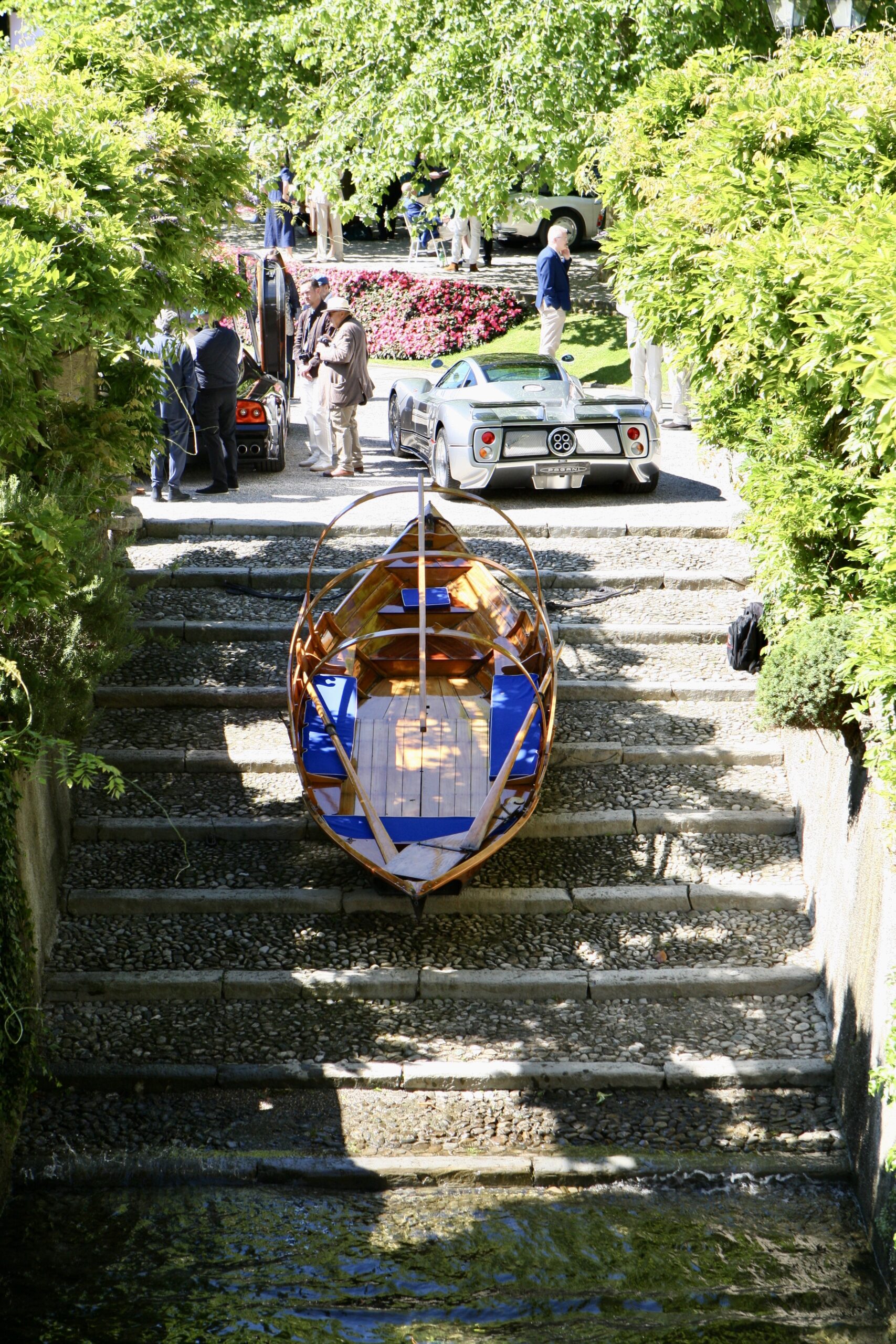
From an Italian private collection, 2000 Pagani-Zonda C12 S 7.0. One of only 16 examples built, and the only example built with a detachable glass roof.

Back in the 1990s Ferdinand Piech decided that he wanted to prove that Volkswagen did not just make sensible cars but was also able to develop a high performance supercar. Entered by Gregor Piech, this Volkswagen W12 ‘Nardo’ is the only privately owned example. Designed by the team at Ital Design overseen by Giorgetto Giugiaro, the Nardo was first shown at the 2001 Tokyo motor show.

The Nardo’s big moment came in February 2002 at the Nardo test track in Southern Italy when an uprated version of the W12 Coupe covered a distance of 7,740.5 kilometers (4809.7 miles) in 24 hours and along the way set several new benchmarks in the process, including a world record average speed of 322.9 km/h (200.6 mph) for 24 hours, a record which still stands today.

Antoine Tauvel’s 2005 Bugatti Veyron 16.4 is one of six preproduction models. Named “Prototype 5.1, it was the second of the key development mules. Completed at Molsheim in 2005, it went on to serve as the reference vehicle for high speed testing and co-development, with Michelin, of the tires that were eventually fitted to the production cars. It also featured heavily in the media for the spectacular photos taken when testing at the Black Rock Dessert.
Concept Cars
Click below for a pdf of class winners


The Aston Martin looks like a late DB4 (they had covered headlamps), with the larger bonnet opening?
Simply BEAUTIFULL !
on the 250 MM Vignales, it is a “Barchetta”, not a Spider
The Countach seems to me to be a Periscopo (S-I) model…?