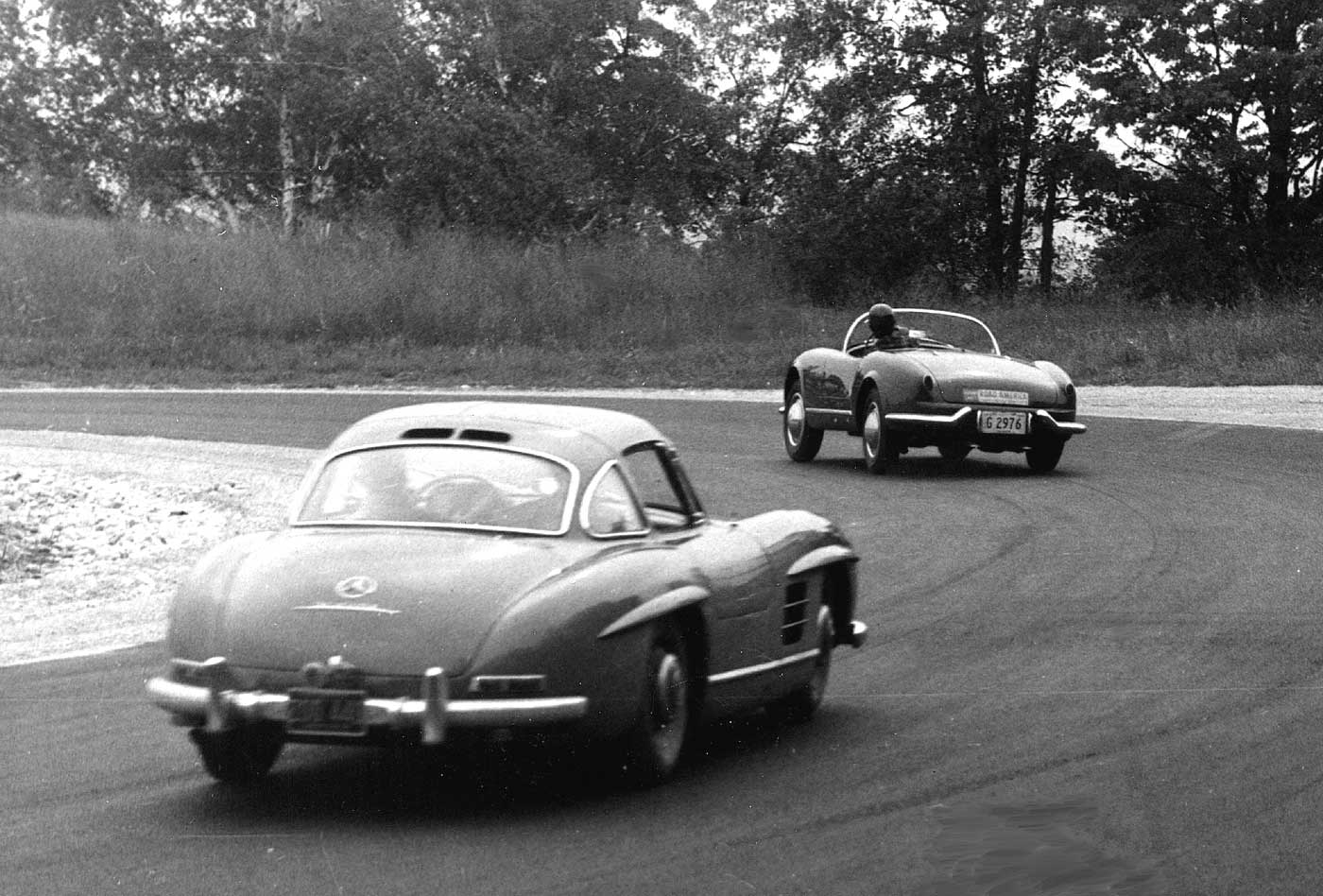
Glen Glendenning captured the first cars on the new track, probably in June of 1955.
Robert Birmingham tells us about Road America’s first event
With photos by Glen Glendenning unless otherwise noted
During the late 1800s, and decades beyond, was a small, calm pastoral village in Sheboygan County, Wisconsin serving the farming community. Times were good, America was entering an industrial period and the village became a popular vacation destination. Available via the Chicago, Milwaukee, St. Paul and Pacific Railroad (Milwaukee Road) the village served many wealthy Chicago and Milwaukee families who sought to enjoy what was offered.
Quality resorts served visitors, the Schwartz Hotel, Siebkins, Pine Point, Sharps and Osthoffs, each overlooking a deep, blue lake where stately trees lined the shore. Business ebbed during World War I, picked up after but during the mid-thirties Great Depression returned to hard times. World War II continued the demise until signs of recovery in the late forties. To put it bluntly the town was not growing, business continued to laze and then something changed. The town was Elkhart Lake, Wisconsin.
In the streets of Elkhart Lake
In early 1950 a small group of mostly Chicago area sportsman staged a weekend event to determine if sports car and vintage racing on public roads had promise. With little publicity a race weekend was held in July and surprisingly close to 10,000 spectators attended. Sheboygan County area residents chose to see what was taking place. The following 2 years attracted even larger crowds to the extent the sponsoring Chicago Region Sports Car Club of America looked further down the road to what they hoped would grow the sport in this fun, friendly, quaint surrounding.
Sports car racing on public roads began in 1948 at Watkins Glen, New York and spread to other eastern cites. Popularity climbed over night, streets were filled with MG TC, Jaguar XK120 and Nash-Healey sports cars. Clearly sports car racing was on its way to become a major spectator sport until it didn’t.
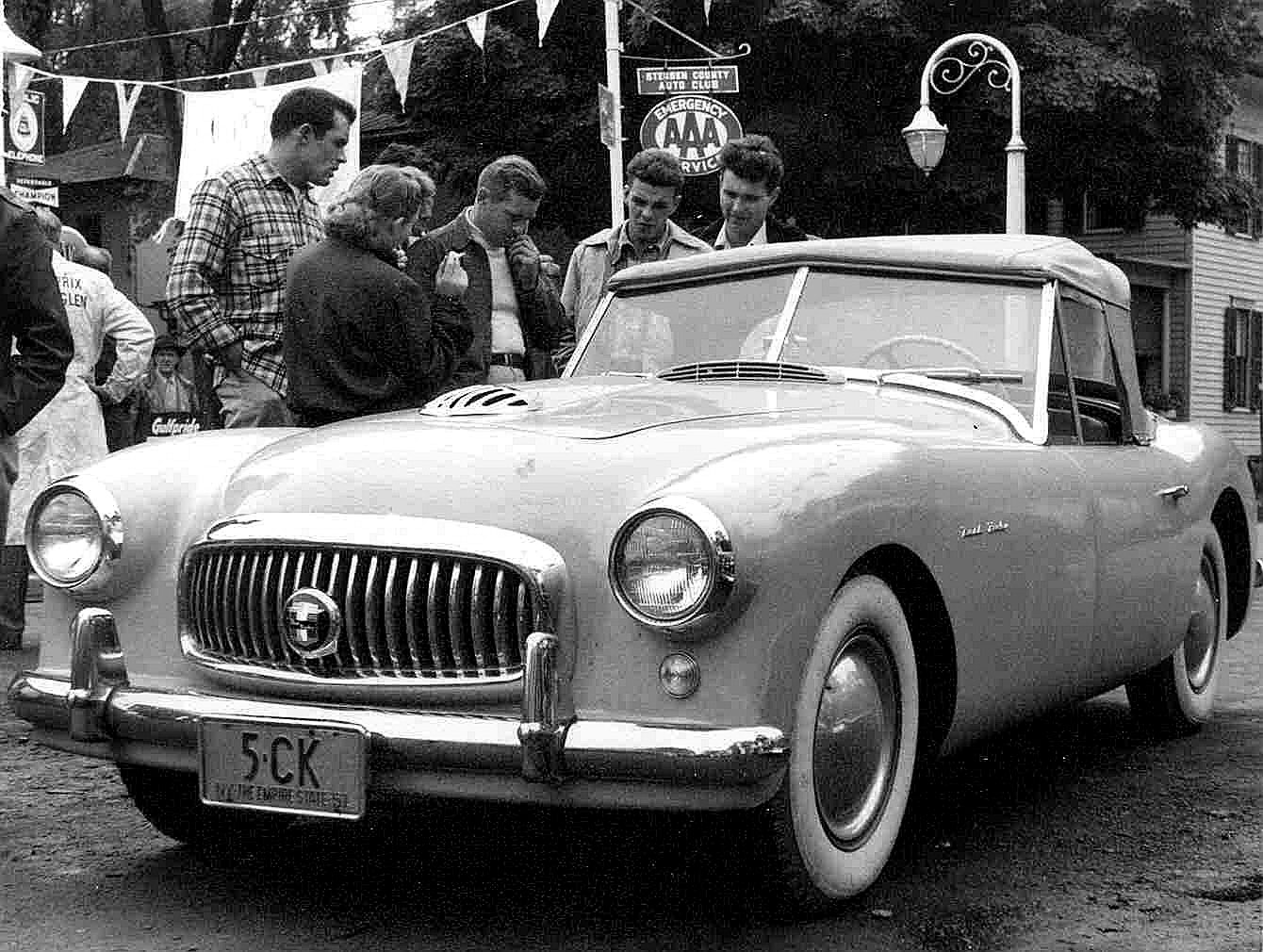
A Nash-Healey at Watkins Glen. Photo by Frank Shaffer.
In September of 1952 at Watkins Glen a spectator was killed and others injured. Spins and crashes across the country were rampant with injuries to spectators until enough was enough. Across the country state and local authorities had serious concerns as did insurance carriers which as one shutdown public road racing in America. Racing moved mostly to United States SAC Air Force bases but without the spectator enjoyment of watching drivers climb hills, drift through reverse camber corners or without nature’s beauty as they charged forward.
Enter Clifton Tufte
Back at Elkhart Lake lived and worked a gentleman, who, while not a sports car owner or fan, was bothered by what once was and was no more. The community had prospered during the three years of public road racing during the early fifties and now it was gone. Clifton (Clif, also spelled as Cliff) Tufte was a World War I veteran and graduate civil engineer who, during the late forties, went into business as Elkhart-Moraine Sand and Gravel Company and soon after purchased a several acres 3 miles south of Elkhart Lake which served to provide lime stone for road construction.
The property sat among a mixed terrain, reasonably flat farm fields with hills, lakes, moraines, drumlins (teardrop shaped hills), and valleys, the result of geographical formations created over 10,000 years ago. Tufte used the property as a source of limestone for construction.
Clearly town and county residents were disappointed with the end of public road racing through town and on nearby rural roads. There were days when one could not refrain from broaching the loss with anyone passing by. It hurt, they missed the excitement, the magnificent European sports cars parked along Lake and Rhine Streets, pretty ladies dressed to the nines, gentlemen clad in tweed blazers and as much as anything substantial income derived from the events.
The citizenry was pretty close, everyone knew each other and most would provide opinions on the loss, so much so that meetings began to be held and people stepped forward to lead the way. Concerned local residents increased their involvement; a resort owner, local bank President, hardware store owner, golf club owner, Tufte and others. Their efforts began to brighten and by late 1954 they had developed a stage 1 plan. Presentations were made to the Elkhart Lake Businessman’s Association whose president, James Johnson, was an enthusiastic backer. Johnson was president of the then Bank of Elkhart Lake and certainly had the foresight to expect growth if and when sports car race weekends returned.
Early meetings were held at Gessert’s Ice Cream Shop on Lake Street, a few in the bank’s second floor as well. Today Gessert’s continues to serve the community and race fans on warm summer nights. Quietly Tufte began in earnest to create scenarios that could result in the return of racing. While traveling nearby roads he made note of corners, hills, long straight paths and esses to get a better understanding of what it could take to duplicate.
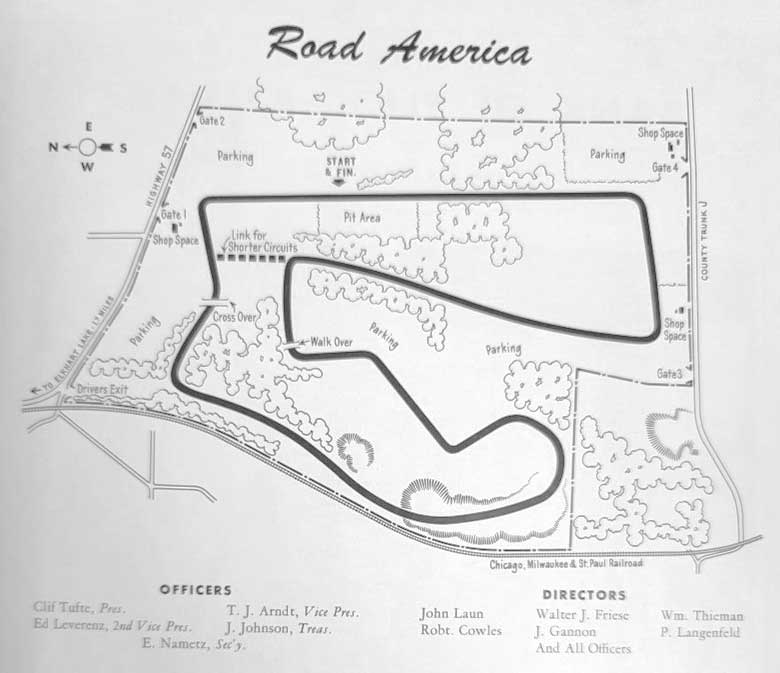
Map as published in the September 1955 race program.
Operating his company meant he was well versed on road construction, but there was a lot more to it and of course time lost planning was income lost. Word of activities spread and before long meetings were held with Chicago Region SCCA officials and as a result things heated up. Banks were contacted to discuss financing and through it all Clif quietly continued exploring country roads to copy when and if the project gained approval from all involved. In August of 1953 the group incorporated as Road America, Inc. a name suggested by Tufte. The following January a stock offering meeting was held and as a result pledges of $500 per share, minimum of 5, totaling $25,000 were received – it was a start and by May $175,000 was pledged by 150 shareholders. The next move was to find acceptable nearby farm land that would meet Tufte’s topography requirements and it turns out they didn’t have to look far. Three farms just east of Tufte’s quarry were purchased. As a matter of fact, the far east section of his quarry abutted the farm land separated by railroad tracks. Bank financing was arranged and the properties purchased. Tufte continued to plan, often with surveyor instruments in hand. Clearly the project was in capable hands.
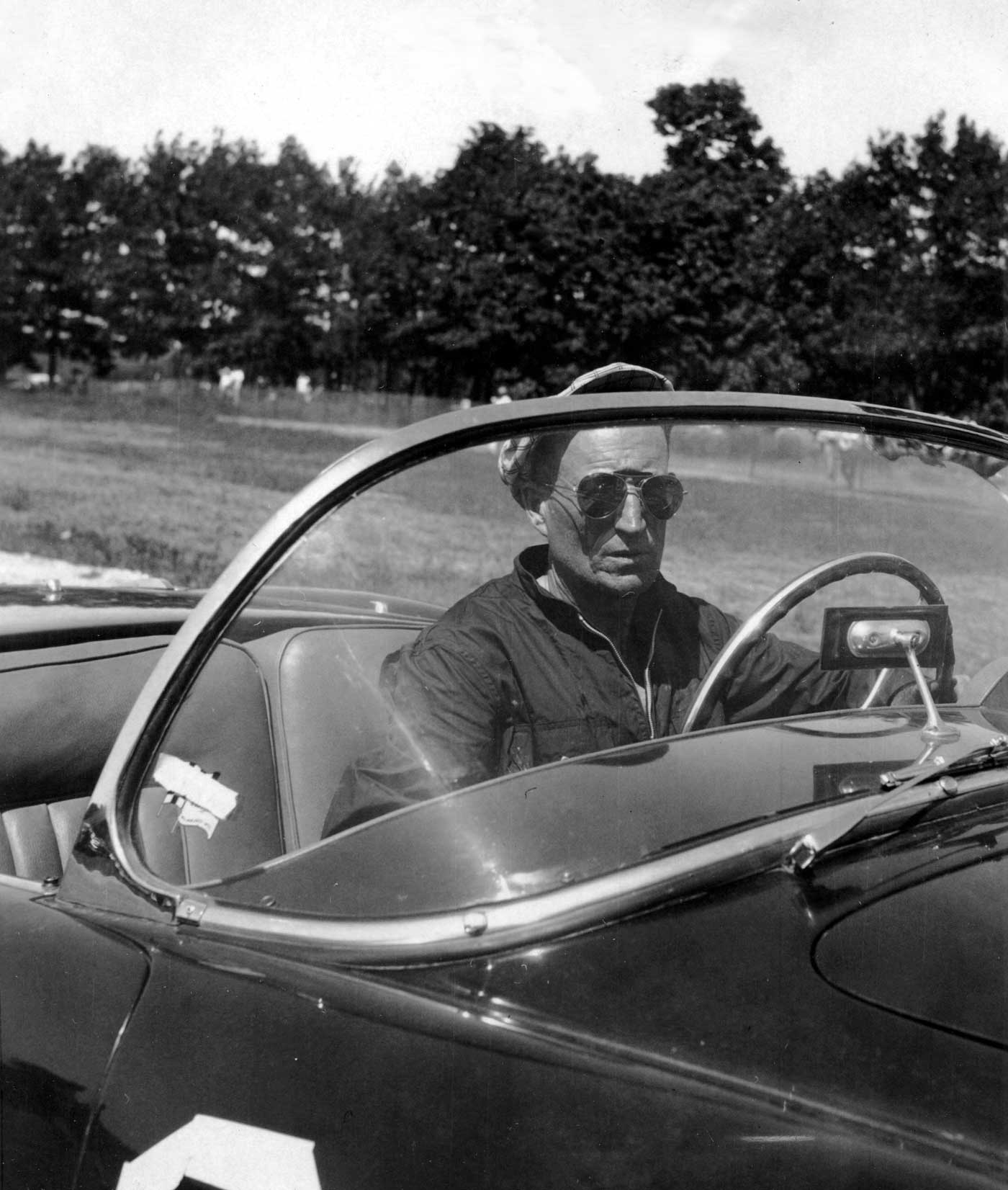
The Lancia that appears in the track opening photos was owned by Clarence Graham.
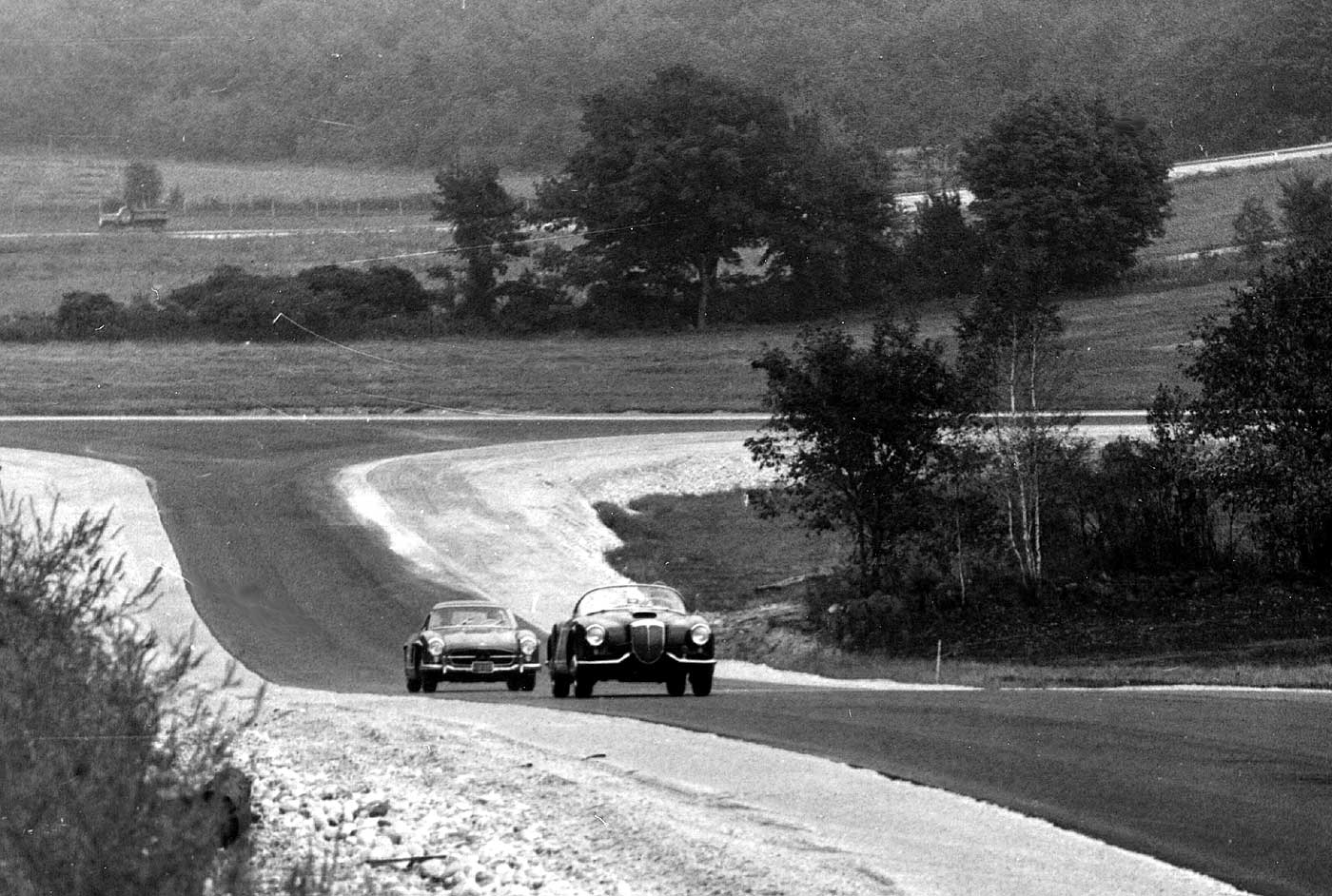
The Graham Lancia and Mercedes clearly enjoying the new track. The driver of the 300SL is unknown.
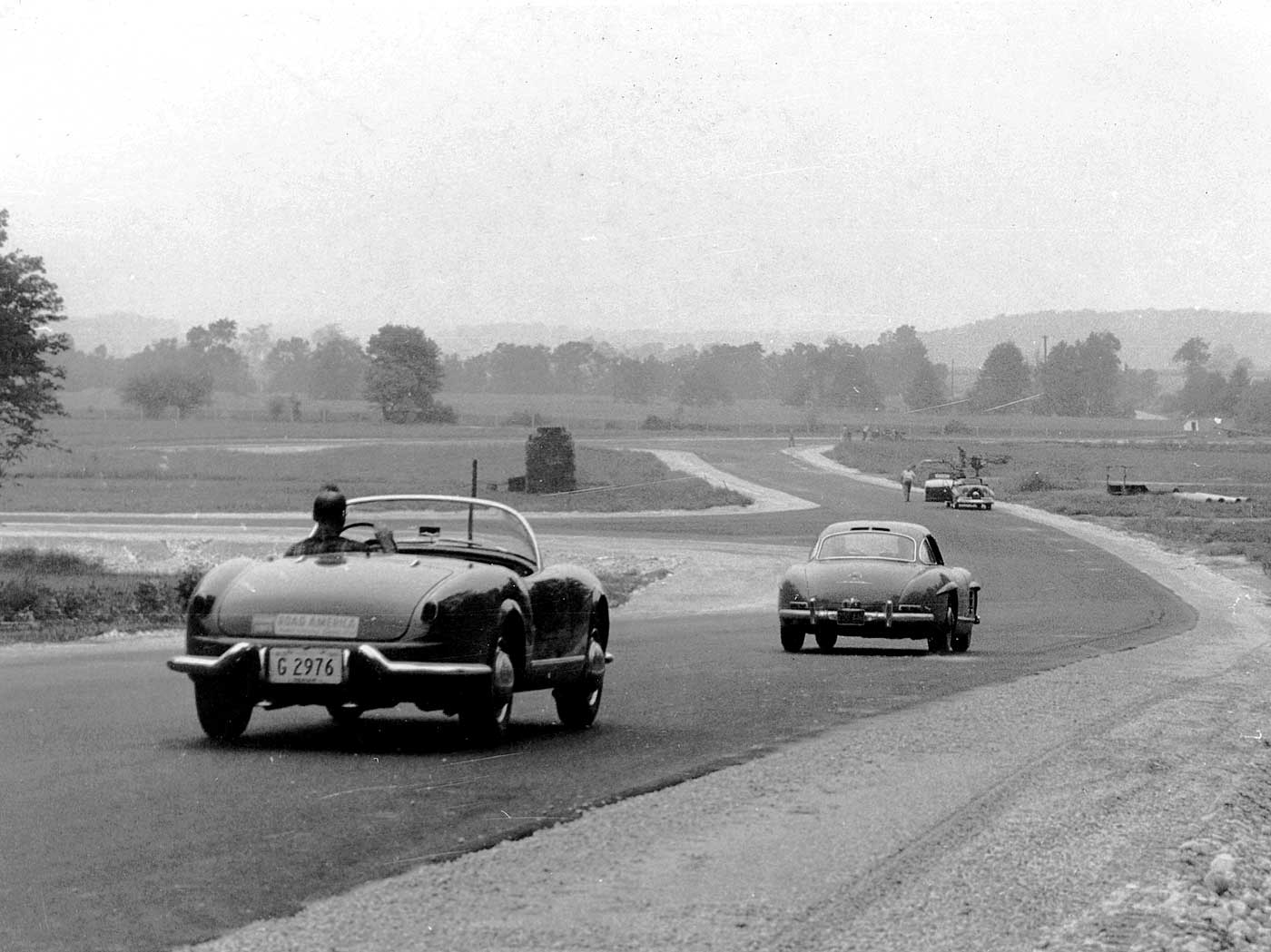
Coming downhill.
The first shovel of dirt was turned in April of 1955 and soon after the Caterpillars, graders, and dump trucks were digging, shaping and hauling. Stumps and boulders were cleared, turns, esses, straights and elevation changes were planned, and then gravel based, hot sheeted 2” thick black top followed. The width was 27’, grade changes were fixed at 1 to 8 feet and in all presented a wide challenge.
Time grew short, construction moved fast but with concern that the September 9-11 inaugural race weekend was going to be tight, the result of SCCA’s required scheduling a year in advance.
Projects included construction of an all wood, 2 floor pagoda with cupolas on both ends. Timers and scorers were housed in the lower level, photographers on the upper. The cupolas provided for VIPs. Volunteers finished painting on Friday and the structure was improved and enlarged within a few years.
Friday practice broke sunny but turned sad. Tom Friedman of Milwaukee lost control while in the carousel, rolled over and his Maserati A6GCS burst into flames. He died the next day at Milwaukee’s Columbia Hospital. Despite this tragic happening the weekend went on to the pleasure of spectators, most of whom were unaware of Friday’s tragedy.
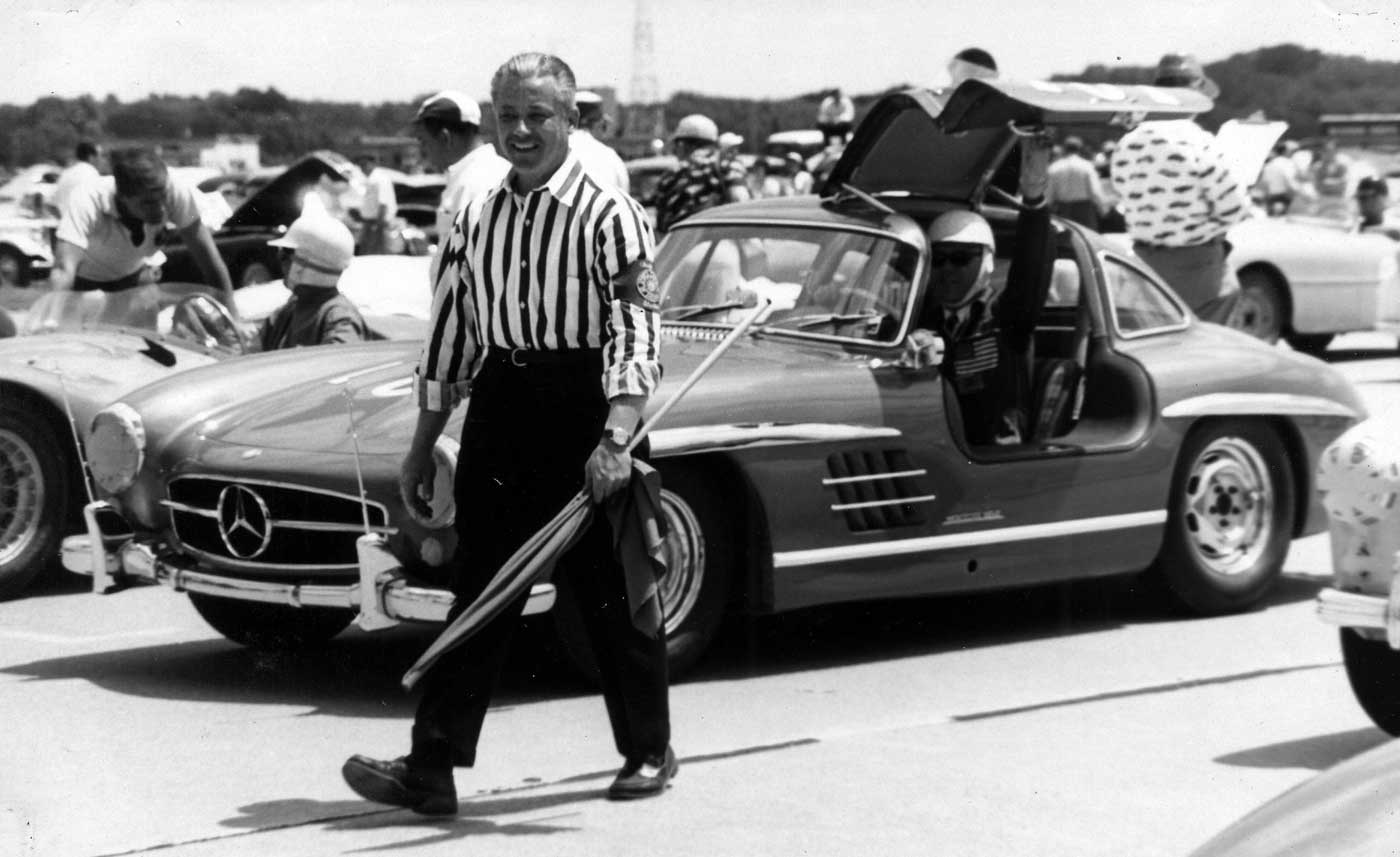
Tom Friedman in the Maserati can be seen at left, behind the Mercedes Gullwing, on the grid at the Iowa SCCA Races, May 30, 1955. His family objected to his racing and he promised he would quit after Road America in September. Glen Glendenning photo. Click on photo to read the full story.
Seven races made up the 2 day card with classes determined by engine displacement ranging from 500cc to 8 liters, from the least powerful to Allards and Cunninghams powered by Chrysler and Cadillac motors. Briggs Cunningham’s entourage included 7 entries and 30 staff consisting of drivers, crew members and quests.
Glendenning’s collection included these images of Race 3 on the program:
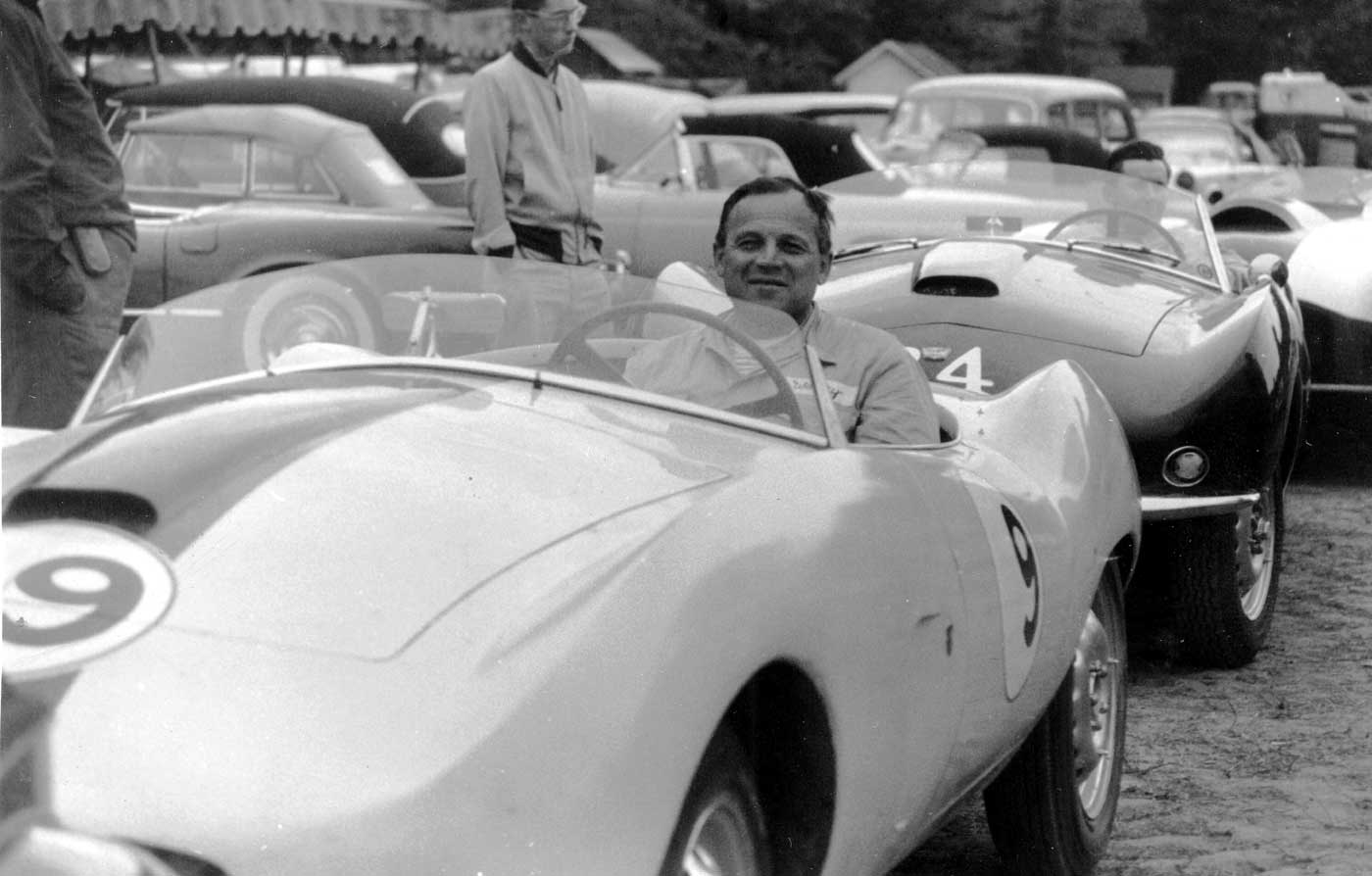
Race 3 brought out S.H. Arnolt with his new Arnolt Bristol, followed by Ralph Loucks.
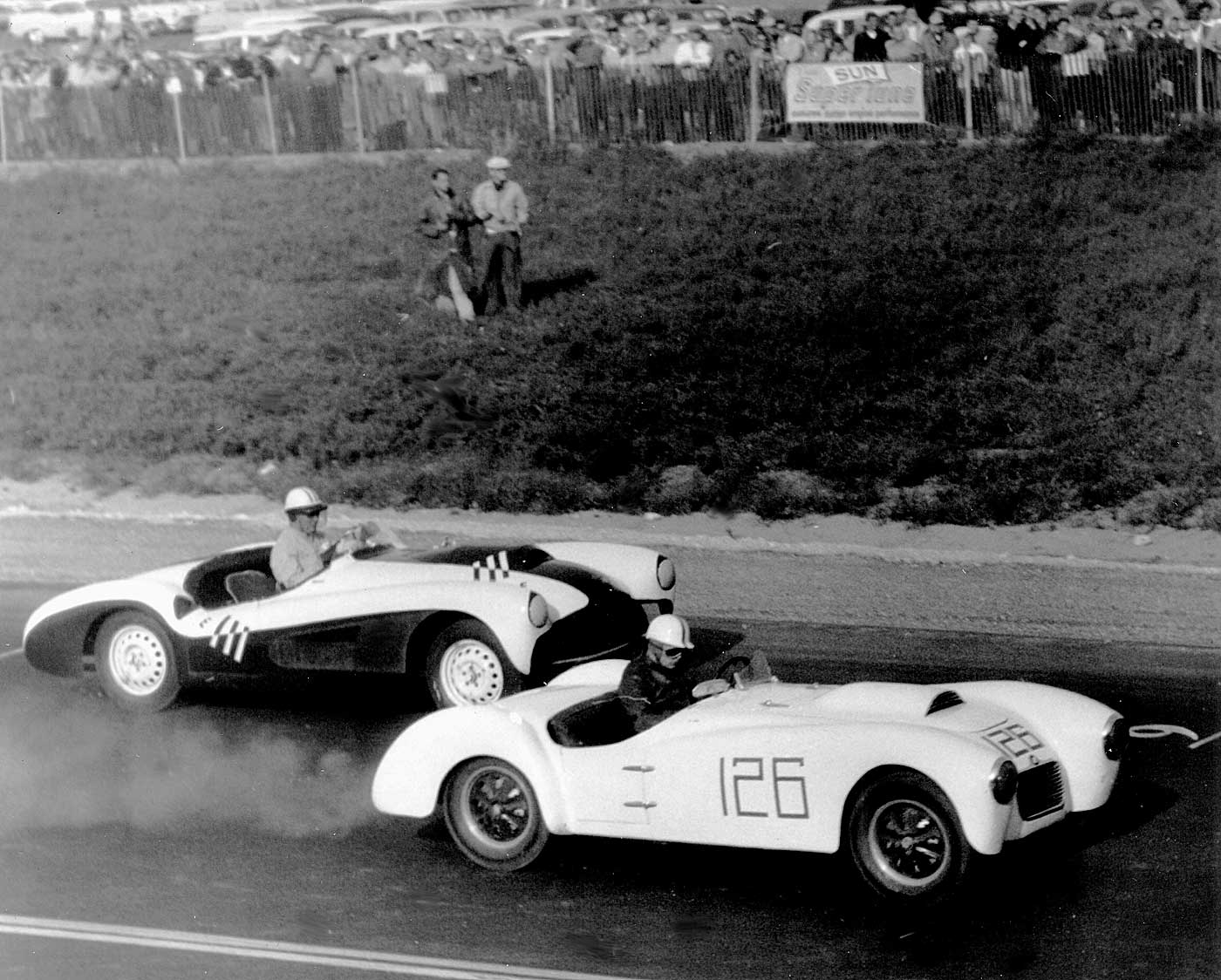
Race 3 featured Trant Jarman leads Robert Goldich, both in Bristols.
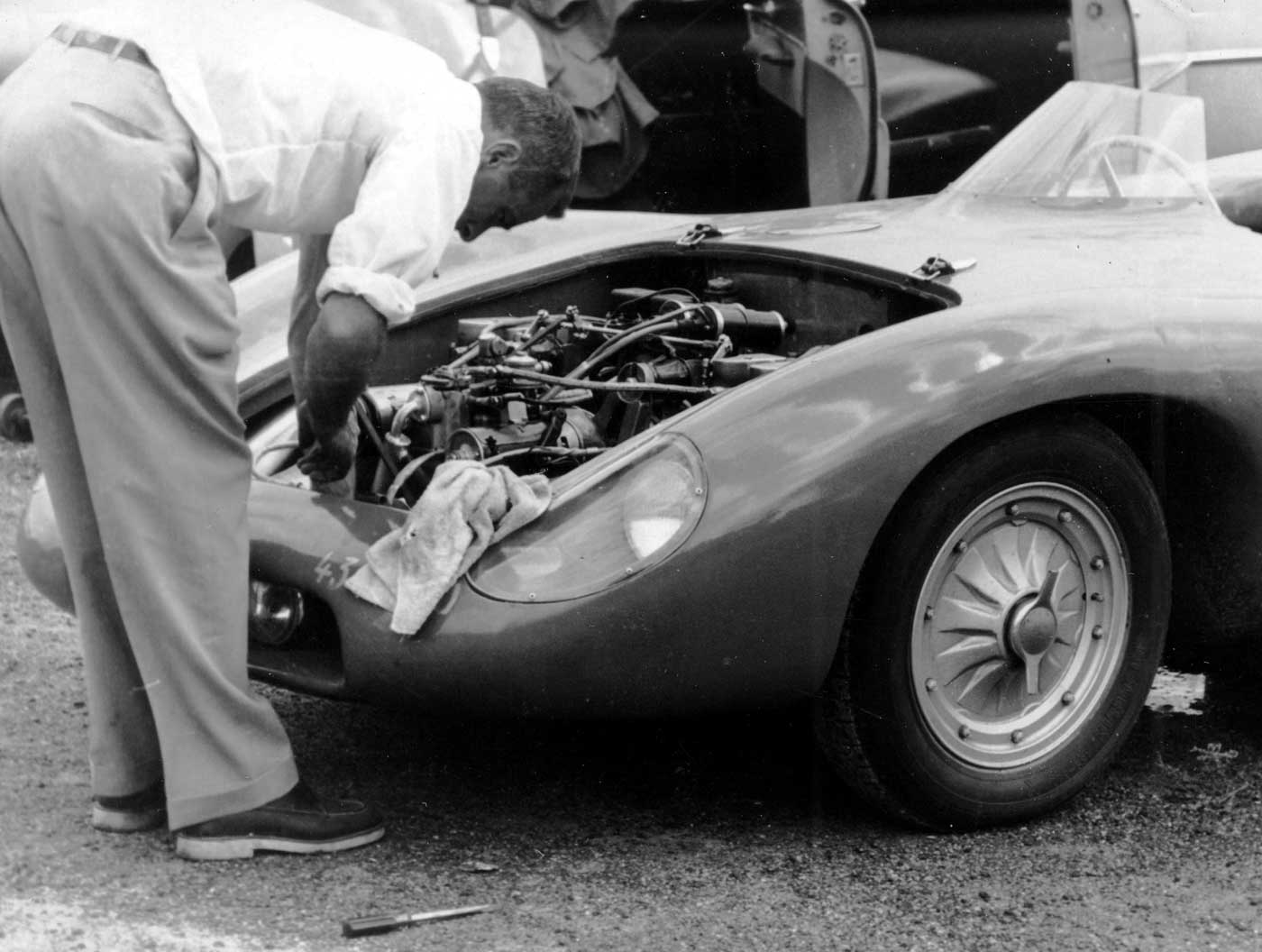
Race 3, Harry Kite, D.B.
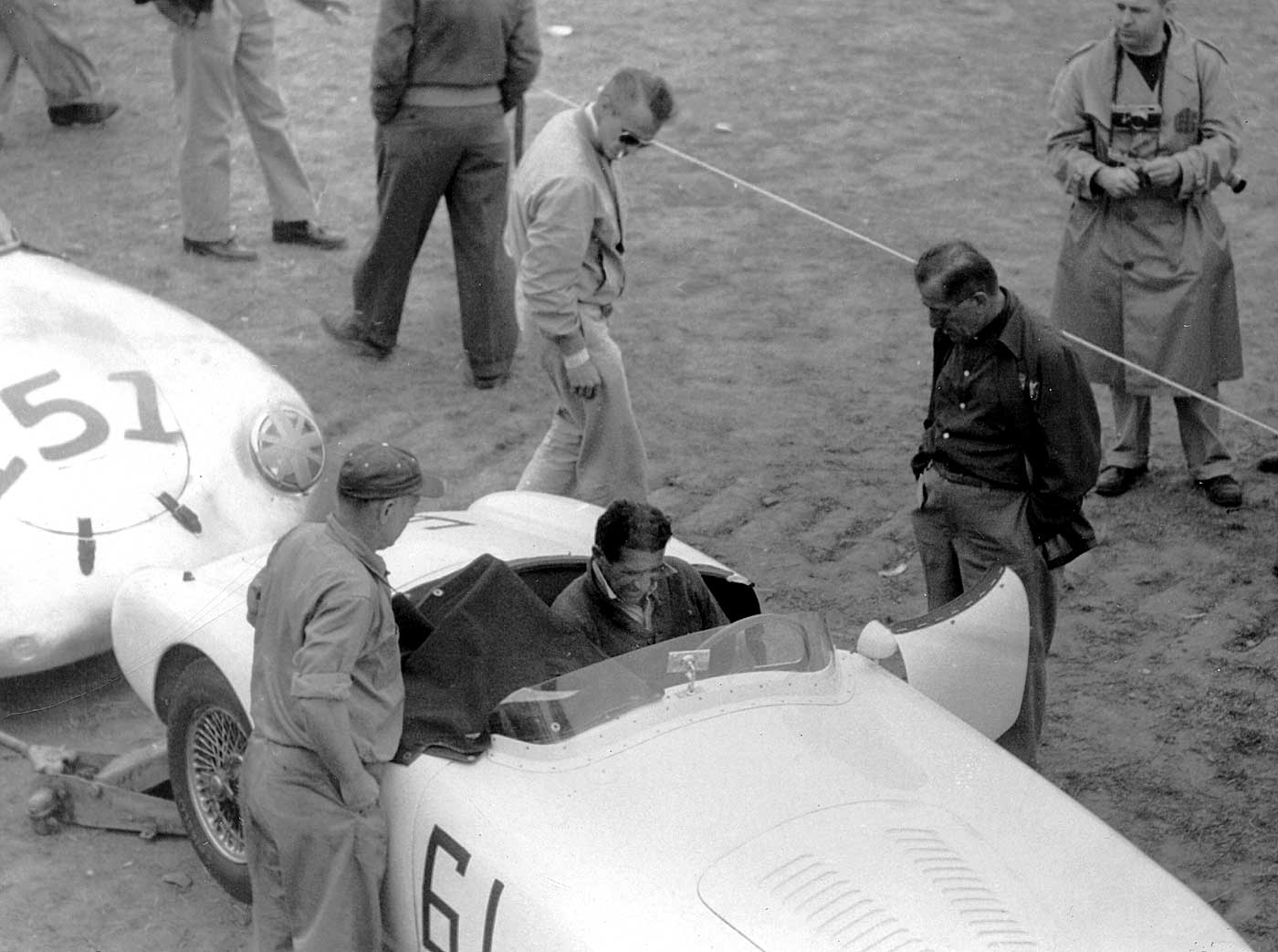
Race 3, Cunningham’s OSCA MT4.
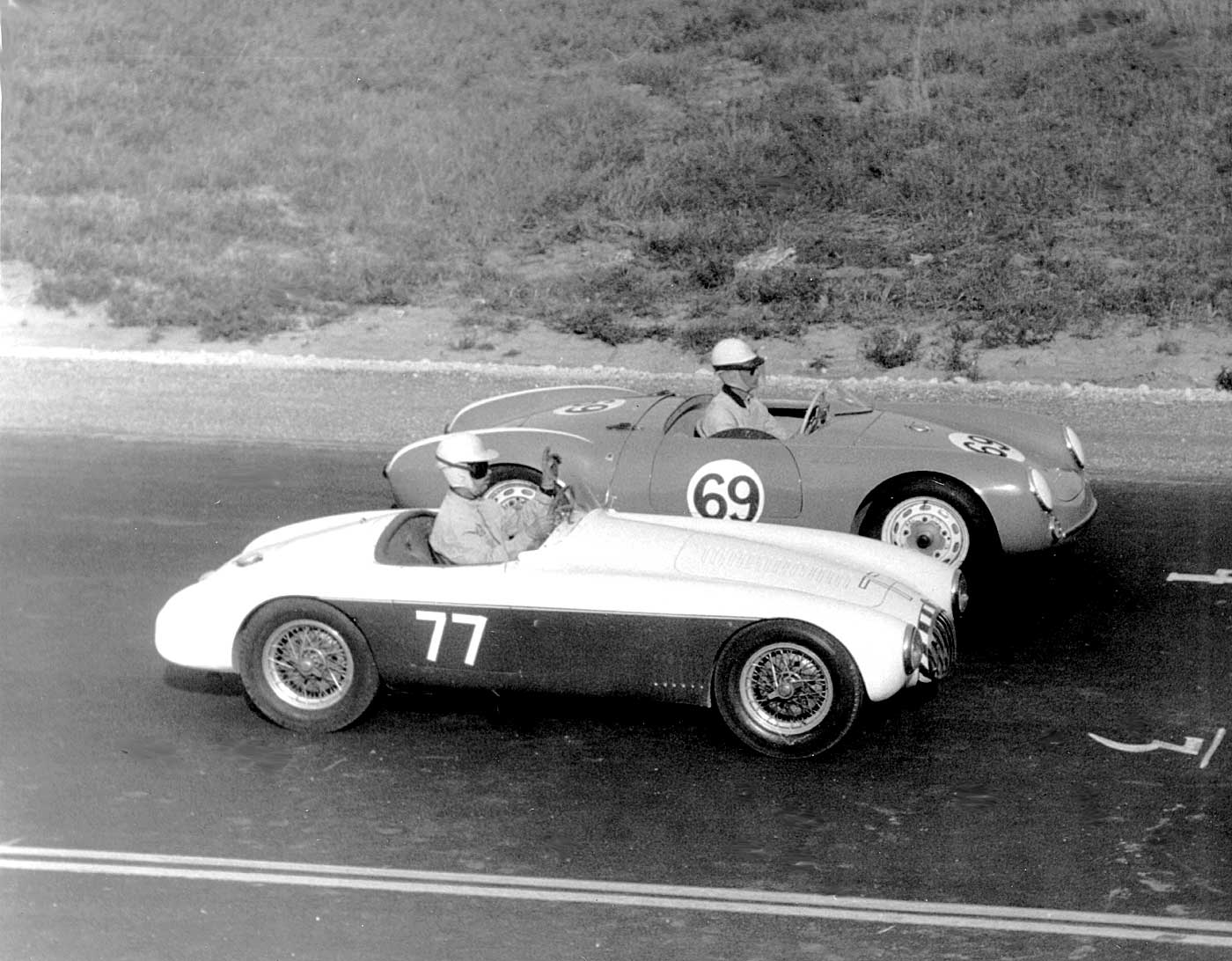
Race 3, Rees Makins, OSCA, Ed Crawford, Porsche.
The races were all fun to watch, especially for spectators, most of whom were attending races for the first time, but it was the final race on Sunday that made the weekend.
After Saturday’s last race, the noise had abated, backslaps and handshakes all around, trophies presented and bratwursts hot off the grill eaten, most drove to Elkhart Lake to attend a Concours d’ Elegance staged in a large lot south of the village square and adjacent to the Schwartz Resort. The term had no meaning to most in attendance and barring the actual French to English translation, was generally accepted as Showing of the Finest. On display were pre-war Duesenbergs, Mercedes, Bentleys and more.
That night the committee, in concert with SCCA officials, burned the midnight oil to determine what went right and conversely what could be improved.
Glendenning’s collection included these images of Race 4, 6 and 7 on the program:
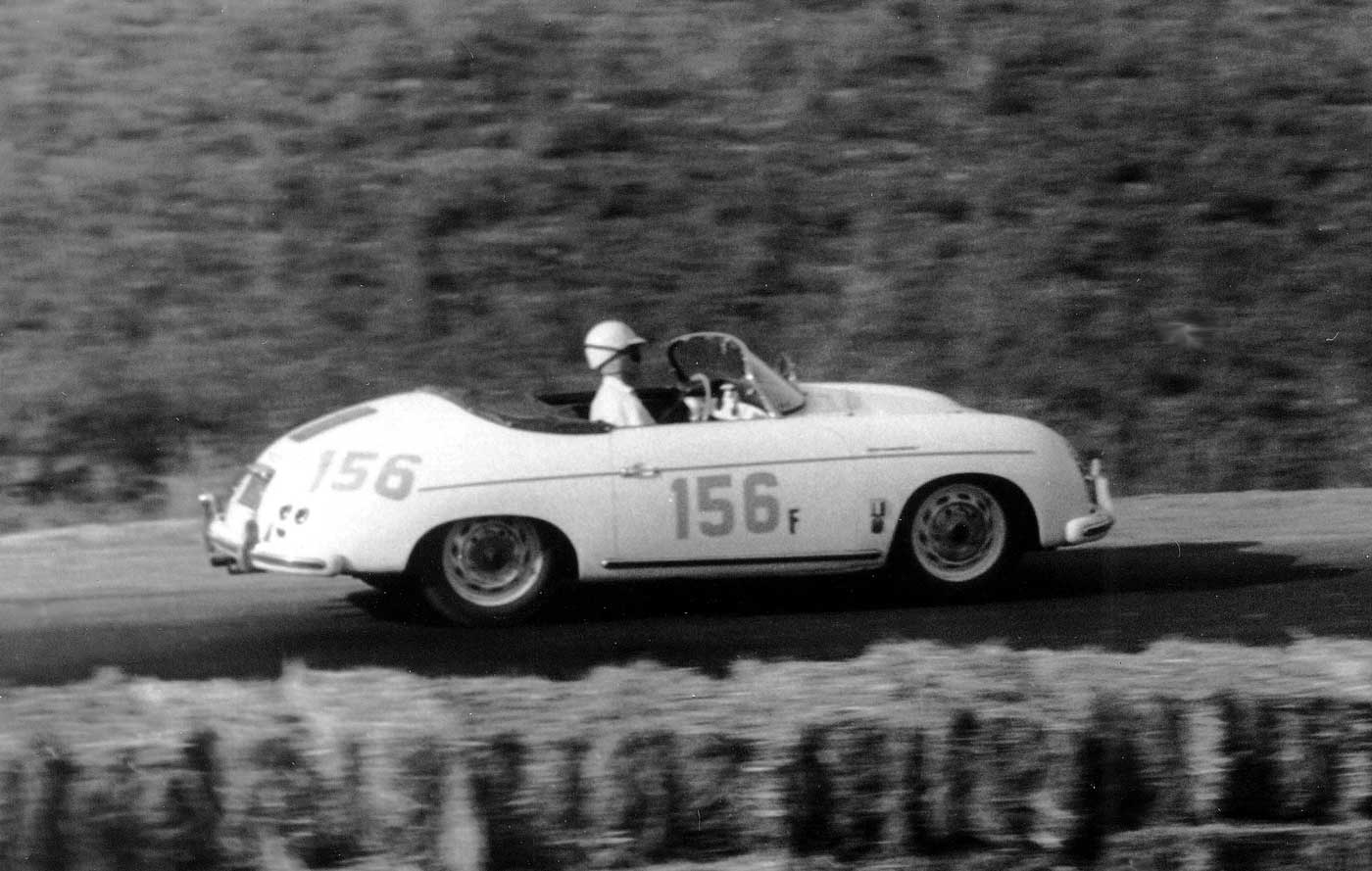
Race 4, Ruth Levy, Porsche
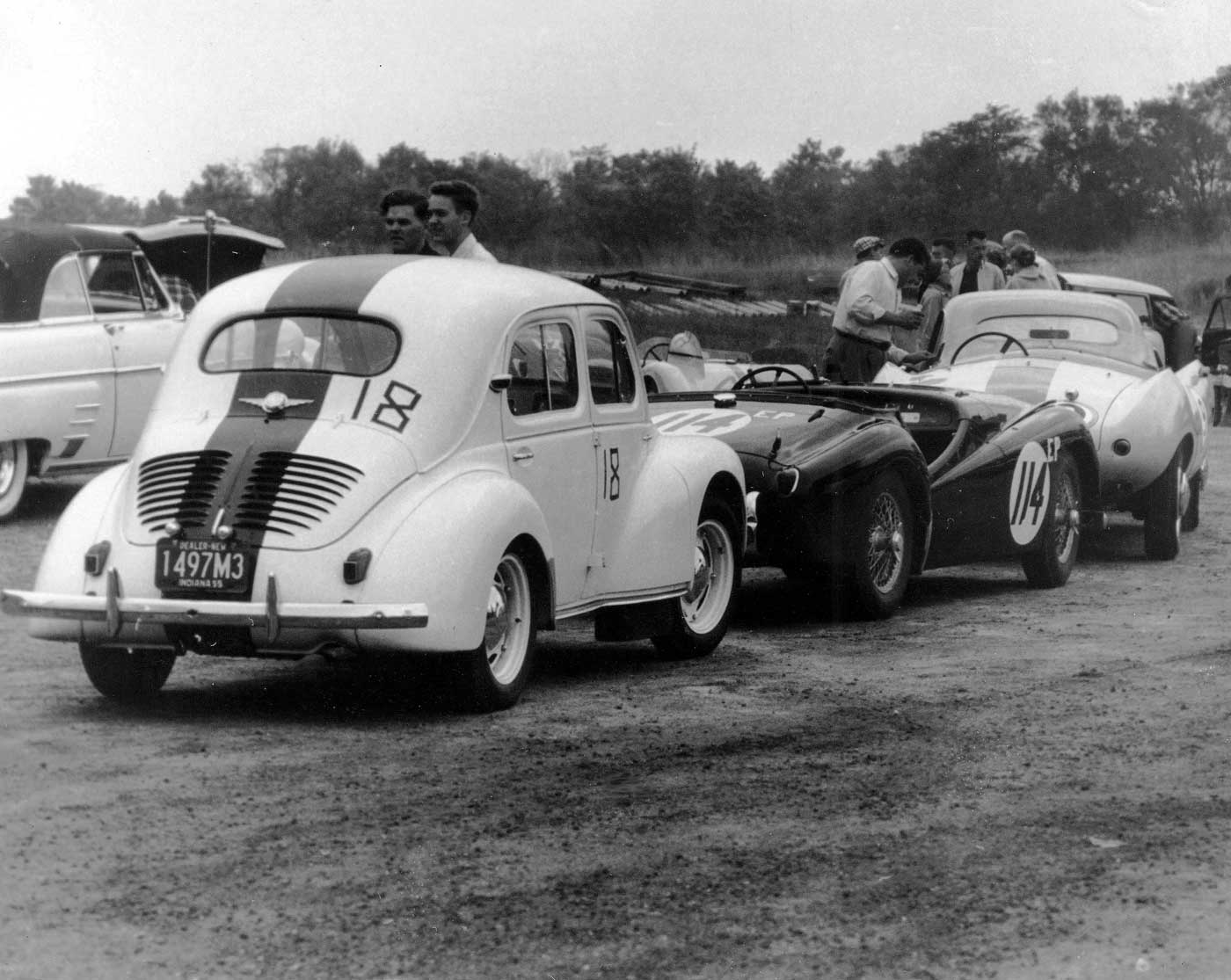
Race 6, S.H. Arnolt, with a Renault 4CV
Thirty plus powerful sports cars took their place on the grid for race 7. Ferraris, an Excalibur, D-type Jaguars, Allards and Cunninghams revved high awaiting starter Ben Harris as he walked front of the field holding his green flag in the air. Drivers’ hands were raised to indicate their mounts were running and when assured Harris moved to the side, jumped in the air waving his flag and the race was on. The favorites were Sherwood Johnston driving Briggs Cunningham’s D Jaguar and Phil Hill in a Ferrari 750 Monza entered by George Tilp. The two moved out and were seldom more than 20 yards apart. Lead changes throughout were many and by lap 33 Johnston’s victory was in sight but on the last lap, with Hill right on his heels, he approached Corner 14 and went wide allowing Hill free passage to the checkered flag.
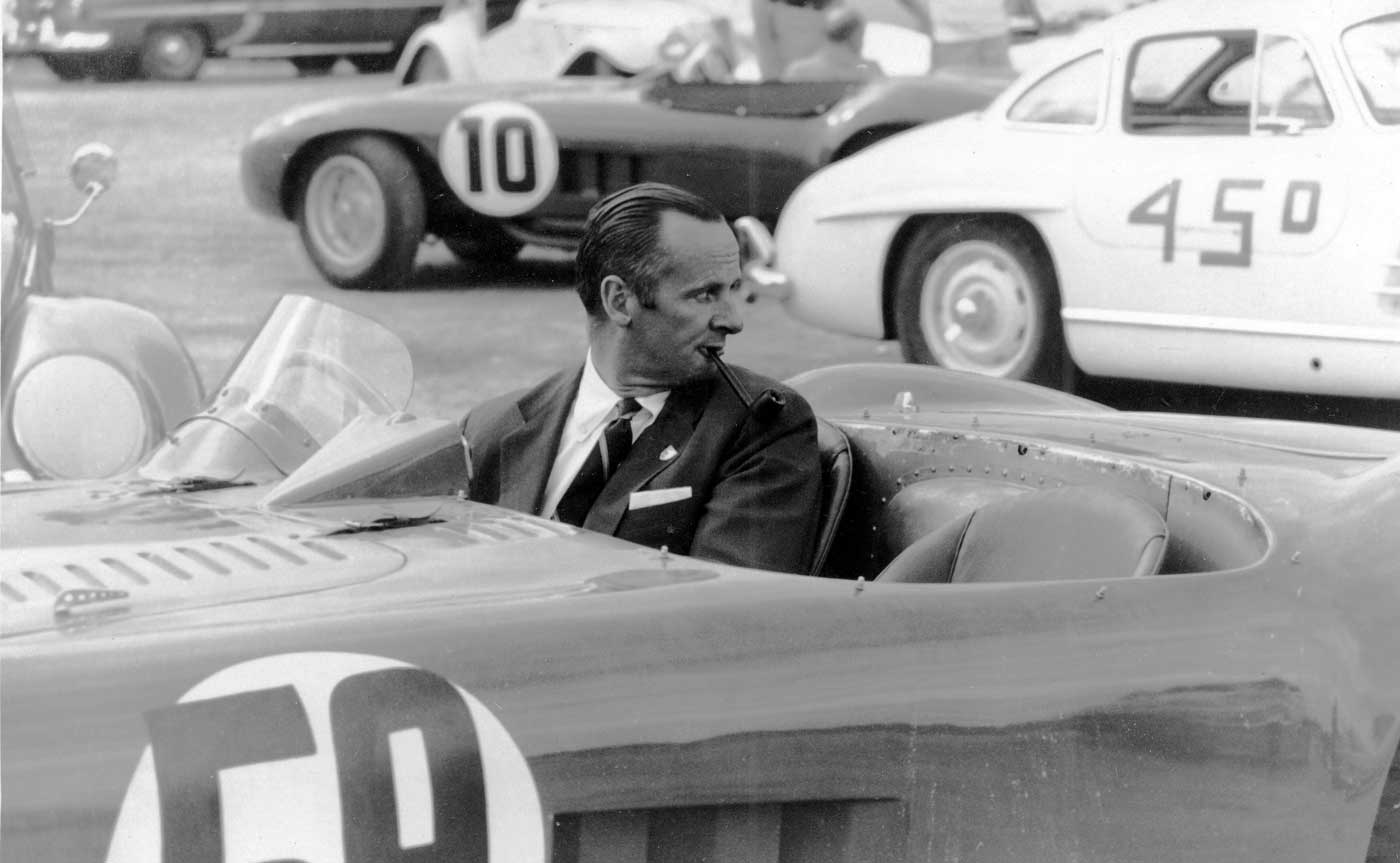
Race 7, Gordon Bennett, Maserati
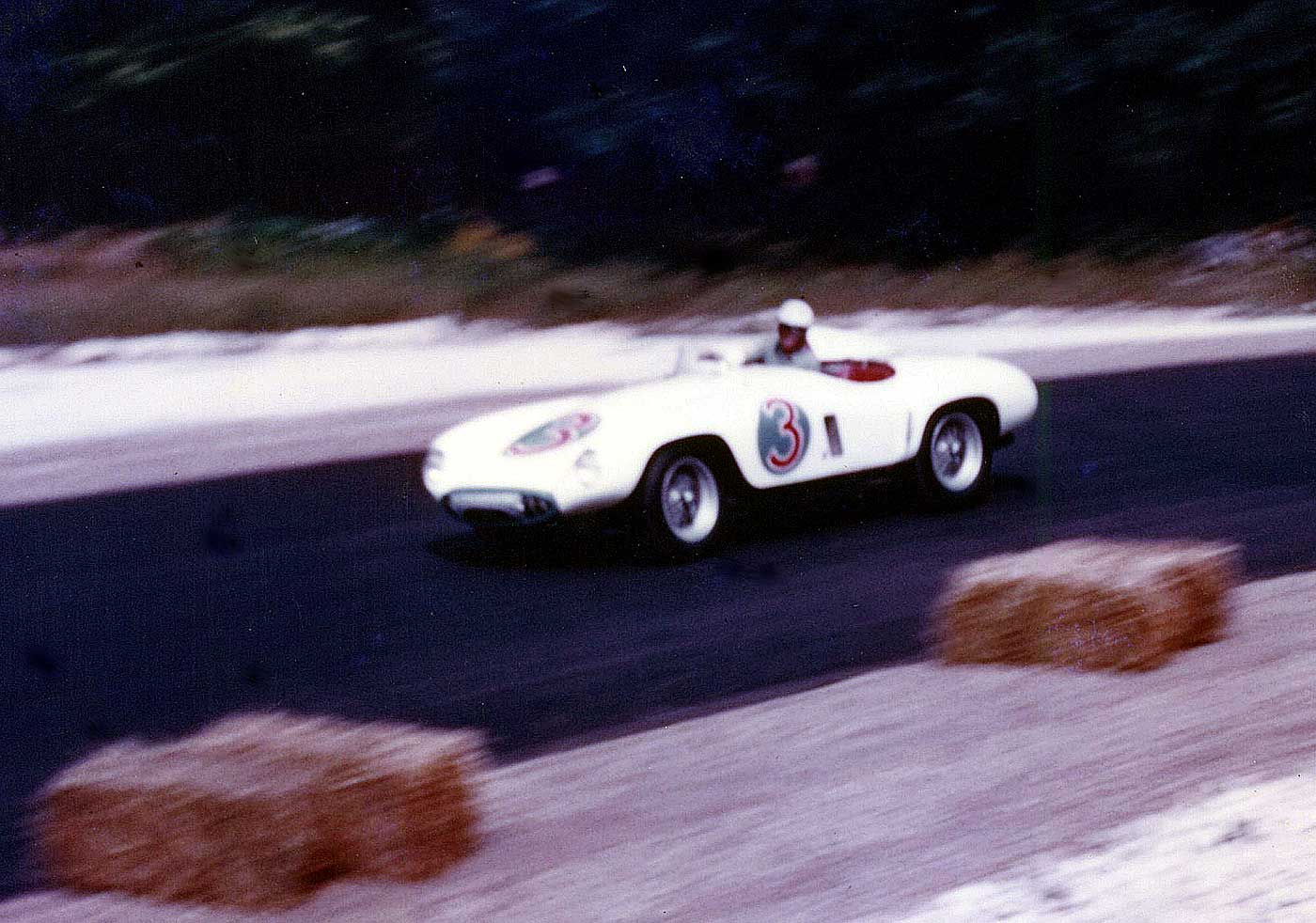
Winner of Race 7, Phil Hill, Ferrari. The Ferrari victory was a taste of things to come in 1956.
The weekend had come to an end, the hours, days and months of toil and worry were behind for Tufte and his massive team of volunteers. They had won and by October shareholders were called to vote on a proposal to seek additional capital via stock offerings and bank financing.
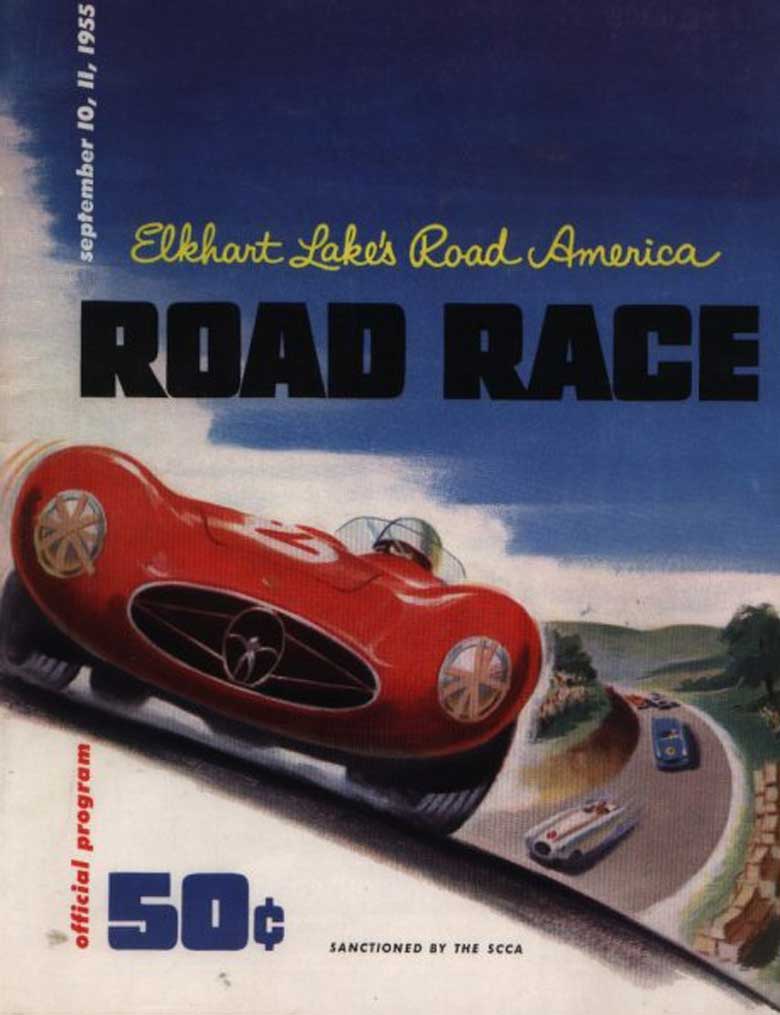
Next: Road America, circa 1956.
Leave a Reply