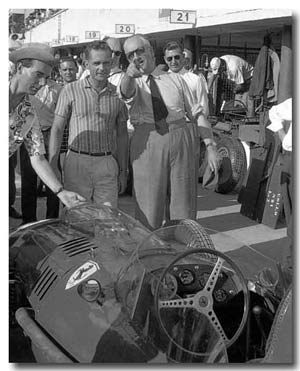
I don’t know when Enzo Ferrari decided not to go to races in which his cars ran but to attend practice days instead, but such was his habit when I was covering the Grand Prix circuit. More often than not he was at Monza, sort of the home ball park, for the late summer Formula 1 races. And so as you see in this photograph shot at practice for the 1958 Grand Prix of Italy is “il Commendatore”, as he was usually referred to then, performing for my camera.
[Read more…] about Denise McCluggage: Ferrari Makes a Point
Gauld: Martinengo Memories and Gentlemen Drivers
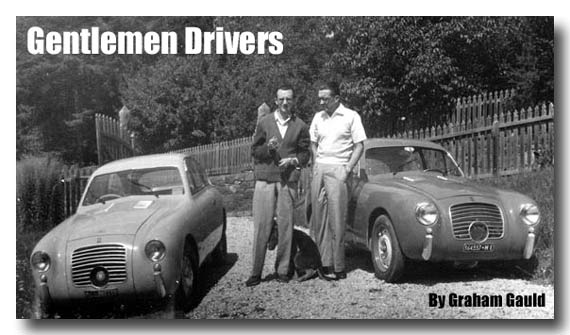
Regular readers may remember my May 2012 article about the Monaco Historics in which I mentioned meeting Cesare Martinengo, whose father Franco was a typical Italian “Gentleman Driver” throughout the 1940s and ’50s. This sounded interesting and I had to find out more. Cesare then brought his scrapbooks to me in the South of France and I spent a fascinating day going back in time when people raced for the fun of it and enjoyed racing with their friends.
Cesare Martinengo, however, did some racing himself, mainly with small Italian sports cars. It was no surprise that thanks to his father’s long-time friendship with Elio Zagato, Cesare raced a double bubble Fiat 750 Zagato. (In the lead photo, Elio, left, with Franco Martinengo stand next to their Fiat 1100 Zagatos.)
1923 French Grand Prix Part 3: Bugatti and Delage
By Gijsbert-Paul Berk
In 1913 Ettore Bugatti (1881 -1947) began working on the design of an eight-cylinder engine at the suggestion of his friend, the pilot Roland Garros. Early in 1914 he sent his collaborator Ernest Friderich to the US with a four-cylinder car of 5.655 liters capacity to participate in the Indianapolis 500. When later that year WWI started, Ettore had to leave his factory in Molsheim, situated in the German occupied Alsace.
First he moved to Milan and later to Paris, where he began designing aircraft engines. In 1919 Bugatti returned to Molsheim and resumed the development of his cars. At the first postwar motor shows in Paris and London, he presented his new three-liter eight-in-line engine. The Type 29/30 engine had three valves per cylinder, operated by one single overhead camshaft.Type 30
When the European auto sport authority CSI announced that for the 1922 to 1924 seasons, the cubic capacity of Grand Prix engines would be limited to just two liters, Bugatti constructed a smaller engine to comply with these regulations. A team of four cars was entered in the 1922 French Grand Prix de Vitesse at Strasbourg. With its long and tapered aerodynamic body, the new Bugatti was nicknamed ‘Le Cigare’ in the French Motoring journals. But it had a successful debut with the three cars finishing second, third and fourth behind the winning Fiat.
Prescott by Jonathan Sharp
A selection of outstanding photos from Prescott by Jonathan Sharp. We’ll have a complete story about Prescott, “The Climb and the Cars” coming up in a future edition of VeloceToday.
[Read more…] about Prescott by Jonathan Sharp
Our Features This Week, August 1st 2012

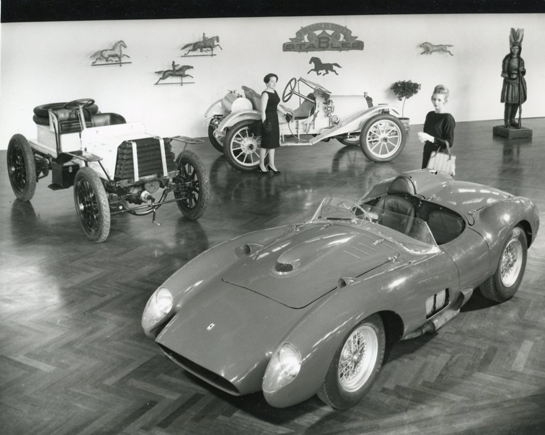
From the collection of Robert F. Pauley: A Ferrari on display somewhere, sometime, by someone. Can you help solve the mystery? The sign reads 'Franklin Hotel Stables'. That's all we know.
This week we feature Brandes Elitch and his Constant Search Part 3; Stephen Mitchell tells all about the Ettinger Shell collection; Gijsbert-Paul Berk continues the Tours saga. Our F1 report finds Ferraris are too slow on Sundays, and read a brief interview with a starving artist. Also, our thanks to those who either donated money or became premium subscribers!
Please Donate or subscribe to VeloceToday; only your support will keep these articles coming to your inbox every week!
Shell Game

By Stephen Mitchell
Photos by Jeanetta Dumouchel
Matthew Ettinger’s long time game of cat-and-mouse with Shell Oil memorabilia
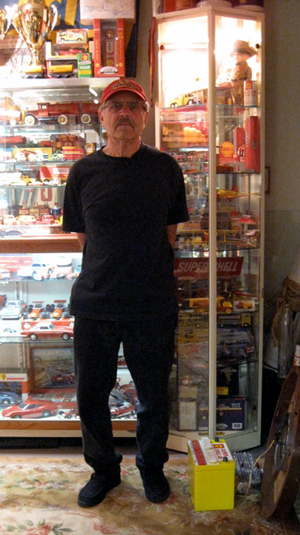
I’ve known Matthew Ettinger since I was in my late teens. When I first met him, he was a nightclub owner and, like me, a Ferrari owner. As our friendship developed and we really got to know each other, we had both moved on to Ferraris that were even more exotic, choosing racing cars as our daily transportation. I had moved on to a GTO while Matthew had acquired the famous Ferrari Breadvan. Matthew was also a serious collector. He loved going through antique shops and knew many of the dealers in Los Angeles personally. His home was filled with original art and rare objects of one sort or another and it would take several visits to get a sense of all that he had.
By Shell obsessed
One of the more obvious pieces one saw upon entering Matthew’s house was an Art Deco Shell Oil gas pump. It was imposing, topped by its white globe with red letters (referred to as the lollipop) proclaiming Shell. This was not Matthew’s first gas pump. He previously had a 1947 Union 76 pump that he had put on display in his Sunshine Meat & Liquor Company, a restaurant/nightclub that he owned. However, Matthew fell in love with the Shell pump when he visited the home of the infamous Gas Pump Ronnie who, according to Matthew, could spray on paint that looked like porcelain. He wanted that Shell pump and traded his Union 76 pump to get it.
More fun than eBay
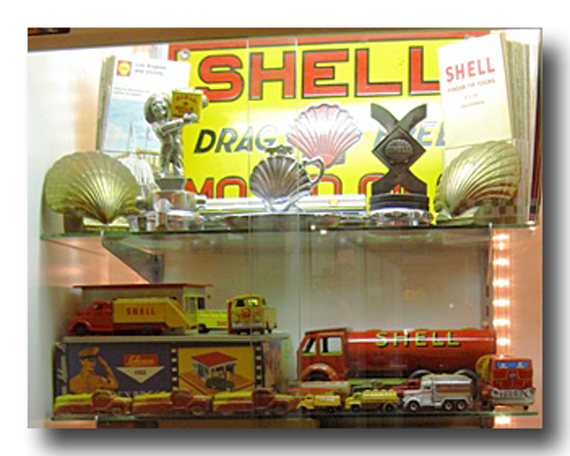
The Shell pump was significant because it set Matthew on a quest for Shell products, signs, promotional toys and memorabilia. No other brand interested him from that point forth. In those days, there was no Internet to facilitate networking or scavenging. One had to look in the back of magazines and attend flea markets–or jumbles as they are called in the UK.
Ferrari and Shell memorabilia together are a natural.
1923 French Grand Prix Part 2: Press and Regulations
By Gijsbert-Paul Berk
The race generated an immense amount of advance publicity. Numerous articles in the national and local newspapers and the sporting magazines created a great deal of curiosity and even greater expectations.
The Press
One of the reasons was that the editors of these publications were well aware of the growing interest of the French public in motorcars and motor racing. They properly reasoned that giving support to this great event would increase their circulations and advertising revenues.
Ferrari and Cobra Art by Wyss at Automobilia
By Brian Winer
There are many automotive fine art painters, most of whom cover the board on marques, depicting first one and then another, as whim dictates. Wallace Wyss, a relative newcomer to the field (his first painting was done in 2007) has intentionally focused on only two makes—Ferrari and the cars of Carroll Shelby, which includes Cobras and GT40s. Wyss will have a booth at Automobilia in Monterey. The booth will be open August 14 and 15th, 2012 from 10 a.m. to the early evening. The location is the Ballroom of the Embassy Suites hotel, located on US 1, just north of 68.
[Read more…] about Ferrari and Cobra Art by Wyss at Automobilia
Our Features This Week, July 25th 2012
–Ferrari F40 Invasion of Silverstone by Jonathan Sharp–
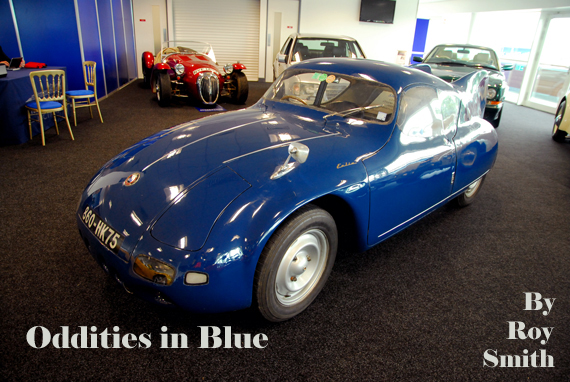
We begin with an exclusive story by historian Michael T. Lynch about Project S 11, the revival of a rare pre-war V8 Alfa Romeo. Your opinions, please! Then a walk through the Silverstone Paddock with Graham Gauld who finds the ex-Jim Clark Porsche. There is only one Graham Gauld and only he can tell these stories with so much insight and first hand experience; Renault Alpine expert and multiple book author Roy Smith finds blue oddities at Silverstone; Automotive journalist Gijsbert-Paul Berk launches Part 1 of the Tours epic; walk the course, circa 1923 with these historic photos. You won’t find these stories anywhere else but here. Lastly a report on the Ferrari/Alonso win at the German Grand Prix.
Please donate or subscribe to VeloceToday; only your support will keep these articles coming to your inbox every week!
1923 French Grand Prix Part 1: The Circuit and Practice
By Gijsbert-Paul Berk
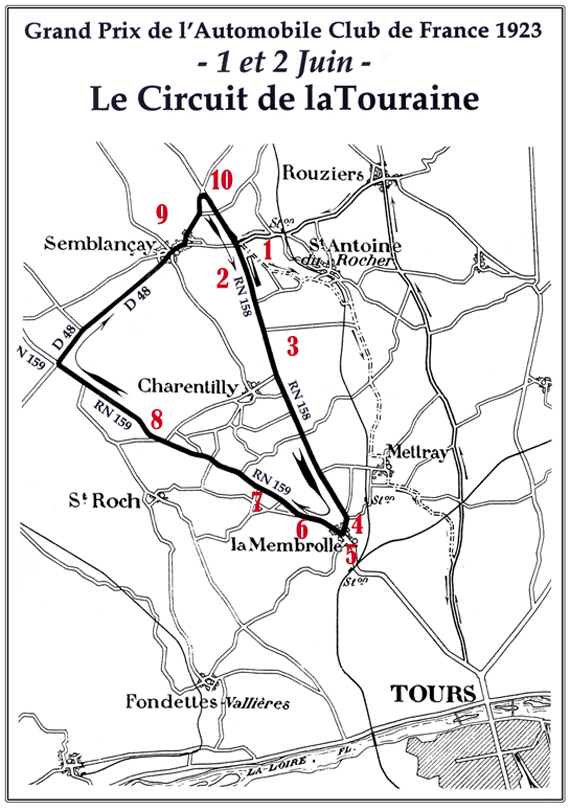
The circuit was a closed-off triangle of public roads, just north of the city of Tours. The starting line was situated just outside a small borough called La Noue-Guérinet, between the villages Neuillé-Pont-Pierre and La Membrolle on the Route Nationale 158. The numbers on the map above correspond to the photographs below. The 1923 Grand Prix of Tours was much tougher and much longer than today’s Grand Prix events. In order to finish, the participants had to cover a distance of 800 km (497 miles). As the ‘Circuit de la Touraine’ had a total length of 22.83 km, (14.1 miles) this meant 35 grueling laps. On the straights some of the cars reached speeds of nearly 200 km/h (125 mph). Around the circuit. 22 marshaling posts had been installed each of them equipped with a telephone in direct and permanent contact with the officials at race control in front of the grandstand.
Come with us as we take a lap around the 1923 French Grand Prix.
Photo 1: At the starting line. At one side were the tribunes and a grandstand for 4000 spectators. Note the direction of travel.
Gauld at Silverstone

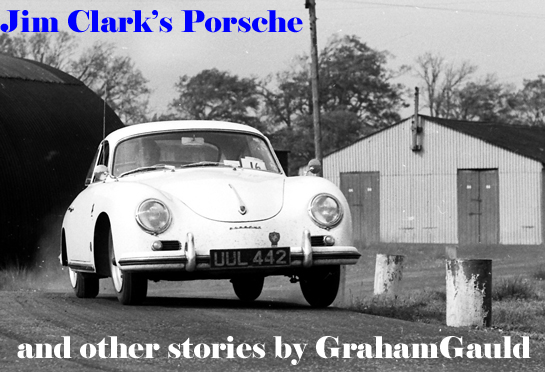
Jim Clark at the wheel of UUL 442 at a small MG Car Club Sprint in 1958 winning the sports car class with the 356 Super. Photo by Graham Gauld.
It doesn’t seem like a year since the last Silverstone Classic event, and with the rain-soaked British Grand Prix just two weeks before, I was prepared for rain. It came on Friday but throughout the rest of the weekend the weather was good. There was an enormous entry this year split into both the old traditional Silverstone Paddock and the new “Wing” Paddock which is the site of the Grand Prix start and finish line.
I had various reasons to be there, but mainly to do research for a book. Thus, I had less time to go on the wander than in the past, but still I am always amazed at the surprise meetings and coincidences that just happen.
Jim Clark’s Porsche
Take for example the ex-Jim Clark Porsche 356 Super; well, it was his after he bought the car from Ian Scott Watson who was his entrant.