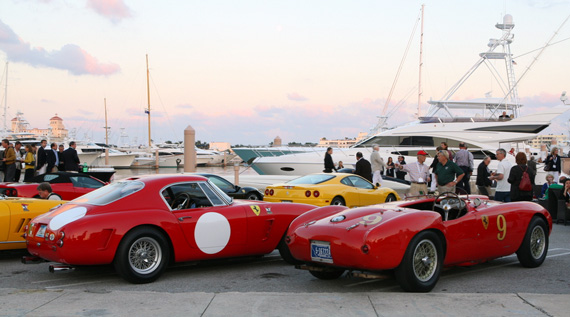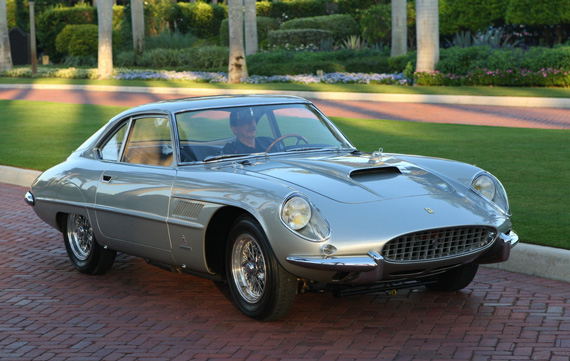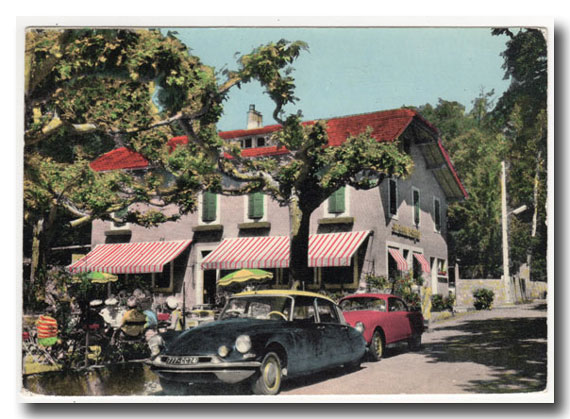
We are on a bit of a holiday, so this week we’ll recap the stories about what we have unanimously voted as the best automotive book of 2012, the Talbot-Lago Grand Sport.
Driving the Talbot Lago 2.5 Gran Turismo
To accompany our stories about the Grand Sport, we asked Gijsbert-Paul Berk if he had a favorite Talbot-Lago. Reaching into his huge bank of automotive experiences, he told us about driving the ultra-rare 2.5 liter 1955-56 Gran Turismo coupe on the banking at Montlhéry. Above, the author’s test car, a Talbot 2.5 liter GT coupé on the cover of the June 1956 issue of the Dutch magazine “Autovisie”. The photo was taken in front of the gate of the stately house called Oostermeer on the bank of the river Amstel near Amsterdam.
I have never owned a Talbot-Lago and they were never on my shortlist. The main reason for this is that when they were new, they were far beyond my financial scope. When they were affordable, as second hand cars, the factory no longer existed, so service and spare parts were a problem. So, it is not that I dislike Anthony Lago’s Talbots; I have driven 4.5 liter sedans, owned by friends. In 1956 I even drove a 2.5 liter GT coupé on the Montlhéry circuit in France. But it was not in a race. [Read more…] about Driving the Talbot Lago 2.5 Gran Turismo
Our Features This Week, December 19th, 2012
Graham Gauld: Special-Bodied Showcars
By Graham Gauld
Show cars fall into two categories:
A. “Let’s put this apparently mad idea up and see if anyone takes any notice.”
B. “We will call this a show car but really show the way we are thinking for the future.”
I have always had an interest in coachbuilding and design. Perhaps it was due to the first books I ever bought about cars. They were the soft cover books produced by Fawcett Publications in the USA and I treasure them to this day. I particularly liked “Sports Car Album” by John Wheelock Freeman because, with photographer Alexandre Georges, he traveled round Europe and wrote stories about the manufacturers and coachbuilders of that time. I was serving two years National Service in the Royal Air Force at that time but little was I to know I would be visiting some of those exact same factories just a few years later. So don’t be surprised if, from time to time, I write about various special-bodied show cars that appeared only to disappear again.
From the Archives: Santa in a Silver Spyder
By Pete Vack
The following true story is based on the recollections of John Wiech, who bent my ear for a few hours at a car meet last year. Our apologies for a story about Porsches, but it’s the truth and it’s a sin to tell a lie, particularly at Christmas time. We originally published this in 2009 and it was one of our reader’s favorites. [Ed.]
The subject had started another family argument. Johnny had become enamored with a rare foreign car but it seemed no one knew exactly how to pronounce the name. It was German, or was it. “…It’s Austrian,” said his Dad. “But made in Stuttgart,” said Johnny, being careful to put the “sch” in. He reasoned that the sch in the car’s name might sound the same and the vowel at the end be pronounced. His older sister said otherwise. “It’s Porch, as in front porch or back porch, without the ‘e’.”
She always thought she was so smart.
[Read more…] about From the Archives: Santa in a Silver Spyder
Our Features This Week, December 12th, 2012
The Silent Champion
Editorial by Gijsbert-Paul Berk
After the safety car-finish of Jenson Button in his McLaren-Mercedes at the Sao Paulo Grand Prix, the new World Champion Sebastian Vettel also got a warm round of applause from an enthusiastic Brazilian crowd. It was not only the 3rd consecutive World Championship for Sebastian, but also the 3rd time that Red Bull won the Constructors Championship.
However, in all the excitement over the Grand Prix of Brazil, most commentators and reporters failed to mention that this was a victory for Renault as well as Vettel and Red Bull. Fortunately the French sports journalist Jean-Louis Moncet, who writes for the magazine Auto Plus and does the race commentary for the French TV station TF1, did remember the role of Red Bull’s engine supplier, and was quite justified in doing so.
[Read more…] about The Silent Champion
Our Features This Week, December 5th, 2012
Explaining the Fulvia HF

Factory brochure for the Fulvia HF Lusso.The standard S2 1600HF, with standard stainless windshield trim, standard nose badge, and standard S2 Coupé bumpers. The bumpers have both front and side brackets, with side bracket holes below the marker lights.
[Lancia Fulvia 1.6HF chassis number 2269 was covered in detail by Andrew Coles last week. Today, Edward Levin gives us further information about how the HF series developed. Ed.]
By Edward Levin, American Lancia Club
Perhaps because he had raced for Fiat at the beginning of his automotive career, Vincenzo Lancia had always forsworn racing. Others raced his cars, and racing drivers from Nuvolari to (later) Hawthorn chose Lancias as their road cars. But Lancia feared that the enormous expense of a factory competition team would detract from his main aim—selling well-engineered, solidly-built cars to a monied audience.
Vincenzo’s fears were proven prescient when, after the founder’s death, his son Gianni embarked on an ambitious program of sports prototype and formula one racing. While this program had yielded some success and led to the development of some advanced competition cars, it also helped propel the firm into the financial difficulties that led to the family’s sale to a private investor in 1955.
The “High Fidelity” Lancias
For the decade following the sale, only privateers raced Lancias. One such privateer group, the HF Squadra Corse had been organized by Cesare Florio, son of Lancia’s marketing director. The Squadra borrowed the “HF” designation from the HiFi Club, a group of lancisti who bought only Lancias, thus exhibiting their “high fidelity” to the marque. When the factory decided to re-enter competition in the mid-‘60s, it must have seemed natural for the factory to essentially absorb and build upon the HF Squadra Corse.
Therefore beginning around 1965, the factory reconstituted a works racing team, the Reparto Corse, and began to prepare its new front-wheel drive Fulvia model for road racing and rally. And although the newly-introduced Coupé (1.2) saw some initial success, its power-to-weight ratio limited its competitiveness. To address this, in 1966 the factory created a lightweight homologation version of the Coupé, officially known as the “Coupé HF”, but now referred to as the 1.2HF.
Fiat Invades the L.A. Auto Show
By Eric Musarra
Photos courtesy Fiat
Buyers these days seem to want cars that only look tiny; a personal tardis if you will. The Minis of the 60s were tiny then, but today they are merely a figurine for anyone over six feet tall. Over years, the new Mini Coopers seem to steadily gain size and weight, creeping the scale along and distorting the beauty of the original. Thankfully a model that doesn’t cheat on her diet continues to be offered.
Now Fiat, still considered a new car in America is fattening up its models, and unveiled a four-door (five if you count the hatch) 500 L at the L.A. Auto Show. It made sense to debut the car in California which accounts for a quarter of Fiat’s sales in America.
[Read more…] about Fiat Invades the L.A. Auto Show