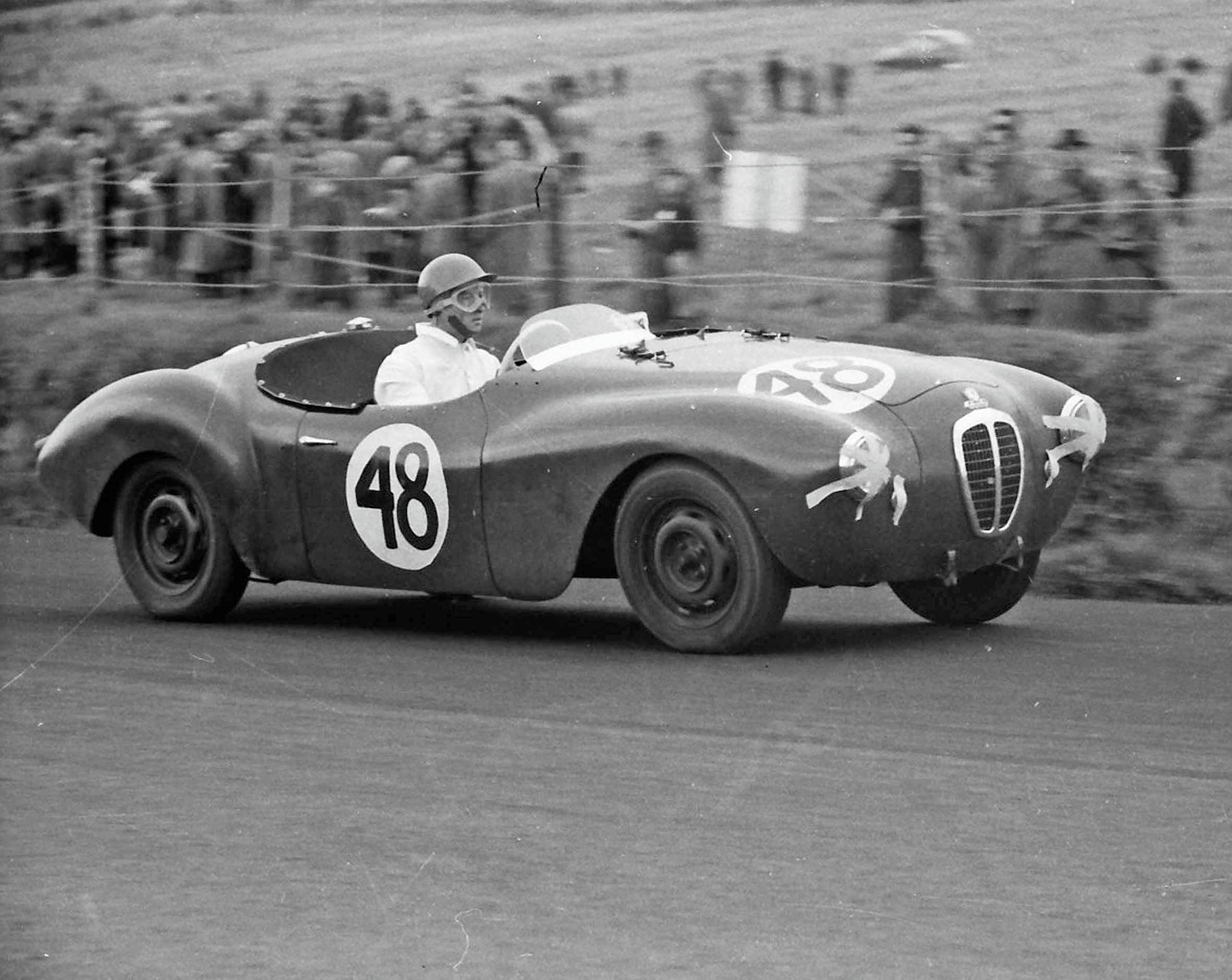
The Frazer-Nash DKW sports car prototype driven by Ken Rudd at the 1955 RAC Tourist Trophy Race. ( Photo Grand Prix Library/Gauld)
Story and photos by Graham Gauld
One of the first cars to impress me as being something of a “sleeper” was the DKW Sonderklasse. The car and the marque are probably totally unknown today as at least two generations have passed since first I saw one in action. It was pale blue and was driven by a young Scottish farmer called Ian Scott Watson.
Ian was the archetypal enthusiast who sold his MG for a typical British kit-car of the 1950s; a Buckler that he built up with the ubiquitous Ford 1250cc engine. It was not a success but he was fascinated by a rather odd looking car sold by AFN Ltd, a company with Frazer-Nash origins, that was to become the main importers of Porsches.
The car was produced by the DKW division of Auto Union GmbH. Auto Union, consisting of Audi, Horch, DKW and Wanderer, was an amalgam of four German car makers set up in 1932 in Saxony when the world was facing an economic crisis. Auto Union is best known for the grand prix car the company built that, with Mercedes Benz, was to dominate grand prix racing from the mid-1930’s until WW2.
It was the D.K.W. division that had started building their first car in 1928 as an independent company before the merger. It had a two cylinder two-stroke engine of 490ccs based on their motor-cycle engines. After the merger that formed Auto Union, DKW launched two models, the Reichklasse with front-wheel-drive and a 589cc two-cylinder two-stroke, and the Sonderklasse, an 896cc three-cylinder two-stroke launched in 1953. This model immediately began to dominate international rallying thanks to factory driver Walter Schluter.
It was the original DKW two-cylinder two-stroke engine that was licensed to the Swedish company SAAB that launched Sweden into the international car market, and SAAB were later to also take on the license to the 3 cylinder engine for SAAB’s 93 model that also became a successful rally winner.
It was this competition history that persuaded Scott-Watson to buy his first DKW Sonderklasse and he always asserted that it represented a compact version of a six-cylinder by being a two-stroke!

Ian Scott-Wastson’s first DKW Sonderklasse after the Scottish Rally accident. (Photo Grand Prix Library/Gauld)
His first major entry with the car was in the 1955 International Scottish Rally but early on his co-driver, fellow farmer Alan Curry, rolled it on one of the tests, but they continued with the car battered and bent, to finish. He did not hesitate and bought another DKW Sonderklasse to replace it and promptly wrote-it off himself. So he bought a third one!
Scott-Watson later came to prominence as the man who persuaded a fellow young farmer called Jim Clark to navigate for him on rallies and it was Scott Watson’s last DKW Sonderklasse that Clark competed in his first ever motor race.

Jim Clark racing Ian Scott-Watson’s last DKW Sonderklasse in 1957. ( Note that in those days it was not compulsory to race with a crash-helmet in a saloon car. (Photo Grand Prix Library/Gauld)
Before he sold his last DKW to buy a Porsche, Ian let me drive the Sonderklasse and I must admit it out performed many of the small sedans of its day. In September 1955 I flew over to Ireland for the RAC Tourist Trophy race which counted for the World Sports Car Championship and was surprised to find the entry of a dumpy little sports car entered as a Frazer Nash BMW.
Michael Burn, the enthusiastic Sales Director of AFN Ltd, the importers of the DKW’s, conceptualized a prototype for a possible two-seater sports car using DKW Sonderklasse mechanicals.
The drivers were Cecil Vard, the well-known Irish driver, and Ken Rudd, who developed AC cars for racing, but their race came to an end prematurely when one of this private team’s mechanics put in straight petrol rather than two-stroke oil and petrol mix: the car’s engine seized. At the time Rudd did admit the car “….went like the clappers” for a few laps before collapsing. That car still exists and came up for auction in 2005 where it was sold for over £20,000.
The concept of a small DKW sports car did not disappear however, for back in Germany DKW had the same idea when they came up with the DKW Monza.
It started out when Gunther Ahrens and Albrecht Mantzel developed their own plastic-bodied DKW sports car built by Dannenhauer & Strauss in Stuttgart. They built ten cars before the bodywork was then produced by Massholder and later Schenk, so over 100 of the original DKW Monzas were built before DKW brought out their own Auto-Union 1000 SP and stopped supplying chassis for the Monza.
Originally the 1000 SP was introduced as a fixed head coupe using the same front-wheel drive with the familiar three-cylinder two-stroke engine, but four years later it was produced as a roadster with coachbuilding by Bauer, and between 1957 and 1966 over 6500 coupes and roadsters were produced and were the last true German DKWs though they continued to be built under license in Brazil.


Leave a Reply