Jeff Allison continues the series looking at Ferraris he’s photographed – this time in 1962.
Twelve Hours of Sebring at the Sebring, Florida Airport on March 23-24, 1962
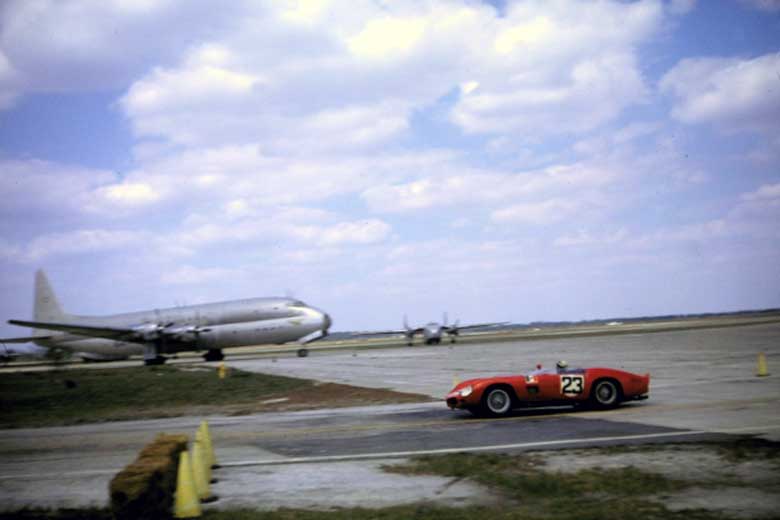
The Scuderia Serenissima, also known as the Scuderia SSS Republica di Venezia, of Italian Count Giovanni Volpi di Misurata entered this 2953cc V12 Ferrari 250 TR61 driven by Swede Jo Bonnier and Italian-born, Belgian-resident Lucien Bianchi (in car).
One of only two 250 TR61s built, it was raced by the factory in 1961 at Sebring (winner) and Le Mans (DNF) before going to Scuderia Serenissima, where it ran at the 1961 Bahamas Speed Weeks and then here at Sebring, where it won for the second consecutive year. Bonnier and Bianchi inherited the lead when the North American Racing Team 250 TR61 of Stirling Moss and Innes Ireland was disqualified. The pair completed 206 laps or 1071.2 miles to finish first on distance. However, the 1962 manufacturers’ championship was for GT cars so the championship points went to the second-place Phil Hill and Olivier Gendebien Ferrari 250 GTO although it was ten laps or 52 miles behind the 250 TR61.
Enzo Ferrari was ready for the 1962 rule change to award the manufacturers’ championship to GT cars rather than sports racing prototypes with the latest iteration of the venerable 250 GT – the 250 GTO. Although a Scuderia Serenissima Ferrari 250 TR61 would finish first on distance, it was this second-place North American Racing Team 2953CC V12 250 GTO, driven by American Phil Hill (in car) and Belgian Olivier Gendebien, that collected the championship points with an amazing second overall and as the first GT car to finish. It was the first race in which a 250 GTO competed, helping Ferrari win the 1962 Challenge Mondial de Vitesse et Endurance. The GTO would go on to win two more FIA GT manufacturers’ class titles. Thus began the racing legend of the iconic Ferrari 250 GTO!

Ferrari 250 GT Sperimentale Berlinetta (Chassis 2643GT), Sebring 12 Hours, March 23-24, 1962-jeff-allison
William McKelvy’s Scuderia Bear entered this car for Americans Ed Hugus and George Reed. It was an experimental car built in 1961 to develop ideas for the successor to the 250 GT SWB Berlinetta. A reworked 250 GT SWB chassis was fitted with a modified 2953cc V12 and other performance tweaks and a lightweight aluminum body in the shape of a 400 Superamerica road car. The factory raced it at the 1961 Le Mans, and Luigi Chinetti’s North American Racing Team entered it in the 1962 Daytona Continental where Stirling Moss drove it to fourth overall and won the GT 3000 class. At Sebring, it finished a creditable eighth overall – one of the four Ferraris to finish in the top ten and third in the GT 3000 class, trailing a 250 GT SWB by three laps and the class-winning 250 GTO by nine laps.
For 1962, Ferrari built rear-engine V6 and V8 Dinos, replacing their outdated front-engine 250 Testa Rossas. American Buck Fulp and Canadian Peter Ryan drove this 2458cc V8 Dino 248 SP (Sports Prototype) for Luigi Chinetti’s North American Racing Team – the unofficial official Ferrari works team. Stirling Moss and Innes Ireland were to drive the car but didn’t like its handling or performance and opted for an older, front-engine 250 TR61. With Fulp and Ryan, it ran out of fuel at one point, was plagued by the poor handling revealed by Moss and Ireland and finished thirteenth overall and third in the Sports 3000 class. Despite the promise and potential of the brand new rear-engine cars, a front-engine Ferrari 250 TR 61 was first on distance, continuing the winning legacy of the front-engine dinosaurs.
Night was approaching and the headlights are on as Englishmen Stirling Moss and Innes Ireland (in car) shared this North American Racing Team’s 2953cc V12 250 TR61. It’s one of two TR 61s built, and it won the 1961 Twenty Four Hours of Le Mans and was later raced in 1961 by Pedro Rodríguez at Mosport, Riverside and the Bahamas Speed Weeks, and in 1962 at Daytona before Sebring. The pair led five of the first seven hours and had an almost three-lap lead before being flagged off the track and disqualified for a refueling infraction that occurred some 55 laps or three hours previously! COMPETITION PRESS (March 31, 1962) observed, “Ireland’s reaction, it is said, raised blisters on the pit area concrete and withered all signs of vegetation in a radius of several hundred yards.”

Ferrari 250 GT SWB Berlinetta Competition (Chassis 2819GT), Sebring 12 Hours, March 23-24, 1962-jeff-allison
Englishman Colin Davis and Frenchman Fernand Tavano were entered by Giovanni Volpi di Misarata’s Scuderia Serenissima in this 2953cc V12 250 GT SWB Berlinetta. The pair was in an excellent eighth place after the first hour and moved steadily up the field until retiring in fifth place at the six-hour mark at 119 laps with engine problems. It led the GT 3000 class the majority of the race. Later in 1962, Volpi, who was miffed because Ferrari didn’t allocate a new 250 GTO to him, had this car redesigned with a radical Kamm tail by Carrozzeria Drogo, supposedly to improve aerodynamics. It became known as the “Breadvan” because the bodywork resembled the back of a French bread van!
Luigi Chinetti’s North American Racing Team entered this 2417cc V6 Dino 246 S for Americans Alan Connell and Bob Grossman. In 1961, it was raced as a works car at Sebring (sixth overall and won the Sports 2500 class), the Targa Florio (second) and the Nürburgring (DNF). Connell and Grossman were later joined by American George Constantine (Ferrari 250 TR59/60) and even later by the Mexican Rodríguez brothers (246 SP) after they retired their cars. Here Pedro Rodríguez is in the car as the daylight fades and the headlights are on, but their race was soon over while in second place when the transmission failed (some sources indicate clutch failure) on lap 168.
It was always a busy time at the Webster Turn. In the foreground is the works TVR Grantura approaching a gaggle of cars led by three Ferraris – the no 34 Ferrari 246 SP of Pedro and Ricardo Rodríguez, the distance-winning no 23 Ferrari 250 TR61 of Jo Bonnier and Lucien Bianchi, the no 35 Ferrari 246 SP of Alan Connell, Bob Grossman, George Constantine and Pedro Rodríguez, followed by the no 21 Cooper Monaco Mark IV-Maserati of Bruce McLaren and Roger Penske. In the background are some of Sebring doyen Alec Ulmann’s military surplus aircraft, which he sold mainly to South American countries.
Sports Car Club of America Regional Races at Geneva, Florida Airport on June 30-July 1, 1962

1955 Ferrari 750 Monza-Chevrolet V8 (Chassis 0554M), Sports Car Club of America Regional Races, Osceola, Florida Airport, June 30-July 1, 1962-jeff-allison
Sanctioned by the Central Florida Region of the Sports Car Club of America, the 2nd Osceola Grand Prix was run on the seven-turn, 2.8-mile road racing course laid out on the Osceola Airport, some 12 miles southeast of Sanford, Florida. Robert H. McNeal, Jr. (left behind headrest) was driving his Ferrari 750 Monza-Chevrolet V8 that was originally owned and raced by American Masten Gregory in Europe, the Bahamas Speed Weeks and the US in 1955-1956. Nebraskan Loyal Katskee was the next owner, and he raced the car extensively in 1956-1959 in SCCA events in the US and the Bahamas. The original 2999.62cc, in-line, four-cylinder Ferrari engine was replaced by a Chevrolet V8 at some point. In a Saturday preliminary 5-lap, 14-mile race, McNeal was third behind Bill Dunn’s BMC Formula Junior and Ross Durant’s Ferrari 250 GT Spyder California. On Sunday, he won his preliminary race, beating Durant to the line. In the 20-lap, 56-mile feature, McNeal was a distant seventh overall – two laps behind the winning Lister-Chevrolet V8.

1958 Ferrari 250 GT LWB Spyder California (Chassis 1055GT), Sports Car Club of America Regional Races, Osceola, Florida Airport, June 30-July 1, 1962-jeff-allison
Ross Durant had upgraded from his normal Alfa Romeo to this 2953cc V12 Ferrari 250 GT Spyder California road car. Luigi Chinetti received the car in 1958 and sold it to several owners in Texas and then Florida where Durant purchased it in 1962. He was second to Bill Dunn’s BMC Formula Junior in his 5-lap, 14-mile preliminary on Saturday and was second to Robert McNeal’s Ferrari 750 Monza in Sunday’s preliminary race. In the 20-lap, 56-mile feature race, he finished second to Art Huttinger’s Lister-Chevrolet V8, one lap behind, but won the B Production class.
Sports Car Club of America Divisional Races at the Sebring, Florida Airport on July 28-29, 1962

Ferrari 500 Mondial-Chevrolet V8, (Chassis 0454MD), Sports Car Club of America Divisional races, Sebring Airport, Florida, July 28-29, 1962-jeff-allison
Decca Records singer and Birmingham, Alabama radio disc jockey (SPORTS CAR RACING IN THE SOUTH: TEXAS TO FLORIDA 1961-1962, 2014) Tommy Charles moves over the extremely wide concrete expanses of the pit straight of the 3.5-mile, thirteen-turn course that was used in lieu of the Sebring’s usual 5.2-mile road racing venue. His 500 Mondial was originally owned by American Bob Said, who raced the car extensively in Europe and the US in 1954-1955. Briton-living-in-the-US Tony Palmer-Morewood owned it next and raced it at Sebring, Venezuela and SCCA events in 1955-1956. Along the way, the in-line, 4-cylinder 1985cc engine was replaced by a Chevrolet V8. Charles has his head in the cockpit checking out a problem as he passes a black flag while his pit crew runs to the line to see what’s wrong during Sunday’s 20-lap, 70-mile feature race at the Second Sebring Summer Championship Races.
The author attended these races and photographed these and many more cars. His personal knowledge and memory of the events was greatly assisted and reinforced by historian and VeloceToday.com contributor Willem Oosthoek’s seminal SPORTS CAR RACING IN THE SOUTH – TEXAS TO FLORIDA 1961-1962 (2014).


Leave a Reply