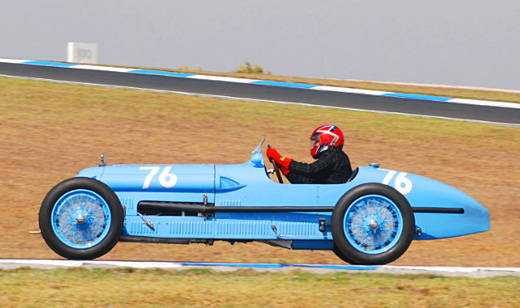
 Anderson out with the restored Talbot Darracq. Photo by Vince Johnson.
Story by Pete Vack
Stuart Anderson remembers the day in 1988 he finally laid eyes on the old blue single seater. “The car was in scruffy condition and was rescued from a shed locked up like Fort Knox. It was buried under junk and festooned with creepers, but amazingly, nothing was broken.” Anderson had persuaded Jack Day’s de-facto widow to part with the car, which had been interred for over twenty years. Day had bought it in 1949 and installed a Wilson pre selector gearbox and 16 inch wheels. It was then garaged and almost forgotten, one of the lost treasures of Australia.
Back to the future
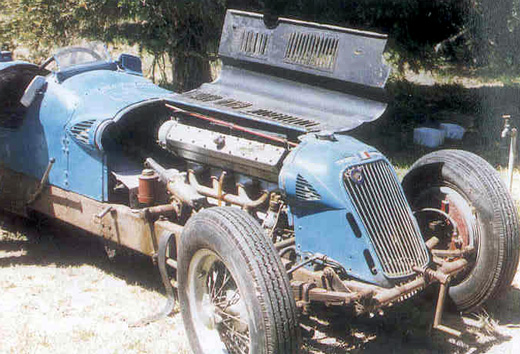
The Talbot Darracq “as found” in 1988 by Stuart Anderson and his brother.
Day had imported the old GP car after buying it from one George Radford of Nottingham. He had purchased it from UK owner Anthony Powys-Lybbe, who was eternally frustrated with the complex engine and running gear; it was not to threaten the likes of the Delage raced by Dick Seaman as planned. Powys-Lybbe had bought the machine from Enrico Plate in 1937, hoping to succeed in voiturette events ala Dick Seaman and the Delage. (Read “Ramponi’s Delage”)
Plate had been equally unsuccessful in making the car truly competitive despite its huge potential. Plate had obtained the car from what was left of the Materassi team, sometime around 1932. With Scuderia Materassi, (according to some historians, the Italian word “Scuderia” was used for the first time by Materassi in 1928) the blown straight eight faced both triumph and tragedy.
And at the beginning of its long life, the tattered but intact Grand Prix car was one of the three technologically advanced cars built by Talbot Darracq to compete in the 1926 1.5 liter blown formula, the same class that produced the Delage 1.5. Forlorn or not, the blue single seater, along with its two sisters, was once one of the most significant race car designs of the 1920s.
Did we say two sisters?
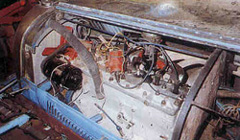
A Graham six inserted into
the chassis of the Talbot Darracq.
By the mid 1980s, collectors were aware–though perhaps only dimly–of the existence of the three hi tech Talbots. One had surfaced in South Africa with a flathead six out of a Graham–surely a remarkably retrograde project which substituted a thoroughly agrarian engine for a supercharged roller bearing alloy DOHC straight eight. But then again, what else are you going to do when a roller rod goes while racing in Rand?
The Graham engined car was with Boetie van Zyl in the 1990s, but little remained of the real Talbot. The frame, engine, transmission had been replaced or modified and that left some body panels. Not a great candidate for restoration.
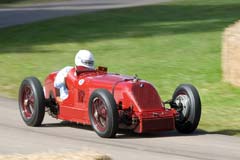
The restored Zweimuller car.Courtesy http://www.ultimatecarpage.com
In the early 1990s, another of the three Talbot Grand Prix cars was purchased from the Guido Dubbini collection by South African collector David Cohen (now with Egon Zweimuller in Austria). This too, was incomplete. Of the original Talbot, only the engine and running gear were intact, having been fit into a special tubular chassis with a new body. The body, chassis and suspension were built from scratch. Thankfully, Cohen had it painstakingly reconstructed in the U.K., and the completed car was ready for the Bagatelle Concours in Paris in 1995. The car was then featured in the March 1996 issue of “Classic and Sportscar” magazine.
________________________________________________________________
If you are enjoying this article, why not consider a donation to VeloceToday? Click here for details..it’s easy!
________________________________________________________________
The last of the three sisters
That meant that the Talbot Darracq locked up like Fort Worth was the most original of the Grand Prix Talbots. The body was unmolested, the engine, drive train and suspension complete, and the only major change was the chassis frame work, modified by Plate to replace the unusual Lancia Lambda-like three piece chassis; a work of art but lacking stiffness. Essentially, as Fred Simeone might say, it was found in a ‘last raced’ condition, dating from the Plate efforts in the 1930s.
Restoration details
Restoring a highly complex Grand Prix car with roller bearing crank and cams does not sound like a job for the faint of heart of weak of wallet. It also requires patience and access to genius. “I bought the car in March 1988, and it made its first public outing in March of 2009.” Twenty years is a good stretch of wait, and Anderson also knew a genius. “The fabrication of a new set of cylinders, final assembly, valve and ignition timing, start up and tuning was done by Grant Cowie, a brilliant engineer who runs a small restoration shop in Victoria.” The engine now puts out about 130 bhp at 5000 rpm, though potentially capable of much more. Apart from that, no one person or shop did the whole restoration – some was done in Anderson’s garage, but most of the work was farmed out to a host of small specialist shops, depending on which component was being worked on/restored/rebuilt/remade.
Chassis
After purchasing all three cars from Materassi in 1931, Gigi Plate re-chassied two of them with new channel section chassis, made by Meroni S.A. of Torino. One of these cars eventually went to South Africa, and the other is the Anderson machine. They were much more conventional than the STD pressed steel lattice girder chassis, their dimensions were such that axles, engines and transmissions could be swapped over without modification. Says Anderson, “It is much stiffer up front than the original, and obviated the front axle tramp under heavy braking and high speed steering wander which was a problem with the torsionally flexible lattice girder chassis. This problem also affected the Delage opposition it seems, for in both cases the overall length of the gearbox-engine-blower was enormous, with too much unbraced chassis over that length.”
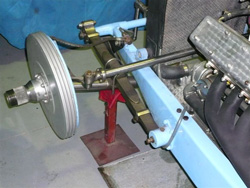
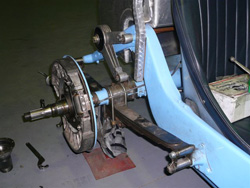
Hydraulic brakes are a Plate upgrade; the craftsmanship is Bugatti-like.
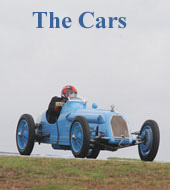
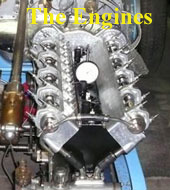
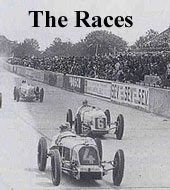
Today all the marvelous hi tech Talbots are present and accounted for. For the Talbot Darracq 1500 racing record, see The Races, for complete engine description, click on The Engines.