
Photos and story by Hugues Vanhoolandt
From the VeloceToday Archives, November 2018
As you know, Pegasos are very rare sports cars that were manufactured in Spain between 1951 and 1956. The main goal of the company was to build trucks, vans and buses for which there was a need in the context of Spain’s economic recovery after the difficult times of the Spanish civil war and WWII.
Hired by the Spanish government to head up the new company ENASA, the engineer and designer Wifredo Ricart left Alfa Romeo in 1945 where he had been working on competition cars. As a logo, Ricart chose the mythical horse Pegasus and so Pegaso came as the brand name. The flying horse with wings had been trademarked by Mobil Oil company in the 1920s, so Pegaso’s Pegasus was bereft of wings and the horse based on the famous Lipizzaner stallions bred from Andalusian bloodlines.
Soon Ricart returned to his love of competition cars and developed a sports car that was presented at the Paris Motor Show in 1951. We should note that one of the main achievements of the brand took place in Belgium, at Jabbeke, in 1953, when a Pegaso Touring Spider broke a speed record, reaching a speed of 243 km per hour. Only 84 Pegaso sports cars were built and it is believed that just 60 to 65 cars survived.

From November 10 to December 9, 2018, the Autoworld Museum in Brussels, Belgium, put the spotlight on this forgotten brand. Thirteen cars and one truck were selected by Autoworld and Pegaso’s specialist Mario Laguna, the man behind the latest Pegaso gatherings at Paris Retromobile in 2015 and at Amelia Island in 2016.
At each of these events, including this one, 13 Pegasos were reunited, the highest number to date. Here are the cars that were in attendance.

This Pegaso Z-102 ENASA berlineta (one ‘t’ in Spanish), s/n 0201, is the oldest surviving Pegaso. After its career as a test car, it has been completely overhauled by ENASA, given a new chassis number and sold as new to its first owner. It is now in a Belgian collection and appeared recently at the Villa d’Este Concorso d’Eleganza.

Pegaso Z-102 Touring berlineta, s/n 0153, presented at the 1954 Paris Motor Show. The sole Pegaso with blinkers inside the radiator grill.

The Pegaso V8 is here equipped with four Weber carburetors.
 Click here to subscribe!

The typical Pegaso chassis plate.

This Pegaso Z-102 Spider, s/n 0140, was originally a Touring berlineta and was presented in this form at the 1953 Paris and London Motor Shows. After an accident, it received in 1957 this Spider body by Spanish coachbuilder Pedro Serra and it is the last of seven Pegasos with Serra body.

Pegaso Z-102 Touring s/n 0141. Tuned by Conrero, this car took part to some races in Spain in the fifties. Originally wearing a Touring berlineta body, it has been converted to a cabriolet in 1960, by Pedro Serra, coachbuilder in Barcelona

Overhead veiw of s/n 0141.

While the previous cars were equipped with a 2.8 Liter V8 engine, this 1955 Pegaso Z-102 Touring berlineta s/n 0167 is powered by a 3.2 Liter V8. It is part of a British private collection.

Rear view of s/n 0167.

This late version of the Z-102 Touring berlineta, s/n 0252, has a grill without cross and is fitted with bumpers. This is the last evolution of the Z-102 Touring prior to the Z-103 Panoramica.

Shown at the 1953 Torino, Paris and London Motor Shows, the Pegaso Z-102 Touring “Thrill” s/n 0133 presented some aerodynamic innovations and was one of the first cars fitted with safety belts. It is now part of a Belgian collection.

Also presented at Torino in 1953, this Z-102 berlineta s/n 0139 is the first Pegaso bodied by Touring after the prototype. The exhausts are integrated in the rear wings. It is part of the same collection that also has the “Thrill.”

Powered by the 3.2 Liter V8, the Pegaso Z-102 ENASA “Pedralbes” s/n 0181 is the sole Pegaso equipped with two compressors. It took part in many races in Spain in the fifties.

Engine of s/n 0181

This Pegaso Z-102 Touring berlineta s/n 0127 was adapted for rallies and was originally fitted with a supercharger. This explains the air scoop on the bonnet. Acquired by Fritz Schlumpf in 1964, it is now part of the ‘Cité de l’Automobile’ in Mulhouse and is shown for the first time since its restoration.

Engine of s/n 0127
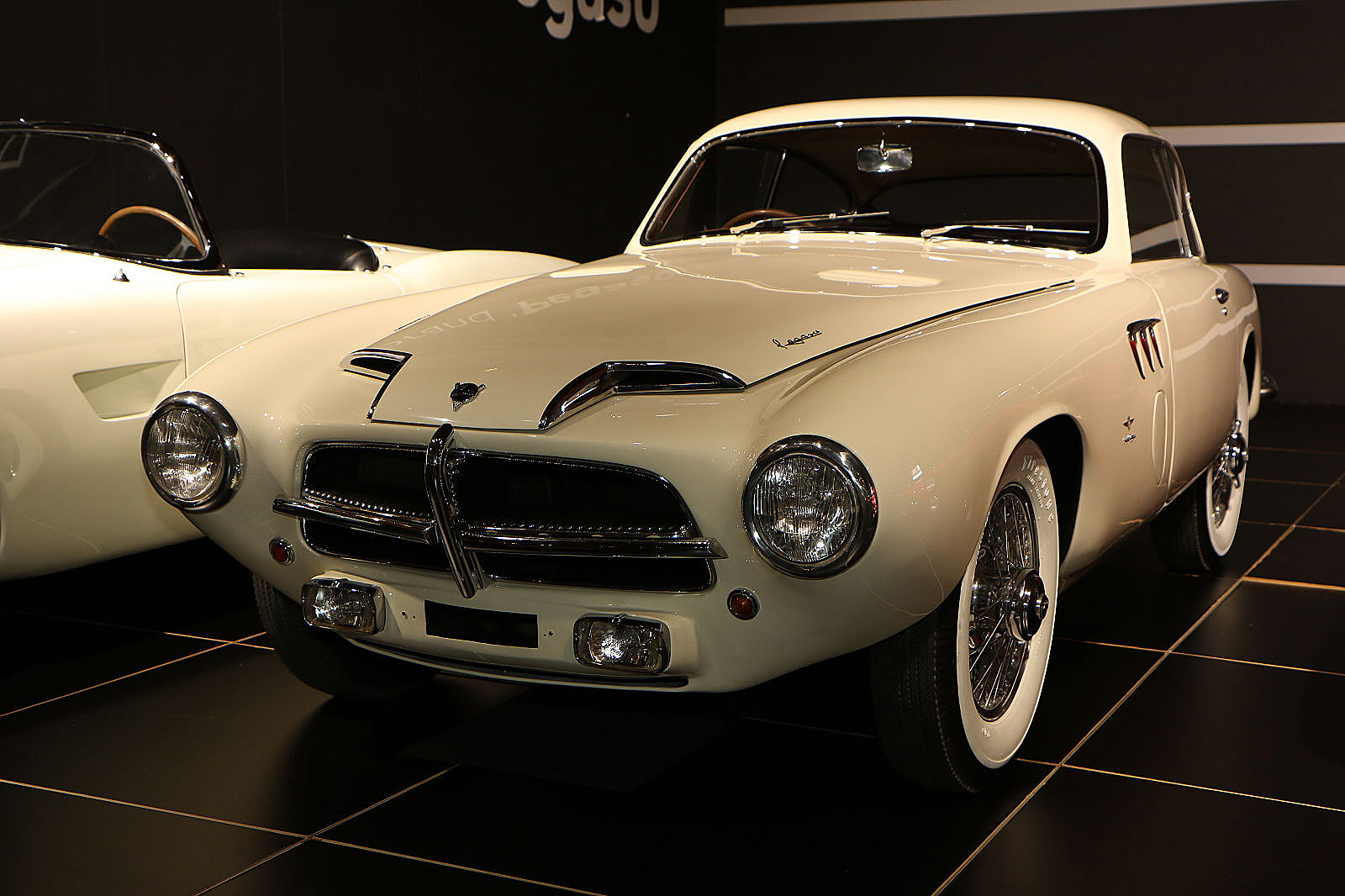
Exhibited at the 1955 Torino and Paris Motor shows, the Pegaso Z-102 Touring berlineta s/n 0162 is the first Pegaso bodied by Touring with the exhausts coming out under the boot and not integrated into the rear wings.

Read view, s/n 0162

Engine, s/n 0162

The Pegaso Z-103 Serra spider s/n 0102 was destined to test the new Z-104 V8 4.7 Liter engine with a unique camshaft and therefore is the sole Pegaso powered by this engine. It has never been sold and is preserved by the Centro Historico Pegaso. It has never been exhibited outside of Spain before.

s/n 0102 interior

Another Z-103 Serra spider, s/n 0173, a 1956 example powered by the 2.8 Liter V8. Shown at the 1956 Paris Salon and the 1957 Barcelona Salon.

Interior, s/n 0173

Engine, s/n 0173

The main job of the ENASA company was to build trucks. From 1946 to 1961, ENASA built the ‘Mofletes’ and the ‘Barajas’, 100 % ENASA products. In 1961, ENASA concluded an agreement with Leyland to produce a more economical truck, the Comet that you see here. In 1986, when Spain entered the European Union, the Italian IVECO acquired the ENASA factories and since then continues to produce trucks.


Pegaso’s were crap cars. The only thing Ricard did was trying to get money from the Spanish authoritarism. And he got loads of money and then ran away.
Very complicated designs, but he needed to justify them to get the money.
Cutting edge design and technology!
Not enough for some, I guess
Complicated time, complicated man, complicated vehicle. Without the three we would be staring at a blank page.
When researching the Alfa book I was amused to come across this quote from Scott Bailey’s Automobile Quarterly conversation with Enzo Ferrari describing Ricart: “With sleek, oiled hair and smart clothes that he wore with a somewhat Levantine elegance, Ricart affected jackets with sleeves that came down far below his wrists and shoes with enormously thick rubber soles. When he shook hands, it was like grasping the cold, lifeless hand of a corpse…” The description of his engineering was somewhat less complimentary. Similar to Ettore Bugatti’s description of his buddy W.O. Bentley’s cars.
I think that Pegaso has enjoyed some cache among the automobile cognoscente was/ is owing to the aesthetics, rather than engineering (about which I have little knowledge nor competence to assess). If one does not look under the bonnet, nor the chassis while on a lift, the clear perception is that these cars (sans Serra) are Italian, and the products of the great genius of the hand of Touring.
Tom Wall
Oakton, VA