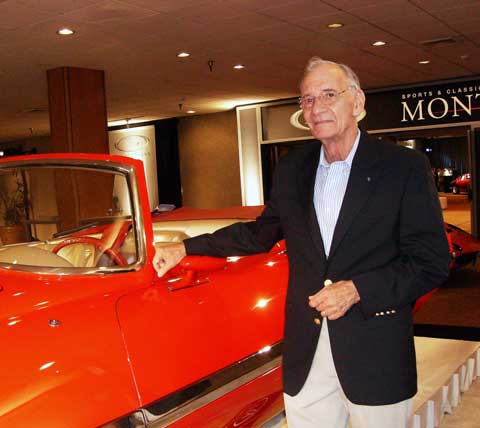
Virgil Exner, Jr., stands next to the Chrysler Ghia Diablo.
By Brandes Elitch
Color Photos by Brandes Elitch
Most car collectors are familiar with the GM “dream cars†of the 1950’s, the heyday of the Motorama. But not many people are familiar with the Chrysler show cars of the same period, most of which were built in Italy and styled by the famous Virgil Exner.
Of course, Chrysler built show cars before, starting with the Thunderbolt and the Parade Phaetons for the World’s Fair of 1939 and 1940, but those cars were built in the company’s prototype workshop department. After the war, Chrysler did not have the resources of GM and Ford, and so their CEO, K.T. Keller, went to Pininfarina and Ghia to have prototypes, then called “idea cars†constructed.
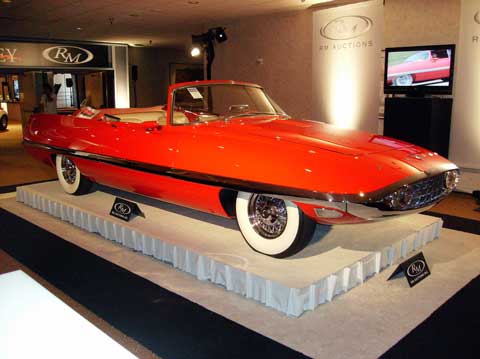
As Exner Jr. remarked, the Diablo still looks quite modern, but spectacularly so.
One reason for this was that the Italian coachbuilders, whose “design studios†consisted of teenage workmen sitting cross-legged in a courtyard hammering out sheets of aluminum on tree stumps, were remarkably cheap: the 1950 Ghia Plymouth sedan cost only $10,000 to build, versus almost $90,000 on each of the parade phaetons. Chrysler chose Ghia over Pininfarina based on what they perceived as better quality of construction. Prototypes were never expected to survive a show season, and the idea that fifty years later they would awe crowds in a concours d’elegance such as Pebble Beach would have been beyond belief in the 1950’s. For a dream car, build quality wasn’t even a meaningful concept!
Ghia had an interesting history. The founder, Giacinto Ghia, died suddenly at the young age of 56 in 1944, and his widow arranged for two of his friends to take over: Giorgio Alberti and designer Felice Mario Boano. They appointed their lieutenant, Luigi Segre, to handle the Chrysler account. Fortuitously, just as this was taking place, Virgil Exner, who in retrospect should be considered as the greatest American stylist of the period, had just been appointed head of Chrysler styling a year before. Exner (known as Ex to his contemporaries) knew an Italo-American who ran a garage in Detroit catering to the new breed of “sports-car†people.
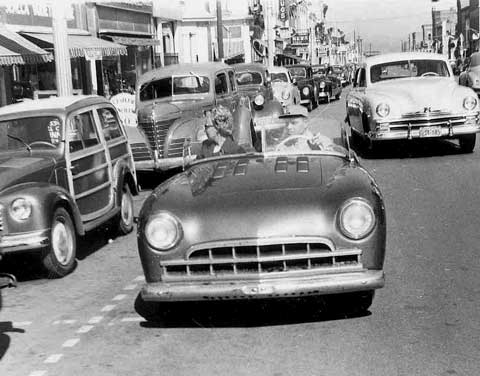
Paul Farago had his own special bodies made up on Fiat 1100 chassis. Here he pauses to look at a Fiat Topolino Giardiniera at Watkins Glen in 1949. Photo by Frank Shaffer.
His name was Paul Farago, and he could act as translator for the Italians. Exner was able to forge a team with Segre and Farago. The first project was the K-310. Some joked that the car was named after K.T. Keller, who weighed 310 pounds, but it was a start, and later was used as the basis for the Volkswagen Karman-Ghia, which was certainly a commercial success.
In 1953, Boano sold his share of Ghia to Segre, who knew that he needed more talent, and promptly hired one of the greatest designers of the last 50 years: Giovanni Savonuzzi famous for his work at Fiat and Cisitalia.
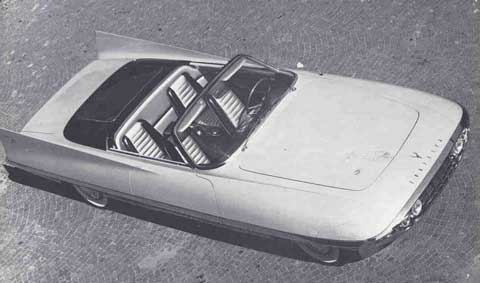
Factory photo of the Diablo with the retractable hardtop and in the silver color which preceded the bright red it now features.
With the creative Savonuzzi, the tiny firm suddenly was now producing a rapid succession of idea cars. However, the strain of creating and managing a Styling Section in a company traditionally managed by engineers finally hit home, and in July 1956 Exner suffered a major heart attack. When he awoke from surgery, his family had to tell him that his latest Ghia dream car, the Norseman, the most expensive project he had ever undertaken (roughly $100k in 1956 dollars) had gone down in the wreck of the Andrea Doria. Nevertheless, he recovered.
All was not lost however, because one of his other projects, the Ghia Dart, which was scheduled to be on the same trip, had missed the boat because of production delays. (Sadly, there were also 20-30 new Lancia Aurelia Spyders and convertibles on the same ship – a great loss to collectors today).
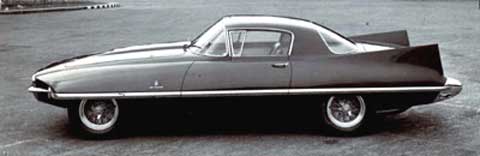
Bob Wilke’s 410 Superamerica Ferrari with the Ghia “Gilda” body. “Gilda” was the name of a movie starring Rita Hayworth.
The Dart was built on a 1955 Chrysler 300 chassis, certainly the most roadworthy of the Detroit efforts at that time, and later updated with the 392 hemi from 1957 used in the New Yorkers and Imperials, the ultimate U.S. motor at the time. The car was built to be the most aerodynamic prototype of the time, and it was constructed as a coupe, for the 1957 show circuit. The Dart featured the daring and dramatic lines introduced on the 1955 Turin show car, “Gilda†and the Bob Wilke Ferrari Ghia 410 Superamerica coupe.
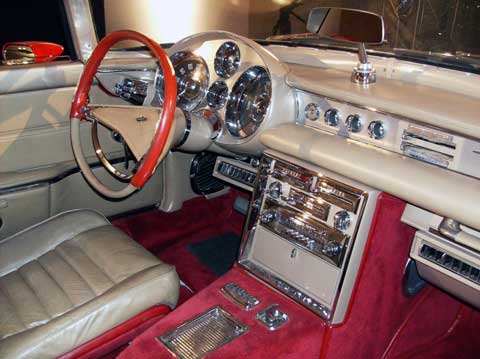
Interior of the Ghia Diablo was an interesting mix of American and Italian styling–note the square Chrysler steering wheel and almost traditional Italian instruments and grouping.
Afterwards, Exner shipped it back to Ghia to be transformed into a convertible, and the name was changed from Dart to Diablo. Originally, the Dart had a retractable metal hardtop, penned by Savonuzzi, who moved to the U.S. in 1957 and worked at Chrysler until 1969. Ghia reworked it to a convertible, modified the fins, and painted it red, a big difference from its original silver. It was a big hit on the show circuit. It is the Dart/Diablo which appeared at Monterey 2008, to be auctioned by RM Auctions, where it reached a no-sale bid of $1.2 million.
At Monterey, I spoke at length to Virgil Exner Jr., and asked him about his reaction to the car which he had not seen since 1958. I asked him what his reaction was, and he said he was overcome with emotion – just like any other knowledgeable car collector who saw it at the RM Auction.
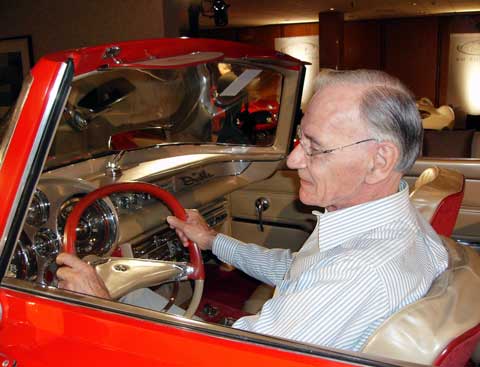
Virgil Exner, Jr. sits in the Diablo, admiring it again, fifty years after he first drove it.
“This was one of my father’s favorite cars. He really wanted to do a convertible, although it was originally a coupe. The C.D. (drag) compares very favorably with any car today, and the car still looks quite modern. He was trying to achieve really clean lines, more like sculpture in appearance, with very little chrome. He achieved his goal with regard to aerodynamics, and the Diablo directly influenced the 1957 (and later) Chrysler lines of cars. The last time I saw it, I drove it around the Chrysler Proving Grounds, and that was fifty years ago.”
It is important to remember the context of this period. While today most people think of the ’57 Chevy as the icon of that year, the fact is that it was a pretty pedestrian effort, and all stylists at the time, including the GM ones, were blown away by the 1957 Chrysler line. In one of the great stories of modern automobile design, the heir apparent of GM styling, Bill Mitchell, herded up his stylists and took them to the railhead to see the new Chrysler cars being shipped on open railcars to the dealers, and they were aghast and panic-stricken. This very event became the basis of the “palace revolt†against Harley Earl that took place shortly thereafter, causing Earl’s premature retirement, well, premature to him! It is indisputable that Chrysler was the styling leader in the US in 1957. And right in the middle of that, the Diablo hit the show circuit for the second time.
Fortunately, most of the incredible Chrysler Ghia showcars survive today, because, unlike Ford and GM, Chrysler sold their cars to the public (although in this case the public was outside of the U.S.), including the Diablo. It has been owned for the last 25 years by the same owner, rumored to be the well-known dream car collector from Highland Park, Illinois, Joe Bortz.
Paul Farago was not just a translator. he was avery competent designer ( The Farago Fiat Special in the photo was designed, engineered and hand built entirely by Farago.) In a he was very involved in all aspects of the engineering and supervision of the building of almost all of the Chrysler Ghia cars right through the Turbine Car. He also totally engineered the Dual Ghia and designed and engineered the Ghia L6.4 except for the back end which he asked Exner to restyle after the original prototype was built. (I own the car and have the original renderings.) He did quite a bit of changes in styling to many of the concept cars in order to make them more functional and buildable. I have numerous pieces of correspondence between Farago, KT Keller and Exner. I also have reel to reel audio tapes from Farago to Chrysler in regard to design ideas and changes. Farago was a true renaissance man when it came to anything involving automobiles. there was nothing that he could not or did not do. I could go on for pages. However, I will stop here.