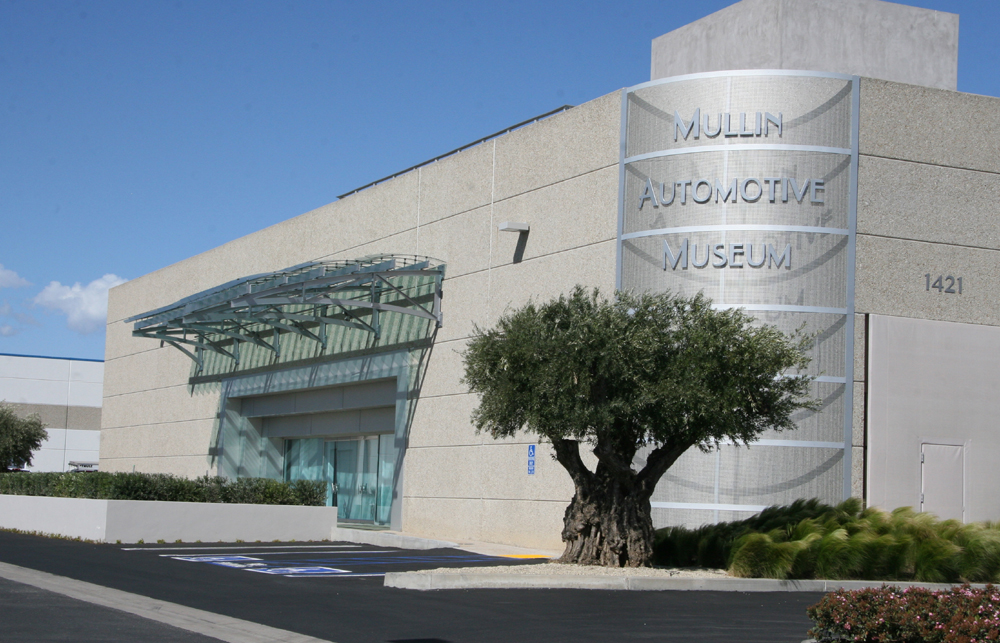
The Mullin Automotive Museum entry includes a dramatic portico, made up of dozens of tinted windshields on an iron frame that would make Gustave Eiffel proud.
From the Archives, April, 2010
Larry Crane takes us on an exclusive tour of the furniture of Carlo Bugatti.
Photos by author except as noted.
Peter Mullin is a gifted artist, at least equal to his talents as a businessman. In spite of his new museum’s name, he wants the public home of his collections to be seen as an art museum, celebrating the art of the first half of the Twentieth Century with a focus on the decorative arts movement universally known as “Art Deco.”
The clean, “streamlined,” new century design theme was introduced in its mature form at the Exposition Internationale des Arts Décoratifs et Industriels of Paris in 1925 and became known as Design Moderne. The movement’s elegant forms were quickly adopted by the French coachbuilders and were the fundamental details of some of the most beautiful automobiles ever created. The universally accepted Art Deco title was popularized by art historian Bevis Hillier with his 1968 book Art Deco of the 20s and 30s.
When a beautiful Delahaye roadster arrived in the Mullin forecourt for a day of photography some years ago, the direction of Peter’s life found a new compass. It reignited the creative fire that led him into the UCLA fine arts program, before he had second thoughts and changed to economics and finance. That decision, of course, allows him to share his remarkable taste with the rest of us in the Peter Mullin Automotive Museum.
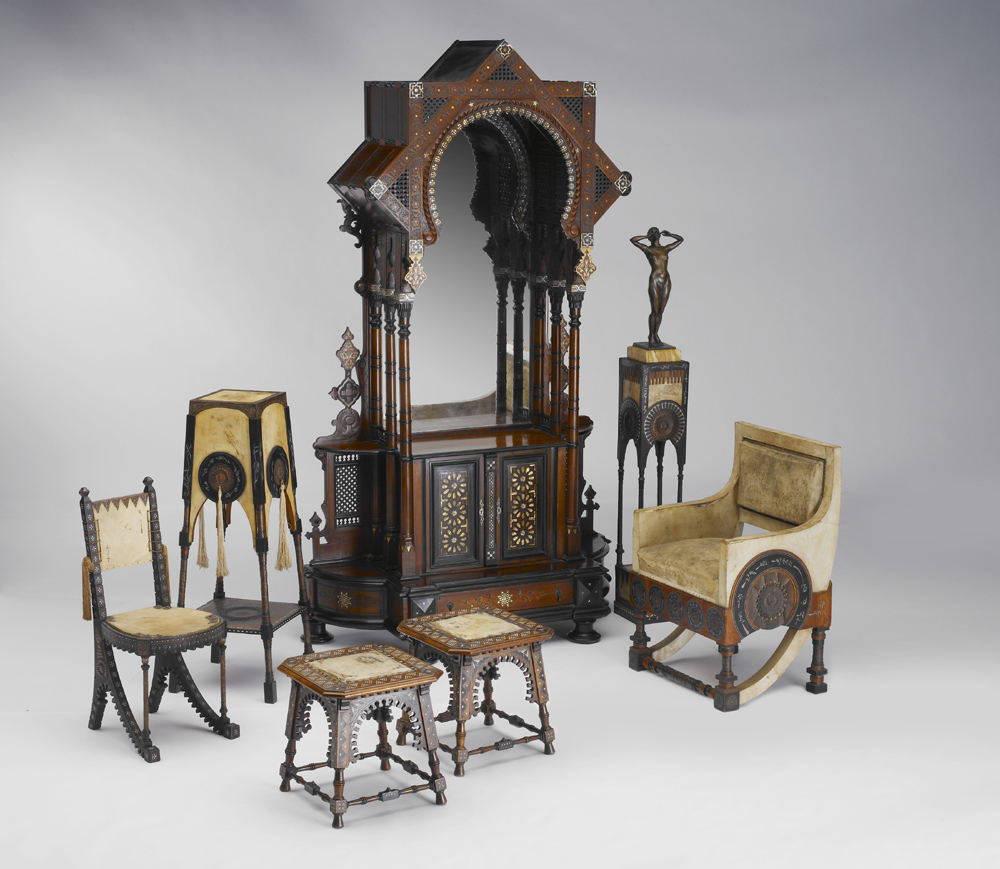
Carlo Bugatti furniture is not as universally celebrated as his son’s automobiles, but they are treasured by the cognoscenti.
As the search and research for automobiles of that celebrated era proceeded, it included many tangents where new discoveries complimented and completed his knowledge of their inspiration; not the least of which was the discovery of the family Bugatti. The automobiles of Ettore Arco Isadoro Bugatti are well known, but the sculptures of his brother Rembrandt are rarely seen, and the furniture of his father Carlo has become so precious as to be sequestered as treasure. Except for the 55 pieces in the Mullin collection. These brilliant examples of Bugatti art are displayed in public spaces around the Peter Mullin Automotive Museum and may alone be worth the visit.
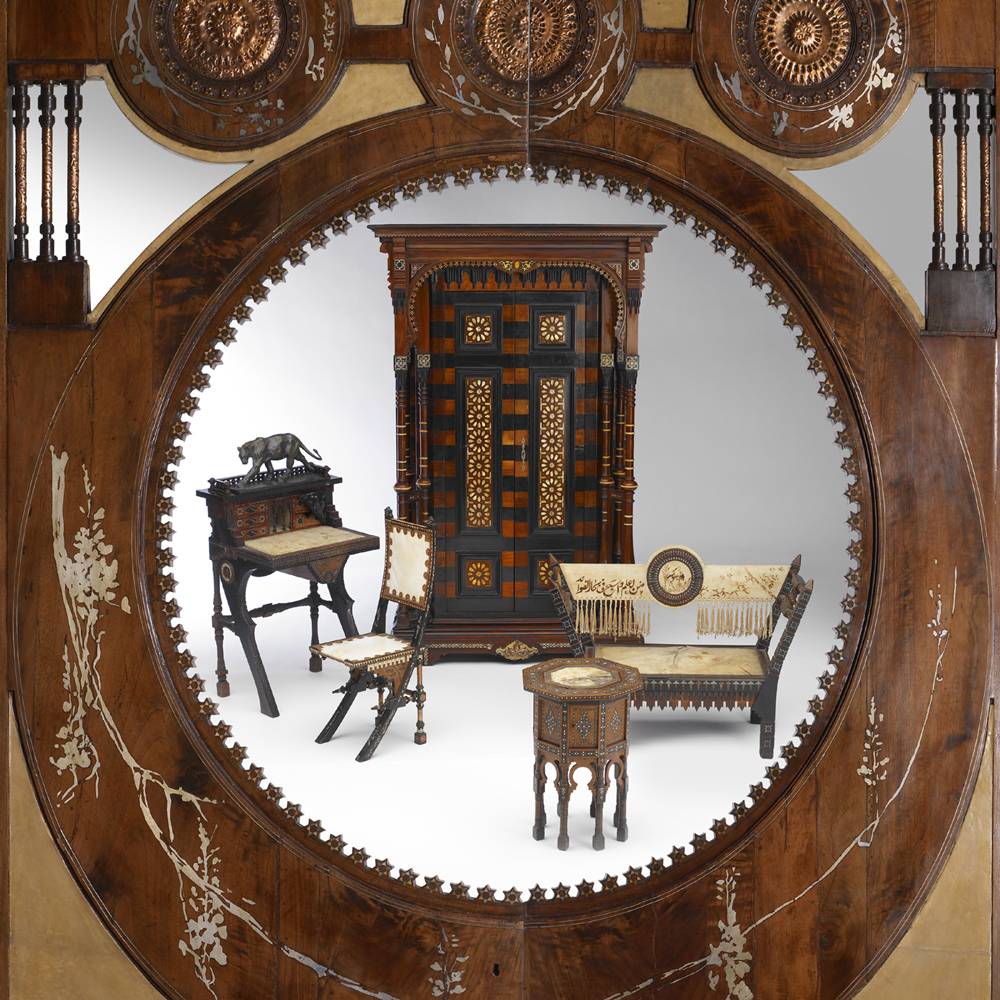
Framed in a pair of Carlo Bugatti doors, his furniture makes a wonderful piece of art in the camera of Michael Furman.
Carlo Bugatti was born near Milan, Italy, on the accepted, though undocumented date of 12 February 1856, the son of Giovanni Luigi Bugatti, an established artisan in the building trades, and Amalia Salvioni. It has been reported that Giovanni spent much of his hard-earned money and available time in the research of perpetual motion, popularly believed certain to power the twentieth century. The Bugatti attribute of individual thought and innovation was certainly in evidence by mid-nineteenth century.
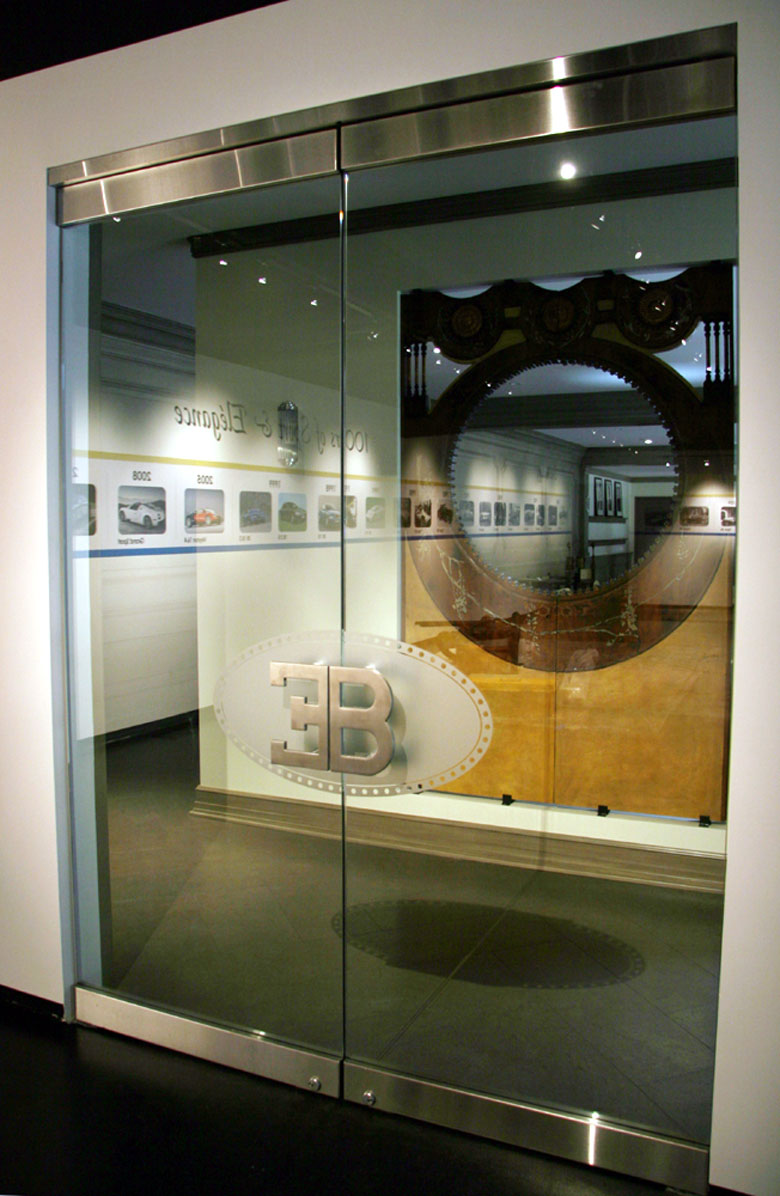
Entry to Club Bugatti is through a pair of glass doors whose Bugatti logo detail makes a perfect shadow on the floor before the Carlo Bugatti doors.
Some evidence suggests that Carlo began his studies at the Brera Academy in Milan beginning in 1871 when he was fifteen; during his apprenticeship in the furniture shop of Mentasti. By the late 1870s he was studying at the Écol des Beaux-Arts in Paris and might have had a studio in the City of Light during the next decade, while he established a furniture business in Milan. The year 1880 was a milestone in Carlo’s journey. His earliest surviving furniture was a gift for the wedding of his sister Luigia (Bice) to his friend and classmate Giovanni Segantini during that year. It was also the year Carlo married beautiful Thérèse Lioroli and began the next generation of his remarkable family.
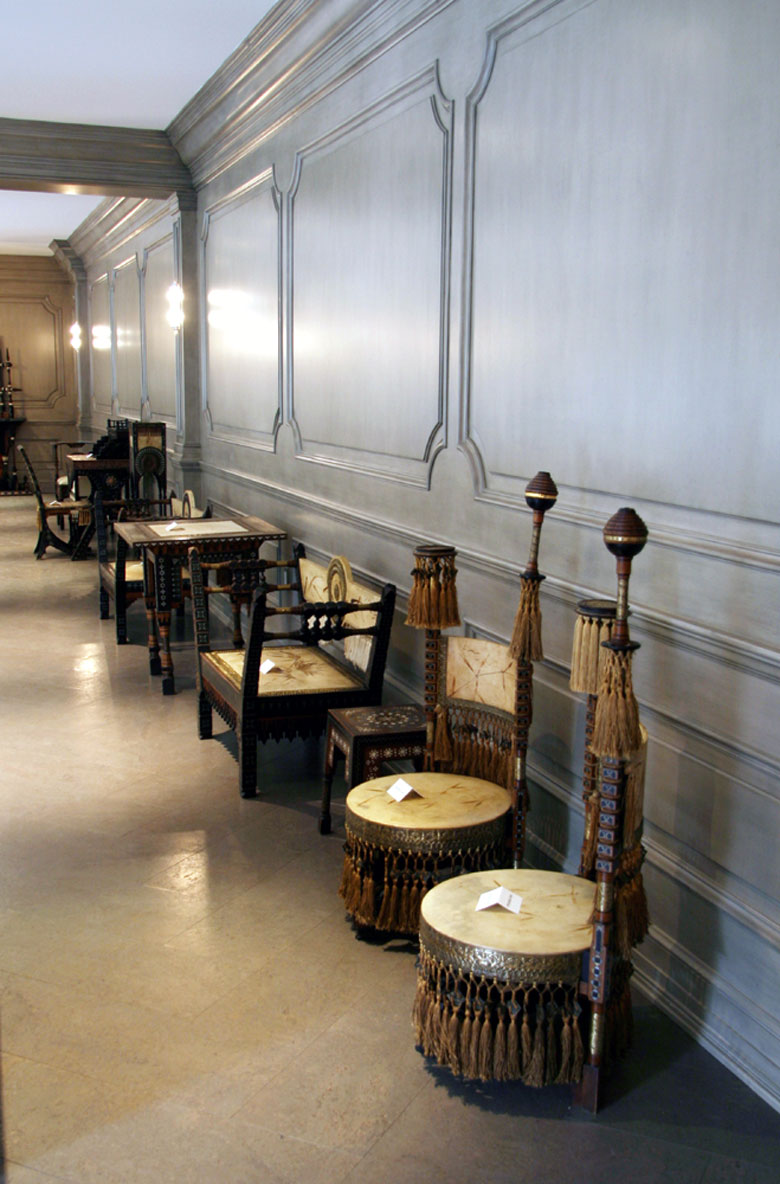
Along the Beaux Art wall of The Club stands a set of Carlo Bugatti’s memorable furniture.
While the art nouveau style of elaborate forms and details was thriving, Carlo seems to have been influenced more by early Asian styles and textures, though the completed designs are uniquely his own. During the Industrial Arts Exhibition in Milan in May 1888 Bugatti designs made the international news and an invitation to the Italian Exhibition at London’s Earl’s Court later that year underscored his new celebrity.
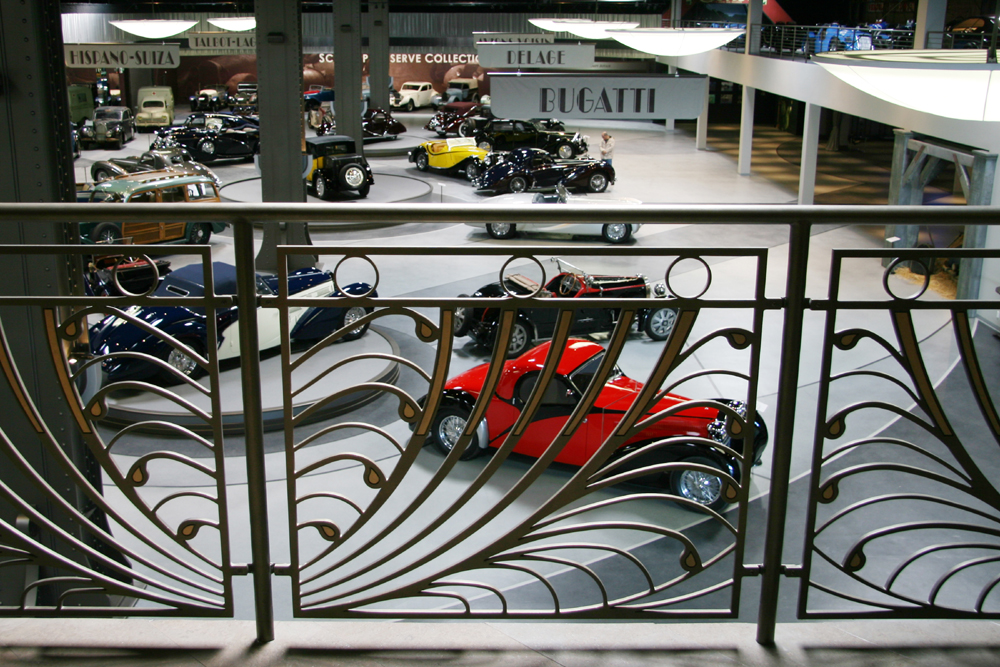
The art deco railing that edges Club Bugatti and the view of the museum’s Grand Salon. To the right is the Le Mans diorama with its perfectly detailed pit counters.
His “ebonized” wood and inlays were described as “Mauresque” but many of his forms and painting styles illustrated as much Japanese influence as Islamic. Stylized forms from nature were often painted in multiples along with elaborate insertions of ebony, ivory, and mother-of-pearl, but the power of distinction came from his ubiquitous circles, either cut into the panels or applied in hand hammered copper over sheets of delicately painted parchment. Elaborate turned rods and silk tassels introduced vertical highlights in an additional blend of haute couture and Romanesque architecture, with the spirit of Asian mystery.
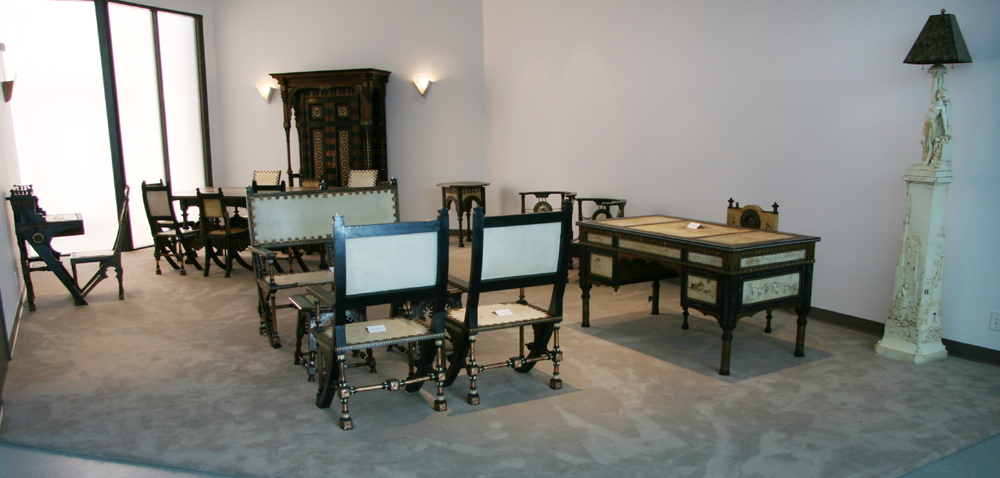
The Carlo Bugatti Gallery has even more of his historic furniture.
In the Mullin Museum’s Club Bugatti lounge alone, there are a dozen Carlo Bugatti pieces and in the Carlo Bugatti Gallery are twice that many. The view from The Club of the fabulous automobiles in the grand salon is also worth the visit. One suspects that in spite of our best efforts for the art collection, it will be cars that will live in your memory—more on them in our next edition.
The Peter Mullin Automotive Museum is located at:
1421 Emerson Avenue
Oxnard, CA 93033
805.385.5400
805.385.5422 (fax)
Info@mullinautomotivemuseum.com
I am a great fan of Bugatti cars and furniture .I would love to visit the Mullin collection.But the world being as it is at the moment this will not be possible.A few years ago I managed to visit the former Schlumpf collection. I was fortunate to meet Peter and Mel on a Bugatti tour several years ago in Edinburgh.