Show of Shows, Paris 1954 Part 2
Story by Pete Vack
Photos by Gerald Vack
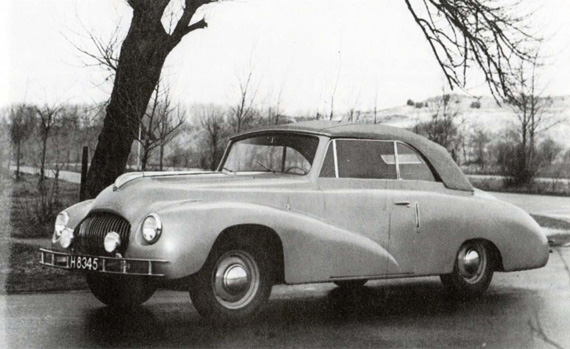
As we have seen in Part 1, the Editor’s uncle Gerry had an opportunity to try out his new Leica camera while at the Paris Auto Show in 1954. For an amateur, he did a pretty good job and the Kodachrome film looks as fresh now as it did in 59 years ago. The stock issue 50 mm lens, however, did not always make it easy to capture the entire car. Better, though, than a 35 mm which would have distorted the lines of the cars. We’ll take as is.
For the Editor, there were some stumpers, and if readers find us incorrect, please let us know. The Siata Fiat derivative is a case in point; we know that Siata made a number of 1100/1400 specials in 1954 and 1955, but were the bodies built in house, or by Vignale, and was the designer actually Michelotti?
Another was the Pegaso, clearly one of the Saoutchik bodied GT cars, but which one? It was not among the three cars on the Pegaso stand that year. It took some research but we turned to the classic book on Pegasos, “Ricart-Pegaso, La Pasion del Automovil” by Carlos Coma-Cros, and there we found the car and the history.
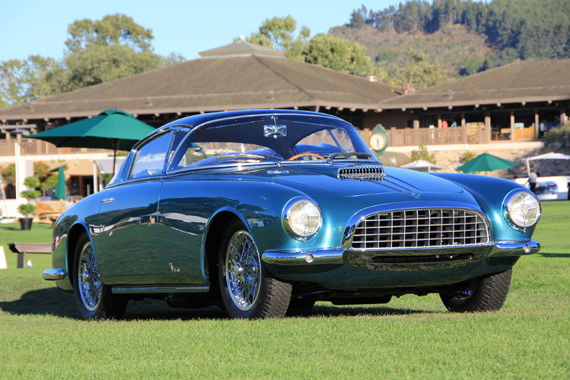
We begin with the all-time Pinin Farina classic, so often said to have been built for Ingrid Bergman and ordered by Roberto Rossellini. Sorry folks, Rossellini did not see it until the show and purchased it afterward. By that time Ingrid was not interested in his cars, or Rossellini for that matter, and the marriage soon fell apart. But the Pinin Farina body, the Ferrari 375 chassis, the famous director and the beautiful actress are legendary; whatever the circumstances of the purchase, Ferrari s/n 0456 embodies all four legends simultaneously.
The star of the show was the Pinin Farina 375 Ferrari built as a Pinin Farina styling exercise. However, immediately after the show ended on October 17th, Italian movie director Roberto Rossellini bought the car for about $6000 USD. When he registered the car, he left for Lyon to meet French director Francois Truffaut and the pair visited southern Spain. The steering broke along the way but the two directors got it repaired and made it home.
Lynch: Art of the Car Concours, Kansas City

Denise McCluggage tells an amusing tale to the delight of the panel on Saturday. From left; Michael T. Lynch, Riddelle Gregory, Denise and Sir Stirling Moss. Note the model of a Maserati 250 F, one of Moss’s favorite rides, on the table.
Story by Michael T. Lynch
June 23rd, 2013
After continuous progress since the first edition, the Art of the Car Concours (Kansas City, Missouri) took a significant step forward in 2013. Added to the previous programs was a new event on Saturday called Meet the Legends/A Conversation with Sir Stirling Moss and Denise McCluggage/Remembering Masten Gregory. Moss is always a big draw and since Gregory was born and raised in Kansas City and McCluggage graduated high school in nearby Topeka, the program generated high interest in the region. [Read more…] about Lynch: Art of the Car Concours, Kansas City
Silverstone by Sharp
Story and photos by Jonathan Sharp
The Silverstone Classic, July 27-28. It just keeps getting bigger and bigger. Over 1100 entries in 24 races; most of the infield of the circuit was full of various car club displays, everything from Alfa Romeo’s to two Volgas all the way from Russia; a fun fair, the BMW Ferris Wheel, loads of retail opportunities, art, food etc. You could have spent all day there and not seen a race at all. [Read more…] about Silverstone by Sharp
The Alfa Mystique
Story by Brandes Elitch
Photos by Petya Elitch unless otherwise noted
Over 700 people registered for “Alfa California 2013: Sonoma Valley Wine Country,” a joint venture of the National Alfa Romeo Owner’s Club (AROC) and the San Francisco-based Alfa Romeo Association (ARA).
Keep in mind that the last new Alfa was sold here almost twenty years ago. Alfas were never common in the US, and expensive when new. Unlike the owners of some even more expensive Italian marques, Alfa owners are different. For one thing, they drive their cars. For the most part, the cars are not restored to a “better than new” standard for concours judging or evaluation. Many of the cars at the show here were restored to a very high standard, but they are usually driven, not restored and put away to await the next swell in market pricing. They are not so complicated, and the parts are not so expensive, so that a person with normal mechanical skills is able to do lot of the work themselves. But what makes them so compelling? And why do over 700 people attend the conventions for these cars? [Read more…] about The Alfa Mystique
Features This Week, July 25, 2013
Introducing VeloceToday Select©
What is VeloceToday Select©?
VeloceToday Select© is a 32 page 8.5 by 5.5 landscape formated high quality full color printed folio, center stapled with high gloss paper. It is both a magazine and a book; always in print, it is not a periodical; they are not dated but numbered. New Folios will be published 4-6 times a year and already are gaining collectible status.
I loved the concept and format. The impact of the articles would have been diminished in a larger format, congratulations! Please put me down for one of each in the future. — Frank Allocca, noted car collector
VeloceToday Select© began as means to provide readers with quality hard copy articles from the VeloceToday archives. However, once the series was created, we were encouraged to include material not found in the VeloceToday database. Our future plans include both new and old articles from your favorite authors. [Read more…] about Introducing VeloceToday Select©
Show of Shows: Paris 1954 Part 1
By Pete Vack
Photos by Gerald Vack
The 1954 Paris Auto Show (or Salon de l’Automobile), was held from October 7th to the 17th, late in the season but close enough to the next year to draw out the new cars planned for the year 1955. If not the most important auto show of the year, it had a reputation of being the most glamorous.
At that time, the show was still held at the magnificent Grand Palais on Port A, Avenue Eisenhower. Built in 1900, the Grand Palais was and remains a marvel of “Belle Epoque” engineering; massive glass roofs supported by an ironwork structure. What better showplace for the new automobile.
The first auto show was held in Paris in 1898; in 1910 the show moved to the new Grand Palais. Up until 1986 it was called Salon de l’Automobile; it took the name Mondial de l’Automobile in 1988. It was held annually through 1976, after which it has been biennial, and the event was moved to the Paris Expo at the Porte de Versailles.

The Grand Palais is particularly attractive at night while lit from inside. Photo copyright Gérard-Ducher.
At some point during in early October of 1954, the Editor’s uncle, Gerald Vack, visited the show with a new Leica camera he’d purchased in Germany, where he was stationed with the U.S. Army. A sports nut, but not a car enthusiast, Gerry realized that his car enthusiast brothers back in the States would like to see some of the cars at the show. His new Leica was loaded with Kodachrome 35 mm film, still rare and expensive as until late in 1954, the film was purchased along with the cost of the development. Back in the States, once shown, Gerry filed the show scenes with other slides and forgot about them until his nephew pestered him about it years later.
What we have below are not images taken by a professional photographer; Gerry was also hampered by the huge crowds that journalists could avoid by attending press-only shows. As floor space at the Paris show was extremely expensive, many of the smaller manufacturers had tiny, one=car stands tucked in a back row, further hampering good photography. He knew very little about the cars he photographed. And we are lucky, for not only does Kodachrome have a tremendous shelf life and is remarkably fade resistant, but in searching through contemporary material and the Internet, we see that color images of the show are fairly rare. Thanks to Gerry remembering the guys back home!
The Grand Palais, with its glass ceiling, provided great natural light for the show. In this scene, one can see how many manufacturers were growing and adding a wide range of models to suite the public. Wriiting for ‘Automobile Review’, Gordon Wilkins reported that “The accelerated pace of development in the world’s automobile industries has produced a great increase in the number of new and improved models…” But at the same time, the increased complexity and cost of tooling was also forcing mergers as small firms could no longer afford to compete.
The 2.5 Liter unblown Formula One went into effect in 1954, and one of the lesser known provisions was the alternate use of a supercharged 750 cc engine. One of the few firms to try to compete in this manner was Deutsch Bonnet, who dusted off the old Monomille and upgraded the Panhard Dyna engine with a supercharger. But the power to weight ratio was only about 250 per ton, while the 2.5 liter cars were good for 400 per ton. French Porsche and DB driver Claude Storez raced the car at Pau in 1955, but it was too underpowered to be effective.
Lancia Dagrada Formula Junior
By Pete Vack
With the announcement of a new “Formula Junior” class in 1958, there was a remarkable flowering of individual designs to populate the grids of the new formula. Race car constructors from America, Italy, England, Germany and France grabbed whatever engine was close to 1100c–BMCs, Fiats, Fords, Renaults–and served them up in a bewildering variety of concoctions. Among the fastest, and certainly the loudest, are the ten or eleven cars built by Angelo Dagrada of Milan.
Born in 1912, Dagrada earned a living as a mechanic, and built several race cars for the Italian 750 and 1100 cc races so popular after WWII. Building a reputation as a speed wizard, Dagrada improved upon the Fiat 1100-Siata head and combustion chambers. His cars achieved some significant wins, but a series of road accidents in the early 1950’s put further race car activities on hold. But by 1955, Dagrada was once again in the speed business, this time with Alfas.
[Read more…] about Lancia Dagrada Formula JuniorLancia Dagrada Restoration
Review by Pete Vack
Photos courtesy Leo Schildkamp
In October of 2004, Leo Schildkamp became the owner of a Lancia Dagrada Formula Junior, chassis #001. It had been in an incident at Goodwood in 2003 and had been significantly damaged.
Schildkamp would spend the next several years restoring the car, one of perhaps ten Formula Juniors built by Angelo Dagrada from 1958 to about 1960. When the restoration was complete, Schildkamp gathered the notes and photos of the car’s history and restoration and instead of putting them in a loose-leaf binder, used a vanity press called ‘blurb’ to produce a hardbound booklet. There is very little text, but a great deal of photos and information about Dagradas, most in color.