Story by Brandes Elitch
Photos by Hugues Vanhoolandt unless othewise noted
I feel confident in saying that the Concorso Italiano, held during the Monterey Historics at the Blackhorse Golf Club in Monterey, is the largest, best organized, and most comprehensive display of Italian automobiles anywhere in the United States.
I was present at the very first event 33 years ago, when it was organized by Francis Mandarano, and held at the Carmel Mission Inn, located at the corner of Rio Road and Route 1, at the entrance to Carmel Valley. My friend Joe had just bought a 3500 GT, and back then Mandarano’s Maserati Information Exchange in Seattle was the first place you would look when you needed parts. It was obvious that Mandarano was onto something here. The next year it was moved to Quail Lodge, where it was clear that this was going to be a Big Thing going forward, and it was. At the beginning, Francis decided to exclude Ferraris and he held out for a few years, but then he relented, and of course the character of the event changed, and ultimately it became too big for Quail Lodge.
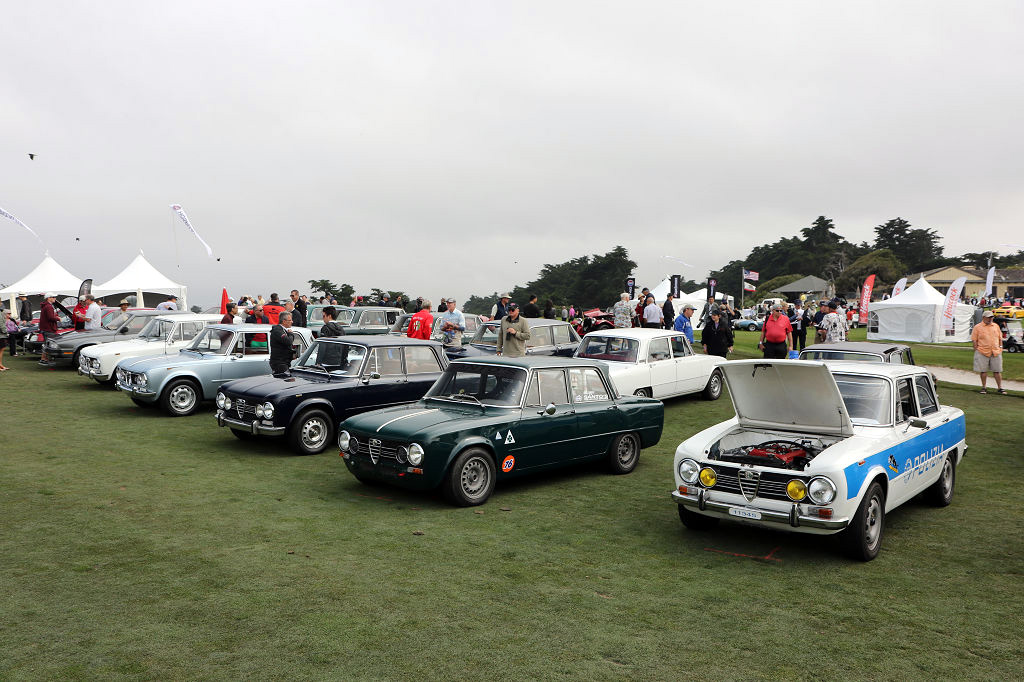
No Italian confusion as Alfa sedans and berlinas were featured this year at Concorso under Tom McDowell.
With Quail out of the picture, Mandarano moved CI to a golf course on the former Fort Ord, where the event continued. Mandarano ultimately sold to a new owner and, because of constant construction, traffic problems persisted. I remember having coffee with the new owner and his wife during a trip to Seattle when I stayed at the old Edgewater Hotel. His background was running a health club, not an event like this. In 2008, the new owners relocated to a nearby airport originally built as Fritzsche Army Air Field in the 1960s. This provided a different kind of ambience: a strong wind which blew dirt all over the cars, parked as though they were, well, in an airport parking lot. There was a backlash from the understandingly enraged exhibitors. CI reappeared under the ownership of Tom McDowell and was revitalized by a move to Laguna Seca Golf Ranch in 2009.
Tom has an investment banking background, and had been called in to advise on a potential sale. Growing up in a car family, he saw the potential and ended up buying it himself, fortunately for the rest of us.
Tom likes to say that every Italian event should have a little chaos, but there is no chaos here. Getting in and getting a parking space and finding your way inside is a breeze, which you cannot say about any other event during Car Week. Amazingly, all one thousand plus Italian cars are already parked in formation by 9:30. Somewhere around 5000 people are in attendance, but because the event is spread out over two par five fairways and a putting green, there is no crowding. There are an additional few hundred special interest cars parked in an adjacent area, but I did not spend time on those as there was enough to see just in the Alfa section.
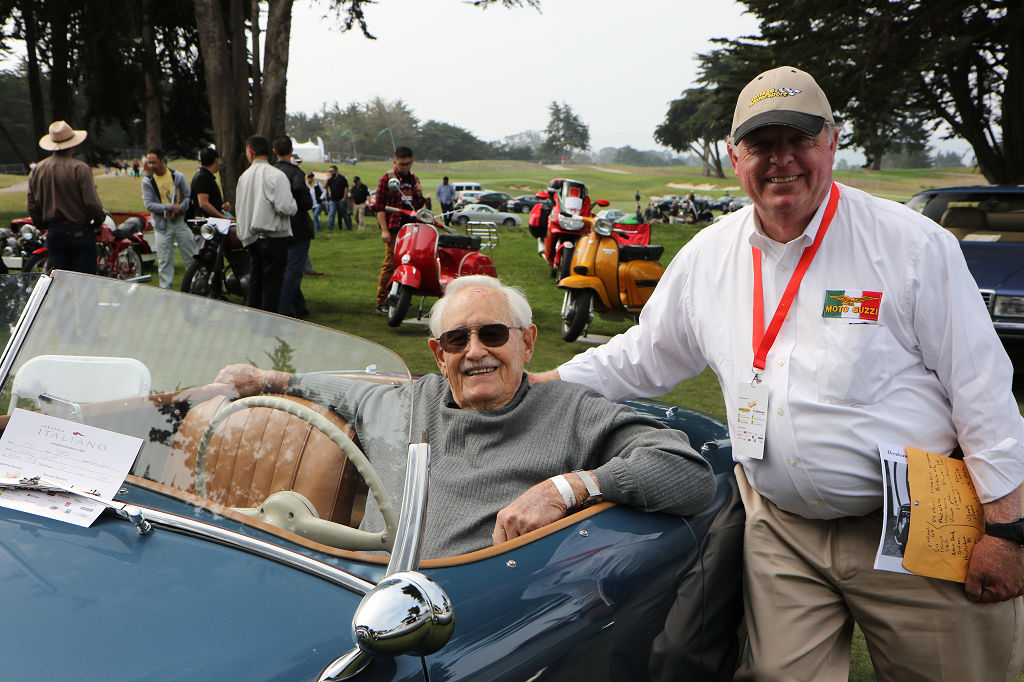
1951 Siata Gran Sport, owned by Harry Hart. Alongside is VeloceToday correspondent Brandes Elitch.
I have a spider, Alfetta GT, and 3 liter type 75, so I found a lot to like there. Remember, ALFA means “always looking for another.” The feature was the Alfa Berlina, “The Family Car That Wins Races!” I love berlinas (this should be a bumper sticker). This year the berlina section included the Giulia Super, Alfetta, Milano, 164, and Giulia. Here’s a quote from the book Alfa Romeo Berlinas by John Tipler (Veloce Press, Dorchester, England, 2000).
“Alfa’s reputation has tended to rest on its sporting creations and competition achievements, and this is to overlook a huge portfolio of sedans which have been its mainstay…Nowadays, the Berlinas have many committed devotees among enthusiast family motorists who value high performance and fine handling at an affordable price – coupled with four-door practicality and decent carrying capacity. What’s more, Alfa sedans often handle better than their sporting siblings because their four-door bodyshells are stiffer and less flexible than the coupe or spider models, which have generally been based on the sedan platform.”
The Giulia production run, from 1962 to 1974 is a testament to the design. The Giulia, styled by Renzo Sfondrini, looked like no previous Alfa, with its steeply raked windshield, wraparound rear window, and Kamm-tail. The Cd was an excellent 0.33, which is better than most cars today. Many people find the Giulia more visually fascinating than the sporting cars, and I include myself in this sentiment. Production figures for the 105-series sedans were 542,085 for the Giulia in all its forms.
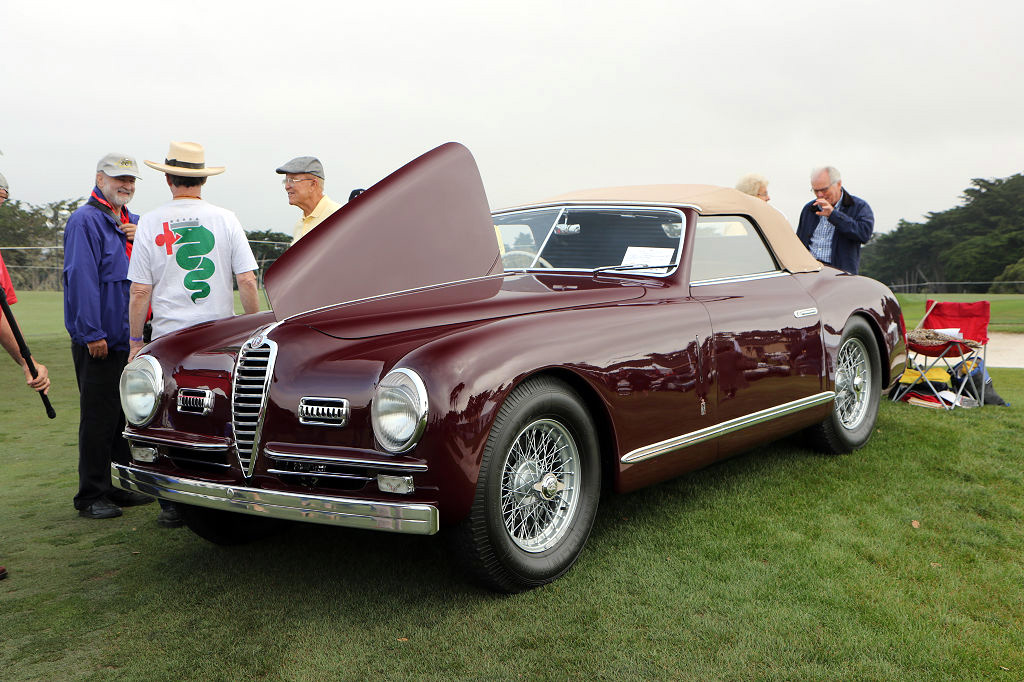
Wysard’s Alfa 6C2500 was judged Best in Show.
Of course, there were a lot of other Alfas, from a 1951 6C 2500 Super Sport owned by Herb Wysard, and judged Best in Show, to an SZ, one of my son’s favorite cars (the other being the Maserati Shamal, which was also in attendance), and in between every model ever sold in the U.S. We are fortunate in the Bay Area to have a big and active club, called the Alfa Romeo Association of Northern California. (Each October for the last 31 years they have put on an “All Italian Day” in Alameda and they will get a hundred Alfas and a hundred other cars as well).
There were a few other features: the 50th anniversary of the Lamborghini Espada and Islero, the Ferrari 365 Daytona, and some special prototypes including the Abarth 124 GT, ATS GT, CeComp Vulcano, Dallara Stradale, Frangivento Charlotte, GFG Stile Sibylla, Icona Nucleus, Italdesign Zerouno Duerta, Touring Sciadipersia, Zagato Aston Martin Vanquish, and my favorite, the MAT New Stratos. It is quite an accomplishment to have these in attendance.
The show is really a combined effort of multiple single marque clubs, including Abarth, Alfa (2), De Tomaso (2), Ferrari (2), FIAT, ISO and Bizzarrini, Lamborghini (2), Lancia, and Maserati (2). The clubs are the glue that holds the event together, and yes, there really is a family atmosphere, which is quite different from the palpable tension at other events, such as Pebble Beach.
With a thousand cars to look at, I can only describe a few that spoke to me. At a show like this, I try to find cars that I am not familiar with, and I present a few here.
The first was coincidentally the first car I saw when I entered the show: the Best in Show Alfa Romeo 6C 2500, the last Pininfarina cabriolet in the series. It has run the Mille Miglia in 2010, and has been at Pebble Beach in 2014 and Villa d’Este and Chantilly in 2017.
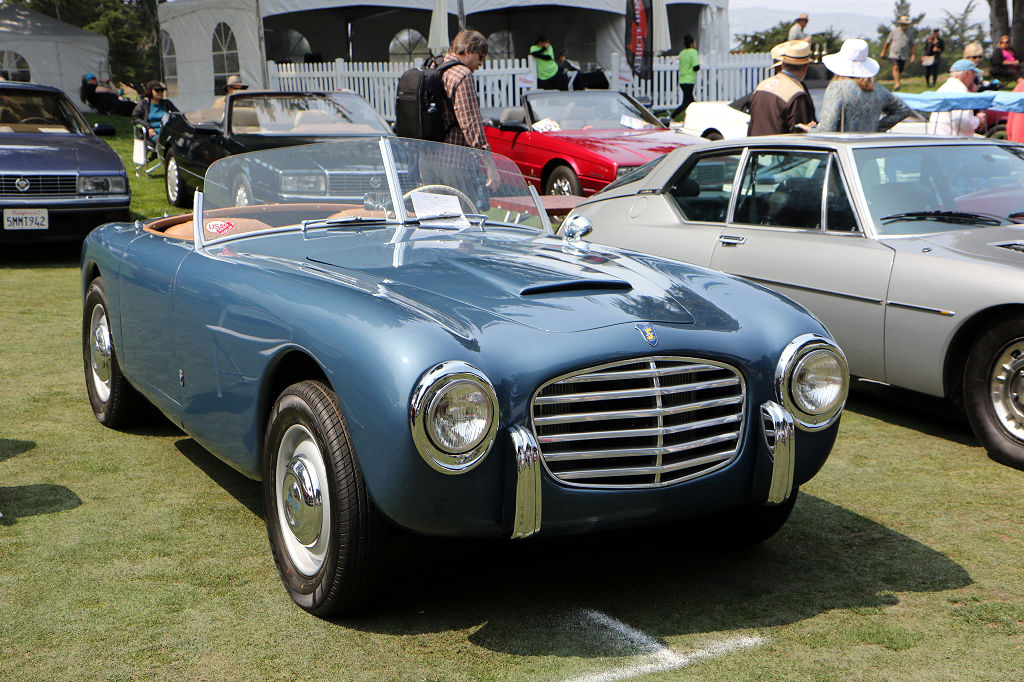
Another view of Harry Hart’s Siata.
The next was a 1951 Siata Gran Sport, owned by Harry Hart from Indian Valley CA. It is one of about 75 made, with a Farina body. Siata was the ex officio racing arm of FIAT. Harry has had it since the early eighties. He found it in a body shop in San Jose and paid $1500 for it. Obviously, it went to the right person.
Another compelling offering was a 1959 Maserati 3500 GT prototype, owned by Phil White from Portola Valley, CA. It is a Michelotti design, produced by Vignale. The car was stored for 30 years and is very original. It is the first of about 251 total production.
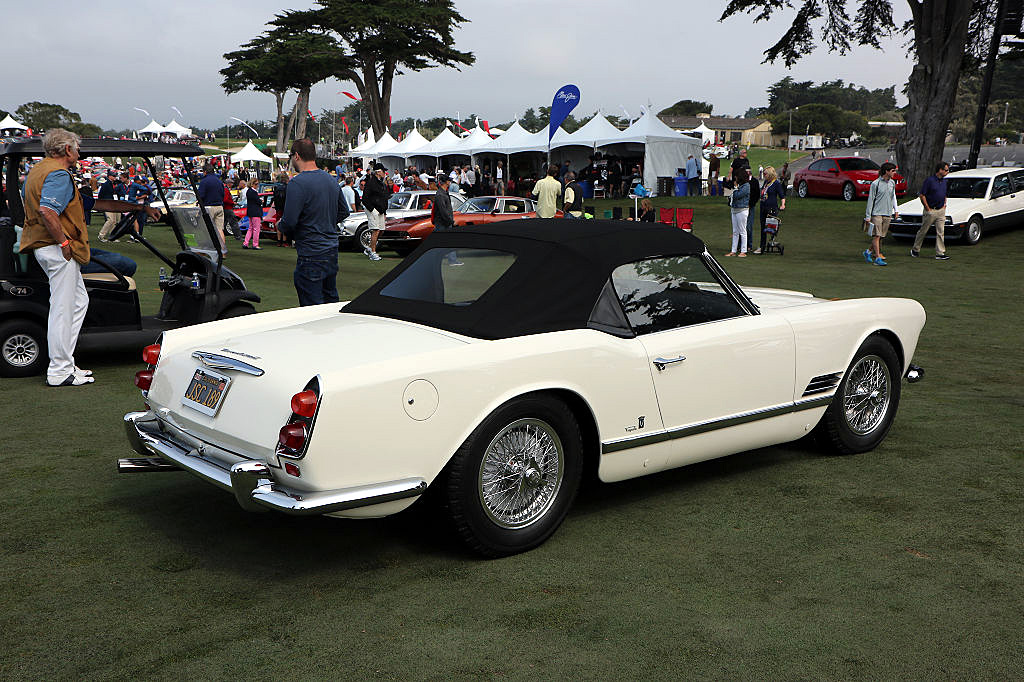
Phil White’s Maserati 3500 GT prototype.
Next up was a 1964 Triumph Italia, with TR 3 running gear, owned by Bob and Sandy Owens of Haverford, PA. The original idea was for each of the 1500 Triumph dealers to buy one, but only 329 cars were manufactured. This was originally an East Coast car and had rust, but it received a comprehensive restoration.
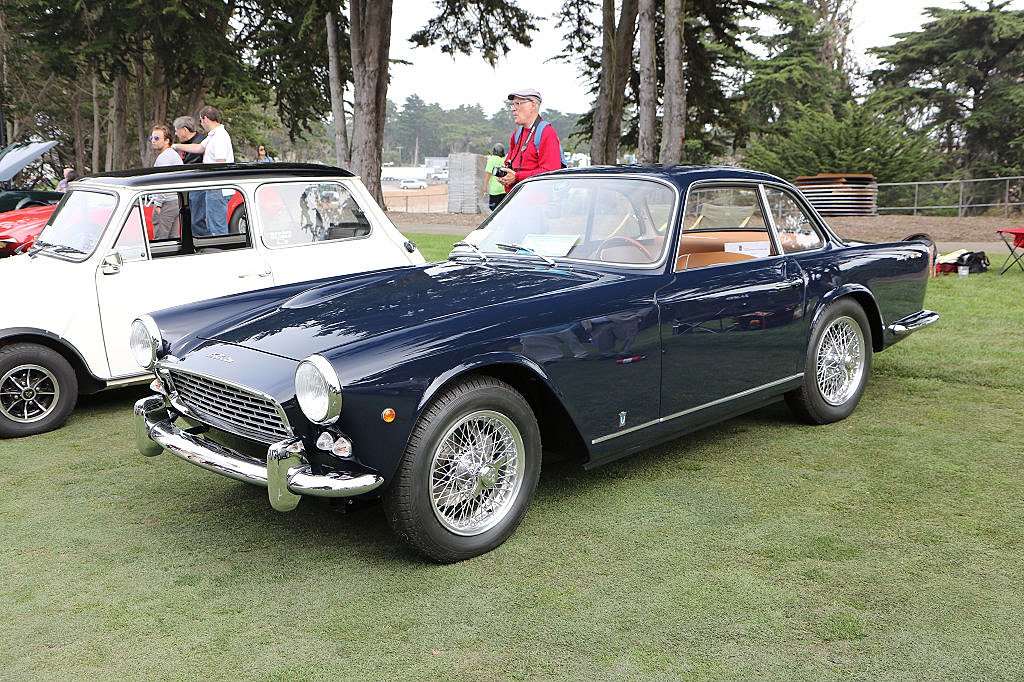
Triumph Italia was another Michelotti design.
Across the way was a 2009 RS Design Corsa Spyder, built over the last fifteen years by Richard Spratling of Orinda, CA. He is a mechanical engineer who built this car by himself, which I found pretty astonishing. It uses a Ford 351 Windsor motor with Yates heads and a ZF five speed box. While not Italian, it certainly captures the flavor of an Italian design, and should be appreciated for the sheer talent and quality of workmanship of the owner-builder that is equivalent to any prototype from Milan or Modena.
I have always admired the Espada, but have never really spent any time with an Islero, so it was a treat to have owner Daniel Donovan explain his car to me. It was built in November 1968 and was delivered originally in Vancouver, Canada. It was sent from there to England from 1998 until 2003, when it was shipped to California. It has under 22,000 miles and recently had a 2-year restoration by Black Horse Garage in Bridgeport, CT. The factory built 125 cars and another 100 of the S version. It is hard to believe that this is fifty years old, and that the Islero and the Espada were built when the firm was only five years old! What a fabulous heritage. Frankly, it is more attractive than any GT coupe made today.
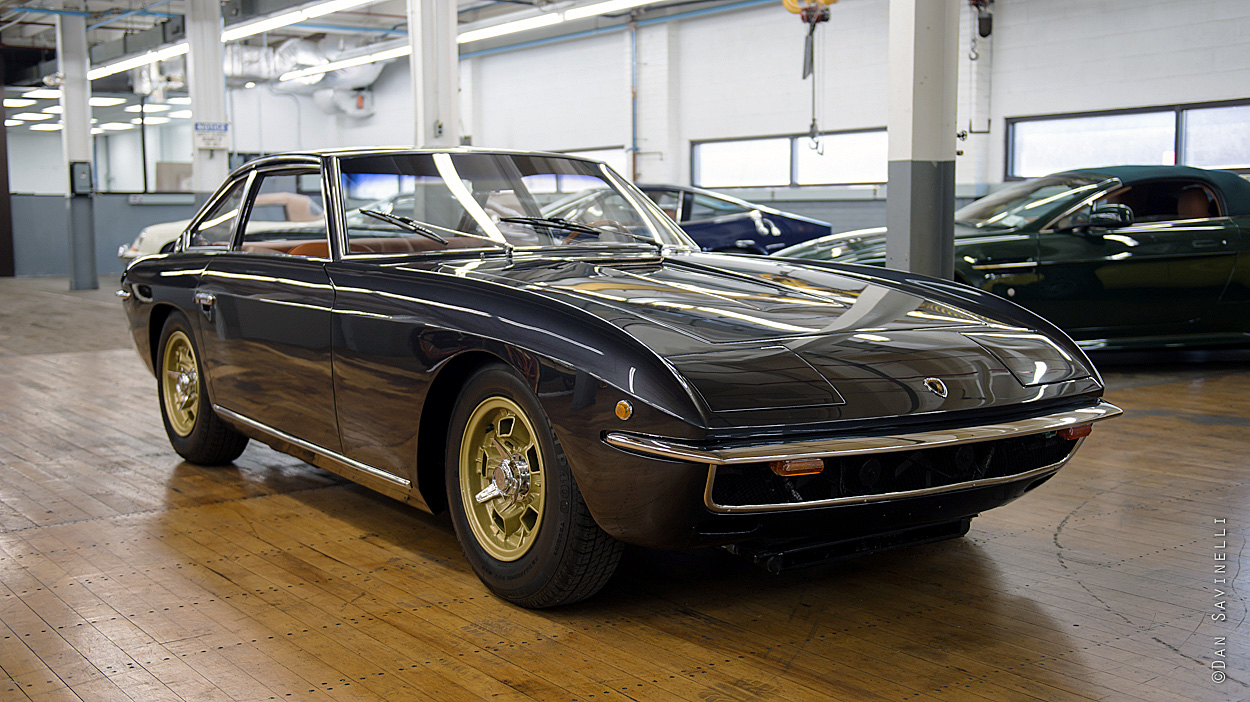
Donovan’s Islero, photo courtesy of owner.
This is only a small part of this show, which really has to be experienced in person. Part of the charm is the venue itself, which offers a view of Monterey Bay, perfect weather, and, of course, in the early morning is shrouded in fog.
Congratulations to Tom and his staff for what has to be a gargantuan planning effort to make this happen. I suspect that they are already working on next year.
thanks for a great review! almost felt as though I was there…..
(almost, sorta…;-) a thousand cars?
sure would have been nice to see a pic of the RS Design Corsa Spyder….., the one you described so well….
thanks!
Thanks for the great pictures and report. (Spoiler alert: I have an art booth there). I like the fact that they allow in some low buck cars (originally) so we can see the “trickle down” of expensive car ideas into lower cost cars say like the Siata Spring. And though many Italian cars are rising in value, I applaud those brave souls showing cars that may not ever take off, appreciation-wise, like the Qvale Mangusta (front engined model). I have been to that other Show That Shall Have No Name (I say that because they turned down my press credential request) on the Peninsula, the one that takes place on Friday, and can say CI is definitely more of a value when that other show cost more than $500 as a spectator. They do have nice couches in the automaker’s booths over there but is a couch sit worth that much?
I completely agree with your sentiment and love the way you worded “Many people find the Giulia more visually fascinating than the sporting cars…”. It is interesting to me how some people find them boring or “dorky”. To me the 4-door Giulias are much cooler than the GT coupes or spiders of the day, and yet they share the same mechanicals and have more passenger and luggage space.
Thanks so much for showing photo’s of my Siata Gran Sport…. unique in the sense that it was a very early version with beautiful instruments that Siata changed after a dozen or so Gran Sports were produced. Later versions had the engines moved back for better balance . In 1991 the car was shown with an assortment of Siatas at Pebble Beach and received a 2d in class award. It will be there again as my Son Jeff Hart has been given the car this year. The 1400cc engine is original with matching numbers .
The grill was missing when purchased and 2 versions were made by John DeBoer back in the days when no one had any money and I traded him some 400 mm wheels pulled from an old Alfa